




Prefer a conversation?
Our team is always available to guide you through the process and ensure your experience is perfectly matched to your preferences.
Our team is always available to guide you through the process and ensure your experience is perfectly matched to your preferences.
Duration
12 Nights
Price
From $8,650
Ship
Silver Muse
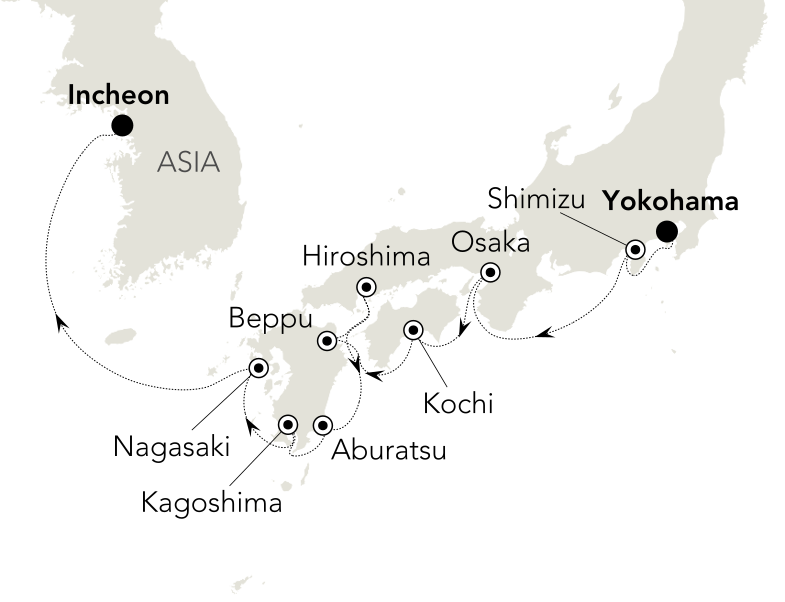
A 12-night ocean voyage aboard Silver Muse, Yokohama, Japan to Incheon, Korea, Republic of. Destination: Asia.
Operated by Silversea Cruises aboard Silver Muse.
Yokohama (Tokyo)
Shimizu
Osaka
Kochi
Beppu (Kyushu Island)
Hiroshima
Aburatsu
Kagoshima (Kyushu Island)
Nagasaki
Incheon (Seoul)
Flying as far under the radar as Japan's second-biggest city possibly can, only a 30-minute train ride separates Yokohama from Tokyo's metropolis. Sat a little further to the south of the Bay of Tokyo than the Japanese capital, Yokohama is a place to enjoy waterfront strolls and the warmest of welcomes, as you arrive and acclimatise to this city in the bustling heart of Japan. Step into this ocean of urbanity, where major cities merge and blend together, and it's hard to square Yokohama's fishing village origins with the vast urban sprawl that you encounter today. An outward-looking place, Yokohama was one of the first to open its harbour to international trade, leading to a rapid transformation from village to big city. The opening of the ports drew many Chinese traders to the bay, and Yokohama houses the country's biggest Chinatown - a colourful and historic explosion of Chinese shops and more than 250 eateries. Landmark Tower is hard to miss, puncturing the sky as Japan's second-largest building, it looks out over the water and rises before the distant loom of Mount Fuji. The towering ferris wheel nearby is one of the world's tallest, and flashes with colour amid the glowing skyline at night. Enjoy breezy strolls along the lively waterfront, with heritage ships, museums and tempting restaurants bordering the sparking bay's waters. Offering the excitement that only landing on Japanese shores can offer, Yokohama is a great starting point for any adventure to this land of culture, colour and grace. Whether you want to venture onwards to Tokyo's neon-bathed wonders, see Mount Fuji up close, or find peace and tranquillity in Kyoto's majestic temples and shrines, Yokohama opens up the best of Japan's wonders to you.
Feel your heart thumping at your first sight of Japan’s most heavenly vision - Mount Fuji’s cone emerging through the haze. With its summit dipped in pure white snow the iconic volcano’s cone is one of the most famous natural landmarks in the world - and a picturesque backdrop for Shimizu. Come ashore to this serene vision of beauty – and whether you head straight for the siren-call of the volcano’s slopes or the sanctuary of gorgeous heritage-rich shrines and tranquil tea plantations - spine-tingling views of Japan’s most tallest mountain are never far away. A perfectly symmetrical spectacle visible for miles around Mount Fuji is an adored national symbol of Japan. Travel closer to its slopes to soak in some of the country’s finest panoramas. Or take in the views with a dash of local culture at the Fujisan Hongu Sengen Shrine – an elegant shrine that stands in thrall to the salt and pepper volcano close by. The Shiraito Waterfall World Heritage Site flows just beneath the volcano – visit to see the gloriously wide curtain of water gushing through the thick vegetation. Visit Kunozan Toshogu Shrine for another perspective or to soak up the tranquil site before swinging above on a scenic ropeway. Located on the adjacent Mount Kuno – privileged views of the mountain and Suruga Bay will unroll before you. Nihondaira Plateau is another option where you can soak in panoramic views of the bay and Mount Fuji dominating behind.
Days at sea are the perfect opportunity to relax unwind and catch up with what you’ve been meaning to do. So whether that is going to the gym, visiting the spa, whale watching, catching up on your reading or simply topping up your tan these blue sea days are the perfect balance to busy days spent exploring shore side.
Japan’s third-biggest city has thrown off its shackles and stepped out of the shadows to light up the sky with glaring neon signs and a larger than life outlook. Giant octopuses cling to buildings and bustling restaurants pack in the crowds in this great and garish place, which is Japan at its most friendly, extroverted and flavourful. So dive in headfirst to experience an all-out sensory assault of delicious food, shopping cathedrals and glittering temples. Dotombori Bridge bathes in the multicoloured, jewel-like lights of signage-plastered buildings, and the neon lights dance on the canal's waters below. Osaka is known as the nation's kitchen, and the Kuromon Ichiba Market has served as the city's spot to tuck in for almost 200 years. Full of street food stalls - try pufferfish, savoury Okonomiyaki pancakes, or ginger and onion flavoured octopus, among the endless feast of exotic flavours. Osaka Castle is another of the city’s landmarks, built in the 16th century by Toyotomi Hideyoshi. A modern museum now waits inside, where you can learn about the country's history, and why this castle is a symbol of Japanese unity. Be sure to take the elevator up to the observation deck for a panoramic view of Osaka's spread. A colourful park encloses the castle and blooms with an ocean of pale pink cherry blossom during the season - the elegant black tiers rising from the pink haze below is one of Osaka's most alluring visions. Kyoto’s peaceful cultural treasures and temples are also just a short jaunt away on Japan’s sleek trains, should you wish to explore further afield.
Japan’s third-biggest city has thrown off its shackles and stepped out of the shadows to light up the sky with glaring neon signs and a larger than life outlook. Giant octopuses cling to buildings and bustling restaurants pack in the crowds in this great and garish place, which is Japan at its most friendly, extroverted and flavourful. So dive in headfirst to experience an all-out sensory assault of delicious food, shopping cathedrals and glittering temples. Dotombori Bridge bathes in the multicoloured, jewel-like lights of signage-plastered buildings, and the neon lights dance on the canal's waters below. Osaka is known as the nation's kitchen, and the Kuromon Ichiba Market has served as the city's spot to tuck in for almost 200 years. Full of street food stalls - try pufferfish, savoury Okonomiyaki pancakes, or ginger and onion flavoured octopus, among the endless feast of exotic flavours. Osaka Castle is another of the city’s landmarks, built in the 16th century by Toyotomi Hideyoshi. A modern museum now waits inside, where you can learn about the country's history, and why this castle is a symbol of Japanese unity. Be sure to take the elevator up to the observation deck for a panoramic view of Osaka's spread. A colourful park encloses the castle and blooms with an ocean of pale pink cherry blossom during the season - the elegant black tiers rising from the pink haze below is one of Osaka's most alluring visions. Kyoto’s peaceful cultural treasures and temples are also just a short jaunt away on Japan’s sleek trains, should you wish to explore further afield.
Small and friendly, this castle town dates back from the early 17th century, and has just one of the 12 Japanese castles to have survived the feudal age. Regrettably, a WWII bombing in 1945 destroyed half the city, although thankfully not the original castle, which serves as a shining example of the Edo Period. A buzzing food market next to the castle provides sustenance – both local and international cuisine and those who are feeling adventurous must try the sugar tomato and rice omelette, either separately or why not together. For those in search of a quintessentially Japanese experience, Kochi is blessed with a superb landscape and an enjoyable local pastime is bathing in the hot springs (onsens) that surround the city. They come in many different shapes, sizes and colours (the colour of the water indicates the dominant minerals present: red for iron, milky for sulphur, blue for bicarbonate and so on). Some are considered rare and each type is said to have a different therapeutic effect. However, some etiquette is expected and first-time visitors should perhaps be aware of the formalities surrounding this bathing ritual. Home as well to some stunning beaches, visitors are advised against swimming in the sea because of strong undercurrents, instead being encourages to enjoy the many beachside attractions of the area, such as the Sakamoto Ryoma Memorial Museum, the lovely walking paths or the sumptuous local speciality katsuo no tataki, served on one of the many surrounding restaurants. Although perhaps not the most picturesque of downtowns, downtown Kochi holds a legendary tale, which centers on the Harimayabashi, (the small red bridge on the west side of the main street). Legend has it that a young priest from Godaisan fell in love with and a girl from Kochi. Because the priest's temple forbade relationships, the couple hid their romance by meeting in secret and exchanging clandestine gifts. One day, the priest was seen buying a hair comb at Harimayabashi, and the couple's secret romance was discovered.
The lantern-lit hot springs of Beppu, known for its eight scorching “Hells”, is a town that’s prettier than a picture. The town is found in a particularly volcanically active part of Japan (hence the abundance of hot springs, or in Japanese, onsens). The viewing pools have evocative names; think Sea Hell, Blood Pond Hell and Tornado Hell. While the names might seem a little off putting, the reality is stunning; sulphur laced air and vast spectrums of blues and reds, depending on the mineralisation of the earth. As if the gorgeous palette of colours at the onsen was not enough, Beppu is also world famous for its Sakura, or cherry blossom season. More than 2,000 cherry trees near the base of the ropeway to Mount Tsurumi make for one of Beppu’s most impressive hanami (flower viewing) spots. If not lucky enough to be in the area during Sakura, from May to June rhododendrons colour the mountain. The view from this 1,375m mountain is beyond impressive, allowing you to see all the way to the Kuju Mountains, Chugoku and Shikoku. If brave enough to climb all the way to the top, the stone Buddhas that were carved into the mountainside during the Heian Period (794-1185) are a worthy reward! As with much of Japan, duality is ever present. Modernity sits very comfortably by ancient buildings. While Beppu’s biggest pull is by far the hot springs and the thermal baths, nearby (10 km) Yufuin has a wealth of art museums, cafes and boutiques, catering to trend setters and urbanites alike.
History buffs will want to write home Hiroshima. Despite being devastated in 1945, this Japanese city is known to all for its commitment peace – its ruin on the 6th August 1945 led to the end of the war and today, the Peace Memorial (a UNESCO World Heritage Site) , is a constant reminder of the destruction that war brings. A walk in the leafy boulevards of Peace Memorial Park brings quiet contemplation. The Flames of Peace – set in the park’s central feature pond – burn brightly and will continue to do so until all the nuclear bombs I the world have been destroyed. There are many other inspiring messages of hope around the city too; the Children’s’ Peace Monument just north of the park is a homage to little Sadako Sasaki, who was just two in 1945. When she developed leukemia in 1956, she believed that if she folded 1,000 paper cranes – a symbol of longevity and happiness in Japan – she would recover. Sadly she died before she finished her task but her classmates finished the rest. If you are lucky enough to visit during the unpredictable and short-lived Sakura (cherry blossom) season, then the extraordinary sight of the delicate pink blossom floating across the water to the red gate, means you can consider yourself one of the luckiest people on the planet.
Located on the south eastern side of Japan, Aburatsu is a tiny port that packs a big punch. More commonly known under the name of Miyazaki – the region where Aburatsu is found, the clement weather and fortuitous topography give Aburatsu a feeling of being on permanent holiday. Visitors should expect along with warm weather a warm welcome from the locals with samples of local culture – such as the traditional Nichinan Taihei dance being performed and bites of exquisite gastronomy for the more adventurous as soon as you disembark. Venturing further afield and one discovers an atypical town that is light years away from the Japan of the future that one might associate other parts of the country with. On the do not miss list should be first and foremost Aoshima, a tiny island of just 1.50km in circumference, connected to the mainland by a 300-metre long bridge. Not to be confused with an identically named island in Ehime Prefecture which is known for its cat population, those with allergies to felines need not worry! Celebrated for its lush vegetation, the island is ringed with white sandy beaches and shallow waters. At the center of the island is Aoshima Jinja, a colorful shrine set back in the jungle that is said to bring luck to married couples. Surrounded at low tide by the geological phenomenon known as Oni no Sentakuita (eroded sandstone and shale boulders) that protrude from the sea between the waves, the straight rows of basalt rock look man made. Because of this, Aoshima is designated a National Natural Monument. Finally, Obi Castletown is a definite must see. A highly impressive traditional castle, the gardens have a cherry tree orchard that is a fine example of Sakura, should you be lucky enough to visit in Spring.
One of Japan's most southerly major cities, Kagoshima is dominated by the imposing Sakurajima volcano's cone – a legendary active volcano that broods, churns and puffs out ash nearby. A pretty old-time ferry chugs across the still waters to the gently sloping foothills of the volcano's cone, and it's easy to imagine where the comparisons with its sister city Naples materialised, as you sail the glorious sweeping Kinko Bay, below beaming sunshine, towards the immense volcanic spectacle. This is certainly no historic relic, and the volcano remains revered and feared, with the most dramatic recent eruption taking place in 1914, and spewing out a new bridge of land into the sea. Make the most of the geothermal activity in the area by indulging in a stress-simmering black sand bath. Incredibly relaxing, you'll be submerged in the warm sand, as you feel your muscles relaxing in the heat, and rejuvenating blood pumping around your body. Enjoy a privileged view of the iconic volcano's loom from the terraced garden of Senganen Garden. Built in 1658, this elegant, traditional garden has belonged to the Shimadzu family for 350 years. Wander the gardens - which bloom with Japan's renowned cherry tree blossoms and feature tiny bridges looping over ponds and rock pools - before sitting back and sipping a wholesome green matcha latte. Elsewhere, museums offer Feudal Era and Satsuma Province history, as well as insights into the Kamikaze squadrons of World War II. Lake Ikeda is also close by, so be sure to keep an eye out for the legendary Issie monster.
Utterly devastated in just a few seconds, Nagasaki was the target of the second US atomic bomb, as World War II moved towards its horrifying conclusion. More than 50,000 were killed, and the stories here are harrowing and poignant. The fact that Nagasaki still stands at all, and has embarked on a new mission to promote global peace with a message of hope, is a testament to the people of this extraordinary place, however. The scars the city wears will never heal, but the colour, culture and creativity of Nagasaki may surprise you. Of course, the events of August 9th 1945 are unavoidable, and the Atomic Bomb Museum pulls no punches in its rendering of the story. Hear from survivors, known as ‘Hibakushas’, who speak at the centre, sharing tales of sadness, hope and resilience. The Memorial Hall is a glass structure of meditation and messages of peace left by visitors from every corner of the world. Nagasaki Peace Park honours the victims, while the Hypocenter Park marks the explosion's epicentre. Suwa Shrine stands just 800 metres away, and you can see the iconic, one-legged torii which was photographed, miraculously still standing amid the sea of devastation. Look out for the temple's scarred trees, which somehow survived the blast too. Look out over the city, nestled in the undulations of the valley – as you reach the top of Mount Inasa - which actually served to protect and shelter Nagasaki from even more destruction. Up here, you can't help but consider the city's journey - as it spreads out before you. A ropeway or a bus will help you reach this spectacular vantage point, to observe the harbour glittering and glistening peacefully.
Days at sea are the perfect opportunity to relax unwind and catch up with what you’ve been meaning to do. So whether that is going to the gym, visiting the spa, whale watching, catching up on your reading or simply topping up your tan these blue sea days are the perfect balance to busy days spent exploring shore side.
B The bright lights of neighbouring big city Seoul might burn brightly but Incheon, just 27 kilometres away, has nothing to be ashamed of. The coastal city was the first to open its borders to the world in 1883, and as such has always enjoyed a special relationship with the west. So much so that it was granted “English Status” in 2007, with many residents priding themselves on their command of the language. The city’s love of English has made it a business powerhouse so expect soaring skyscrapers and smart technology as part of the landscape. Incheon was also the first to welcome the Chinese and today the city’s Chinatown is one of the most vibrant and welcoming there is. A frenetic and exciting hybrid of Chinese and Korean heritage, it is said that Jjajangmyeon (black soy bean noodles), South Korea’s de facto national dish originates from here. Try a steaming bowl from one of the many vendors, then walk it off with the short 15-minute stroll from Chinatown to the traditional Sinpo Market for different kind of sensational feast. The city is steeped in history, notably in recent times during the Korean War. In 1950, the US general General MacArthur led UN forces behind enemy lines in freeing the city from North Korean pressure. MacArthur’s victory is commemorated by a statue in the Jaya (Freedom) Park. The city’s history of course goes back much further, with the first historical record dating as far back as 475 CE. At the time the city was called Michuhol, only changing its name to Incheon in 1413.
From $8,650
per guest · 12 nights
Prices are a guide and vary with season, cabin category and party size. Your advisor will confirm the exact cost before anything is booked.
Classic Veranda
suite
Deluxe Veranda
suite
Grand 1 Bedroom
suite
Grand 2 Bedroom
suite
Medallion
suite
Owner 1 Bedroom
suite
Owner 2 Bedroom
suite
Panorama
suite
Royal 1 Bedroom
suite
Royal 2 Bedroom
suite
Silver
suite
Superior Veranda
suite
Vista
suite








