




Prefer a conversation?
Our team is always available to guide you through the process and ensure your experience is perfectly matched to your preferences.
Our team is always available to guide you through the process and ensure your experience is perfectly matched to your preferences.
Duration
10 Nights
Price
From $10,200
Ship
Silver Wind Expedition
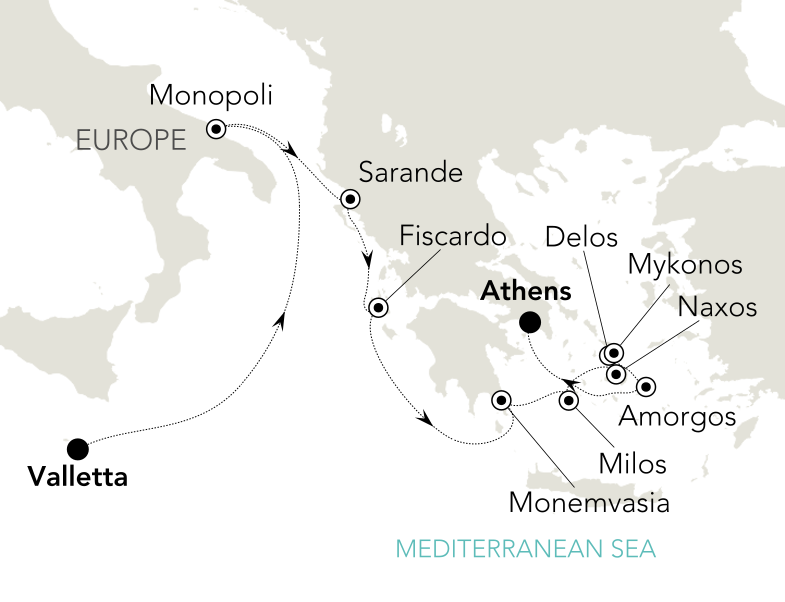
A 10-night expedition voyage aboard Silver Wind, Valletta, Malta to Athens, Greece. Destination: Mediterranean.
Operated by Silversea Cruises aboard Silver Wind Expedition.
Valletta
Monopoli
Sarande
Fiscardo, Kefalonia
Monemvasia (Laconia)
Milos, Nisos Melos
Naxos
Delos
Mykonos
Amorgos
Athens (Piraeus)
Perched high on the imposing Sciberras Peninsula, Valletta immediately presents its massive, protective walls and vertical bastions to visitors arriving by sea. Rising to 47 metres in places, the fortifications protect lavish palaces, grand domes and illustrious gardens. Built by the Knights of St John on the narrow peninsular, Valletta is a compact, richly historical treasure trove of Baroque wonders. Ascend to reach the restful, flower-filled Upper Barrakka Gardens, where cannons fire and boom in salute at noon each day, sending echoing cracks of noise out across the waves below. Recognised as 2018’s European Capital of Culture, Valletta is a fascinating and dense haven of history and intrigue. A busy, bustling capital, the breathtaking St John’s Cathedral - commissioned in 1572 - is almost concealed among its narrow streets. The relatively modest exterior is counterpointed by a staggeringly opulent, gold-leaf bathed interior, containing a Caravaggio masterpiece - the shadowy vision of the Beheading of St John. Cinematic and magnificent, Valletta has served as a filming location for Game of Thrones - but real epic history abounds on this rocky isle too. From the prehistoric and megalithic sites of the Hypogeum of Paola and Tarxien, to the fascinating War Museum at Fort St Elmo. Mdina also waits nearby, and the former medieval capital is a striking contrast to the island’s main city. Cars are barred from its streets, and it offers endlessly atmospheric old-time wanders. With a strategic positioning in the Mediterranean, Malta is a jewel that many have wrestled for over the centuries. Independence from Britain was finally achieved in 1964, but the close allegiance remains evident, with English recognised as an official language, cars driving on the left, and red post boxes and telephone gleaming in Malta’s sunshine.
Days at sea are the perfect opportunity to relax unwind and catch up with what you’ve been meaning to do. So whether that is going to the gym, visiting the spa, whale watching, catching up on your reading or simply topping up your tan these blue sea days are the perfect balance to busy days spent exploring shore side.
Located in the heel of Italy’s boot, Monopoli is a Puglia port town that knows how to make a splash. In fact, the words Monos and Polis mean singularly unique – and Monopoli’s special blend of part historical, part functional is most definitely that. The city might lack some of the more aesthetic elements of its neighbours, but that only means good things for those who do discover it: far from the tourist route you’ll be greeted with medieval churches and castles, white stone buildings (contrasting perfectly with the azure of the sea and sky) and authenticity in buckets. Founded by the Greeks in 500 BC, then taken over by the Romans (and beset by various invaders), Monopoli was – and still is – a thriving port town. It’s position in Puglia between the seas made it strategic, while its placement on the Via Traiana (which led all the way to Rome) made it prosperous. The city came under Venetian control in 1484 and much of Monopoli’s architecture can be attributed to this period. The charming Old Town is dominated by Castello Carlo V, built in 1552, while the still solid Baroque-Romanesque cathedral, built in 1693, is considered as positively modern. Like most of Italy, the food here is as important as religion. As a port town, fish and seafood are deliciously fresh. Do not miss tasting “scapece” (small fish covered in flour, deep-fried, put in layers with breadcrumbs and saffron, then soaked with vinegar) for a tasty treat that you will find nowhere else in the country.
Overlooking the turquoise blue Ionian Sea Albania’s most southerly harbour is a short 20-minute boat ride from Corfu and bathes in the glow of more than 300 sunny days each year. Revel in Albania’s best beach life or explore historic ancient cities and fortresses embedded with immense archaeological interest. Clear turquoise waters lap the city's beaches and there's always something to see along the lively Boulevard Hasan Tahsini - which traces the seafront and is stacked with bars restaurants and shops. The hardy 16th-century Lekuresi Castle has been battered by weather and war over the years but it offers a fantastic lookout point to survey Sarande's expanse Corfu's island and the turquoise sea beyond. From here you can head to the Blue Eye Spring a rejuvenating natural landmark where a groundswell of the purest water gushes up 50 metres to surface amid the forest. Bathe in the immaculate waters which are intensely refreshing on sunny days. The majestic ruins of Butrint's ancient city stand nearby unearthed from the leafy site after the city was abandoned in medieval times. Albania's first UNESCO World Heritage Site Butrint was an ancient Greek and Roman stronghold - and you can walk back in time along stone-paved streets to discover the immense history here. Roam between the compact Roman theatre and the impressive arched-windows of the basilica before admiring the stunning floor mosaics that have been left behind.
The Ionian Island of Kefalonia, also known as Cephalonia, is strikingly beautiful, with jagged limestone cliffs and terraced slopes dotted with olive groves. The highest point on the island is Mount Ainos, rising to 5,914 feet. Large areas are covered by luxuriant subtropical vegetation, and all around the island the scenery offers magnificent views of the mountains and the sea.Many sites on Kefalonia reflect its tumultuous history of ever-changing kings and rulers. The Norman Kings of Sicily ruled the island during medieval times, followed by Italian overlords who ruled for three centuries under the principality of the Morea. In 1478, the Turks conquered the island only to be defeated twenty years later by the Venetians. And, for a short time, the British ruled here as well. Finally, in 1864, Kefalonia was returned to Greece. In 1823, Lord Byron spent several months on the island, captivated by the enduring spirit of the people, the natural beauty of the land and its rich history. Visitors to Kefalonia look to spend time in such places as the serene fishing village of Assos and the scenic port town of Fiscardo. Other highlights on the island include a Venetian Fortress, a 13th century castle, and spectacular caves.Tiny Fiscardo on the northeastern tip of the island boasts a picturesque harbor full of sailboats and fishing vessels and lined by whitewashed houses. It is said that the tiny port was named for the Norman leader Robert Guiscard, who met his death here in the late 11th century.During wintertime, Fiscardo numbers only about 100 inhabitants, but in summer the influx of visitors often overwhelms this off-the-beaten-path spot. Many of the old houses have been converted for use as holiday homes. Come ashore, and see why the island is such a popular destination. Pier Information The ship is scheduled to anchor in Fiscardo Bay. Guests will be taken ashore via ship’s tenders. The landing site is just in the center of town. A few taxis are generally available on the pier. Shopping There are a number of souvenir shops located next to the Tassia Restaurant which specialize in colorful blown glass, hand embroidered linen and hand knitted goods. Cuisine The specialty of the area is Kreatopitta (meat pies) and fried cod with garlic sauce. Two restaurants of reknown are Tassia’s and Gytani. Other Sites Argostoli Argostoli, Kefalonia’s capital, lies on a peninsula projecting into the Gulf of Argostoli. Almost completely destroyed in a 1953 earthquake, Argostoli has been rebuilt in modern style. There is a small archaeological museum containing Mycenaean and Roman finds. North of town are the famous sea-mills, now partly buried as a result of the earthquake. Kranioi Four miles east of Argostoli lie the remains of ancient Kranioi. Kastro In Kastro stands the 13th century castle of Ayios Yeoryios, and a 17th century monastery noted for its fine frescoes and icons. Lord Byron stayed at nearby Metaxata in 1823. In this same area can also be found three Mycenaean rock-cut tombs. Sami Sami, the island’s principal harbor, is 15 miles east of Argostoli. Ancient Sami, the island’s former capital, lay to the south of the modern town. Remains of the old town walls and a 2nd century Roman villa can still be seen.
A town of rustic, lyrically romantic beauty, Monemvasia boasts a glorious natural setting - perched on a colossal rock island, which rears spectacularly from the waves. A truly unique castle city, the island is linked to the mainland by just a single solitary causeway. It is hard to imagine a better – and more impenetrable - setting for a fortress town than this, and the rock is laced with tight cobbled streets, exposed stone masonry and pretty Byzantine churches. Known as the Gibraltar of Greece, you would be forgiven for assuming that the limestone monolith was unoccupied as you approach from the seas. Look a little closer, however, and you’ll begin to pick out the ancient walls and terracotta roofs of the quaint town clinging to its steep, dramatic slopes - and the walls of the fortress crowning it. A natural stronghold of overwhelming romantic beauty – the rock is said to lend couples wedded here extra strong foundations to build from. Arrive on the island to wander the historic knot of streets of a true Adriatic wonder. Encounter gorgeous, tree-shaded terraces, which look out across the rippling blue waves. Visit the picturesque Church of Christ Elkomenos, where you can shelter in the cool interior, and see storied religious iconography. A historic paved pathway twists back on itself, rising sharply up the slope on a daunting ascent to the now uninhabited upper fortress. The views from here are even more incredible, as you look down across the rustic domes of the lower village’s churches and stone-paved streets below.
Milos, one of the thousands of Greek islands, is to be found in the SW Cyclades, a large island group in the Aegean Sea. It is 86 nautical miles from Piraeus and approximately half way between Piraeus and Crete. Its surface area is 151 square kilometres and its varied coastline is 125 kilometres long. Adamas is the main port of Milos and also a seaside village of white houses shimmering on the blue waters of the Aegean. This village was founded in 1835 by refugees from Sfakia who came from Crete after the failure of their rebellion against the Turks From these times and on, Adamas became increasingly important historically because of its large, safe, naturally made harbour, and its strategic position in the eastern Mediterranean Adamas is surrounded by many beaches and offers various touristy facilities such as banks, post-office, doctors, tourist agencies, port police. Many old churches as well as mining and ecclesiastical museums are worth visiting. The geographical bearing of its capital, Plaka, is 36o 44' 35'' longitude, 24o 25' 28'' latitude. In general terms, it is a low island, whose highest peak is Prophet Elias in the north-west, rising to 751 metres. The Small Mountain in the same area is 636 metres high, while no other peak reaches over 400 metres. Its’ most characteristic feature is its magnificent gulf, providing a natural harbour, which is possibly the largest in the Mediterranean. This, in combination, with the island’s vast mineral wealth, has played and is still playing, a major role in the history, economy, culture and development of the island society throughout the last 7,000 years. Most of the inhabitants live in the 8 villages, which are in the flat, northern part of the island. These are the capital Plaka, Plakes, Triovassalos, Pera Triovassalos, Tripiti, Pollonia, Zefiria, and Adamas. Officially, Milos is part of the county of the Cyclades, whose capital is the town of Ermupolis, on the island of Syros. However, de-centralisation of the administration has been achieved by sub-dividing the county into four provinces. One of these is Milos province, incorporating the Western Cycladic islands, Kimolos, Siphnos and Seriphos and with its administrative capital on Milos. Its geological make-up, which will be dealt with later, is volcanic. However, this formation, which is different from that of the rest of the Cyclades group (with the exception of Kimolos), is the reason for the island's lack of forests, rich vegetation, natural water supplies and rivers. Never the less, it has given it colour. This unique Milos colour, is dazzlingly evident in its multitude of beautiful beaches - more than 75- with their glistening silver sand and clear blue waters. Also in the chalky white, terracotta, ochre and jet black rocks, the like of which can be seen nowhere else in the whole of Greece. CRUISE SIGHTS Church Of Agia Triada The church of Agia Triada (Holy Trinity) is located in the centre of Adamas, the port of Milos. This church dates from the 17th century and it houses a small ecclesiastical museum. Mineralogical Museum This museum was established to help promote the effects of mining in the history of Milos and to display the mineral wealth of the island. It is located at the waterfront in Adamas. Ancient Theatre This theatre was probably constructed in the Hellenistic times. However, today only the Roman phase of this monument survives. It is located close to Catacombs. CRUISE SHOPPING There are quite a few souvenir shops in Adamas and Plaka, where you can get your own copy of Aphrodite and some Greek souvenirs and local products. CRUISE ACTIVITIES Beaches: Sarakiniko - Location: 4 km east of Plaka - Location: 4 km east of Plaka Description: This beach is one of the most beautiful beaches of Milos and surely the most particular one. It is located along the coastal road east of Adamas, north-east of Milos. It is the most photographed spot of the island. Its particular landscape is very impressive and surely unforgettable: long horizontal rocks bent over the sea; those rocks are eroded by time and salt water, and have small and huge hollows all over them. The entire landscape formed by the volcanic rocks doesn't show any signs of vegetation and is coloured entirely in a bright white, which makes an interesting contrast with the deep blue and turquoise of the surrounding waters. This amazing scenery gives one the impression of standing on the surface of the moon. Agia Kiriaki- Location: 14 km south east of Plaka - Location: 14 km south east of Plaka Description: From Zefiria a road leads to the beautiful coast of Agia Kyriaki, an organized beach with pure white sand and emerald crystal-clear waters. Firiplaka – Location: 15 km south east of Plaka – Location: 15 km south east of Plaka Description: Firiplaka Beach Milos: Right next to the lovely beach of Tsigrado lies the superb beach of Firiplaka. It is a long beach with silver sand and huge coloured rocks forming its coastline. The waters in Firiplaka are really exotic: crystalline and shallow green-blue, they never fail to enchant anyone who had the chance to swim in them. Papafragas - Location: 10 km east of Plaka - Location: 10 km east of Plaka Description: After Kapros one can find the idyllic landscape of Papafragas, one of the most impressive sites of Milos. From the top of the rock, it resembles a huge natural swimming pool, an enormous cave carved out of the cliff’s side. A tiny path leads to the tiny strip of sand that forms the beach. Crystalline waters of changing colours, depending on the weather and the light, welcome the visitor and invite him to enjoy their coolness. Deep dark sea caves surround the place. The most ancient site of Milos is just a few metres away: the amazing Papafragos, the ancient town of Phylakope,. The few remaining ruins of walls, buildings and tombs are now almost entirely covered by the water, but still bear witness of the life and civilisation existing there during the Neolithic period. Provatas - Location: 13 km south east of Plaka - Location: 13 km south east of Plaka Description: The beautiful beach of Provatas is located in the south-western side of Milos. Small hotels, good restaurants and the beauty of the place are more than enough to attract many visitors every summer. Huge multi-coloured rocks, golden sand and limpid waters complete the superb image of Provatas. Tsigrado - Location: 14 km south east of Plaka - Location: 14 km south east of Plaka Description: Tsigrado is one of the most beautiful southern beaches of Milos. Located right next to Firiplaka, Tsigrado is a small sandy cove with crystal water. Going down this beach is a bit difficult as visitors have to pass through a rocky passage to get there. The surrounding environment with the rocky cliffs is quite impressive.
A little bit more rough and ready around the edges than a lot of other Greek islands, Naxos is the thinking-person’s Greece. The largest of all the Cyclades islands, it was once the cultural centre of Classical Greece and Byzantium, so do not be surprised that the world’s oldest culture has left its mark. Museums range from the Archaeological Museum (housed in an elegant Venetian mansion), an impressive geological museum to the lovely Venetian and unusual museum, housed in an 800-year old private house. For those who want to venture further afield, Haki, the old capital of Naxos, has a great distillery museum, run by the same family who first opened it in 1896. Not only are there two lovely monasteries worth visiting, but because of its high mountains Naxos benefits from much more rainfall than most other Greek islands, which makes the land very green and fertile. Local produces includes olives, grapes, figs, citrus fruit, corn and potatoes and if you get a chance, a healthy home-grown meal in a back-country taverna will be undoubtedly be memorable. The golden sands that circle Naxos are particularly nice, catering for all personality types. The active among you will certainly want to head to the eastern side of the island, where the wind is perfect for budding kite and windsurfers, as well as those who like their beaches as natural as can be. The western side of the island, notably Platka beach, is where the sun-lovers will be seen soaking up the rays.
Delos was the most important Panhellenic sanctuary, and, according to mythology, the birth-place of Apollo and Artemis. The first signs of habitation on the island date from the 3rd millenium B.C., and important remains of the Mycenaean period have been uncovered in the area of the sanctuary. In the 7th century B.C. Delos was already a known Ionic center because of its religious importance as the birth-place of Apollo. Athenian influence was initiated on the sanctuary with the first purification of Delos by Peisistratos in 540 B.C. but it gradually developed into a proper domination lasting - with short intervals - until the end of the 4th century B.C., when Delos was finally declared free and independent (314 B.C.).The independence of the island lasted until 166 B.C. when the Romans gave it over to the Athenians. The second Athenian domination started with the definite expulsion of the Delians to Achaia, in the Peloponnese. The declaration of Delos as an "international" harbor by the Romans led to an influx of foreigners who became a significant element of the island's population. The absence of taxes resulted to the concentration of trade activity on the island and, subsequently, to its economic prosperity. The close relations of Delos with Rome, though, was the main reason for its decline. During Mithridates' wars against the Romans, Delos suffered severe damage in the raids of 88 B.C. and 69 B.C. Since then, the island's prosperity gradually came to an end. In the 2nd and 3rd centuries A.D. only a small settlement existed on Delos and, as Christianity had gradually replaced the ancient religion, the island finally lost its importance. Delos was a sacred place with splendid buildings and sanctuaries and as such, it was never forgotten; many references are preserved by travelers who visited the island in the last centuries. Numerous pieces of sculpture were transferred to Museums of Greece and abroad, while marbles from the ancient buildings were used as building material by the inhabitants of the nearby islands. Excavations on Delos started in 1873 by the French School of Archaeology at Athens. Intensive excavations were conducted in the years 1958-1975. The excavations are still carried out by the French School of Archaeology, but the religious, political and commercial center of the island has already been revealed along with many private houses. Large-scale restoration work has been undertaken by the French School of Archaeology mainly in the sector of the private houses, but in the recent years, the 21st Ephorate of Prehistoric and Classical Antiquities has also carried out similar work. In 1990 Delos was included in the World's Cultural Heritage, protected by the UNESCO. Pier Information The ship will be at anchor and guests will be tendered ashore. Other Sites All sights of interest on the Island of Delos are covered in tour DEL-A. Private arrangements are not available in this port.
Indulge in idyllic island life, as you take your fill of superb foods and wines, and soak in endless views of sweeping turquoise seascapes and pretty whitewash buildings. Known for its lively nightlife and rejuvenating, care-free outlook, Mykonos is a dazzlingly beautiful island escape. The secret is well and truly out, but nonetheless, Mykonos has managed to retain the enduring, exclusive allure that first drew celebrities like Brigitte Bardot to its star-studded shores. True to its roots, Mykonos is a rich land of culture, tradition and swirling legend, and the island is said to be built on the frozen bodies of giants slain by Hercules and to have been the legendary battleground between Zeus and the Titans. Head out onto the crystalline waters to seek out serene islands, hit perfect beaches, or venture into the labyrinth of Mykonos Town. White facades, red roofs and cobalt blue shutters add to this lively town’s appeal. Explore narrow streets housing studios – where artisans piece together mosaics - and plenty of restaurants and bars offer sanctuary. Head to Little Venice for a waterfront view of one of the island’s famed sunsets, and to enjoy an aperitif of the favourite aniseed liqueur, ouzo. Boasting numerous attractive sandy coves, a wealth of top-notch restaurants, and rich cultural appeal, it’s little wonder that Mykonos is one of the most popular Greek Islands. Discover this jaw-droppingly scenic island paradise, watched over by its iconic huddles of picturesque windmills.
If you feel a sense of déjà vu when you arrive in Amorgos don’t be surprised. The little island in the Cyclades found fame in the late 1980s thanks to Luc Besson’s cult film “The Big Blue”. But movie stars aside (and for anyone who has seen the film you know we are talking about the dolphins who are the real stars of the show) Amorgos is what everything a Greek island should be. Think pink bougainvillea climbing up every whitewashed wall and scarlet geraniums spilling out of every blue framed window. Small friendly cafes line the (labyrinthine cobbled) streets beach bars serve tall glasses of ouzo over ice and traditional tavernas serve everything from souvlaki to tzatziki. Amorgos might be most famous however for its lack of mass tourism. You won’t find any wild nightclubs nor luxury boutiques here. Instead you’ll feel the pull of the past with the vestiges of a Minoan city the beautiful 13-th century Venetian Kastro and its windmills and the 11th century Pangaea Hozoviotissa Monastery. Nature lovers will no doubt be in their element here too: seven main trails connect the villages to each other. Most hikes take around an hour and are considered easy but there are one or two exceptions so beware! Divers will also be happy the southern end of the island is home to the famous shipwreck features in The Big Blue. Now rife with algae it is a prime feeding spot for the local marine life.
A city of legend, civilisation and enduring culture, Athens is a majestic and magical urban sprawl. Extraordinary elegance and grace combine with grit and graft in Greece's capital, where highways encase ruins from antiquity, and gleaming museums and galleries stand beside concrete sprayed with edgy street art. These contrasts enhance and elevate the wonders of this 2,500-year-old city, however, which can count notable contributions to philosophy, drama and democracy, among its global legacy. Piraeus' giant port and naval base welcome you to the edge of the Athens' urban area. From there it's a simple jaunt to the centre. The majestic ancient citadel of the Acropolis dominates an elevated platform and is a constant presence as you explore the city. The wonderful remains of the columned temple of the Parthenon - which date back to the 5th century BC - stand here, representing the pinnacle of classical architecture. The nearby Acropolis Museum adds context to your visit and frames the broad views from its giant glass windows. Or rise up Mount Lycabettus, to be rewarded with perhaps Athens' best panorama of the Acropolis sitting high over the city on its grand stage. See the marble horseshoe of the Old Olympic Stadium, where the first modern Olympics were held in 1896, for more of the city's enduring legacy. Elsewhere, golden beaches and temples stretch out along the coastline, should you wish to explore a little further afield. Coffee is an art form to the Greeks, and it's an unwritten rule that coffee time must never be rushed. So prepare to settle down for a couple of hours and lose yourself in a good chat. Feeling hungry - try traditional souvlaki made with sauces handed from generation to generation.
From $10,200
per guest · 10 nights
Prices are a guide and vary with season, cabin category and party size. Your advisor will confirm the exact cost before anything is booked.
Classic Veranda
suite
Deluxe Veranda
suite
Grand 1 Bedroom
suite
Grand 2 Bedroom
suite
Medallion
suite
Owner 1 Bedroom
suite
Owner 2 Bedroom
suite
Royal 1 Bedroom
suite
Royal 2 Bedroom
suite
Silver
suite
Vista
suite








