




Prefer a conversation?
Our team is always available to guide you through the process and ensure your experience is perfectly matched to your preferences.
Our team is always available to guide you through the process and ensure your experience is perfectly matched to your preferences.
Duration
14 Nights
Price
From $9,650
Ship
Silver Muse
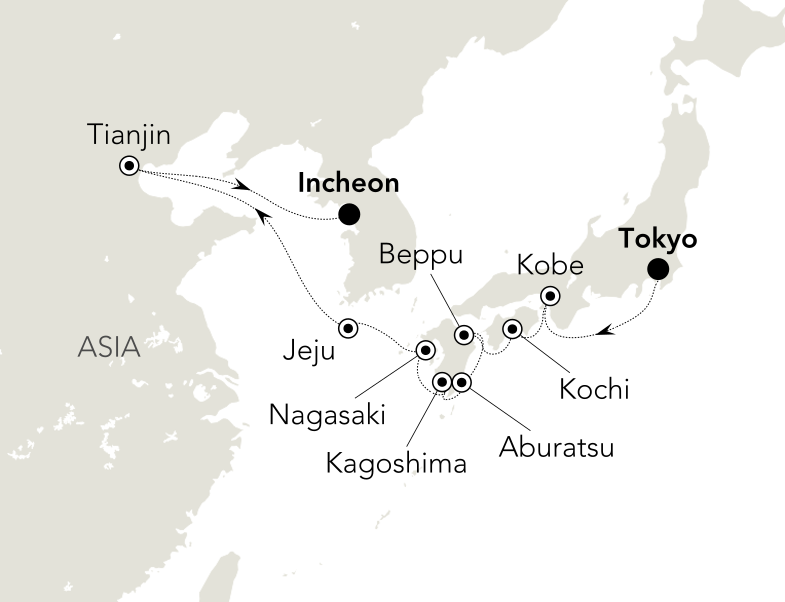
A 14-night ocean voyage aboard Silver Muse, Tokyo, Japan to Incheon, Korea, Republic of. Destination: Asia.
Operated by Silversea Cruises aboard Silver Muse.
Tokyo
Kobe
Kochi
Beppu (Kyushu Island)
Aburatsu
Kagoshima (Kyushu Island)
Nagasaki
Jeju
Tianjin (Beijing)
Incheon (Seoul)
Dense and delightful, there’s nowhere else like Japan’s kinetic capital - a city where ancient traditions blend seamlessly with a relentless pursuit for the future’s sharpest edge. See the city from above, as elevators rocket you up to towering viewing platforms, from which you can survey a vast urban ocean, interspersed with sky-scraping needles. Look out as far as the distant loom of Mount Fuji’s cone on clear days. Futuristic – second-accurate - transport seamlessly links Tokyo’s 14 districts, while the glow of flashing advertisement boards, clanks of arcade machines, and waves of humanity flowing along its streets, adds to the sense of mesmerising, dizzying and glorious sensory overload. One of Tokyo’s most iconic sights, don’t miss the flood of people scrambling to cross Shibuya’s famous intersection. Join the choreographed dance, as crowds of briefcase-carrying commuters are given the green light to cross at the same time – bathed in the light of massive neon advertisements. The culture is immensely rich and deep, with 7th-century, lantern-decorated temples, stunning palaces and tranquil scarlet shrines waiting below cloaks of incense and nestling between soaring skyscrapers. Restaurants serve up precisely prepared sushi, and wafer-thin seafood slivers, offering a unique taste of the country’s refined cuisine. Settle into traditional teahouses, to witness intricate ceremonies, or join the locals as they fill out karaoke bars to sing the night away. In the spring, cherry blossom paints a delicate pink sheen over the city’s innumerable parks and gardens.
Days at sea are the perfect opportunity to relax unwind and catch up with what you’ve been meaning to do. So whether that is going to the gym, visiting the spa, whale watching, catching up on your reading or simply topping up your tan these blue sea days are the perfect balance to busy days spent exploring shore side.
The Japanese city of Kobe needs no introduction. The name is synonymous with its home grown superstar. We are not talking of its stunning shrines, cherry trees laden with blossom during sakura or effervescent city, buzzing with life 24/7. We are of course talking of a much more grass roots hero – its eponymous beef. The delicacy might have put the city on the map, but there is far more to Kobe than its meat. Naturally, Kobe wears its cuisine as a badge of honour. Its port history has given it a gastronomy that is quite different from its neighbours. Seafood and sushi is naturally some of the freshest and most diverse you can find, but Kobe’s multi-cultural nature (the city is home to 98 different nationalities) means that it has one of the most diverse gastronomic cultures in Japan. Bread and bakeries are also an (unexpected) delicacy. Additionally, Sake is taken very seriously – Kobe even has its own museum dedicated to the national spirit. Historically, Kobe has always been a key city for Japan. Renamed in 1889, it was known as Owada no Tomari during the Nara Period (710-784 C.E.). Kobe’s location on the calm Inland Sea between Osaka and Kyoto has proven to be pivotal in Japanese history; it is mentioned in famous literary works such as The Tale of Genji (from approximately late 9th century) and the Taiheiki (14th century). The city and region are home to many attractions including the Himeji Castle (widely considered to be Japan's most beautiful feudal castle), a short ride away.
The Japanese city of Kobe needs no introduction. The name is synonymous with its home grown superstar. We are not talking of its stunning shrines, cherry trees laden with blossom during sakura or effervescent city, buzzing with life 24/7. We are of course talking of a much more grass roots hero – its eponymous beef. The delicacy might have put the city on the map, but there is far more to Kobe than its meat. Naturally, Kobe wears its cuisine as a badge of honour. Its port history has given it a gastronomy that is quite different from its neighbours. Seafood and sushi is naturally some of the freshest and most diverse you can find, but Kobe’s multi-cultural nature (the city is home to 98 different nationalities) means that it has one of the most diverse gastronomic cultures in Japan. Bread and bakeries are also an (unexpected) delicacy. Additionally, Sake is taken very seriously – Kobe even has its own museum dedicated to the national spirit. Historically, Kobe has always been a key city for Japan. Renamed in 1889, it was known as Owada no Tomari during the Nara Period (710-784 C.E.). Kobe’s location on the calm Inland Sea between Osaka and Kyoto has proven to be pivotal in Japanese history; it is mentioned in famous literary works such as The Tale of Genji (from approximately late 9th century) and the Taiheiki (14th century). The city and region are home to many attractions including the Himeji Castle (widely considered to be Japan's most beautiful feudal castle), a short ride away.
Small and friendly, this castle town dates back from the early 17th century, and has just one of the 12 Japanese castles to have survived the feudal age. Regrettably, a WWII bombing in 1945 destroyed half the city, although thankfully not the original castle, which serves as a shining example of the Edo Period. A buzzing food market next to the castle provides sustenance – both local and international cuisine and those who are feeling adventurous must try the sugar tomato and rice omelette, either separately or why not together. For those in search of a quintessentially Japanese experience, Kochi is blessed with a superb landscape and an enjoyable local pastime is bathing in the hot springs (onsens) that surround the city. They come in many different shapes, sizes and colours (the colour of the water indicates the dominant minerals present: red for iron, milky for sulphur, blue for bicarbonate and so on). Some are considered rare and each type is said to have a different therapeutic effect. However, some etiquette is expected and first-time visitors should perhaps be aware of the formalities surrounding this bathing ritual. Home as well to some stunning beaches, visitors are advised against swimming in the sea because of strong undercurrents, instead being encourages to enjoy the many beachside attractions of the area, such as the Sakamoto Ryoma Memorial Museum, the lovely walking paths or the sumptuous local speciality katsuo no tataki, served on one of the many surrounding restaurants. Although perhaps not the most picturesque of downtowns, downtown Kochi holds a legendary tale, which centers on the Harimayabashi, (the small red bridge on the west side of the main street). Legend has it that a young priest from Godaisan fell in love with and a girl from Kochi. Because the priest's temple forbade relationships, the couple hid their romance by meeting in secret and exchanging clandestine gifts. One day, the priest was seen buying a hair comb at Harimayabashi, and the couple's secret romance was discovered.
The lantern-lit hot springs of Beppu, known for its eight scorching “Hells”, is a town that’s prettier than a picture. The town is found in a particularly volcanically active part of Japan (hence the abundance of hot springs, or in Japanese, onsens). The viewing pools have evocative names; think Sea Hell, Blood Pond Hell and Tornado Hell. While the names might seem a little off putting, the reality is stunning; sulphur laced air and vast spectrums of blues and reds, depending on the mineralisation of the earth. As if the gorgeous palette of colours at the onsen was not enough, Beppu is also world famous for its Sakura, or cherry blossom season. More than 2,000 cherry trees near the base of the ropeway to Mount Tsurumi make for one of Beppu’s most impressive hanami (flower viewing) spots. If not lucky enough to be in the area during Sakura, from May to June rhododendrons colour the mountain. The view from this 1,375m mountain is beyond impressive, allowing you to see all the way to the Kuju Mountains, Chugoku and Shikoku. If brave enough to climb all the way to the top, the stone Buddhas that were carved into the mountainside during the Heian Period (794-1185) are a worthy reward! As with much of Japan, duality is ever present. Modernity sits very comfortably by ancient buildings. While Beppu’s biggest pull is by far the hot springs and the thermal baths, nearby (10 km) Yufuin has a wealth of art museums, cafes and boutiques, catering to trend setters and urbanites alike.
Located on the south eastern side of Japan, Aburatsu is a tiny port that packs a big punch. More commonly known under the name of Miyazaki – the region where Aburatsu is found, the clement weather and fortuitous topography give Aburatsu a feeling of being on permanent holiday. Visitors should expect along with warm weather a warm welcome from the locals with samples of local culture – such as the traditional Nichinan Taihei dance being performed and bites of exquisite gastronomy for the more adventurous as soon as you disembark. Venturing further afield and one discovers an atypical town that is light years away from the Japan of the future that one might associate other parts of the country with. On the do not miss list should be first and foremost Aoshima, a tiny island of just 1.50km in circumference, connected to the mainland by a 300-metre long bridge. Not to be confused with an identically named island in Ehime Prefecture which is known for its cat population, those with allergies to felines need not worry! Celebrated for its lush vegetation, the island is ringed with white sandy beaches and shallow waters. At the center of the island is Aoshima Jinja, a colorful shrine set back in the jungle that is said to bring luck to married couples. Surrounded at low tide by the geological phenomenon known as Oni no Sentakuita (eroded sandstone and shale boulders) that protrude from the sea between the waves, the straight rows of basalt rock look man made. Because of this, Aoshima is designated a National Natural Monument. Finally, Obi Castletown is a definite must see. A highly impressive traditional castle, the gardens have a cherry tree orchard that is a fine example of Sakura, should you be lucky enough to visit in Spring.
One of Japan's most southerly major cities, Kagoshima is dominated by the imposing Sakurajima volcano's cone – a legendary active volcano that broods, churns and puffs out ash nearby. A pretty old-time ferry chugs across the still waters to the gently sloping foothills of the volcano's cone, and it's easy to imagine where the comparisons with its sister city Naples materialised, as you sail the glorious sweeping Kinko Bay, below beaming sunshine, towards the immense volcanic spectacle. This is certainly no historic relic, and the volcano remains revered and feared, with the most dramatic recent eruption taking place in 1914, and spewing out a new bridge of land into the sea. Make the most of the geothermal activity in the area by indulging in a stress-simmering black sand bath. Incredibly relaxing, you'll be submerged in the warm sand, as you feel your muscles relaxing in the heat, and rejuvenating blood pumping around your body. Enjoy a privileged view of the iconic volcano's loom from the terraced garden of Senganen Garden. Built in 1658, this elegant, traditional garden has belonged to the Shimadzu family for 350 years. Wander the gardens - which bloom with Japan's renowned cherry tree blossoms and feature tiny bridges looping over ponds and rock pools - before sitting back and sipping a wholesome green matcha latte. Elsewhere, museums offer Feudal Era and Satsuma Province history, as well as insights into the Kamikaze squadrons of World War II. Lake Ikeda is also close by, so be sure to keep an eye out for the legendary Issie monster.
Utterly devastated in just a few seconds, Nagasaki was the target of the second US atomic bomb, as World War II moved towards its horrifying conclusion. More than 50,000 were killed, and the stories here are harrowing and poignant. The fact that Nagasaki still stands at all, and has embarked on a new mission to promote global peace with a message of hope, is a testament to the people of this extraordinary place, however. The scars the city wears will never heal, but the colour, culture and creativity of Nagasaki may surprise you. Of course, the events of August 9th 1945 are unavoidable, and the Atomic Bomb Museum pulls no punches in its rendering of the story. Hear from survivors, known as ‘Hibakushas’, who speak at the centre, sharing tales of sadness, hope and resilience. The Memorial Hall is a glass structure of meditation and messages of peace left by visitors from every corner of the world. Nagasaki Peace Park honours the victims, while the Hypocenter Park marks the explosion's epicentre. Suwa Shrine stands just 800 metres away, and you can see the iconic, one-legged torii which was photographed, miraculously still standing amid the sea of devastation. Look out for the temple's scarred trees, which somehow survived the blast too. Look out over the city, nestled in the undulations of the valley – as you reach the top of Mount Inasa - which actually served to protect and shelter Nagasaki from even more destruction. Up here, you can't help but consider the city's journey - as it spreads out before you. A ropeway or a bus will help you reach this spectacular vantage point, to observe the harbour glittering and glistening peacefully.
Time moves at a much slower clip here on Jeju-do. Blessed with tangerine groves, swaying palm trees, white sand beaches, and a verdant landscape, Korea's southernmost volcanic island has long been a favored holiday and honeymoon retreat for natives and neighbors. Still relatively unknown to Western travelers, Jeju's recent title as one of the New Seven Wonders of Nature is bound to bring Jeju up on quite a few radars. Dining Given that Jeju-do is surrounded by water, it's no surprise that the region is known for its seafood dishes. The popular restaurants in town offer delicious varieties of local favorites but don't hesitate to venture out into the lesser-known parts of the island for an excellent sampling of the regional island fare. Dream Forest Built of logs and stone and set on 5.95 hectares of land, this rustic establishment is also an herbal farm. The décor is inspired by The Little Prince and it definitely feels like dining in a fairy tale. Sit inside under a ceiling painted like the night sky and watch the chef at work in the open kitchen, or sit at a picnic table outside next to the stream. Owner and chef Han serves up classics such as bibimbap, sujaebi, and bbq pork cutlet with fresh mint and rosemary grown on the farm. Rajmajal Owner Kamal B.K. serves up delicious traditional Indian cuisine in this second story restaurant located on a busy shopping street in Yeon-dong district. It's a dimly lit, cozy space, decorated with Indian tapestries on the walls and very popular with visitors looking for a break from Korean food. The family-size specials are a great deal and come with a green salad, dessert, and a scrumptious sweet curry. This mouth-watering menu is large, so choosing between the varieties of chicken, lamb and vegetarian dishes can be challenging. If it all gets too hot, the Indian cinnamon-milk tea helps temper the spice. Mulmaegol This vegetarian temple food restaurant serves dishes made with organic and seasonal ingredients, many of which, like seaweed porridge, a selection of spicy kimchi dishes, and rice wrapped in lotus leaves, are vegan-friendly. The rustic dining room is decorated with traditional Korean art and pottery. Diners can sit at one of the long, low wooden tables on colorful cushions or at a regular table if you prefer to stretch your legs. The restaurant is located in owner and Chef Kim Ae Ja's home, where she also grows many of the herbs that you'll find in your meal. Start off with a glass of shindari, a fermented rice drink and the perfect aperitif. La Vie If you're hankering for a taste of home, head over to the very popular La Vie for what's rumored to be the best burger on the island. The friendly folks here also serve a nice selection of reasonably-priced sandwiches, like roast beef, spicy chicken, and avocado and cheddar. This cozy, laid-back, tiki-themed bar and cafe is where locals and expats go for a cold beer and good conversation. Occasional trivia contests and live music on Wednesday make La Vie a great place to spend an entertaining evening. Sam Gwa Dul (Mountain and Fields) This favorite hole-in-the wall offers some of the freshest, cheapest bimbimbab on the island. Order it cold or sizzling hot and served in the traditional stone kettle bowl; it comes with a choice of meat, including Jeju's renowned black pork, and fresh vegetables, rice, and a fried egg. Don't worry that the owner doesn't speak English, the giant menu has pictures. The dining room is set up like many typical Korean restaurants lining the streets of Jeju: low tables, simple furnishings, and a TV playing soap operas in the corner. The meal comes with the usual banchan (side dishes) and ends with soo cheong ga, a refreshing, ice-cold ginger and cinnamon drink. The Plate This Western-style restaurant stands out on the strip of traditional Korean restaurants—look for the English signage and wooden patio (which stays open year-round). The menu runs the gamut from pastas and burgers to Thai food. The fresh, organic salads are especially delicious. The Plate also serves up a popular brunch from 10 to 2 on weekends. The breakfast burrito is excellent. Soopsori Located in Jeju Gonaechon, a quick 25 minute drive from Jeju Airport, Soopsori is nestled within a gorgeous pine grove and close to walking trails. Owner Ham Oak-keum serves up a full spectrum of traditional Korean delicacies but we recommend his outstanding samgyetang (chicken stuffed with rice and ginseng) and agujjim (spicy steamed monkfish). Order hanjeongsik (a tasting menu) and get a full meal and lots of small, savory side dishes. Haeoreum Sikdang The entrance of this friendly local BBQ joint is guarded by two hulking stone statues of heuk dwaeji (black pigs). Not surprisingly, black pig is also the star dish on the menu. Owner Park Sung Hun has been in business for 17 years and acquired quite a reputation for his impressive 6-foot-long skewers packed with locally sourced pork (from Park's sister's nearby farm), potatoes, peppers, squash, and onions. If you're not a big meat eater, don't fret—there are plenty of vegetarian side dishes, like broccoli topped with red chili peppers and sesame oil, to fill you up. Olive9 Buffet Restaurant This lively, family friendly restaurant has traditional Korean BBQ grills at every table plus a large buffet with a variety of marinated meats, spring rolls, salads, and desserts. At the sushi station in the back, chefs whip up a variety of hand rolls and sashimi. The large dining room is bright, colorful, and the big waitstaff is always at your service. There's also a children's play room equipped with video cameras that broadcast onto TV screens around the restaurant so parents can enjoy their meal and easily keep an eye on their kids at the same time. Zapata's The best Mexican food on the island with a delicious Asian twist: tacos, burritos, and enchiladas are made from flour tortillas, fresh Jeju veggies, and spicy Asian sauces. Every item on the menu is delicious and filling and classic Mexican ingredients, like pico de gallo, avocado, and jalapenos, lend authenticity. The dark-wooden floors, Mexican revolution-era posters, and a chalkboard covering one wall give Zapata's a laid-back, Mexican taco shop feel. The good selection of Mexican beers and tequilas can't be found anywhere else on the island. The service is usually slow, so plan for a leisurely meal. Hotels Lodging on Jeju Island runs the gamut, from humble guesthouses to world-class luxury resorts with spas and private beaches. Nightlife Arts/Entertainment Jeju Culture and Arts Center Built in 1988, the Center has a massive 902-seat theater for major performances and two smaller theaters. There's also an exhibition hall that hosts a number of international events. Come to watch free movies, brass or wind ensembles, choir performances or pop in the check out a photography or amateur painting exhibit. Prices and show times vary so check the local listings. Jeju NANTA Theater The internationally acclaimed, non-verbal, musical performance of NANTA is the most famous show to come from Korea. Actors play cooks preparing a wedding banquet and use their kitchen utensils as musical instruments. The traditional Korean beats mixed with international music makes for a lively and entertaining performance. Stage actors mingle and get the audience involved as well. Nightlife Ideal weather and an exotic locale only add to Jeju Island's already hopping nightlife. Choose from a little bit of everything—concert hall performances, DJ dance fests, annual festivals, and clubs. There's plenty to keep you entertained. The Factory Located in the Si-cheong district, this trendy, bohemian hangout is where locals and expats go to listen to live acoustic music. Kick off the evening with one of their excellent whiskey coffees. Ile de Vin This cozy wine bar offers over 130 reasonably priced vintages from Chile, France, the US, Spain, Italy, Argentina, and New Zealand. There's also a small menu with pastas, salads, and cheese plates. Magic World Some tricks and treats that the whole family will enjoy—this 2000 seat performance space hosts a live Chinese acrobatic circus featuring colorfully costumed acrobats, motorcycle stunt men, and kangaroo boxing. The most impressive acts are the aerial acrobatics and bicycle tricks; 12 people on one bicycle seems like an impossible feat but these acrobats make it look easy. The venue is a 10 minute cab ride from the airport. Gecko's Korea Walking into Gecko's is like going home for a few hours: the dark wood furniture, pool table, and dart board are just a few elements that make it an authentic American-style bar. The local expats rave about the delicious Western food which is unlike anything else on the island. The bar offers a variety of beers on tap and an extensive list of shots, shooters, and cocktails. Come for a tasty lunch during the day or a cocktail and lively conversation at night. American top 40s play around the clock. Gecko's even offers free van service on Fridays and Saturdays to City Hall and Shin Jeju in Jeju City and Seogwipo. Jeju Aroma Superdome This flashy, four-story establishment hosts DJ spinning pop music and club hits from a raised platform at the center of a stage. Dance music intermissions feature K-pop lip-syncing and dancers. The nightly opening of the dome to reveal the night sky, synced with a laser show and confetti, is the highlight of the evening. Jane's Groove The energy picks up in this little bar around 11 when the tables get pushed aside and the entire space becomes a groovy dance floor. Local expats and visitors come to hear their favorite top 40s and drink Western-style cocktails and draft beers. Fun Café Korean's love board game cafés and the people of Jeju are no exception. Fun Café has stacks of board games from all over the world; there are classics like Scrabble and Monopoly, and more obscure games like It's a Dog's Life. The room is large, well-lit, and has big, comfy, albeit a tad drab, chairs and sofas. There's no sign in English outside so look for the Mr. Pizza building across from City Hall and go up to the fifth floor. The Bar This no frills, dimly-lit basement bar is frequented by expats who come to play bar games, listen to classic rock, and chat with the friendly staff. Bar food is served alongside Western-style cocktails and beers on tap. Shopping The exclusive shopping districts in Jeju City and Seogwipo are full of popular, brand name shops and funky boutiques. Souvenir stores and the traditional, outdoor markets are also integral parts of the Jeju shopping experience. Be aware that shopping on the Island is an expensive activity. Shilla Duty Free Shop Duty free shops are popular and located all over the island. The sprawling Shilla Duty Free Shop in the Yeon-dong district is the largest on the island and carries designer brand names like Louis Vuiton, Prada and a good selection of perfumes, cosmetics, handbags, and sunglasses. Jeju Folk Arts Complex This huge complex is basically a sprawling, open shop with all types of arts and crafts, as well as local products like honey, teas, hallabong chocolates, and citrus wine. Tap-dong Jeju Conveniently located at the heart of downtown Jeju, Tap-dong is the largest shopping district on the island. Most shops stay open till 4am, so it's a great place to spend an evening. There are also a lot of restaurants, bars and theaters, as well as local vendors selling handicrafts on the street. Jungang Underground Shopping Center An underground labyrinth of boutiques, name-brand shops, skin-care stands, small restaurants, and ice cream stalls. Try to hit the sales as prices here are sometimes even more expensive than the above-ground shopping districts. Yeon-Dong Shopping District This pedestrian-only street is jam packed with funky boutiques, exclusive brand name shops, restaurants and Karaoke bars. It's decorated with sculptures and flowerpots, and is a happening spot on Saturday nights when stores stay open late. Locals also call this area Jewon. Jeju City Five Day Market The largest open-air market in Jeju has around 1,000 stalls, with everything from pet hedgehogs to shark fins. The five-day market is a staple for locals and a must-see cultural experience for visitors. The market is only open one out of every 5 days, on the 2nd, 7th, 12th, 17th, 22nd, and 27th of every month. Seogwipo Olle Market This large, indoor market holds 208 stalls filled with fresh agricultural products and home goods. A little more spacious and less crowded than the bigger markets in the north, the Olle Market is a relaxing shopping (and cultural) experience. The Market is located on olle walking trail #6, a nice place to stroll afterwards. Dongmun Market Place Open since 1945, Dongmun is the best place to go for a taste of the local foodstuffs, like black pork, tangerines, hairtail fish, and abalone. Located at the crossroads of several olle walking trails and next to the lively Tap-dong district, it's a great place to explore. Si-cheong District Packed with high school kids and lunchtime shoppers, Si-cheong is by far the liveliest shopping district on the island. Small shops and boutiques sell women's clothing at more affordable prices than the up-scale shopping centers of Tap-dong and Yeon-dong. Si-cheong is also known for its foreign restaurants: think Mexican, Italian, and Japanese. When shops close around 9, the area bars fill up. Lotte Mart A trusted brand in Korea, this seven-floor, discount department store houses a movie theater, a two-story supermarket, and a Korean and Western buffet, in addition to row upon row of clothing, sporting goods, toys, and housewares. These types of one-stop-shopping establishments are becoming the new norm in Korea and replacing traditional, open-air markets. Sights Seongsang Ilchubong (Sunrise Peak) Formed from a volcano eruption, the 600 ft. high Sunrise Peak was designated a UNESCO World Heritage Site in 2007 and is the perfect place to enjoy breathtaking sunrises. The jagged rocks lining the outer rim of the crater are said to resemble a king's crown. Be aware that the climb to the top is steep and challenging. Udo Island This tiny island off the east coast is a 15 minute ferry ride away. Circle the island in only 30 minutes on a rented scooter, ATV, or golf cart and take in the scenic views and white sand beaches. Udo Island makes for a relaxing day trip but is also a great place to spend the night in a beachfront pension. Try to avoid visiting on national holidays and catch a ferry early in the morning to beat the crowds on weekends. The most convenient port to catch the ferry is Seongsan Port near Sunrise Peak. Check weather conditions as the ferry closes for rough sea. Sanbanggul (Sanbang Cave) This grotto carved into the side of Mt. Sanbang is a significant Buddhist shrine and important site for locals. The steep staircase climb is exhausting but well worth the effort for the panoramic ocean views. Once at the top, visitors can drink from the fresh mountain spring and make a donation to the life-sized Buddha statue. This is one of the most popular cultural sites in Jeju. Marado Provincial Ocean Park Eight miles off the coast of Jeju, this is the country's southernmost point. It's a tiny but stunning island, with steep cliffs, fantastical rock formations, lighthouses, and plenty of sea caves. You can comfortably stroll around the entire island in about an hour and a half. Ferries leave every hour on the half hour from Moseulpo Port. The trip takes 30 minutes. Check weather conditions as the ferry closes for rough sea. Hallasan National Park A long extinct volcano, Hallasan towers 6,397ft (1,950m) over the island. At its base are forests, fertile fields, tangerine groves, and quaint villages. The hike to the top is challenging but views of the crater lake on a clear day are spectacular. The five most popular hiking trails varying in length and difficulty. The Gwaneumsa course goes all the way to the crater and takes 10 hours. The easiest course, the one-hour Eoseungsaekngak, is a staircase leading to the top of a small oreum (parasitic volcano). Trails open and close at varying times depending on the weather; check local listings for updates. Beware of the strong winds and sudden change in temperature as altitude increases. Hallasan has camping sites, parking, a visitors center, and bathrooms. Hallim Park Here is a botanical garden, zoo, and cultural experience all wrapped up in one. At this Jeju-themed park, visitors experience the exotic flora of Jeju while winding through a maze of greenhouses, orchards, and reptile enclosures. The walk-in bird sanctuary puts you face to face with peacocks and other exotic fowl. The water garden, traditional folk village, and bonsai and stone statue park represent the island's artistic heritage. There are even two small lava tubes guests can walk through. If your visit is short, Hallim Park is a great way to experience Jeju's many facets in just a few hours. Jeju Love Land Described as "a place where love oriented art and eroticism meet" this theme sculpture park provides some intriguing—albeit daring—insights into the art of love making. Given Korea's relative conservatism this venue may come as a surprise for some. Throughout the grounds are 140 large sculptures and monuments. This is strictly an adult activity, keep the kids at home. Manjanggul Lava Cave Designated as a UNESCO world heritage site, this cave was created many millennia ago when the island's volcano was still active. Manjanggul is the largest lava cave on the island and one of the longest lava tube systems in the world—it stretches out for 8 miles, though only the first half mile is open to the public. The path into the cave is well lit but it still feels dark and spooky. Manjanggul is part of the larger, 300,000-year-old Geomun Oreum lava tube system and is packed stalactites, stalagmites, and a lava column—it's a photographer's playground. Cheonjiyeon Waterfall A popular attraction for tour groups and families during the day and a romantic stop for couples at night, the picturesque, 72-foot-high falls are surrounded by woods but still just a half mile walk down a paved path from the parking lot, so they're easily accessible. The area around the falls is known for its diverse plant life, migratory birds, and the water is home to marbled eel. Seongeup Folklore Village Go back in time and experience the traditional Jeju way of life in this preserved agricultural village. The thatched roof and lava rock wall homes have been passed down through the generations and locals still inhabit the 3,000 homes. Visitors gather here to watch villagers perform folk songs and listen to them speak in the Jeju dialect. Stop by the souvenir shop to pick up a harubang, the grandfather statue that has become the image of Jeju. Jeongbang Waterfall The seventy-two-feet-high Jeongbang Falls is the only waterfall in Asia that flows directly into the ocean. Though swimming is not recommended, visitors can wade out into the water; when the tide is low it's possible to get quite close to waterfall. On the rocks near the water is an excellent spot for a picnic lunch, or at the top of the cliffs where you can see another nearby waterfall (Sojeonbong) and take in surrounding views at the observatory. Be sure to wear durable, rubber-soled shoes as the rocks can be extremely slippery. Get here early to avoid the crowds.
Days at sea are the perfect opportunity to relax unwind and catch up with what you’ve been meaning to do. So whether that is going to the gym, visiting the spa, whale watching, catching up on your reading or simply topping up your tan these blue sea days are the perfect balance to busy days spent exploring shore side.
Set on the north-east coast of the Bohai Sea, Tianjin’s port opens up the city and serves as a gateway to Beijing - which lies approximately three-hours drive inland. Tianjin is a vast and impressive city in its own right, with oodles of character and charm – especially since it received a comprehensive facelift for China’s Olympic Games in 2008. There is deep international history here, as the area was conceded to foreign powers during the Opium Wars. As a result, it’s peppered with historical buildings, temples and palaces, and you'll encounter a dizzying swirl of cultures. There is a distinctive European flavour in places - notably the architecture of the Five Avenues, which features a blend of historical buildings from Europe's past empires. The skyscrapers of modern China’s booming economy have also sprung up, along with ambitious structures like the flowing curves of the library. Unique creations like the Tianjin Eye span the river – a fusion between a ferris wheel and a bridge, it glows brightly over the river's water at night. The Ancient Culture Street is a traditional Qing Dynasty style stretch of bustling, living history. For most, however, the allure of one of China and the world’s mega-cities, Beijing, will be too strong a draw. Visit immense cultural treasures like the extraordinary Forbidden City, an incredible central labyrinth of 800 palaces. The vast and iconic Tiananmen Square stretches out close by - watched over by a ginormous Chairman Mao portrait - where you can see the Chinese flag ceremonially hoisted high into the sky each day, and a venue where dramatic and iconic events of Chinese history have played out. You’re also within reach of one of the world’s most recognisable landmarks - the undulating expanse of the Great Wall of China, which snakes across the area's mountains.
Set on the north-east coast of the Bohai Sea, Tianjin’s port opens up the city and serves as a gateway to Beijing - which lies approximately three-hours drive inland. Tianjin is a vast and impressive city in its own right, with oodles of character and charm – especially since it received a comprehensive facelift for China’s Olympic Games in 2008. There is deep international history here, as the area was conceded to foreign powers during the Opium Wars. As a result, it’s peppered with historical buildings, temples and palaces, and you'll encounter a dizzying swirl of cultures. There is a distinctive European flavour in places - notably the architecture of the Five Avenues, which features a blend of historical buildings from Europe's past empires. The skyscrapers of modern China’s booming economy have also sprung up, along with ambitious structures like the flowing curves of the library. Unique creations like the Tianjin Eye span the river – a fusion between a ferris wheel and a bridge, it glows brightly over the river's water at night. The Ancient Culture Street is a traditional Qing Dynasty style stretch of bustling, living history. For most, however, the allure of one of China and the world’s mega-cities, Beijing, will be too strong a draw. Visit immense cultural treasures like the extraordinary Forbidden City, an incredible central labyrinth of 800 palaces. The vast and iconic Tiananmen Square stretches out close by - watched over by a ginormous Chairman Mao portrait - where you can see the Chinese flag ceremonially hoisted high into the sky each day, and a venue where dramatic and iconic events of Chinese history have played out. You’re also within reach of one of the world’s most recognisable landmarks - the undulating expanse of the Great Wall of China, which snakes across the area's mountains.
Days at sea are the perfect opportunity to relax unwind and catch up with what you’ve been meaning to do. So whether that is going to the gym, visiting the spa, whale watching, catching up on your reading or simply topping up your tan these blue sea days are the perfect balance to busy days spent exploring shore side.
B The bright lights of neighbouring big city Seoul might burn brightly but Incheon, just 27 kilometres away, has nothing to be ashamed of. The coastal city was the first to open its borders to the world in 1883, and as such has always enjoyed a special relationship with the west. So much so that it was granted “English Status” in 2007, with many residents priding themselves on their command of the language. The city’s love of English has made it a business powerhouse so expect soaring skyscrapers and smart technology as part of the landscape. Incheon was also the first to welcome the Chinese and today the city’s Chinatown is one of the most vibrant and welcoming there is. A frenetic and exciting hybrid of Chinese and Korean heritage, it is said that Jjajangmyeon (black soy bean noodles), South Korea’s de facto national dish originates from here. Try a steaming bowl from one of the many vendors, then walk it off with the short 15-minute stroll from Chinatown to the traditional Sinpo Market for different kind of sensational feast. The city is steeped in history, notably in recent times during the Korean War. In 1950, the US general General MacArthur led UN forces behind enemy lines in freeing the city from North Korean pressure. MacArthur’s victory is commemorated by a statue in the Jaya (Freedom) Park. The city’s history of course goes back much further, with the first historical record dating as far back as 475 CE. At the time the city was called Michuhol, only changing its name to Incheon in 1413.
From $9,650
per guest · 14 nights
Prices are a guide and vary with season, cabin category and party size. Your advisor will confirm the exact cost before anything is booked.
Classic Veranda
suite
Deluxe Veranda
suite
Grand 1 Bedroom
suite
Grand 2 Bedroom
suite
Medallion
suite
Owner 1 Bedroom
suite
Owner 2 Bedroom
suite
Panorama
suite
Royal 1 Bedroom
suite
Royal 2 Bedroom
suite
Silver
suite
Superior Veranda
suite
Vista
suite








