




Prefer a conversation?
Our team is always available to guide you through the process and ensure your experience is perfectly matched to your preferences.
Our team is always available to guide you through the process and ensure your experience is perfectly matched to your preferences.
Duration
12 Nights
Price
From $16,350
Ship
Silver Endeavour
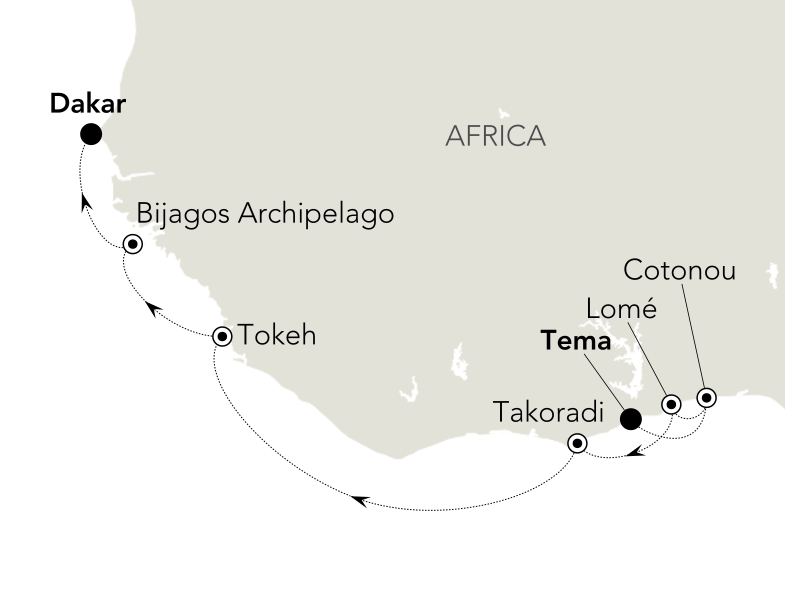
A 12-night expedition voyage aboard Silver Endeavour, Tema, Ghana to Dakar, Senegal. Destination: Africa & Indian Ocean.
Operated by Silversea Cruises aboard Silver Endeavour.
Tema (Accra)
Cotonou
Lomé
Takoradi
Tokeh
Bijagos Archipelago
Dakar
From a modest fishing port to the biggest in Ghana, Tema’s industrial activity has all but tarnished the charming, postcard scenery of the region. The neighbouring white-sanded beaches remain immaculate, still serving as a testimony of the rich variety of birds that can be found in the area.In the way Mother Nature intended it, gannets, boobies and kingfishers amongst other species fish in and around the cerulean waters of the coast. A light breeze tickles the inflamed, iron-filled soil of the mainland on which the railway linking Tema to Accra lures hundreds of visitors each day. On board one of the carriages to Accra, distinctively noticeable by their painted coats of red, yellow and green that echo Ghana’s national flag, a peek out of the window will offer scenic views of the harbour and coast, as well as the fields that separate Tema from the capital.
Tucked between Nigeria and Togo in Benin is the busy trading port of Cotonou. Named a “market town” for its coastal placement and lucrative palm oil and textile trades Cotonou is a sprawling amorphous city swaddled between the Atlantic coast and Lake Nakoué. Because of its especial geographical situation Cotonou is bursting with life — visitors disembarking here will find a colourful port alive with economic activity and very much the capital (although not in name the official capital is Porto-Novo to the east) of the trading industry.
If polished beach resorts with identikit sun loungers and beach menus are not quite your idea of experiential travel, then you have come to the right place. Because Lomé is authenticity at it very best. Tourists are few and far between, village life carries on much as it has for centuries and adventure, excitement and discovery are guaranteed. The capital of Togo, Lomé enjoys a heady status as the former “jewel of West Africa” (although both Ghana and the Ivory Coast claim ownership of the title). With over 40 tribes calling the tiny city home, whether it is the jewel of West Africa or not, it is certainly the most diverse melting pot of cultures to be found on the west coast. This patchwork of population is best experienced in the capital, where the dizzying sight of vendors strolling with huge bags balanced on their heads and motorbikes beeping and slaloming between the traffic is a tangible lesson in modern day history! A trip around the daily market will have you discovering not only a treasure trove of different tribal traditions but will also have you bargaining for anything from thirst quenching fresh fruit and beautifully made fabrics to livestock and voodoo spirit dolls. Voodoo ceremonies are still widely seen all over Togo, and visitors that are lucky enough to witness one will definitely take home a souvenir worth remembering. These are not just for tourists but an ancient, deep religious practice that merges African and Christian beliefs and is said to rid you of the devil within.
Ghana's fourth-largest city plays serene beaches against a bustling commercial centre. People from around the world visit the shore, both for its beauty and to enjoy the fresh seafood served right on the sands. Frantic city life awaits a short distance inland, where an economy fuelled by Ghana’s oil industry is most apparent in the maze of vendors at Market Circle. Takoradi is also the gateway to the UNESCO World Heritage sites of Elmina and Cape Coast Castle.
Days at sea are the perfect opportunity to relax unwind and catch up with what you’ve been meaning to do. So whether that is going to the gym, visiting the spa, whale watching, catching up on your reading or simply topping up your tan these blue sea days are the perfect balance to busy days spent exploring shore side.
Days at sea are the perfect opportunity to relax unwind and catch up with what you’ve been meaning to do. So whether that is going to the gym, visiting the spa, whale watching, catching up on your reading or simply topping up your tan these blue sea days are the perfect balance to busy days spent exploring shore side.
Tokeh or Tokeh Town as it is also known is a coastal resort town that relies mainly on fishing and tourism. Only twenty miles outside Freetown the capital of Sierra Leone this town is nestled in an area of beautiful scenery surrounded by mountains forests and beaches. The Tokeh Beach is considered one of the largest and most attractive beaches in West Arica. This town was first founded by a Sherbo fisherman who settled along the river bank. Much later in 1968 a prominent barrister from Sierra Leone purchased the land and in partnership with a French company developed the village. Today it is a thriving town with the resort a church mosque community center school and about 6000 residents.
Bijagos Archipelago, Guinea-Bissau : Sacred, serene and secluded, the Bijagos Archipelago is one of the most intriguing island collections the world can offer. Almost falling off the map, the string of 88 lands form an archipelago of tropical beauty, scattered from the west of Guinea Bissau. The sprawling archipelago’s challenging location cocooned the islanders from much of the colonial interference for many years. So local traditions - of ancient ritual and colourful initiation ceremonies - have remained strong and safeguarded here. Thatch-roofed houses host welcoming locals, in villages where diminutive pygmy cows wander freely. Anthropologists note the islands for matriarchal elements in society, and priestesses play a significant role here, sermonising the islanders’ bonds with the natural world. Many of the islands are uninhabited, instead declared sacred and reserved for spirits. This has also helped form a protected paradise for some of Africa’s most exotic wildlife. UNESCO declared the archipelago a Biosphere Reserve in 1996 and its sprawling mangrove forests, undisturbed savannahs and muddy flats attract long-legged migrating birds, as well as beady-eyed crocodiles. West Africa’s largest saltwater hippo colony lurks in the waters of Orango National Park - see them smashing their way in and out of the water. Endangered sea turtles also faithfully return to the tranquil beaches each year, digging out over 25,000 nests. Extraordinary and authentic - an expedition to this enchanted, off-the-grid archipelago is one to cherish.
Bijagos Archipelago, Guinea-Bissau : Sacred, serene and secluded, the Bijagos Archipelago is one of the most intriguing island collections the world can offer. Almost falling off the map, the string of 88 lands form an archipelago of tropical beauty, scattered from the west of Guinea Bissau. The sprawling archipelago’s challenging location cocooned the islanders from much of the colonial interference for many years. So local traditions - of ancient ritual and colourful initiation ceremonies - have remained strong and safeguarded here. Thatch-roofed houses host welcoming locals, in villages where diminutive pygmy cows wander freely. Anthropologists note the islands for matriarchal elements in society, and priestesses play a significant role here, sermonising the islanders’ bonds with the natural world. Many of the islands are uninhabited, instead declared sacred and reserved for spirits. This has also helped form a protected paradise for some of Africa’s most exotic wildlife. UNESCO declared the archipelago a Biosphere Reserve in 1996 and its sprawling mangrove forests, undisturbed savannahs and muddy flats attract long-legged migrating birds, as well as beady-eyed crocodiles. West Africa’s largest saltwater hippo colony lurks in the waters of Orango National Park - see them smashing their way in and out of the water. Endangered sea turtles also faithfully return to the tranquil beaches each year, digging out over 25,000 nests. Extraordinary and authentic - an expedition to this enchanted, off-the-grid archipelago is one to cherish.
Bijagos Archipelago, Guinea-Bissau : Sacred, serene and secluded, the Bijagos Archipelago is one of the most intriguing island collections the world can offer. Almost falling off the map, the string of 88 lands form an archipelago of tropical beauty, scattered from the west of Guinea Bissau. The sprawling archipelago’s challenging location cocooned the islanders from much of the colonial interference for many years. So local traditions - of ancient ritual and colourful initiation ceremonies - have remained strong and safeguarded here. Thatch-roofed houses host welcoming locals, in villages where diminutive pygmy cows wander freely. Anthropologists note the islands for matriarchal elements in society, and priestesses play a significant role here, sermonising the islanders’ bonds with the natural world. Many of the islands are uninhabited, instead declared sacred and reserved for spirits. This has also helped form a protected paradise for some of Africa’s most exotic wildlife. UNESCO declared the archipelago a Biosphere Reserve in 1996 and its sprawling mangrove forests, undisturbed savannahs and muddy flats attract long-legged migrating birds, as well as beady-eyed crocodiles. West Africa’s largest saltwater hippo colony lurks in the waters of Orango National Park - see them smashing their way in and out of the water. Endangered sea turtles also faithfully return to the tranquil beaches each year, digging out over 25,000 nests. Extraordinary and authentic - an expedition to this enchanted, off-the-grid archipelago is one to cherish.
Bijagos Archipelago, Guinea-Bissau : Sacred, serene and secluded, the Bijagos Archipelago is one of the most intriguing island collections the world can offer. Almost falling off the map, the string of 88 lands form an archipelago of tropical beauty, scattered from the west of Guinea Bissau. The sprawling archipelago’s challenging location cocooned the islanders from much of the colonial interference for many years. So local traditions - of ancient ritual and colourful initiation ceremonies - have remained strong and safeguarded here. Thatch-roofed houses host welcoming locals, in villages where diminutive pygmy cows wander freely. Anthropologists note the islands for matriarchal elements in society, and priestesses play a significant role here, sermonising the islanders’ bonds with the natural world. Many of the islands are uninhabited, instead declared sacred and reserved for spirits. This has also helped form a protected paradise for some of Africa’s most exotic wildlife. UNESCO declared the archipelago a Biosphere Reserve in 1996 and its sprawling mangrove forests, undisturbed savannahs and muddy flats attract long-legged migrating birds, as well as beady-eyed crocodiles. West Africa’s largest saltwater hippo colony lurks in the waters of Orango National Park - see them smashing their way in and out of the water. Endangered sea turtles also faithfully return to the tranquil beaches each year, digging out over 25,000 nests. Extraordinary and authentic - an expedition to this enchanted, off-the-grid archipelago is one to cherish.
Capital of Senegal, and a major gateway to Western Africa, the former colonial trading post of Dakar stamps the Cap-Vert peninsular with glorious surf-fringed beaches. Enjoy the thrum of markets - where colourful textiles are exchanged - and wander streets where jazz, sambar and mbalax spill from every ajar door. Offering tropical island-style beaches in an incongruous urban setting, Dakar is a wild and urgent experience for the senses. Watch on as surfers revel in consistent rollers on this, the most westerly peninsula of continental Africa. Scuba divers can explore worlds below the surface in Dakar's diving areas, or you can head to sandy beaches like Plage des Mamelles' cove, which provide endless options for cooling off. Looking for a little more activity, loosen up and play on golf courses that unroll along the sun-kissed Senegalese coastline, or visit startling natural sites like the vivid pink water of the salty pink Lake Retba. Cultural relevance abounds in Dakar - those wanting to delve a little deeper into the dark history of Senegal should visit the House of Slaves on the UNESCO World Heritage Site listed Goree Island, or duck into the Theodore Monod Museum to pour over an incredible collection of masks, artefacts, and treasures. Sandaga Market is a full-on experience of choreographed chaos, sound and flavours. Tear into fish fresh off the boat, and don't be afraid to get your hands a little greasy while handling Dibi - the national street food - soft mutton, simmered with onions and zesty orange spice.
Capital of Senegal, and a major gateway to Western Africa, the former colonial trading post of Dakar stamps the Cap-Vert peninsular with glorious surf-fringed beaches. Enjoy the thrum of markets - where colourful textiles are exchanged - and wander streets where jazz, sambar and mbalax spill from every ajar door. Offering tropical island-style beaches in an incongruous urban setting, Dakar is a wild and urgent experience for the senses. Watch on as surfers revel in consistent rollers on this, the most westerly peninsula of continental Africa. Scuba divers can explore worlds below the surface in Dakar's diving areas, or you can head to sandy beaches like Plage des Mamelles' cove, which provide endless options for cooling off. Looking for a little more activity, loosen up and play on golf courses that unroll along the sun-kissed Senegalese coastline, or visit startling natural sites like the vivid pink water of the salty pink Lake Retba. Cultural relevance abounds in Dakar - those wanting to delve a little deeper into the dark history of Senegal should visit the House of Slaves on the UNESCO World Heritage Site listed Goree Island, or duck into the Theodore Monod Museum to pour over an incredible collection of masks, artefacts, and treasures. Sandaga Market is a full-on experience of choreographed chaos, sound and flavours. Tear into fish fresh off the boat, and don't be afraid to get your hands a little greasy while handling Dibi - the national street food - soft mutton, simmered with onions and zesty orange spice.
From $16,350
per guest · 12 nights
Prices are a guide and vary with season, cabin category and party size. Your advisor will confirm the exact cost before anything is booked.
Classic Veranda
suite
Deluxe Veranda
suite
Grand 1 Bedroom
suite
Owner 1 Bedroom
suite
Premium Veranda
suite
Silver
suite
Superior Veranda
suite








