




Prefer a conversation?
Our team is always available to guide you through the process and ensure your experience is perfectly matched to your preferences.
Our team is always available to guide you through the process and ensure your experience is perfectly matched to your preferences.
Duration
11 Nights
Price
From $9,950
Ship
Silver Spirit
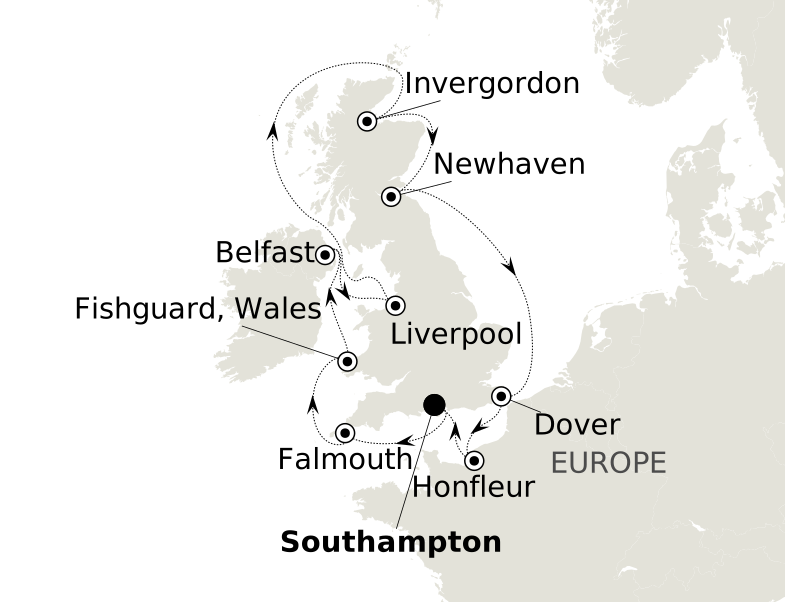
A 11-night ocean voyage aboard Silver Spirit, Southampton, United Kingdom to Southampton, United Kingdom. Destination: Northern Europe & British Isles.
Operated by Silversea Cruises aboard Silver Spirit.
Southampton
Plymouth, England
Fishguard, Wales
Belfast
Liverpool
Invergordon (Highland)
South Queensferry (Edinburgh), Scotland
Dover (London), England
Honfleur
Home of the ill-fated Titanic departure, Southampton has a long maritime history. Henry V’s fleet bound for the battle of Agincourt left from here, as did the Mayflower (not from Plymouth as many believe) and the great British ocean liners, Queen Elizabeth 2 and Queen Mary both departed on their maiden voyages from the port. So suffice to say, that Southampton is a seafearing place. Today Southampton is the cruise capital of Northern Europe, so expect a city that understands how to have fun. This comes in a variety of ways: a castellated old city that has lots of charm, some excellent museums (the most notable of which is the Sea City Museum) and extensive green spaces. Authentic Tudor remains provide a fascinating insight to 15th century living while other landmarks date back even further. A stroll around the city is generous in its attractions, so there is no better way to see Southampton than on foot. Culture wise, the city’s bustling Guildhall Square is the centre for art, education and food and drink. Southampton’s location of the south coast of England means just a short distance away lie some interesting spots. Pre-historic enigma Stonehenge is less than an hour away while the quintessentially English market town Salisbury is perfect for a bit of shopping. Both are well worth a visit. For those who prefer their entertainment crafted by Mother Nature, a short ride to the New Forest will give you peace; think idyllic glades, ancient woodland, open moors, heathland and cliff top walks.
Devon’s largest city is packed with seafaring heritage and quintessential britishness. Tea shops, pubs, a famous gin distillery plus a newly revamp port promenade provide much in the way of gentle entertainment, while those who like to stretch their legs only have to look northwards to the rolling moors. The city is of course most famous for its role in the launching of the Mayflower, as it is from Plymouth that the Pilgrim Fathers left for the New World in 1620 – the original steps may have been lost but a stone plaque allows visitors to stand on the exact spot they left from. The town is peppered with remnants of its historic maritime heritage, across the waters of Plymouth Sound lies fortified Drake’s Island guarding the approaches, while Plymouth Hoe, where Sir Francis Drake was famously playing bowls when he received news of the invading Armada, is just up from the docks. Nearby Royal William Yard, built by John Rennie between 1825-31, boasts the largest collection of Grade 1-listed military buildings in Europe. Plymouth City Museum and Art Gallery contains maritime displays including important Napoleonic ship models. The city's strategic position on England’s south coast cost it dearly during WWII. From 1940-44 the Luftwaffe basically razed the original city, and many of the original building were destroyed. What was rebuilt is more gritty than pretty, but those who are willing to look beyond the dour city centre will find a very pleasing place surrounded by beautiful English countryside.
Perched on a clifftop and stunningly picturesque Fishguard is considered the very heart of North Pembrokeshire. A small market town that almost seems untouched by time you’ll find clusters of quayside cottages family businesses selling local produce and plenty of Gaelic charm! Market day falls on a Saturday and although principally food there are some stalls selling local arts and crafts too. If you are not lucky enough to be visiting on market day the pretty high street has some lovely shops where you can easily while away a couple of hours. Known internationally as the place of the last invasion of Britain when the French landed in 1797 the village heaves with history. Historians will of course already know that the two-day invasion soon failed and the peace treaty was signed in the Royal Oak pub in the market square. The calm waters are perfect for kayaking while walkers will love the national parks that are filled with signposted trails for all levels of ability. Cyclist of all levels will also be pleased Fishguard and its surroundings do have a few hills but also lots of straight roads that offer a gentle visit of the stunning landscape. If all the activity gets too much for you then why not enjoy a delicious local welsh cake in one of the pretty cafes or head to the town hall and have a look at the 100 foot long Last Invasion Tapestry a humorous and entertaining story in a Bayeux tapestry style of the 1797 invasion of mainland Britain.
Reborn as a cool modern city Belfast has successfully left its troubles behind emerging as a hotbed of culture and architecture where the comfort of a cosy pub is never far away. A walk across the Lagan Weir Footbridge brings you to Belfast’s fascinating Titanic District – an area of the city devoted to its rich ship-building heritage. The state-of-the-art Titanic Museum brings the story of the doomed vessel to life and is the largest museum dedicated to the infamously ‘unsinkable’ ship. There’s just enough time to give the 10-metre long Salmon of Knowledge sculpture a quick peck for luck before continuing to explore. A stark barbed wire and graffitied sheet metal barrier marks an abrupt scar through the city’s residential areas. The Peace Line was constructed during the height of the Troubles when Belfast was plagued by sectarian divisions between Protestants and Catholics. Nowadays you can jump in a black taxi tour to see the colourful murals and living history of the walls which stand as a stark reminder of the fragility of peace. After exploring the city’s historic divisions a reminder of Belfast’s uniting creativity can be found at the Metropolitan Arts Centre – a seven-storey tall building which invites light to gloriously cascade inside. The Cathedral Quarter is a cobbled blend of flower-adorned pubs restaurants and theatres and venues where music spills out onto the streets at night and many a pint is cheerily shared.
Who can say Liverpool with thinking of the Beatles? Home to the fab four, Penny Lane, Strawberry Fields and the Cavern Club, this northern English city is undoubtedly one of the most important places on the 20th century music scene. Even UNESCO agrees - Liverpool became a City of Music (one of only 19 in the world) in 2015. So understandably, it’s bursting with pride. Not only for its most famous former residents but also its football team, its maritime heritage and its thriving cultural scene (it was Capital of Culture in 2008). A huge regeneration project over the past two decades has seen Liverpool blossom from being a below-par northern English city to a somewhere buzzing with charm. The arrival of the Tate Liverpool paved the way – quickly followed by the restoration of some 2,500 plus listed buildings (that’s more than any English city outside London). The waterfront revitalisation came next with bars, clubs, galleries and independent boutiques, giving Liverpool some of the best dining and shopping there is. Don’t leave here without tasting Scouse – a traditional beef stew – and from where Livepudlians draw their nickname “Scousers”. Culturally speaking, Liverpool is “bang on” as Scousers would say. The three Graces (named after the Greek goddesses of charm, beauty and creativity) line the waterfront, and are responsible in part for Liverpool’s second UNESCO gong as a World Heritage Site. Further afield, the lovely parks and Crosby Beach offer welcome respite from the urban hub.
Days at sea are the perfect opportunity to relax unwind and catch up with what you’ve been meaning to do. So whether that is going to the gym, visiting the spa, whale watching, catching up on your reading or simply topping up your tan these blue sea days are the perfect balance to busy days spent exploring shore side.
Promising epic Highlands scenery and monstrous lochs Invergordon welcomes you to the heart of Scotland's land of castles stories and scenery. Taste the prized Scottish gold in a glass as you swirl and sample the produce of history-rich distilleries or lace up your hiking boots to explore the Great Glen's wild mountains and green and gold blotched moorlands. Sleepy Invergordon provides a charming welcome ashore and you'll immediately enjoy stunning views across the widespread of the Firth. Loch Ness is a massive expanse of still water surrounded by emerald fortress-studded hills. What's lurking beneath has been the subject of intense speculation and captured the world's imagination since 1933. Cruise the loch on a boat trip and keep an eye out for any ripples disturbing the surface - perhaps you will be lucky enough to discover the truth about Nessie's mystery. The River Ness flows on to Inverness the Capital of the Highlands which is overlooked by the sandstone rise of Inverness Castle. The fairytale Cawdor Castle is also within reach set among immaculate gardens and entered via an impressive drawbridge. The castle's links to Shakespeare's Macbeth are often mentioned but in truth they are a little tenuous as this castle was built after King Macbeth's death. Fort George meanwhile is a colossal military institution spread across a huge expanse. Visit to be immersed in the life of a soldier as you wander among the vast battlements amid a sea of redbrick military installations.
Days at sea are the perfect opportunity to relax unwind and catch up with what you’ve been meaning to do. So whether that is going to the gym, visiting the spa, whale watching, catching up on your reading or simply topping up your tan these blue sea days are the perfect balance to busy days spent exploring shore side.
The famous white chalk cliffs cradle England’s southeast’s principal cross-Channel port of Dover. It lies only twenty-one miles from the continent, and on a clear day the low cliffs of Calais are visible. The Romans put Dover on the map when, having conquered Europe, they decided to move on toward Britannia, using the natural harbor of Dover as the base for their northern fleet. They erected a lighthouse to guide their ships into port. Following their withdrawal from England in the 4th century when the Normans constructed the keep that now presides over the bulk of Dover Castle. This superbly positioned fortress had been in continuous use as some sort of military installation until 1958. A network of tunnels constructed beneath the castle during the Napoleonic wars was extended during World War II for use as headquarters for the Dunkirk evacuation. More recently, sections of the 3.5 miles of tunnels were provisioned as a refuge for Kent’s elite in the event of nuclear war. Now that there seems no longer a need for such facilities, the tunnels have been restored and opened to the public. Pier Information The ship is scheduled to dock at Dover’s Western Docks. The distance to downtown Dover is two miles. Taxis may have to be called for pierside pickup. Dover is 85 miles from London. Frequent train service connects the port with London; traveling time is approximately 90 minutes (subject to traffic conditions). Shopping Stores in Dover are limited interest to visitors. Serious shoppers will want to set time aside to explore the endless shopping opportunities in London. Some of the most exclusive shops are found along Oxford, Bond and Regent Streets. Upscale department stores such as Harrods, Selfridges and Liberty offer convenient shopping with everything under one roof. Designer clothing, china and antiques may be of interest. Purchases are subject to a 17.5% VAT (value-added tax). Guests not residing in one of the EU countries can obtain a partial refund of the VAT after spending a certain amount of money. Proper forms have to be requested from the shop at the time of purchase. The refund can be claimed at the airport VAT Refund Desk; if leaving the ship, check on board with the Purser’s Office for procedures. The local currency is the British pound. Cuisine The town of Dover has a limited selection of pubs and restaurants and more can be found in the surrounding countryside, serving meals cooked from locally grown produce and accompanied by a wide variety of bars and wines. Other Sites The county of Kent is a fascinating part of England that is dotted with Castles, historic houses, beautiful gardens and bustling market towns. Dover Castle Dominating the town from its hilltop location, this is Europe’s oldest concentrically-planned castle. From its position you can enjoy a fine panorama of Dover, its white cliffs and the English Channel. Inside the castle is Hellfire, a secret underground war room used by Winston Churchill. In addition to Dover Castle, other attractions include the Old Town Goal, a new museum, the White Cliffs Experience and the Roman Painted House. This ancient guest house was discovered during the construction of a car park. The excavated rooms feature the finest Roman wall paintings in England. Guests in transit to the next cruise may check with the Tour Office on board for additional sightseeing possibilities or arrangements by private car.
The crammed together, timber-framed houses of Honfleur's delightful waterfront simply beg to be painted, and the waterfront beauty has been immortalised on the canvases of artists like Monet, and Honfleur's celebrated son, Boudin. Located in scenic Normandy, where the Seine opens out into the Channel, this is one of France's - and the world's - most spectacular, historic harbours. Impossibly picturesque, the Vieux Bassin's Norman harbour townhouses are an artist’s dream, reflecting out onto the still water, between bright wooden fishing boats. It may be gorgeous, but it’s also a historically important port, and Samuel de Champlain's epic voyage - which resulted in the founding of Quebec - launched from these waters. Take a stroll back in time, as you wander cobbled streets where flowers spill down walls or sit to indulge in Calvados – brandy made from Normandy's famous apples. A museum dedicated to Eugene Boudin, the town's influential impressionist artist, displays visions of the harbour and region, as well as paintings of the town's stunning wooden church. Wander to Eglise St Catherine itself, to see the twisting structure, which is France's largest wooden chapel. Constructed from trees taken from nearby Touques Forest, it replaced the stone church that stood here previously, which was destroyed during the Hundred Years War. Out of Honfleur, The spectacular Pont de Normandie cable-stayed bridge loops up over the Seine's estuary, bringing excursions to Le Havre even closer. The pensive, sombre beaches of the D-Day landings stretch out across Normandy's coastline, while the Bayeux Tapestry unfurls within reach of Honfleur's picturesque scenery.
Home of the ill-fated Titanic departure, Southampton has a long maritime history. Henry V’s fleet bound for the battle of Agincourt left from here, as did the Mayflower (not from Plymouth as many believe) and the great British ocean liners, Queen Elizabeth 2 and Queen Mary both departed on their maiden voyages from the port. So suffice to say, that Southampton is a seafearing place. Today Southampton is the cruise capital of Northern Europe, so expect a city that understands how to have fun. This comes in a variety of ways: a castellated old city that has lots of charm, some excellent museums (the most notable of which is the Sea City Museum) and extensive green spaces. Authentic Tudor remains provide a fascinating insight to 15th century living while other landmarks date back even further. A stroll around the city is generous in its attractions, so there is no better way to see Southampton than on foot. Culture wise, the city’s bustling Guildhall Square is the centre for art, education and food and drink. Southampton’s location of the south coast of England means just a short distance away lie some interesting spots. Pre-historic enigma Stonehenge is less than an hour away while the quintessentially English market town Salisbury is perfect for a bit of shopping. Both are well worth a visit. For those who prefer their entertainment crafted by Mother Nature, a short ride to the New Forest will give you peace; think idyllic glades, ancient woodland, open moors, heathland and cliff top walks.
From $9,950
per guest · 11 nights
Prices are a guide and vary with season, cabin category and party size. Your advisor will confirm the exact cost before anything is booked.
Classic Veranda
suite
Deluxe Veranda
suite
Grand 1 Bedroom
suite
Grand 2 Bedroom
suite
Medallion
suite
Owner 1 Bedroom
suite
Owner 2 Bedroom
suite
Panorama
suite
Royal 1 Bedroom
suite
Royal 2 Bedroom
suite
Silver
suite
Silver 2 Bedroom
suite
Superior Veranda
suite
Vista
suite








