




Prefer a conversation?
Our team is always available to guide you through the process and ensure your experience is perfectly matched to your preferences.
Our team is always available to guide you through the process and ensure your experience is perfectly matched to your preferences.
Duration
13 Nights
Price
From $11,250
Ship
Silver Dawn
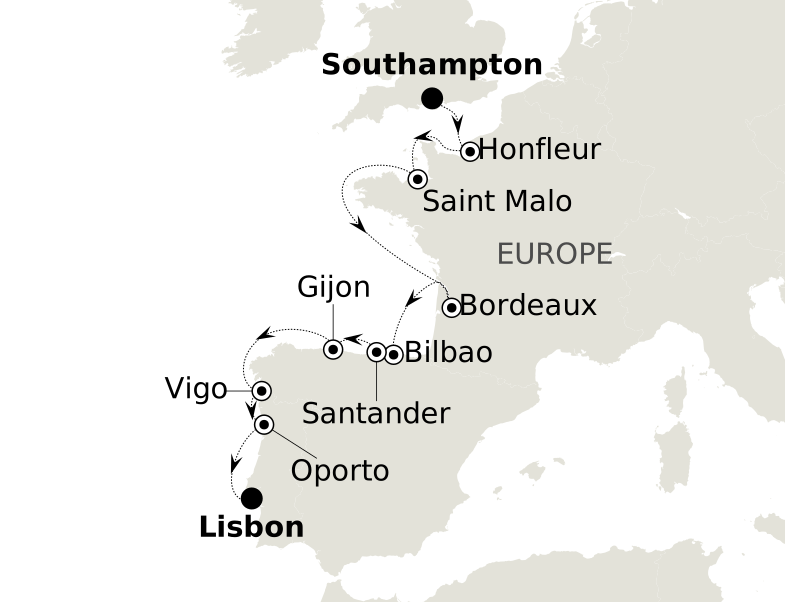
A 13-night ocean voyage aboard Silver Dawn, Southampton, United Kingdom to Lisbon, Portugal. Destination: Northern Europe & British Isles.
Operated by Silversea Cruises aboard Silver Dawn.
Southampton
Honfleur
Saint Malo (Brittany)
Bordeaux
Bilbao
Santander
Gijon
Vigo (Galicia)
Porto (Leixões)
Lisbon
Home of the ill-fated Titanic departure, Southampton has a long maritime history. Henry V’s fleet bound for the battle of Agincourt left from here, as did the Mayflower (not from Plymouth as many believe) and the great British ocean liners, Queen Elizabeth 2 and Queen Mary both departed on their maiden voyages from the port. So suffice to say, that Southampton is a seafearing place. Today Southampton is the cruise capital of Northern Europe, so expect a city that understands how to have fun. This comes in a variety of ways: a castellated old city that has lots of charm, some excellent museums (the most notable of which is the Sea City Museum) and extensive green spaces. Authentic Tudor remains provide a fascinating insight to 15th century living while other landmarks date back even further. A stroll around the city is generous in its attractions, so there is no better way to see Southampton than on foot. Culture wise, the city’s bustling Guildhall Square is the centre for art, education and food and drink. Southampton’s location of the south coast of England means just a short distance away lie some interesting spots. Pre-historic enigma Stonehenge is less than an hour away while the quintessentially English market town Salisbury is perfect for a bit of shopping. Both are well worth a visit. For those who prefer their entertainment crafted by Mother Nature, a short ride to the New Forest will give you peace; think idyllic glades, ancient woodland, open moors, heathland and cliff top walks.
The crammed together, timber-framed houses of Honfleur's delightful waterfront simply beg to be painted, and the waterfront beauty has been immortalised on the canvases of artists like Monet, and Honfleur's celebrated son, Boudin. Located in scenic Normandy, where the Seine opens out into the Channel, this is one of France's - and the world's - most spectacular, historic harbours. Impossibly picturesque, the Vieux Bassin's Norman harbour townhouses are an artist’s dream, reflecting out onto the still water, between bright wooden fishing boats. It may be gorgeous, but it’s also a historically important port, and Samuel de Champlain's epic voyage - which resulted in the founding of Quebec - launched from these waters. Take a stroll back in time, as you wander cobbled streets where flowers spill down walls or sit to indulge in Calvados – brandy made from Normandy's famous apples. A museum dedicated to Eugene Boudin, the town's influential impressionist artist, displays visions of the harbour and region, as well as paintings of the town's stunning wooden church. Wander to Eglise St Catherine itself, to see the twisting structure, which is France's largest wooden chapel. Constructed from trees taken from nearby Touques Forest, it replaced the stone church that stood here previously, which was destroyed during the Hundred Years War. Out of Honfleur, The spectacular Pont de Normandie cable-stayed bridge loops up over the Seine's estuary, bringing excursions to Le Havre even closer. The pensive, sombre beaches of the D-Day landings stretch out across Normandy's coastline, while the Bayeux Tapestry unfurls within reach of Honfleur's picturesque scenery.
Ship sails flutter in the breeze, at the natural port of Saint-Malo - a historic and resilient walled city, which watches out over golden sands and island fortresses. Strung tenuously to the mainland, Saint Malo was the historic home of a rowdy mix of skilled sailors and new world explorers - as well as the plunderers who earned the place its 'Pirate City' title. Some of history's great voyages have launched from here - including Jacques Cartier's, which led to the settlement of New France and modern-day Quebec. Founded by a Welsh monk, who made his way here in the 6th century, Saint Malo's castle is forged from sheer granite, and its steep defensive ramparts arise defiantly. The atmospheric walled town turns its back to the mainland and gazes out longingly into the sea. Explore streets that breathe with maritime tales and medieval charm - restored from the intense damage sustained during the Second World War. Cathédrale de St Malo rises above the tight paths, offering views of the peppered islands and fortifications. Boatloads of fresh oysters and scallops are heaved ashore - savour them or grab savoury crepes galettes, stuffed with cheese and ham. Wash Saint Malo's foods down with a Brittany cider, which challenges wine as the indulgence of choice in these parts. A highly tidal region, the pocket-sized islands of Petit Bé and Grand Bé join the mainland, and you can explore at leisure as the tide recedes. The incredible island of Mont Saint Michel also looms in the estuary of the Couesnon River nearby, hovering like a cinematic mirage above high tide’s waters. Elsewhere, Cap Fréhel's lush green peninsula juts out from the emerald coast towards Jersey, tempting with rich coastal hiking trails.
Days at sea are the perfect opportunity to relax unwind and catch up with what you’ve been meaning to do. So whether that is going to the gym, visiting the spa, whale watching, catching up on your reading or simply topping up your tan these blue sea days are the perfect balance to busy days spent exploring shore side.
The name alone conjures images of sun-ripened grapes, splashes of refined flavour, and the joy of clinking glasses. Bordeaux is synonymous with quality and prestige, and the promise of endless opportunities to sample the city’s famous, full-bodied red wines makes a visit to this elegant French port city one to truly savour. Sprinkled with scenic, turret-adorned mansion castles, which stand above soil softened by the Atlantic and winding flow of the Garonne River, the vineyards of Bordeaux consistently produce revered wines, enjoyed right across the globe. Explore France’s largest wine region, walking through vineyards where dusty clumps of grapes hang, before descending into cellars to see the painstaking processes that make this region a global wine centre. The acclaimed, sensory experience of Cité du Vin wine museum lets you put your own nose to the test, learning more about the craft involved in producing world class vintages. Brush up on your wine knowledge, with our blog [insert You’ll Fall in Love with Wine in Bordeaux]. Bordeaux itself is an intoxicating blend of old and new – a fact perfectly illustrated by the Water Mirror. This living art installation has reinvigorated one of the city’s most important historical sites, and it feels as though you’re walking on water, as you step through the cooling mist of Place De La Bourse. The moisture generates a glorious mirrored composition of the 300-year-old elegant palatial architecture in front of you. Water also flows freely from the magnificent Monument aux Girondins statue, where horses rear up to extol the values of the Girondin revolutionaries. Marche des Quais – the city’s lively fish market – is the spot to try this wine capital’s freshest lemon-drizzled oysters and juicy prawns.
The name alone conjures images of sun-ripened grapes, splashes of refined flavour, and the joy of clinking glasses. Bordeaux is synonymous with quality and prestige, and the promise of endless opportunities to sample the city’s famous, full-bodied red wines makes a visit to this elegant French port city one to truly savour. Sprinkled with scenic, turret-adorned mansion castles, which stand above soil softened by the Atlantic and winding flow of the Garonne River, the vineyards of Bordeaux consistently produce revered wines, enjoyed right across the globe. Explore France’s largest wine region, walking through vineyards where dusty clumps of grapes hang, before descending into cellars to see the painstaking processes that make this region a global wine centre. The acclaimed, sensory experience of Cité du Vin wine museum lets you put your own nose to the test, learning more about the craft involved in producing world class vintages. Brush up on your wine knowledge, with our blog [insert You’ll Fall in Love with Wine in Bordeaux]. Bordeaux itself is an intoxicating blend of old and new – a fact perfectly illustrated by the Water Mirror. This living art installation has reinvigorated one of the city’s most important historical sites, and it feels as though you’re walking on water, as you step through the cooling mist of Place De La Bourse. The moisture generates a glorious mirrored composition of the 300-year-old elegant palatial architecture in front of you. Water also flows freely from the magnificent Monument aux Girondins statue, where horses rear up to extol the values of the Girondin revolutionaries. Marche des Quais – the city’s lively fish market – is the spot to try this wine capital’s freshest lemon-drizzled oysters and juicy prawns.
The name alone conjures images of sun-ripened grapes, splashes of refined flavour, and the joy of clinking glasses. Bordeaux is synonymous with quality and prestige, and the promise of endless opportunities to sample the city’s famous, full-bodied red wines makes a visit to this elegant French port city one to truly savour. Sprinkled with scenic, turret-adorned mansion castles, which stand above soil softened by the Atlantic and winding flow of the Garonne River, the vineyards of Bordeaux consistently produce revered wines, enjoyed right across the globe. Explore France’s largest wine region, walking through vineyards where dusty clumps of grapes hang, before descending into cellars to see the painstaking processes that make this region a global wine centre. The acclaimed, sensory experience of Cité du Vin wine museum lets you put your own nose to the test, learning more about the craft involved in producing world class vintages. Brush up on your wine knowledge, with our blog [insert You’ll Fall in Love with Wine in Bordeaux]. Bordeaux itself is an intoxicating blend of old and new – a fact perfectly illustrated by the Water Mirror. This living art installation has reinvigorated one of the city’s most important historical sites, and it feels as though you’re walking on water, as you step through the cooling mist of Place De La Bourse. The moisture generates a glorious mirrored composition of the 300-year-old elegant palatial architecture in front of you. Water also flows freely from the magnificent Monument aux Girondins statue, where horses rear up to extol the values of the Girondin revolutionaries. Marche des Quais – the city’s lively fish market – is the spot to try this wine capital’s freshest lemon-drizzled oysters and juicy prawns.
Whether it’s the flow of its boundary pushing architecture, delights of its finger food tapas, or sweeps of gorgeous shoreline nearby, Bilbao is a city that places a premium on aesthetics. The relentless drive to all things beautiful may be a reaction to the city’s industrial past, but it has led this Basque city to emerge as a new beacon of artistry. American architect Frank Gehry’s masterpiece of flowing metal is the shining standout here, a perfect harmony of smooth titanium and glass, and a thrilling piece in itself. Inside the Guggenheim Museum Bilbao, world-class exhibitions are exhibited in the bright, expansive interior - which practically begs you to explore more. The city has gorgeous historical presence too. Casco Viejo - the medieval area - is its historic core, and home to the original seven streets and cathedral, dating back to the 14thcentury. Tall banks of coloured buildings rise either side as you walk, dwarfed by a tide of pretty facades, overflowing flower boxes, and intricate rail balconies. Plaza Nueva is Bilbao’s neoclassical square, with a procession of arches all around you. Morning flea markets regularly overtake it, offering opportunities to pick through piles of coins, dusty books and rusted antiques on the hunt for bargains, in this most elegant setting. The titanic Mercado de la Ribera market looms tall by the river. Explore to eat your way through an endless pile of Basque pintxos – the local take on tapas. Cocktail sticks will quickly stack up as you gorge on plump olives, organic cheeses, and feather thin slices of curled hams, while orbiting Europe’s largest covered market. Described as a perfect blend of beauty and function by UNESCO, the Vizcaya Bridge is an unusual but spectacular piece of industrial architecture. The world’s oldest, gigantic transporter crane is still in use today, swinging cars and passengers from one side of the gaping Nervion River’s mouth to the other.
Northern Spain might not have the same allure as the Mediterranean end of the country, yet as every traveller knows, often the best places are those that are the least known. Enter Santander. With heritage hailing from the prehistoric, Roman and Middle ages, suffice to say that Santander’s roots stretch very far back. As one of Spain’s more important ports during the New World trading era, Santander enjoyed great wealth during the Middle Ages. King Alfonso 13th (1886-1941) made the city his summer residence, bringing about a further economic boom and laying the foundations for modern Santander: a popular summer resort that enjoys one of the most beautiful bay in Spain, a fantastic art and cultural hub (don’t miss the Centro Botin) and a great lust for la vida. Tragically, a two-day fire in 1941 destroyed much of the city, including almost all the medieval heritage. Thus, Santander is today a city of two faces. One: an elegant seaside resort with at least six urban beaches, fabulous restaurants and all the fun in the sun you can muster. The other: a city with 15,000-year-old prehistoric roots that are visible in the cave paintings at Altamira or Puente Viesgo. If travelling the 30-minutes to see the real things seems too far, make sure you head to the fabulous Prehistory and Archaeology Museum of Cantabria, for extensive displays that take you on an interactive journey through time. Alternatively, make like a local and head to El Sardinero beach for a boho beach vibe that rivals Barcelona.
Think of the north coast of Spain and one does not immediately think surfing and cider. But, as you approach this pretty Asturian city that what you’ll be greeted with. Gijon might not offer the sophistication of Barcelona or Bilbao, but it what it lacks in world-famous museums is more than made up for by its unique cultural identity, warm, welcoming charm and miles and miles of nature. Part of “Green Spain”, weather in Gijon is a bit more of an issue here than in other parts of the country. As with most places that benefit from lush, verdant nature, it can (and does) rain here, so be prepared and don’t let that tamper the joy of the exquisite, untouched coastline that stretches from Portugal to France. Gijon dates from Roman times, and the city hosts some superb Roman baths ruins. Some parts of the old city were destroyed in the Spanish Civil War, but from there grew a more streamline city, which seems to have remained lost in the time when it was built. You don’t come to Gijon expecting bright lights and big cities, you come because that is what you are trying to get away from. The city is the self-proclaimed capital of Cider, tradition being to pour the (still, not sparkling) drink from a great height. Gijon’s ciderhouses, called sidrerias, are found all over the city but the best ones (or the ones with the best view) are on the edge of the Cimavilla (old town), where you can enjoy the show of the waiter pouring your drink, while listening to the rumbling of the Atlantic Ocean crashing below.
Days at sea are the perfect opportunity to relax unwind and catch up with what you’ve been meaning to do. So whether that is going to the gym, visiting the spa, whale watching, catching up on your reading or simply topping up your tan these blue sea days are the perfect balance to busy days spent exploring shore side.
Located in in Galicia, in the northwest of Spain on the Portuguese border, Vigo is perhaps the country’s most underrated destination. Considered by many as “just’ an industrial fishing port (meaning the seafood rarely travels further than a mile to your plate), Vigo seduces everyone with its cuisine, landscape and warm Spanish welcomes. Like many of Galicia’s coastal towns, life in Vigo has been dictated by the ocean. The city dates back to Roman times and Romanesque architecture such as the churches of Santa María de Castrelos, Santiago de Bembrive, San Salvador de Coruxo can be found all over the city. From the 16th-18th centuries it became alive with commercial trade and buccaneers looking for sunken treasure. The town still enjoys its status as having sunken treasure in its waters, and debates about who would own this if ever discovered periodically colour local conversations. The old town and fishermen’s quarter are worth exploring, although unfortunately with the port’s rapid expansion in the 20th century, many of the original fishermen’s houses were demolished. However, remnants of the city’s Medieval past are still visible and a trip along the Spanish-Portuguese border will reward you with the beautiful walled Medieval city of Tui and the Velansa Fortress. The 13th century fortress offers a splendid view of the fortified Cathedral of Tui on the opposite side of the River Miño. Mount Castro, a castle fortress actually in the city, commands a magnificent view of Vigo and the bay.
Porto brings together Portugal’s Atlantic islands and seafaring heritage in a way that feels unmistakably its own. The atmosphere deepens around Porto wine and historic landmarks Porto, revealing a destination with more than one register and a natural elegance that grows clearer as you explore. This is the sort of destination that turns a port call into a story, thanks to its beauty, history, and the lived character that gives every scene greater resonance, and it feels worthy of more than a passing glance.
A glorious mosaic of beauty, freedom and authenticity, Portugal’s capital is a stirring artwork of a city. Known for the seven hills it spreads across, and its stirring fado music, Lisbon is a pastel-coloured blend of houses and beautiful tile artworks - and this creative city strikes a perfect harmony between natural and manmade beauty. Stroll along Alfama's steep, cobbled streets as you explore one of the city’s oldest neighbourhoods - where each house and door could be its own photograph. Look for the decorative tiles, with the distinctive blues and whites of Azulejo ceramics, and visit the dedicated museum to learn more. Afterwards, wind up to São Jorge Castle, where views out across Lisbon’s red rooftops unravel. Just one of many majestic viewpoints, you can also seek out Miradouro da Graça for perhaps Lisbon's finest panorama, with the copper-coloured suspension bridge stretching over sparkling water beyond the sea of buildings. The elegant Tower of Belém rises in the Tagus estuary and is a historic defender of these shores. The grand, carved cloisters of Jerónimos Monastery spread out close by, and there's another UNESCO recognised location close by at Sintra, where a colourful town is set amid thick gardens and towering mountains - capped by the royal Pena Palace. Later, relax and take a quick break to drink Ginjinha, a cherry liqueur made from chocolate cups instead of coffee. Lisboetas have a sweet tooth, and the famous Pastel de Nata's crumbling pastry and caramelised-custard topping is the essential accompaniment to any coffee stop.
From $11,250
per guest · 13 nights
Prices are a guide and vary with season, cabin category and party size. Your advisor will confirm the exact cost before anything is booked.
Classic Veranda
suite
Deluxe Veranda
suite
Grand 1 Bedroom
suite
Grand 2 Bedroom
suite
Owner 1 Bedroom
suite
Owner 2 Bedroom
suite
Panorama
suite
Royal 1 Bedroom
suite
Royal 2 Bedroom
suite
Silver
suite
Silver 2 Bedroom
suite
Superior Veranda
suite
Vista
suite








