

Prefer a conversation?
Our team is always available to guide you through the process and ensure your experience is perfectly matched to your preferences.
Our team is always available to guide you through the process and ensure your experience is perfectly matched to your preferences.
Duration
16 Nights
Price
From $11,300
Ship
Silver Muse
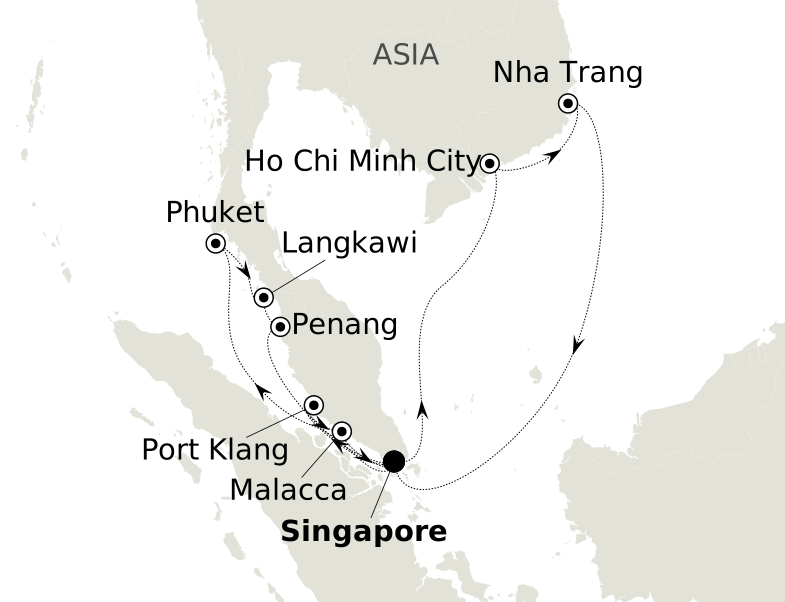
A 16-night ocean voyage aboard Silver Muse, Singapore, Singapore to Singapore, Singapore. Destination: Asia.
Operated by Silversea Cruises aboard Silver Muse.
Singapore
Phuket
Langkawi
Penang, George Town
Ho Chi Minh City
Nha Trang
Port Klang (Kuala Lumpur)
Malacca
Advanced, airy and elevated, Singapore is a spectacular, futuristic vision of utopian city life. A healthy population of almost six million call it home, but this is a city designed with space to breathe, and gorgeous outdoor parks, massive indoor greenhouses and beautiful recreational spaces spread between the City of Gardens' skyscrapers and soaring structures. Once a quiet fishing village, now a glistening island city-state and an international beacon of science, education and technology. Singapore is almost intimidatingly clean - and the hyper-efficient public transport system whips residents and visitors across the city's neighbourhoods in a heartbeat. Glorious fountains and audacious skyscrapers loom up - nodding to traditional feng shui beliefs - and putting on dazzling illuminated displays after dark. The lush green botanical gardens are a spectacular UNESCO World Heritage Site, covering 52 hectares and decorated with impressive colourful orchids. Or breathe in more of the freshest air by heading up to wander the canopy strung bridges of MacRitchie Reservoir Park. Head for the iconic Marina Bay - a landmark of the city crowned by three interconnected towers, which watch out over island sprinkled waters. Jaunt between Little India and the atmospheric Chinatown in minutes, where beautiful temples - like the Chinese Thian Hock Keng Temple and Hindu Sri Mariamman Temple add rich cultural intrigue. Singapore's cuisine is a mouthwatering fusion of its Indian, Chinese, Indonesian, and Malay influences, taking and enhancing the best of each. Enjoy dishes in towering restaurants, or toast the glowing skyline with the city's eponymous gin-soaked cocktail - a Singapore Sling.
Days at sea are the perfect opportunity to relax unwind and catch up with what you’ve been meaning to do. So whether that is going to the gym, visiting the spa, whale watching, catching up on your reading or simply topping up your tan these blue sea days are the perfect balance to busy days spent exploring shore side.
Thailand’s largest island promises ocean bliss and wide beaches of indulgent opulence, with some of the country’s most attractive, and dreamily dramatic scenery. Head for sumptuous spas and perfect beaches, or explore the streets of busy Phuket Town, which hum with markets, lively celebrations and an endless chorus of whirring scooters. Phang Nga Bay National Park is a nearby treasure - a remarkable landscape of towering limestone karst. The iconic rock formations are breathlessly beautiful, encased by theatrical inlets and incredible greenery-clad rock formations. Heavenly beaches - where the sun dips to paint vibrant pink and red streaks across the skies - offer intense relaxation, and you can indulge in rejuvenating treatments or take it slow to enjoy cocktails and glorious sea views while swinging in a hammock. Wander beaches where the only sounds are the rustle of folding waves, and the gentle crunch of footprints in the sand. Watersport lovers can rip across the waves, or glide through the air while taking part in the various adrenaline-pumping activities on offer. Speedboat tours give you the chance to feel the salty whip of the air in your hair, as you whizz between secluded islands, and visit authentic stilted villages, teetering out over the beautiful waters. Tuck into a delicious fusion of Thai food - think crab curry and tom yum goong’s sweet and sour prawns – to ensure this sensory journey delights your taste buds too. Lavish temples, Chinese shrines and giant Buddha statues add another layer of cultural depth
Jakarta is big. And we mean huge. A sprawling metropolis of over 10 million people, it’s the second most populous city in the world. It even goes by the name of the “Big Durian” – Indonesia’s answer to the Big Apple. And yet, amid all the skyscrapers, you will still find fruit sellers that have held the same spot for generations, temples that have stood for centuries and an old town that is full of the spirit of the past. Yes, Jakarta is a juxtaposition: a city that is a global business heavyweight, rife with modernity but also a city that is a melting pot of village identity and heritage that dates back to 400 BC. Located on the northwest tip of Java, the city’s placement made it one of the most important trading centres for the Sunda kingdom. Once part of the part of the 4th-century Sundanese kingdom of Tarumanagara, the initial port was built by the Portuguese in 1513, who saw Jakarta’s position as a haven on the spice routes. Dutch colonisation followed in the 17th century, who named the city Batavia – a name by which the city would be known until independence in 1949. Under Dutch reign, the city prospered; population swelled and (mainly textile) commercial opportunities abounded. Today Jakarta is a forward thinking city that has not forgotten its past, if you know where to look. Make a beeline for the Kali Besar bridge – a living reminder of the colonial era. Taman Mini Indonesia Indah represents a wonderful way to experience the magnificent archipelago of Indonesia in a single day.
An island off the northwest coast of peninsular Malaysia, Penang is blessed with a multicultural history that's led to a fascinating fusion of East and West. Claimed by the British East India Company in 1786, the island's city center of Georgetown—listed as a UNESCO World Heritage Site—is filled with colonial architecture, temples, and museums. The island has also attracted many Chinese immigrants, who now make up the majority of the population. On Penang you'll find an exciting mix of jungle, coast, farmland, and fishing villages, along with the country's largest Buddhist temple. Dining Gurney Drive Hawker Center Along with being a prime spot to catch the sunset along the coast, Gurney Drive is key for those hunting down hawker fare and classic Penang dishes. Stalls are set up one after the other, each specializing in a unique dish. Try the char kway teo (stir-fry flat rice noodles with whole prawns), popiah (fresh spring roll), and Penang rojak (a tart fruit-and-vegetable salad mixed with crushed peanut and shrimp-paste sauce). All stalls are self-service, and plastic tables and stools are set up in the center for diners to claim as they wish. 1885 The Eastern & Oriental Hotel's colonial charm is displayed in top form in its much revered restaurant, 1885, named for the year in which the hotel was established. Quintessential afternoon tea is served with scones, cucumber sandwiches, and cakes presented on an elegant three-tier plate, along with clotted cream. The dinner menu is always changing but offers top cuts of meat and fresh seafood served in a contemporary Western style. The real draw is the classic fine-dining setting, which includes glowing candles, white linen, and fresh flowers. Try and score a table by the windows for a view of the surrounding architecture and manicured lawns. Nyonya Baba Cuisine Formerly called the Dragon King, which opened in 1976, this family-run restaurant is one of the few in Penang that continues to serve traditional Nyonya cuisine. It's situated in a row of restored shophouses, and the Peranakan theme can be seen in the colorful floral tiling and in all of the dishes featured in the picture menu. The owners are friendly and around to offer dining advice for those new to the cuisine, however the hong bak (stewed pork in thick gravy), fried chicken, and prawn curry are all top picks. Nan Guang Coffee Shop Loyal eaters of laksa, a spicy noodle soup from the Peranakan culture, will travel near and far in search of the best bowl. One place you will find many of these pilgrims returning to and raving about is Kim Laksa at the Nan Guang Coffee Shop. The stall outside the scruffy, open-air dining area prepares two types of laksa: the Asam uses tamarind to make a more sour soup; and the Siam is rich with coconut milk and lemongrass. Tropical fruit and nutmeg juices are prepared fresh, along with durian—the Malaysian "King of Fruits"—and mangosteen to enjoy for dessert. That Little Wine Bar Tucked away on a side street, this European-style boutique wine bar is run by owner Chef Tommes, who was inspired to open the restaurant after witnessing a shortage of authentic wine options in Penang. Oenophiles are offered a wide selection of labels from around the world, along with modern European fare. Light bites to accompany a few glasses include the traditional chicken pâté served with a fresh baguette, and the black-and-white sesame-seared tuna with ginger marinade and herb mayonnaise. Main courses cover typical French fare, including duck breast à l'orange and Croque Monsieur. Sights Fort Cornwallis Of the many historic landmarks left behind after British settlement, Fort Cornwallis is one of the most prominent—it's the largest fort still standing in Malaysia. This is where Captain Francis Light, the founder of Penang, first set foot on the island in 1786. After claiming the land for the British East India Company, Light went on to build the fort as defense against neighboring Kedah. A bronze statue of the captain stands at the front, and inside the outer walls the compound has been transformed into a park. Today the landmark serves as a good starting ground for a tour of the Colonial District. Wander past the Victoria Memorial Clock Tower, Town Hall, and Supreme Court to gain a sense of the island's past. Kek Lok Si Temple Southeast Asia's largest Buddhist temple, Kek Lok Si ("Temple of Supreme Bliss") was founded in 1890 by an immigrant Chinese Buddhist. A maze of souvenir stalls leads to Ban Po Thar, a seven-tier tower that displays a Chinese base, a middle tier with Thai architecture, and a Burmese crown on top. On the hillside, above the pagoda, a huge bronze figure of Kuan Yin ("Goddess of Mercy") was completed in 2002. The temple continues to grow, with several projects still in the making. Penang State Museum & Art Gallery Visit the museum to learn about the history of Penang through photographs of old transportation, artifacts that include weapons and betel boxes, and paintings that capture the past. The art gallery houses a collection of modern and contemporary art—a combination of sculpture, prints and videos—from 1965 to the present. The pieces cover themes including urbanization, globalization, and the environment. Tropical Spice Garden You can discover some 500 species of tropical flora and fauna during a wander around Tropical Spice Garden's three winding trails. The shaded Jungle Trail overlooks a stream and displays ferns and wild orchids, exotic flora is tucked away in the heart of the valley on the Ornamental Trail, and the Spice Trail is where you will find more than 100 spices and herbs used for cooking, as well as for medicines, dyes, and perfumes. Stop by the visitor center to learn about cooking courses on offer; sip on a cool lime soda in the Tree Monkey Restaurant, which offers a panoramic view of the bay; and make sure to swing by the gift shop for spice-inspired souvenirs. Penang Botanic Gardens A nearby cascade of water has given Penang Botanic Gardens the widely known nickname the "Waterfall Gardens." Originally established by the British back in 1884 out of an old granite quarry site, the gardens lie in a deep valley and feature 30 hectares (75 acres) of tropical forests. Keep an eye out for long-tailed macaques, dusky leaf monkeys, and black giant squirrels. Do not feed the monkeys! There are plenty of signs to remind you and a steep fine for anyone who breaks the law.
Days at sea are the perfect opportunity to relax unwind and catch up with what you’ve been meaning to do. So whether that is going to the gym, visiting the spa, whale watching, catching up on your reading or simply topping up your tan these blue sea days are the perfect balance to busy days spent exploring shore side.
Days at sea are the perfect opportunity to relax unwind and catch up with what you’ve been meaning to do. So whether that is going to the gym, visiting the spa, whale watching, catching up on your reading or simply topping up your tan these blue sea days are the perfect balance to busy days spent exploring shore side.
A chaotic, enchanting swirl of sensory stimulation - Ho Chi Minh City is a place of incense-infused temples, colonial architecture, warm people and delicious street food. Formerly known as Saigon, the city was affectionately-labelled the Pearl of the Orient by the French. Afternoons here drift by lazily on the gentle chaos of the River Saigon, as taxi boats and motor canoes flit up and down, and parks fill out with locals playing jianzi, kicking shuttlecocks back and forth. The French colonial imprint is evidenced in the Saigon Notre Dame Basilica, which stands out with its grand double bell towers and red brick hue. Just across the road, you'll also find the celebrated Ho Chi Minh Post office, which was erroneously credited as a Gustav Eiffel creation. In reality, the architect was another Frenchman, Alfred Foulhoux. The French also caffeinated this city with coffee culture, and a refreshing iced coffee, from the innumerable coffee shops, will perk you up instantly. Taste the street food to get under Ho Chi Minh City's skin, with humble restaurants serving up rich flavours - from the Vietnamese take on the baguette, a banh mi sandwich - to the local staple of pho, a delicious noodle soup. The Tortoise pagoda is a tranquil escape and a serene place of worship for Vietnamese who practice Buddhism and Taoism, while the Vietnamese medical museum has a fascinating collection of remedies and potions - some dating back to Stone Age. Journey out to learn more of the Vietnam War at the Remnants Museum and Cu Chi tunnels. Offering a vivid glimpse of conditions, and the ingenuity and resilience of the soldiers, you'll learn of the guerrilla war campaign raged from within this claustrophobic, 70-mile network of war tunnels.
A chaotic, enchanting swirl of sensory stimulation - Ho Chi Minh City is a place of incense-infused temples, colonial architecture, warm people and delicious street food. Formerly known as Saigon, the city was affectionately-labelled the Pearl of the Orient by the French. Afternoons here drift by lazily on the gentle chaos of the River Saigon, as taxi boats and motor canoes flit up and down, and parks fill out with locals playing jianzi, kicking shuttlecocks back and forth. The French colonial imprint is evidenced in the Saigon Notre Dame Basilica, which stands out with its grand double bell towers and red brick hue. Just across the road, you'll also find the celebrated Ho Chi Minh Post office, which was erroneously credited as a Gustav Eiffel creation. In reality, the architect was another Frenchman, Alfred Foulhoux. The French also caffeinated this city with coffee culture, and a refreshing iced coffee, from the innumerable coffee shops, will perk you up instantly. Taste the street food to get under Ho Chi Minh City's skin, with humble restaurants serving up rich flavours - from the Vietnamese take on the baguette, a banh mi sandwich - to the local staple of pho, a delicious noodle soup. The Tortoise pagoda is a tranquil escape and a serene place of worship for Vietnamese who practice Buddhism and Taoism, while the Vietnamese medical museum has a fascinating collection of remedies and potions - some dating back to Stone Age. Journey out to learn more of the Vietnam War at the Remnants Museum and Cu Chi tunnels. Offering a vivid glimpse of conditions, and the ingenuity and resilience of the soldiers, you'll learn of the guerrilla war campaign raged from within this claustrophobic, 70-mile network of war tunnels.
A chaotic, enchanting swirl of sensory stimulation - Ho Chi Minh City is a place of incense-infused temples, colonial architecture, warm people and delicious street food. Formerly known as Saigon, the city was affectionately-labelled the Pearl of the Orient by the French. Afternoons here drift by lazily on the gentle chaos of the River Saigon, as taxi boats and motor canoes flit up and down, and parks fill out with locals playing jianzi, kicking shuttlecocks back and forth. The French colonial imprint is evidenced in the Saigon Notre Dame Basilica, which stands out with its grand double bell towers and red brick hue. Just across the road, you'll also find the celebrated Ho Chi Minh Post office, which was erroneously credited as a Gustav Eiffel creation. In reality, the architect was another Frenchman, Alfred Foulhoux. The French also caffeinated this city with coffee culture, and a refreshing iced coffee, from the innumerable coffee shops, will perk you up instantly. Taste the street food to get under Ho Chi Minh City's skin, with humble restaurants serving up rich flavours - from the Vietnamese take on the baguette, a banh mi sandwich - to the local staple of pho, a delicious noodle soup. The Tortoise pagoda is a tranquil escape and a serene place of worship for Vietnamese who practice Buddhism and Taoism, while the Vietnamese medical museum has a fascinating collection of remedies and potions - some dating back to Stone Age. Journey out to learn more of the Vietnam War at the Remnants Museum and Cu Chi tunnels. Offering a vivid glimpse of conditions, and the ingenuity and resilience of the soldiers, you'll learn of the guerrilla war campaign raged from within this claustrophobic, 70-mile network of war tunnels.
Set against a stunning backdrop of white sandy beaches, emerald hills and distant islands, the Vietnamese city of Nha Trang balances boho beach life with historical heritage. The city is all things to all people; history buffs will enjoy the remnants of the impressive Cham Towers and its well-known pagoda. Those who like to discover a city through the finer things in life will no doubt enjoy the traditional hot spa treatments (the city is famous for them). Urbanites will want to jump in a pedi-cab and quickly immerse themselves in the frenetic, cacophonic street life. Finally, if drinking in miles beautiful Vietnamese countryside, gazing at one of the world’s most beautiful bays, climbing cascading waterfalls and learning about local village life is more your cup of tea then look no further – Nah Trang is more than a sum of its parts. Nha Trang’s rich and storied history dates back to at least the 2nd century, when it was known as Kauthara and was a part of the ancient Champa Empire. The Empire lasted 1,500 years, during which Nha Trang gained massive political clout as coastal and southern Vietnam’s maritime centre, even stretching into China. As the Cham Empire fell into decline and eventual collapse, the area became deserted, allowing it to become a veritable paradise for wildlife including tigers, which still roam the highlands. The region became to be the de facto capital of Indochina, during the 19th century. Independence came to the area in 1954, after an eight-year independent war.
Days at sea are the perfect opportunity to relax unwind and catch up with what you’ve been meaning to do. So whether that is going to the gym, visiting the spa, whale watching, catching up on your reading or simply topping up your tan these blue sea days are the perfect balance to busy days spent exploring shore side.
Advanced, airy and elevated, Singapore is a spectacular, futuristic vision of utopian city life. A healthy population of almost six million call it home, but this is a city designed with space to breathe, and gorgeous outdoor parks, massive indoor greenhouses and beautiful recreational spaces spread between the City of Gardens' skyscrapers and soaring structures. Once a quiet fishing village, now a glistening island city-state and an international beacon of science, education and technology. Singapore is almost intimidatingly clean - and the hyper-efficient public transport system whips residents and visitors across the city's neighbourhoods in a heartbeat. Glorious fountains and audacious skyscrapers loom up - nodding to traditional feng shui beliefs - and putting on dazzling illuminated displays after dark. The lush green botanical gardens are a spectacular UNESCO World Heritage Site, covering 52 hectares and decorated with impressive colourful orchids. Or breathe in more of the freshest air by heading up to wander the canopy strung bridges of MacRitchie Reservoir Park. Head for the iconic Marina Bay - a landmark of the city crowned by three interconnected towers, which watch out over island sprinkled waters. Jaunt between Little India and the atmospheric Chinatown in minutes, where beautiful temples - like the Chinese Thian Hock Keng Temple and Hindu Sri Mariamman Temple add rich cultural intrigue. Singapore's cuisine is a mouthwatering fusion of its Indian, Chinese, Indonesian, and Malay influences, taking and enhancing the best of each. Enjoy dishes in towering restaurants, or toast the glowing skyline with the city's eponymous gin-soaked cocktail - a Singapore Sling.
Days at sea are the perfect opportunity to relax unwind and catch up with what you’ve been meaning to do. So whether that is going to the gym, visiting the spa, whale watching, catching up on your reading or simply topping up your tan these blue sea days are the perfect balance to busy days spent exploring shore side.
Advanced, airy and elevated, Singapore is a spectacular, futuristic vision of utopian city life. A healthy population of almost six million call it home, but this is a city designed with space to breathe, and gorgeous outdoor parks, massive indoor greenhouses and beautiful recreational spaces spread between the City of Gardens' skyscrapers and soaring structures. Once a quiet fishing village, now a glistening island city-state and an international beacon of science, education and technology. Singapore is almost intimidatingly clean - and the hyper-efficient public transport system whips residents and visitors across the city's neighbourhoods in a heartbeat. Glorious fountains and audacious skyscrapers loom up - nodding to traditional feng shui beliefs - and putting on dazzling illuminated displays after dark. The lush green botanical gardens are a spectacular UNESCO World Heritage Site, covering 52 hectares and decorated with impressive colourful orchids. Or breathe in more of the freshest air by heading up to wander the canopy strung bridges of MacRitchie Reservoir Park. Head for the iconic Marina Bay - a landmark of the city crowned by three interconnected towers, which watch out over island sprinkled waters. Jaunt between Little India and the atmospheric Chinatown in minutes, where beautiful temples - like the Chinese Thian Hock Keng Temple and Hindu Sri Mariamman Temple add rich cultural intrigue. Singapore's cuisine is a mouthwatering fusion of its Indian, Chinese, Indonesian, and Malay influences, taking and enhancing the best of each. Enjoy dishes in towering restaurants, or toast the glowing skyline with the city's eponymous gin-soaked cocktail - a Singapore Sling.
Towered over by the world's most famous architectural siblings - the Petronas Twin Towers - Kuala Lumpur is a staggering melting pot of influences. These twin towers stand 451 metres over the city and bathe in bright lights as night's cloak descends. The glittering skyline mingles with colonial architecture and ornate temples, which decorate lush hillsides around the city. Haggle your way through humming markets, visit cultural treasures and historic sites, and dive headfirst into this city, where tradition collides head-on with modernity. The capital of Malaysia, Kuala Lumpur, is a multicultural metropolis of lively markets and tongue-tantalising street food. Globe-trot between different streets and influences in minutes, as you discover diverse architectural treasures all over the city. Evenings are spent shopping in air-conditioned malls and bustling streets filled with sprawling outdoor markets. Fill up on fragrant coconut rice of nasi lemak and sink ice-cold beers to soak up the lively atmosphere. Malaysia achieved independence in Merdeka Square in 1957, when the Union Jack was lowered, and Malaysia’s flag was hoisted high into the sky. One of Malaysia’s most visited attractions is Batu Caves, an awe-inspiring, colourful journey into a sacred void in these immense limestone cliffs. Huge statues tower over the brightly-hued steps, as you climb to the unique cave temple, in this most dramatic of locations. The golden onion dome of the National Palace, Istana Negara, is a spectacular sight, where horses clop and white-robed soldiers wait patiently. Look for the Malaysian flag fluttering before it – if it’s present, the King and Queen of Malaysia are in residence.
Melaka (or Malacca) is Malaysia's most historic city. Its origins can be traced to the 14th century with the founding of a fishing kampung (village) by a fugitive prince from Sumatra. Thanks to its strategic location on the Strait that bears its name, Melaka was, from its earliest days, an intermediary centre of trade. Sheltered from the monsoons by the island of Sumatra, the settlement was perfectly located for merchants to take advantage of the trade winds. When Singapore was still a fishing village, Melaka had already achieved fame and, by the beginning of the 16th century, was the most important port in the region. Foreign merchants traded in Indian and Persian textiles, spices from the Moluccas, silk and porcelain from China, as well as gold, pepper, camphor, sandalwood, and tin. The prosperity of Melaka attracted the Portuguese who ousted the Sultan and established themselves as the new lords under whose rule the city continued to thrive. In the mid-1600s, a Dutch blockade and a six-month siege of the city forced the surrender of the last Portuguese governor. Over the next hundred years, the Dutch carried out an extensive building program; some of the buildings still stand in Dutch Square. When the Dutch trade began to bother the English East India Company, England's objective for control of Melaka was satisfied in the Treaty of London. In 1826, the port became a part of the British Straits Settlement along with Penang and Singapore. In the 19th century, Melaka faded into obscurity until the first rubber estate in Malaysia was established with some seedlings from Singapore's Botanical Garden. The idea caught on among Chinese and European planters and Melaka soon became one of the country's leading rubber producers. Exploration of Melaka includes temples, churches, old Dutch houses and, close to the waterfront, a village of traditional Melakan houses. An interesting trail, called the Jerak Warison Heritage Trail, features many of the historic sights. Jonkers Street is renowned for its antique shops. Pier Information The ship is scheduled to anchor off Melaka. Guests are taken ashore via tenders. The landing pier, Shah Bandar Jetty, is less than one mile (about one kilometre) from the town centre. Taxis are generally available, but be sure to agree on the fare before leaving the jetty. Shopping Melaka is best known for its antique shops along Jonkers Street (Jln Hang Jebat). Other items of interest may include local handicrafts, batik and pewter, leather goods, electronics, watches and jewellery. Most shops are open from 10:00 a.m. to 10:00 p.m. The local currency is the ringgit. Cuisine With its multicultural background, Melaka has a wide range of ethnic food restaurants. You can find Malay, Indian, Thai and Portuguese cuisine, as well as international fare and seafood. You may even spot Kentucky Fried Chicken and McDonalds. Other Sites Tang Beng Swee Clock Tower Though Dutch in appearance, the clock tower was built by a wealthy Strait's Chinese family in 1886. Melaka Cultural Museum A replica of a 15th-century palace houses now a museum with exhibits focusing on Melakan culture, including clothes, games, weapons, musical instruments and a diorama of a 15th-century Sultan's court. Proclamation of Independence Memorial Dating from the early 1900s, this old, Dutch colonial building was formerly home to the Melaka Club. It was the social centre of British colonial Melaka and now contains a collection of photographs and exhibits depicting the events leading to Malaysian independence in 1957. Private Arrangements For those guests interested in touring at your leisure, we are pleased to offer full-day private arrangements by private car or van. Due to the distance required to bring vehicles and guides to Melaka, the minimum hourly charge is for eight hours. You may book this in advance at www.silversea.com or it may be purchased on board, subject to availability. Other private arrangements for independent sightseeing may be requested through the Tour Office on board.
Advanced, airy and elevated, Singapore is a spectacular, futuristic vision of utopian city life. A healthy population of almost six million call it home, but this is a city designed with space to breathe, and gorgeous outdoor parks, massive indoor greenhouses and beautiful recreational spaces spread between the City of Gardens' skyscrapers and soaring structures. Once a quiet fishing village, now a glistening island city-state and an international beacon of science, education and technology. Singapore is almost intimidatingly clean - and the hyper-efficient public transport system whips residents and visitors across the city's neighbourhoods in a heartbeat. Glorious fountains and audacious skyscrapers loom up - nodding to traditional feng shui beliefs - and putting on dazzling illuminated displays after dark. The lush green botanical gardens are a spectacular UNESCO World Heritage Site, covering 52 hectares and decorated with impressive colourful orchids. Or breathe in more of the freshest air by heading up to wander the canopy strung bridges of MacRitchie Reservoir Park. Head for the iconic Marina Bay - a landmark of the city crowned by three interconnected towers, which watch out over island sprinkled waters. Jaunt between Little India and the atmospheric Chinatown in minutes, where beautiful temples - like the Chinese Thian Hock Keng Temple and Hindu Sri Mariamman Temple add rich cultural intrigue. Singapore's cuisine is a mouthwatering fusion of its Indian, Chinese, Indonesian, and Malay influences, taking and enhancing the best of each. Enjoy dishes in towering restaurants, or toast the glowing skyline with the city's eponymous gin-soaked cocktail - a Singapore Sling.
From $11,300
per guest · 16 nights
Prices are a guide and vary with season, cabin category and party size. Your advisor will confirm the exact cost before anything is booked.
Classic Veranda
suite
Deluxe Veranda
suite
Grand 1 Bedroom
suite
Grand 2 Bedroom
suite
Medallion
suite
Owner 1 Bedroom
suite
Owner 2 Bedroom
suite
Panorama
suite
Royal 1 Bedroom
suite
Royal 2 Bedroom
suite
Silver
suite
Superior Veranda
suite
Vista
suite