




Prefer a conversation?
Our team is always available to guide you through the process and ensure your experience is perfectly matched to your preferences.
Our team is always available to guide you through the process and ensure your experience is perfectly matched to your preferences.
Duration
8 Nights
Price
From $7,150
Ship
Silver Nova
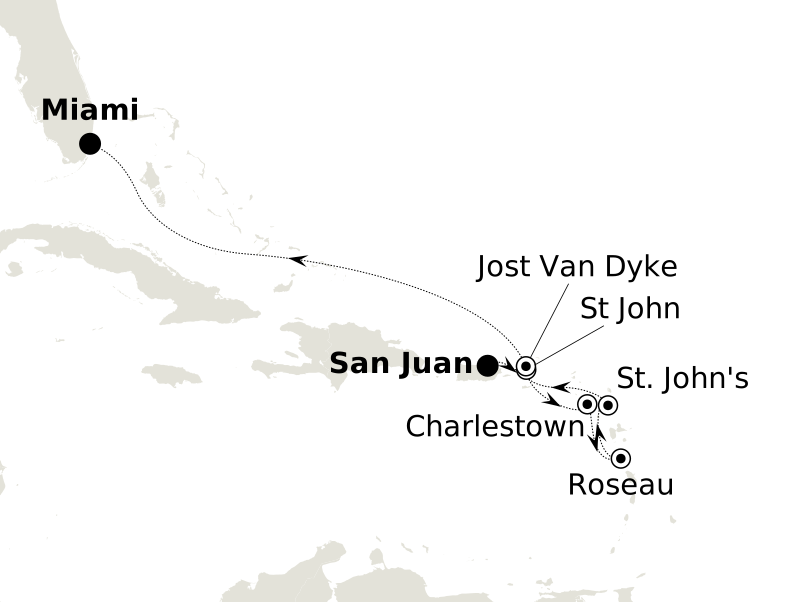
A 8-night ocean voyage aboard Silver Nova, San Juan, United States of America to Miami, United States of America. Destination: Caribbean & Central America.
Operated by Silversea Cruises aboard Silver Nova.
San Juan
St John
Charlestown (Nevis)
Roseau
St. John's
Jost Van Dyke (British Virgin Islands)
Miami, FL
Tour description San Juan, Puerto Rico Although Puerto Rico is a commonwealth of the United States, few cities in the Caribbean are as steeped in Spanish tradition as San Juan. Within a seven-square-block area in Old San Juan are restored 16th-century buildings, museums, art galleries, bookstores, and 200-year-old houses with balustraded balconies overlooking narrow, cobblestone streets. In contrast, San Juan's sophisticated Condado and Isla Verde areas have glittering hotels, fancy boutiques, casinos, and discos. Out in the countryside is 28,000-acre El Yunque National Forest, a rain forest with more than 240 species of trees growing at least 100 feet high. You can stretch your sea legs on dramatic mountain ranges, numerous trails, in vast caves, at coffee plantations, old sugar mills, and hundreds of beaches. No wonder San Juan is one of the busiest ports of call in the Caribbean. Like any other big city, San Juan has its share of petty crime, so guard your wallet or purse, especially in crowded markets and squares. Sights Old San Juan, the original city founded in 1521, contains carefully preserved examples of 16th- and 17th-century Spanish-colonial architecture. More than 400 buildings have been beautifully restored. Graceful wrought-iron balconies with lush hanging plants extend over narrow streets paved with adoquines (blue-gray stones originally used as ballast on Spanish ships). The Old City is partially enclosed by walls that date from 1633 and once completely surrounded it. Designated a U.S. National Historic Zone in 1950, Old San Juan is chockablock with shops, open-air cafés, homes, tree-shaded squares, monuments, and people. You can get an overview on a morning's stroll (bear in mind that this "stroll" includes some steep climbs). However, if you plan to immerse yourself in history or to shop, you'll need a couple of days. Alcaldía. San Juan's city hall was built between 1602 and 1789. In 1841, extensive alterations were made so that it would resemble the city hall in Madrid, with arcades, towers, balconies, and an inner courtyard. Renovations have refreshed the facade of the building and some interior rooms, but the architecture remains true to its colonial style. Only the patios are open to public viewings. A municipal tourist information center and an art gallery with rotating exhibits are in the lobby. 153 Calle San Francisco, Plaza de Armas, Old San Juan. Castillo San Cristóbal. This huge stone fortress, built between 1634 and 1790, guarded the city from land attacks from the east. The largest Spanish fortification in the New World, San Cristóbal was known in the 17th and 18th centuries as the Gibraltar of the West Indies. Five freestanding structures divided by dry moats are connected by tunnels. You're free to explore the gun turrets (with cannon in situ), officers' quarters, re-created 18th-century barracks, and gloomy passageways. Along with El Morro, San Cristóbal is a National Historic Site administered by the U.S. Park Service; it's a World Heritage Site as well. Rangers conduct tours in Spanish and English. Calle Norzagaray at Av. Muñoz Rivera, Old San Juan. Admission charged. Castillo San Felipe del Morro (El Morro). At the northwestern tip of the Old City is El Morro ("the promontory"), a fortress built by the Spaniards between 1539 and 1786. Rising 140 feet above the sea, the massive six-level fortress was built to protect the harbor entrance. It is a labyrinth of cannon batteries, ramps, barracks, turrets, towers, and tunnels. Built to protect the port, El Morro has a commanding view of the harbor. You're free to wander throughout. The cannon emplacement walls and the dank secret passageways are a wonder of engineering. The fort's small but enlightening museum displays ancient Spanish guns and other armaments, military uniforms, and blueprints for Spanish forts in the Americas, although Castillo San Cristóbal has more extensive and impressive exhibits. There's also a gift shop. The fort is a National Historic Site administered by the U.S. Park Service; it's a World Heritage Site as well. Various tours and a video are available in English. Calle del Morro, Old San Juan. Admission charged. Catedral de San Juan Bautista. The Catholic shrine of Puerto Rico had humble beginnings in the early 1520s as a thatch-roofed, wooden structure. After a hurricane destroyed the church, it was rebuilt in 1540, when it was given a graceful circular staircase and vaulted Gothic ceilings. Most of the work on the present cathedral, however, was done in the 19th century. The remains of Ponce de León are behind a marble tomb in the wall near the transept, on the north side. The trompe l'oeil work on the inside of the dome is breathtaking. Unfortunately, many of the other frescoes suffer from water damage. 151 Calle Cristo, Old San Juan. Admission charged. Galería Nacional. Built by Dominican friars in 1523, this convent-the oldest in Puerto Rico-once served as a shelter during Carib Indian attacks and, more recently, as headquarters for the Antilles command of the U.S. Army. The beautifully restored building contains the Galería Nacional, which showcases the collection of the Institute of Puerto Rican Culture. Arranged chronologically, the museum traces the development of Puerto Rican art over the centuries, from José Campeche and Francisco Oller to Rafael Tufiño and Myrna Báez. You'll also find a good collection of santos, traditional wood carvings of saints. 98 Calle Norzagaray, Old San Juan. Admission charged. La Fortaleza. Sitting atop the fortified city walls overlooking the harbor, the Fortaleza was built between 1533 and 1540 as a fortress, but it wasn't a very good one. It was attacked numerous times and was occupied twice, by the British in 1598 and the Dutch in 1625. When El Morro and the city's other fortifications were finished, the Fortaleza became the governor's palace. Numerous changes have been made to the original primitive structure over the past four centuries, resulting in the current eclectic yet eye-pleasing collection of marble and mahogany, medieval towers, and stained-glass galleries. It is still the official residence of the island's governor, and is the Western Hemisphere's oldest executive mansion in continual use. Guided tours of the gardens and the building's exterior are conducted several times a day in English and Spanish. Call ahead, as the schedule changes daily. Proper attire is required: no sleeveless shirts or very short shorts. The tours begin near the main gate in a yellow building called the Real Audiencia, housing the Oficina Estatal de Preservación Histórica. Western end of Calle Fortaleza, Old San Juan. Museo de las Américas. On the second floor of the imposing former military barracks, Cuartel de Ballajá, this museum houses four permanent exhibits: Popular Arts, African Heritage, the Indian in America, and Conquest and Colonization. You'll also find a number of temporary exhibitions of works by regional artists. A wide range of handicrafts is available in the gift shop. Calle Norzagaray and Calle del Morro, Old San Juan. Admission charged. Elsewhere in San Juan Casa Bacardí Visitor Center. Exiled from Cuba, the Bacardí family built a small rum distillery here in the 1950s. Today it's the world's largest, with the capacity to produce 100,000 gallons of spirits a day and 21 million cases a year. You can hop on a little tram to take an approximately 45-minute tour of the visitor center, though you don't visit the distillery itself. Yes, you'll be offered a sample. Bay View Industrial Park, Rte. 165, Km 2.6, at Rte. 888, Cataño. Museo de Arte de Puerto Rico. One of the biggest museums in the Caribbean, this beautiful neoclassical building was once the San Juan Municipal Hospital. The collection of Puerto Rican art starts with works from the colonial era, most of them commissioned for churches. Here you'll find works by José Campeche, the island's first great painter. His Immaculate Conception, finished in 1794, is a masterpiece. Also well represented is Francisco Oller y Cestero, who was the first to move beyond religious subjects to paint local scenes. Another gallery room is filled with works by artists inspired by Oller. The original building, built in the 1920s, proved to be too small to house the museum's collection: the newer east wing is dominated by a five-story-tall stained-glass window, the work of local artist Eric Tabales. There's also a beautiful garden filled with a variety of native flora and a 400-seat theater that's worth seeing for its remarkable hand-crocheted lace curtain. 299 Av. José de Diego, Santurce. Admission charged. Shopping San Juan is not a duty-free port, so you won't find bargains on electronics and perfumes. However, shopping for native crafts can be fun. Popular souvenirs and gifts include santos (small, hand-carved figures of saints or religious scenes), hand-rolled cigars, local coffee, handmade lace, and carnival masks. In Old San Juan, especially on Calles Fortaleza and Cristo, you can find everything from T-shirt emporiums to selective crafts stores, bookshops, art galleries, jewelry boutiques, and even shops that specialize in made-to-order Panama hats. Calle Cristo is lined with factory-outlet stores, including Coach and Ralph Lauren. Beaches San Juan doesn't have the island's best beaches, but anyone can rent a chair for the day at one of the public entry points.
Like so many of the islands in the Caribbean, 2017’s double whammy of hurricanes Irma and Maria devastated much of St. John. However, as relief funds get funnelled into rebuilding, normality is gradually being restored, and St. John version 2.0 is emerging - bolder, brighter and better. St. John’s small size might just give it the edge over other desert islands. The US purchased the tiny landmass (at just nine miles long, the island is the smallest of the three American Virgin Islands) from the West India and Guinea Company in 1917 and it remains under US govern to this day. Historically speaking however St. John is Danish, who colonised it for almost 250 years before its sale to America. The Virgin Island Nation park covers almost two-thirds the island, meaning visually St. John is stunning, and will remain that way for generations to come. This ‘gift’ to the world comes thanks to Laurence Rockefeller who in 1956 gave the 5,000 acres of lush forest to the people of the island, with the caveat that it become a national park. Thus, velvety green hills slope into picture perfect white sand beaches, which are ringed by turquoise seas. One very definite winner of the tourism hiatus since 2017 has been the marine wildlife. Underwater life was barely affected by the storms and the subsequent lack of tourism has allowed the eco-systems to propagate. The island’s abundant coral reefs were not overly affected by the storms and today the waters are teeming with sea turtles, reef sharks and sting rays.
Glorious golden beaches fiery sunsets and verdant tropical backdrops await at Nevis - a picturesque sliver of Caribbean heaven and the smaller twin of Saint Kitts. The sight of the island’s golden sands lying before the verdant backdrop of Nevis Peak’s clouded taper is sure to mesmerise you. Charlestown serves as the laidback capital of Nevis and is peppered with a charming assortment of baby blue colonial architecture. The perfume of incense hangs heavy in the air at the Botanical Gardens of Nevis - where orchids open up in the bright sunshine and fountains trickle among the green haven of tropical plants. The simple pleasure of a vivid sunset is one of a myriad of reasons why Nevis is such a sought-after destination and the nightly explosions of salmon-pinks and blood-reds that spill across the sky never fade in impact. Head to the magnificent Pinney's Beach - which stretches for more than three miles - to stroll through turquoise water and caramel-coloured sand. Lovers Beach offers an alternative flavour in a quieter breathlessly romantic setting – laying out views across the Atlantic rollers to St Kitts before you. Shipwrecks wait strewn just offshore and enthusiastically embraced by abundant marine life. Scuba dive to explore the skeletal wrecks first hand as clownfish zip between the broken boughs of doomed vessels. Booby High Shoals is a popular diving spot where you can meet curious sea turtles gliding through the water.
Raise a glass to the immaculate surroundings of Roseau where beautiful beaches - alive with fine bubbles fizzing upwards from the geothermal activity below - wait for you. Dive into extraordinary snorkelling and diving experiences amongst thriving marine life active corals and live volcanoes concealed below the waves. With attractive volcanic sands to relax on and glorious jungled mountains to explore Roseau is an intoxicating welcome to Dominica's Caribbean island appeal. Nowadays Old Market Square is crammed with locals trading huge vegetables colourful fruits and handmade jewellery - but the square has a darker past and was the centre of the island's slave-trade. Head up to the former British fort which offers a panoramic postcard-perfect view from the top of Roseau and the lush green mountains behind. The large botanical gardens offer more magnificent views and you can walk amongst thriving tropical plant life as parrots flutter and add splashes of colour to the greenery. The rainforest around the city conceals rich wildlife and waterfalls spilling into splash pools while plantations give a taste of the island's heritage. You can also discover the second-largest hot spring in the world - Boiling Lake - which brews with angry volcanic activity in the steamy Morne Trois Pitons National Park. The hiking and snorkelling can take its strain - so simmer away any stiffness in a mineral-rich hot pool or by indulging in a rum punch or two.
Lush and lively, Antigua is a bedazzling Caribbean destination, gorged with sunshine and crisp white sand beaches. Historic forts, sparkling coastline, and dense rainforest all contribute to Antigua’s land of thrilling natural beauty. With its bright blue to turquoise sea gradients – the beaches are vibrant and plentiful and the island has no shortage to choose from, with a rumoured 365 options. Experience the beauty on horseback, as your ride pounds across the sands, and the wind whips through your hair. Choose to loll in a catamaran offshore, or lie back on a bed of the softest sand to soak it all in. Beach shacks cook up fresh seafood and spicy goat meat curries if you're feeling hungry. St John’s glows in the sunshine, with flamingo pink and baby blue paints boldly coating vivid Georgian buildings. Lively markets offer an authentic slice of Antiguan life, while museums celebrate the island’s revered cricketers like Viv Richards, and the story of independence. The whacks and whoops of makeshift cricket games hint at the island’s British history, and you can see more of this heritage at Falmouth Harbour - which was the centre of the British presence in the Caribbean. The area is still filled with sailers and dallying yachts, as well as the only working Georgian dockyard in the world. Built in 1725, the UNESCO World Heritage Site, Nelson's Dockyard, was led by the admiral Horatio Nelson himself and is a fascinating time warp. Hike up to viewpoints here, which reward with glorious views of the forest-clad inlets, craggy cliffs and pointed hills. The stone towers of sugar mills dot the island, and hint at the tragic history of slavery, amid the island's sugar trade past.
Glowing turquoise waters lazily bowing palm trees and pristine white sand beaches – it's all waiting for you in Jost Van Dyke's picturesque Caribbean splendour. Slip off your shoes you won't be needing them too much in these parts as you wander soft heavenly sands and paddle out into impossibly clear waters. If this is your first experience of the Caribbean's splendour you may be a little sceptical about the reality of those famed shockingly bright colours that you see in photographs. Splash into water that glows with a bright teal hue and is blotched with occasional swells of deeper royal blue. Snorkellers will adore the explosions of colourful fish beneath the waves. White Bay is a slice of island perfection with a neat hill of trees framing a sandy sweep of shaded beach bars. The wander up to Majohnny Hill is the most exertion needed to explore this four-square-mile island and it's worth it to see the heavenly beaches emerging from tranquil waters below. Even the natural sea formations here encourage you to unwind with waves gurgling and frothing over the rocks to create Bubbly Pool a natural jacuzzi. Jost Van Dyke has a reputation as the off-the-radar island getaway of choice for celebrities like Keith Richards. A lot of that comes down to the calypso charm of its rustic beach bars - especially the legendary Foxy's Bar which is run by island legend Foxy Callwood. Rum-drenched cocktails and icy buckets of beach beers await - sure to get you into the island’s party spirit in no time.
Days at sea are the perfect opportunity to relax unwind and catch up with what you’ve been meaning to do. So whether that is going to the gym, visiting the spa, whale watching, catching up on your reading or simply topping up your tan these blue sea days are the perfect balance to busy days spent exploring shore side.
Days at sea are the perfect opportunity to relax unwind and catch up with what you’ve been meaning to do. So whether that is going to the gym, visiting the spa, whale watching, catching up on your reading or simply topping up your tan these blue sea days are the perfect balance to busy days spent exploring shore side.
The seaport city of Miami, a hip urban centre located on Biscayne Bay in south-eastern Florida, is one of the world’s most popular vacation spots and is known as the ‘Cruise Capital of the World’. For more than two decades, the Port of Miami has been the number one cruise passenger port in the world. It is the second-largest city in Florida with a population of around 5.5 million people, and is a major centre, and a leader in finance, commerce, culture, media, entertainment, the arts, and international trade. Miami, Named after a Native American word meaning "big water," was original claimed for Spain in1566 by explorer Pedro Menéndez de Avilés. One year later, a Spanish mission was established. Spain and Great Britain successively "controlled" Florida, and finally Spain ceded it to the United States in 1821. The landscape is very flat, with the highest elevation being only 12m (40 ft ) above sea level, with an averages of about 1.8m (6 ft.).
From $7,150
per guest · 8 nights
Prices are a guide and vary with season, cabin category and party size. Your advisor will confirm the exact cost before anything is booked.
Classic Veranda
suite
Deluxe Veranda
suite
Grand 1 Bedroom
suite
Junior Grand 1 Bedroom
suite
Junior Grand 2 Bedroom
suite
Master
suite
Medallion
suite
Otium
suite
Owner 1 Bedroom
suite
Owner 2 Bedroom
suite
Premium Medallion
suite
Premium Veranda
suite
Signature
suite
Silver
suite
Superior Veranda
suite








