




Prefer a conversation?
Our team is always available to guide you through the process and ensure your experience is perfectly matched to your preferences.
Our team is always available to guide you through the process and ensure your experience is perfectly matched to your preferences.
Duration
14 Nights
Price
From $3,950
Ship
Silver Shadow
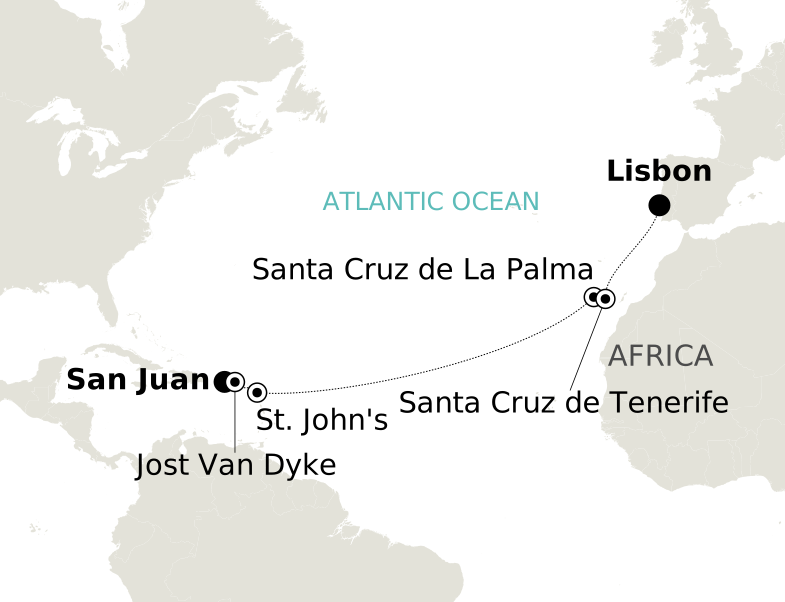
A 14-night ocean voyage aboard Silver Shadow, San Juan, United States of America to Lisbon, Portugal. Destination: Transoceanic.
Operated by Silversea Cruises aboard Silver Shadow.
San Juan
Jost Van Dyke (British Virgin Islands)
St. John's
Santa Cruz de La Palma (Canary Islands)
Santa Cruz de Tenerife
Lisbon
Tour description San Juan, Puerto Rico Although Puerto Rico is a commonwealth of the United States, few cities in the Caribbean are as steeped in Spanish tradition as San Juan. Within a seven-square-block area in Old San Juan are restored 16th-century buildings, museums, art galleries, bookstores, and 200-year-old houses with balustraded balconies overlooking narrow, cobblestone streets. In contrast, San Juan's sophisticated Condado and Isla Verde areas have glittering hotels, fancy boutiques, casinos, and discos. Out in the countryside is 28,000-acre El Yunque National Forest, a rain forest with more than 240 species of trees growing at least 100 feet high. You can stretch your sea legs on dramatic mountain ranges, numerous trails, in vast caves, at coffee plantations, old sugar mills, and hundreds of beaches. No wonder San Juan is one of the busiest ports of call in the Caribbean. Like any other big city, San Juan has its share of petty crime, so guard your wallet or purse, especially in crowded markets and squares. Sights Old San Juan, the original city founded in 1521, contains carefully preserved examples of 16th- and 17th-century Spanish-colonial architecture. More than 400 buildings have been beautifully restored. Graceful wrought-iron balconies with lush hanging plants extend over narrow streets paved with adoquines (blue-gray stones originally used as ballast on Spanish ships). The Old City is partially enclosed by walls that date from 1633 and once completely surrounded it. Designated a U.S. National Historic Zone in 1950, Old San Juan is chockablock with shops, open-air cafés, homes, tree-shaded squares, monuments, and people. You can get an overview on a morning's stroll (bear in mind that this "stroll" includes some steep climbs). However, if you plan to immerse yourself in history or to shop, you'll need a couple of days. Alcaldía. San Juan's city hall was built between 1602 and 1789. In 1841, extensive alterations were made so that it would resemble the city hall in Madrid, with arcades, towers, balconies, and an inner courtyard. Renovations have refreshed the facade of the building and some interior rooms, but the architecture remains true to its colonial style. Only the patios are open to public viewings. A municipal tourist information center and an art gallery with rotating exhibits are in the lobby. 153 Calle San Francisco, Plaza de Armas, Old San Juan. Castillo San Cristóbal. This huge stone fortress, built between 1634 and 1790, guarded the city from land attacks from the east. The largest Spanish fortification in the New World, San Cristóbal was known in the 17th and 18th centuries as the Gibraltar of the West Indies. Five freestanding structures divided by dry moats are connected by tunnels. You're free to explore the gun turrets (with cannon in situ), officers' quarters, re-created 18th-century barracks, and gloomy passageways. Along with El Morro, San Cristóbal is a National Historic Site administered by the U.S. Park Service; it's a World Heritage Site as well. Rangers conduct tours in Spanish and English. Calle Norzagaray at Av. Muñoz Rivera, Old San Juan. Admission charged. Castillo San Felipe del Morro (El Morro). At the northwestern tip of the Old City is El Morro ("the promontory"), a fortress built by the Spaniards between 1539 and 1786. Rising 140 feet above the sea, the massive six-level fortress was built to protect the harbor entrance. It is a labyrinth of cannon batteries, ramps, barracks, turrets, towers, and tunnels. Built to protect the port, El Morro has a commanding view of the harbor. You're free to wander throughout. The cannon emplacement walls and the dank secret passageways are a wonder of engineering. The fort's small but enlightening museum displays ancient Spanish guns and other armaments, military uniforms, and blueprints for Spanish forts in the Americas, although Castillo San Cristóbal has more extensive and impressive exhibits. There's also a gift shop. The fort is a National Historic Site administered by the U.S. Park Service; it's a World Heritage Site as well. Various tours and a video are available in English. Calle del Morro, Old San Juan. Admission charged. Catedral de San Juan Bautista. The Catholic shrine of Puerto Rico had humble beginnings in the early 1520s as a thatch-roofed, wooden structure. After a hurricane destroyed the church, it was rebuilt in 1540, when it was given a graceful circular staircase and vaulted Gothic ceilings. Most of the work on the present cathedral, however, was done in the 19th century. The remains of Ponce de León are behind a marble tomb in the wall near the transept, on the north side. The trompe l'oeil work on the inside of the dome is breathtaking. Unfortunately, many of the other frescoes suffer from water damage. 151 Calle Cristo, Old San Juan. Admission charged. Galería Nacional. Built by Dominican friars in 1523, this convent-the oldest in Puerto Rico-once served as a shelter during Carib Indian attacks and, more recently, as headquarters for the Antilles command of the U.S. Army. The beautifully restored building contains the Galería Nacional, which showcases the collection of the Institute of Puerto Rican Culture. Arranged chronologically, the museum traces the development of Puerto Rican art over the centuries, from José Campeche and Francisco Oller to Rafael Tufiño and Myrna Báez. You'll also find a good collection of santos, traditional wood carvings of saints. 98 Calle Norzagaray, Old San Juan. Admission charged. La Fortaleza. Sitting atop the fortified city walls overlooking the harbor, the Fortaleza was built between 1533 and 1540 as a fortress, but it wasn't a very good one. It was attacked numerous times and was occupied twice, by the British in 1598 and the Dutch in 1625. When El Morro and the city's other fortifications were finished, the Fortaleza became the governor's palace. Numerous changes have been made to the original primitive structure over the past four centuries, resulting in the current eclectic yet eye-pleasing collection of marble and mahogany, medieval towers, and stained-glass galleries. It is still the official residence of the island's governor, and is the Western Hemisphere's oldest executive mansion in continual use. Guided tours of the gardens and the building's exterior are conducted several times a day in English and Spanish. Call ahead, as the schedule changes daily. Proper attire is required: no sleeveless shirts or very short shorts. The tours begin near the main gate in a yellow building called the Real Audiencia, housing the Oficina Estatal de Preservación Histórica. Western end of Calle Fortaleza, Old San Juan. Museo de las Américas. On the second floor of the imposing former military barracks, Cuartel de Ballajá, this museum houses four permanent exhibits: Popular Arts, African Heritage, the Indian in America, and Conquest and Colonization. You'll also find a number of temporary exhibitions of works by regional artists. A wide range of handicrafts is available in the gift shop. Calle Norzagaray and Calle del Morro, Old San Juan. Admission charged. Elsewhere in San Juan Casa Bacardí Visitor Center. Exiled from Cuba, the Bacardí family built a small rum distillery here in the 1950s. Today it's the world's largest, with the capacity to produce 100,000 gallons of spirits a day and 21 million cases a year. You can hop on a little tram to take an approximately 45-minute tour of the visitor center, though you don't visit the distillery itself. Yes, you'll be offered a sample. Bay View Industrial Park, Rte. 165, Km 2.6, at Rte. 888, Cataño. Museo de Arte de Puerto Rico. One of the biggest museums in the Caribbean, this beautiful neoclassical building was once the San Juan Municipal Hospital. The collection of Puerto Rican art starts with works from the colonial era, most of them commissioned for churches. Here you'll find works by José Campeche, the island's first great painter. His Immaculate Conception, finished in 1794, is a masterpiece. Also well represented is Francisco Oller y Cestero, who was the first to move beyond religious subjects to paint local scenes. Another gallery room is filled with works by artists inspired by Oller. The original building, built in the 1920s, proved to be too small to house the museum's collection: the newer east wing is dominated by a five-story-tall stained-glass window, the work of local artist Eric Tabales. There's also a beautiful garden filled with a variety of native flora and a 400-seat theater that's worth seeing for its remarkable hand-crocheted lace curtain. 299 Av. José de Diego, Santurce. Admission charged. Shopping San Juan is not a duty-free port, so you won't find bargains on electronics and perfumes. However, shopping for native crafts can be fun. Popular souvenirs and gifts include santos (small, hand-carved figures of saints or religious scenes), hand-rolled cigars, local coffee, handmade lace, and carnival masks. In Old San Juan, especially on Calles Fortaleza and Cristo, you can find everything from T-shirt emporiums to selective crafts stores, bookshops, art galleries, jewelry boutiques, and even shops that specialize in made-to-order Panama hats. Calle Cristo is lined with factory-outlet stores, including Coach and Ralph Lauren. Beaches San Juan doesn't have the island's best beaches, but anyone can rent a chair for the day at one of the public entry points.
Glowing turquoise waters lazily bowing palm trees and pristine white sand beaches – it's all waiting for you in Jost Van Dyke's picturesque Caribbean splendour. Slip off your shoes you won't be needing them too much in these parts as you wander soft heavenly sands and paddle out into impossibly clear waters. If this is your first experience of the Caribbean's splendour you may be a little sceptical about the reality of those famed shockingly bright colours that you see in photographs. Splash into water that glows with a bright teal hue and is blotched with occasional swells of deeper royal blue. Snorkellers will adore the explosions of colourful fish beneath the waves. White Bay is a slice of island perfection with a neat hill of trees framing a sandy sweep of shaded beach bars. The wander up to Majohnny Hill is the most exertion needed to explore this four-square-mile island and it's worth it to see the heavenly beaches emerging from tranquil waters below. Even the natural sea formations here encourage you to unwind with waves gurgling and frothing over the rocks to create Bubbly Pool a natural jacuzzi. Jost Van Dyke has a reputation as the off-the-radar island getaway of choice for celebrities like Keith Richards. A lot of that comes down to the calypso charm of its rustic beach bars - especially the legendary Foxy's Bar which is run by island legend Foxy Callwood. Rum-drenched cocktails and icy buckets of beach beers await - sure to get you into the island’s party spirit in no time.
Lush and lively, Antigua is a bedazzling Caribbean destination, gorged with sunshine and crisp white sand beaches. Historic forts, sparkling coastline, and dense rainforest all contribute to Antigua’s land of thrilling natural beauty. With its bright blue to turquoise sea gradients – the beaches are vibrant and plentiful and the island has no shortage to choose from, with a rumoured 365 options. Experience the beauty on horseback, as your ride pounds across the sands, and the wind whips through your hair. Choose to loll in a catamaran offshore, or lie back on a bed of the softest sand to soak it all in. Beach shacks cook up fresh seafood and spicy goat meat curries if you're feeling hungry. St John’s glows in the sunshine, with flamingo pink and baby blue paints boldly coating vivid Georgian buildings. Lively markets offer an authentic slice of Antiguan life, while museums celebrate the island’s revered cricketers like Viv Richards, and the story of independence. The whacks and whoops of makeshift cricket games hint at the island’s British history, and you can see more of this heritage at Falmouth Harbour - which was the centre of the British presence in the Caribbean. The area is still filled with sailers and dallying yachts, as well as the only working Georgian dockyard in the world. Built in 1725, the UNESCO World Heritage Site, Nelson's Dockyard, was led by the admiral Horatio Nelson himself and is a fascinating time warp. Hike up to viewpoints here, which reward with glorious views of the forest-clad inlets, craggy cliffs and pointed hills. The stone towers of sugar mills dot the island, and hint at the tragic history of slavery, amid the island's sugar trade past.
Days at sea are the perfect opportunity to relax unwind and catch up with what you’ve been meaning to do. So whether that is going to the gym, visiting the spa, whale watching, catching up on your reading or simply topping up your tan these blue sea days are the perfect balance to busy days spent exploring shore side.
Days at sea are the perfect opportunity to relax unwind and catch up with what you’ve been meaning to do. So whether that is going to the gym, visiting the spa, whale watching, catching up on your reading or simply topping up your tan these blue sea days are the perfect balance to busy days spent exploring shore side.
Days at sea are the perfect opportunity to relax unwind and catch up with what you’ve been meaning to do. So whether that is going to the gym, visiting the spa, whale watching, catching up on your reading or simply topping up your tan these blue sea days are the perfect balance to busy days spent exploring shore side.
Days at sea are the perfect opportunity to relax unwind and catch up with what you’ve been meaning to do. So whether that is going to the gym, visiting the spa, whale watching, catching up on your reading or simply topping up your tan these blue sea days are the perfect balance to busy days spent exploring shore side.
Days at sea are the perfect opportunity to relax unwind and catch up with what you’ve been meaning to do. So whether that is going to the gym, visiting the spa, whale watching, catching up on your reading or simply topping up your tan these blue sea days are the perfect balance to busy days spent exploring shore side.
Days at sea are the perfect opportunity to relax unwind and catch up with what you’ve been meaning to do. So whether that is going to the gym, visiting the spa, whale watching, catching up on your reading or simply topping up your tan these blue sea days are the perfect balance to busy days spent exploring shore side.
Days at sea are the perfect opportunity to relax unwind and catch up with what you’ve been meaning to do. So whether that is going to the gym, visiting the spa, whale watching, catching up on your reading or simply topping up your tan these blue sea days are the perfect balance to busy days spent exploring shore side.
Volcanoes dominate the island of La Palma. The island sits over a hot spot in the Earth’s crust. Beginning on the seabed 4,000 metres below sea level, the volcanoes grew to emerge above the waves and through the clouds to form a mountainous island. The highest point is 2,423 metres (7,950 feet) above sea level. The peak flanks La Caldera de Taburiente, a giant collapsed volcanic crater with a canyon exiting it. The ridge extending south of the Caldera erupted as recently as 1971, when Teneguía volcano sent slow lava flows to the sea. Roads reach lookouts where further exploration on foot begins. The Spanish port town of Santa Cruz de la Palma began in 1493 and supported the sea route from Europe to the New World. In the 16th century Santa Cruz was the third most important port in Europe, after Antwerp and Seville. But it attracted trouble. The pirate Françoise Le Clerc or ‘Peg Leg’, ransacked the town in 1553, leading to the construction of the forts Castillo de Santa Catalina and Castillo de la Virgen. History buffs should walk the cobbled town streets amongst colourful colonial buildings. Several vegetation zones are traversed if you travel up the mountains. Dry coastal scrub gives way to a woodland with large Canary Palms, a plant now grown worldwide. Higher slopes catch moisture from clouds, creating the lush laurel zone of semi-tropical forest. Next is a Canary Pine forest and finally an alpine zone of shrubs. The highlight here is the tall pink flowering spikes of the La Palma Bugloss.
Although this busy port city is smaller, quieter and less attractive than Las Palmas in Gran Canaria, Santa Cruz has its own share of elegant monuments. Until 1837, the island's capital was La Laguna, not Santa Cruz, so there are only a few of the buildings in the city center that are any older than that. At the busy Plaza de España, there are several pedestrian streets leading north and to the area west of the port, where you'll find the city's stunning auditorium and maritime park. A real highlight of the city are its ramblas, long tree-lined boulevards that fall steeply from the north end of the city to the sea. Nightlife The core of Santa Cruz nightlife is Avenida Anaga, facing the port. For about seven blocks beginning at Plaza España, Anaga crawls with upscale disco-bars. The more traditional bars, where you can have drinks and tapas outdoors, are near Plaza España. Farther away from the plaza are the louder bars and dance clubs, dominated by the latest hits and filled with a younger crowd. Shopping By Canary Island standards, Santa Cruz de Tenerife is a major shopping center, although it doesn’t have the variety and number of stores found in Las Palmas. Calle Castillo, the main pedestrian street through the center of town, is lined with souvenir shops, trendy boutiques, and electronics stores. Calle del Pilar has higher-end fashions and the department stores Marks & Spencer and El Corte Inglés (another branch is next to the bus terminal). Dining El Lateral 27 This restaurant's key position in the main shopping street makes it a handy place to stop for a meal after sightseeing, especially since the kitchen is open from 11 am to midnight. If there are free tables, sit outside on the pleasant terrace in the leafy pedestrian street—inside is less pretty. Specialties include a wide range of salads such as ensalada de bacalao confitado con pimientos asados (slow-cooked cod with baked peppers) and fresh fish. Tasca Tagoror Opposite the Mencey Hotel, this tiny bar serves Canary cooking in abundant portions at reasonable prices. Tasca Tagoror (it means "meeting place" in Guanche) has a low, beamed ceiling with white walls dashed with gray rock. Seating is on wooden benches or stools around barrels, which doesn't exactly encourage lingering. Food is simple and unpretentious—daily specials might include fried fresh sardines with black potatoes or chicken breast with garlic and mushrooms. The wine list is surprisingly comprehensive. Shopping La Casa de Los Balcones Near Plaza España, this shop stocks colorful Canarian blankets, embroideries, jars of mojo sauce, and hefty bags of gofio. Artenerife Artenerife sells traditional crafts made by local artisans and guaranteed by the island's government as productos artesanos. The selection includes Tenerifan calado—exquisitely embroidered linen tablecloths and place mats—and clay pottery made using the same methods as those used by the island's aboriginal settlers. (The aborigines didn't use potter's wheels; rather, they rolled the clay into churros, or cylindrical strips, and hand-kneaded these into bowls. Pebbles, branches, and shells were used to buff the results.) La Cava La Cubana Local and foreign cigars are available at this tobacco shop. Sights Iglesia de Nuestra Señora de la Concepción The Iglesia de Nuestra Señora de la Concepción has a six-story Moorish bell tower. The church was renovated as part of an urban-renewal project that razed blocks of slums in this area. Chruch opening times vary, but you can generally visit before and after Mass. Mercado de Nuestra Señora de Africa This colorful city market is part bazaar and part food emporium. Stalls outside sell household goods; inside, stands displaying everything from flowers to canaries are arranged around a patio. Downstairs, a stroll through the seafood section will acquaint you with the local fish. A flea market with antiques and secondhand goods is held here on Sunday. Museo de Bellas Artes Old masters and modern works are in the two-story Museo de Bellas Artes, including canvases by Breughel and Ribera. Many works depict local events. The museum is on the Plaza Príncipe de Asturias. Museo de la Naturaleza y el Hombre Primitive ceramics and mummies are on display at the Museo de la Naturaleza y el Hombre. The ancient Guanches mummified their dead by rubbing the bodies with pine resin and salt and leaving them in the sun to dry for two weeks. Plaza de España The heart of Santa Cruz de Tenerife is the Plaza de España. The cross in the plaza is a monument to those who died in the Spanish civil war, which was actually launched from Tenerife by General Franco during his exile here. For two weeks before Lent each year, during Carnaval, Santa Cruz throbs to a Latin beat emanating from this plaza. Castillo San Cristóbal and the tourist office are both here. Playa de las Teresitas Santa Cruz's beach, Las Teresitas, is about 7 km (4½ miles) northeast of the city, near the town of San Andrés. The 1½ km of beach was created using white sand imported from the Sahara and planted with palms. A manmade barrier runs parallel to the sands and ensures safe bathing. Busy in the summer and on weekends, this beach is especially popular with local families. The 910 TITSA bus route connects the beach with Santa Cruz. There's a good choice of bars and restaurants, and plenty of lounge chairs for rent. Amenities: food and drink; lifeguards; showers; toilets. Good for: sunset; swimming; walking. Parque Marítimo César Manrique Just west of the auditorium, this maritime park with its three saltwater pools and tropical gardens is a favorite with locals. Designed by the Lanzarote architect César Manrique, the park combines volcanic rock with palms and local flora. Castillo San Cristóbal The walls of the city castle were uncovered when the car park under the Plaza de España was built. The site is now a museum that includes an 18th-century cannon, a shot from which reputedly cost Britain's Admiral Nelson his right arm in an attack he led in 1794. Entrance to the museum is via a stairway opposite the lake. Auditorio de Tenerife A magnificent white shell of an auditorium dominates the west end of the city. Built by the architect Santiago Calatrava in 2003, the auditorium has a year-round program of concerts and opera. If you want a guided tour, it's best to book one ahead of time. Tenerife Espacio de Artes Soon after it opened in 2008, this art museum became quickly became the main landmark for contemporary art on the islands due to its sleek low-rise design as well as its avant-garde exhibitions. Designed by the Swiss architects Herzog & Meuron, it's next to the Museo de la Naturaleza. The emphasis is on the 20th and 21st centuries, and art incorporating or commenting on modern technology. A major permanent exhibition is dedicated to the Tenerife surrealist artist, Oscar Domínguez.
Days at sea are the perfect opportunity to relax unwind and catch up with what you’ve been meaning to do. So whether that is going to the gym, visiting the spa, whale watching, catching up on your reading or simply topping up your tan these blue sea days are the perfect balance to busy days spent exploring shore side.
Days at sea are the perfect opportunity to relax unwind and catch up with what you’ve been meaning to do. So whether that is going to the gym, visiting the spa, whale watching, catching up on your reading or simply topping up your tan these blue sea days are the perfect balance to busy days spent exploring shore side.
A glorious mosaic of beauty, freedom and authenticity, Portugal’s capital is a stirring artwork of a city. Known for the seven hills it spreads across, and its stirring fado music, Lisbon is a pastel-coloured blend of houses and beautiful tile artworks - and this creative city strikes a perfect harmony between natural and manmade beauty. Stroll along Alfama's steep, cobbled streets as you explore one of the city’s oldest neighbourhoods - where each house and door could be its own photograph. Look for the decorative tiles, with the distinctive blues and whites of Azulejo ceramics, and visit the dedicated museum to learn more. Afterwards, wind up to São Jorge Castle, where views out across Lisbon’s red rooftops unravel. Just one of many majestic viewpoints, you can also seek out Miradouro da Graça for perhaps Lisbon's finest panorama, with the copper-coloured suspension bridge stretching over sparkling water beyond the sea of buildings. The elegant Tower of Belém rises in the Tagus estuary and is a historic defender of these shores. The grand, carved cloisters of Jerónimos Monastery spread out close by, and there's another UNESCO recognised location close by at Sintra, where a colourful town is set amid thick gardens and towering mountains - capped by the royal Pena Palace. Later, relax and take a quick break to drink Ginjinha, a cherry liqueur made from chocolate cups instead of coffee. Lisboetas have a sweet tooth, and the famous Pastel de Nata's crumbling pastry and caramelised-custard topping is the essential accompaniment to any coffee stop.
From $3,950
per guest · 14 nights
Prices are a guide and vary with season, cabin category and party size. Your advisor will confirm the exact cost before anything is booked.
Grand 1 Bedroom
suite
Grand 2 Bedroom
suite
Medallion
suite
Owner 1 Bedroom
suite
Owner 2 Bedroom
suite
Royal 1 Bedroom
suite
Royal 2 Bedroom
suite
Silver
suite
Terrace
suite
Veranda 1
suite
Veranda 2
suite
Veranda 3
suite
Veranda 4
suite
Vista
suite








