




Prefer a conversation?
Our team is always available to guide you through the process and ensure your experience is perfectly matched to your preferences.
Our team is always available to guide you through the process and ensure your experience is perfectly matched to your preferences.
Duration
18 Nights
Price
From $14,600
Ship
Silver Whisper
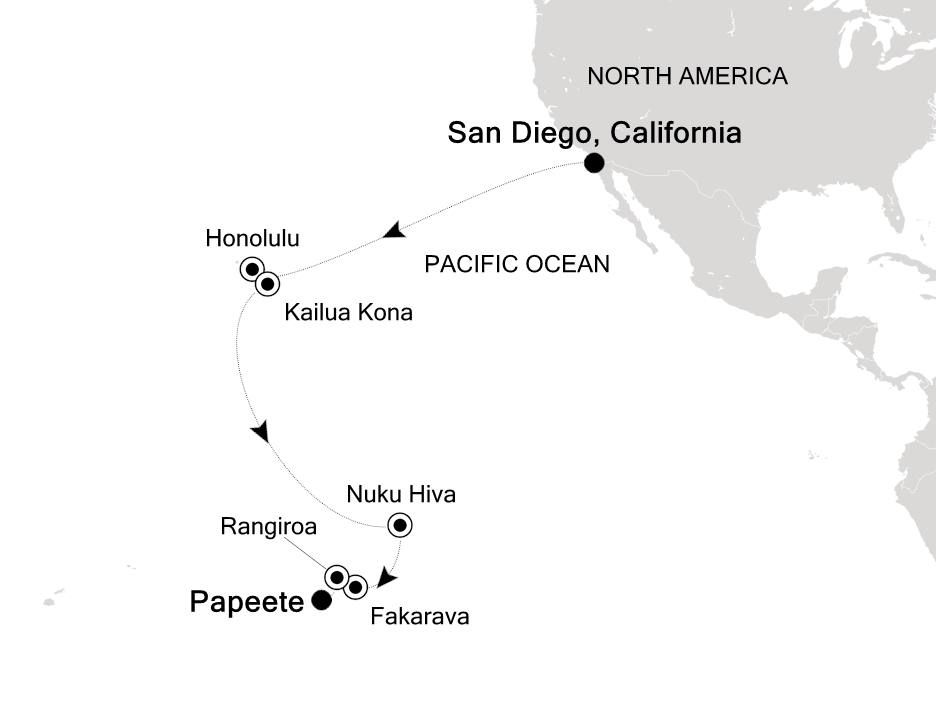
A 18-night ocean voyage aboard Silver Whisper, San Diego, United States of America to Papeete, French Polynesia. Destination: French Polynesia & Pacific.
Operated by Silversea Cruises aboard Silver Whisper.
San Diego, California
Honolulu, Oahu, Hawaii
Kailua Kona, Hawaii
Nuku Hiva, Marquesas Islands
Fakarava, Tuamotu Archipelago
Rangiroa
Papeete (Tahiti)
Attention all sun, sea and surf lovers! Welcome to the place that considers those three words the only three little words worth saying. This is where the vibe is cool, the living is easy and weekends are spent worshiping the holy trinity, beachside. The southernmost city in California, San Diego borders Mexico which gives the place a slightly transient feel, although as America’s eighth largest city, it is anything but. Made up of little neighbourhoods, each has their own personality which gives a blended family feel. There’s Mission Beach, Little Italy, the Gaslamp Quarter, Downtown… all in all 17 neighbourhoods range from quirky to cool result in a city which is much more than a sum of its parts. European settlers arrived in the mid-18th century although Iberian explorer Juan Rodriguez Cabrillo claims to have discovered San Diego Bay in 1542, 200 years previously. Regardless of when the Europeans arrived, there is proof that Native Americans populated the land 12,000 years before, and a trip to the San Diego History Centre is both educational and inspirational. The town became part of the United States of America in 1848 (it had been under Mexican rule before that) and since then has carved out a niche for being “America’s finest city”, a moniker that you’ll see everywhere from t-shirts to bumper stickers. If it feels familiar, that’s because it is. Jack Lemmon, Tony Curtis and Marilyn Monroe filmed Some Like It Hot here and the city’s slightly worn around but ever so glamourous feel has remained.
Days at sea are the perfect opportunity to relax unwind and catch up with what you’ve been meaning to do. So whether that is going to the gym, visiting the spa, whale watching, catching up on your reading or simply topping up your tan these blue sea days are the perfect balance to busy days spent exploring shore side.
Days at sea are the perfect opportunity to relax unwind and catch up with what you’ve been meaning to do. So whether that is going to the gym, visiting the spa, whale watching, catching up on your reading or simply topping up your tan these blue sea days are the perfect balance to busy days spent exploring shore side.
Days at sea are the perfect opportunity to relax unwind and catch up with what you’ve been meaning to do. So whether that is going to the gym, visiting the spa, whale watching, catching up on your reading or simply topping up your tan these blue sea days are the perfect balance to busy days spent exploring shore side.
Days at sea are the perfect opportunity to relax unwind and catch up with what you’ve been meaning to do. So whether that is going to the gym, visiting the spa, whale watching, catching up on your reading or simply topping up your tan these blue sea days are the perfect balance to busy days spent exploring shore side.
Days at sea are the perfect opportunity to relax unwind and catch up with what you’ve been meaning to do. So whether that is going to the gym, visiting the spa, whale watching, catching up on your reading or simply topping up your tan these blue sea days are the perfect balance to busy days spent exploring shore side.
Honolulu is the capital and largest city of Hawaii. It is located on the southeast coast of the island of Oahu, and is considered to be the most remote major city in the world. The closest point on the US is the Point Arena Lighthouse in California, about 2,045 nautical miles (3,787 km) away. Honolulu's name derives from the native words meaning "sheltered harbour". Archaeological evidence shows that Polynesian migrants first settled here in the 11th century. Although Captain Cook noted this island during his voyage in 1778, the first European to sail into Honolulu Harbour was Captain William Brown of Great Britain in 1794. Soon, the port of Honolulu became a focal point for merchant ships trading between North America and Asia. Hawaii has been subject to strong pressures from many forces, including American missionaries, who arrived in 1820, and opportunistic whalers. These whalers played an important role in the development of Honolulu by bringing trade, commerce, and prosperity that led to expansion into the sugar and pineapple industries. The Honolulu area was bombed by Japan in a surprise attack on the unprepared U.S. naval base at Pearl Harbor on Dec. 7, 1941
Honolulu is the capital and largest city of Hawaii. It is located on the southeast coast of the island of Oahu, and is considered to be the most remote major city in the world. The closest point on the US is the Point Arena Lighthouse in California, about 2,045 nautical miles (3,787 km) away. Honolulu's name derives from the native words meaning "sheltered harbour". Archaeological evidence shows that Polynesian migrants first settled here in the 11th century. Although Captain Cook noted this island during his voyage in 1778, the first European to sail into Honolulu Harbour was Captain William Brown of Great Britain in 1794. Soon, the port of Honolulu became a focal point for merchant ships trading between North America and Asia. Hawaii has been subject to strong pressures from many forces, including American missionaries, who arrived in 1820, and opportunistic whalers. These whalers played an important role in the development of Honolulu by bringing trade, commerce, and prosperity that led to expansion into the sugar and pineapple industries. The Honolulu area was bombed by Japan in a surprise attack on the unprepared U.S. naval base at Pearl Harbor on Dec. 7, 1941
The Kona coast, on Hawaii’s western shore, divides into two distinct areas – the north with spectacular sandy beaches followed farther up by a long bleak slope of barren lava trails from dormant Mauna Kea all the way down to the sea. Southwards, the hillsides are more fertile and there is still a feel of the old Hawaii. The Big Island’s main resort is officially called Kailua, but mostly everyone simply refers to it as Kona, or Kailua-Kona. It is by far the island’s most developed area. Whilst the main road, Ali’i Drive, is lined with shops, hotels and condominiums, most of the shoreline vista remains intact thanks to low-rise buildings. To show just how fertile lava can be when tended, miles of multi-hued bougainvillea and poinsettias line Ali’i Drive like a colourful lei. East of town is the 8,271-foot (2,521-metre) Mount Hualalai, where local people still earn a living growing vegetables and taro on small farms spreading over the side of the mountain. In the centre of Kona stands the Hulihee Palace built as the governor’s residence in 1838. The relatively simple dwelling was heavily damaged during the last big storm and is now under restoration. The north end of downtown is home to Ahuena Heiau, where King Kamehameha spent the last years of his life. A dozen miles south of Kona at Kealakekua Bay is the site where Captain Cook was killed on his second voyage to Hawaii. South Kona is also the prime source of the famous Kona coffee.
Days at sea are the perfect opportunity to relax unwind and catch up with what you’ve been meaning to do. So whether that is going to the gym, visiting the spa, whale watching, catching up on your reading or simply topping up your tan these blue sea days are the perfect balance to busy days spent exploring shore side.
Days at sea are the perfect opportunity to relax unwind and catch up with what you’ve been meaning to do. So whether that is going to the gym, visiting the spa, whale watching, catching up on your reading or simply topping up your tan these blue sea days are the perfect balance to busy days spent exploring shore side.
Days at sea are the perfect opportunity to relax unwind and catch up with what you’ve been meaning to do. So whether that is going to the gym, visiting the spa, whale watching, catching up on your reading or simply topping up your tan these blue sea days are the perfect balance to busy days spent exploring shore side.
Days at sea are the perfect opportunity to relax unwind and catch up with what you’ve been meaning to do. So whether that is going to the gym, visiting the spa, whale watching, catching up on your reading or simply topping up your tan these blue sea days are the perfect balance to busy days spent exploring shore side.
Days at sea are the perfect opportunity to relax unwind and catch up with what you’ve been meaning to do. So whether that is going to the gym, visiting the spa, whale watching, catching up on your reading or simply topping up your tan these blue sea days are the perfect balance to busy days spent exploring shore side.
Think of French Polynesia and you are automatically transported to the white sands of Tahiti, the blue seas of Bora Bora or, at the very least, the iconic statues of Easter Island. Now, imagine a place that is home to that majestic trinity, but has no crowds and is full of island authenticity that is rare in these global times. You have just imagined Nuku Hiva. The island is the second largest after Tahiti in the archipelago, but is yet to be discovered by tourism. As part of the Marquesas Islands, Nuku Hiva is technically French, but don’t expect to find any blue and white striped shirts here! In fact, even though French is the “official” language of the island, a sing-song dialect of Tahitian mixed with Marquesan is more widely spoken. The younger generations also speak English. Undeniably, Nuku Hiva has been blessed by the Gods. With towering mountains, eight magnificent harbours, and one of the world's highest waterfalls, Nuku Hiva is rich with Mother Nature’s jewels. The island could lay claim to a great many claims to fame, such as its deep, unpolluted waters, its lush forests bursting with vitality or its fascinating assortment of archaeological interests including tikis (sacred statues) and pae pae (stone platforms that formed the foundations of houses). Yet for those in the know, the island’s primary claim to fame is that author Herman Mellville deserted his ship in order to live among the natives of the island and his books Typee and Omoo were inspired by his experiences on Nuku Hiva.
Days at sea are the perfect opportunity to relax unwind and catch up with what you’ve been meaning to do. So whether that is going to the gym, visiting the spa, whale watching, catching up on your reading or simply topping up your tan these blue sea days are the perfect balance to busy days spent exploring shore side.
Fakarava is oblong shaped and has an almost continuous string of reef and motu stretching for 40 km (25 mi) on its eastern edge. It's the second largest of the Tuamotu atolls located 450 km (280 mi) northeast of Tahiti and 120 km (75 mi) southeast of Rangiroa. It's renowned for the drift diving in its two passes—Garuae (also spelled Ngarue) in the north near the main town of Rotoava (and the airport) and Tamakohua Pass 48 km (30 mi) across the lagoon in the south. The tiny village of Tetamanu situated by the southern pass was once the capital of the Tuamotus and houses the first church built in the archipelago in 1874. In 2006 the entire atoll was deemed an UNESCO biosphere reserve to preserve the lagoon no overwater bungalows have been built in it. Fakarava was "discovered" by Russian explorer Fabian Gottlieb Von Bellingshausen in 1820 some 20 years later missionaries arrived in the guise of fanatical Catholic priest Honore Laval and began building churches.
Rangiroa is French Polynesia’s largest atoll. More than 400 motu (islets) enclose the lagoon, which is so wide and long that one cannot see the southern row of motu from the two main islets in the north –hence the local name Rangiroa meaning wide or long sky, sometimes taken as “immense sky”. There are several passes from the ocean into the lagoon and the two main villages of Avatoru and Tiputa are located next to the passes of the same names. Drift diving and snorkeling the incoming tides looking for sharks and manta rays at these passes is one of Rangiroa’s main touristic draws. Government jobs, ecotourism and pearl farming are the main sources of income on the atoll. The lagoon’s calm turquoise waters, rich marine underwater world and relaxed atmosphere attract visitors year-round to the many local guesthouses and a few hotels. Both Avatoru and Tiputa also feature schools for the other Tuamotu Islands which have no higher education possibilities. One of Rangiroa’s most unusual attractions is the white and rose wine produced on the islet immediately west of Avatoru –the wine has won several awards.
Papeete is the center of the tropical paradise of French Polynesia where islands fringed with gorgeous beaches and turquoise ocean await to soothe the soul. This spirited city is the capital of French Polynesia and serves as a superb base for onward exploration of Tahiti – an island of breathtaking landscapes and oceanic vistas. A wonderful lagoon of crisp clear water begs to be snorkelled stunning black beaches and blowholes pay tribute to the island's volcanic heritage and lush green mountains beckon you inland on adventures as you explore extraordinary Tahiti. Visit to relax and settle into the intoxicating rhythm of life in this Polynesian paradise.
From $14,600
per guest · 18 nights
Prices are a guide and vary with season, cabin category and party size. Your advisor will confirm the exact cost before anything is booked.
Classic Veranda
suite
Deluxe Veranda
suite
Grand 1 Bedroom
suite
Grand 2 Bedroom
suite
Medallion
suite
Owner 1 Bedroom
suite
Owner 2 Bedroom
suite
Royal 1 Bedroom
suite
Royal 2 Bedroom
suite
Silver
suite
Superior Veranda
suite
Vista
suite








