




Prefer a conversation?
Our team is always available to guide you through the process and ensure your experience is perfectly matched to your preferences.
Our team is always available to guide you through the process and ensure your experience is perfectly matched to your preferences.
Duration
14 Nights
Price
From $15,100
Ship
Silver Wind Expedition
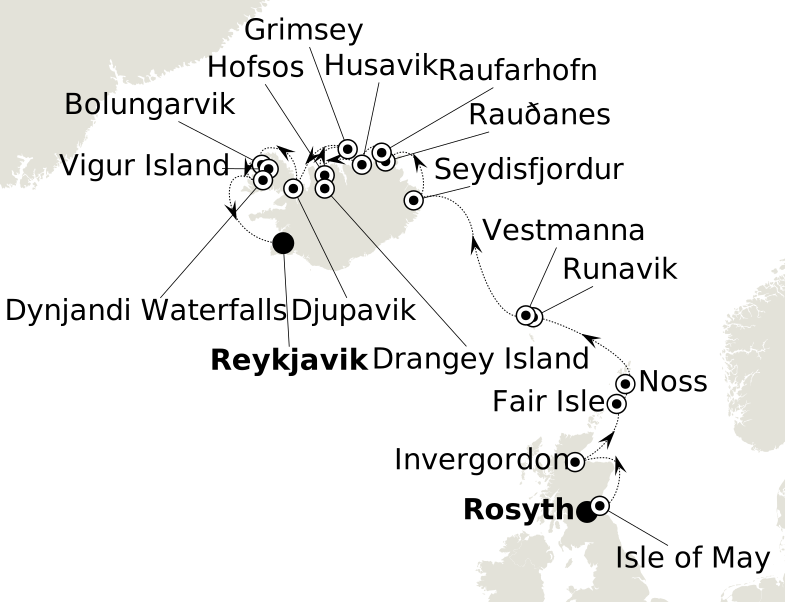
A 14-night expedition voyage aboard Silver Wind, Edinburgh, United Kingdom to Reykjavik, Iceland. Destination: Northern Europe & British Isles.
Operated by Silversea Cruises aboard Silver Wind Expedition.
Rosyth (Edinburgh), Scotland
Isle of May
Invergordon (Highland)
Fair Isle, Scotland
Noss, Scotland
Runavík
Vestmanna (Faroe Islands)
Seydisfjordur
Rauðanes
Raufarhofn
Husavik
Hofsos
Drangey Island
Grimsey
Djupavik
Bolungarvik
Vigur Island
Dynjandi Waterfalls
Reykjavik
Just over ten miles to the north-west of Edinburgh Rosyth is a hearty welcome to Scotland's scenery and sophistication. Cross beside the spectacular iron span of the Forth Bridge – a historic world heritage site that has been a Scottish landmark since 1889 – to reach Edinburgh’s treasures. Or historic Dunfermline is even closer where Robert the Bruce lies in rest along with 11 other Scottish monarchs from history. Most visitors to Rosyth will journey to Edinburgh - the elegant Scottish Capital which sprawls across a glorious setting of seven hills. An imposing 7th-century castle dominates proceedings crowning the city and perching on an elevated volcanic plug. Below you'll find cobbled streets of endless historical charm. Bagpipes ring down the beautiful Royal Mile - a steep rise up from the Scottish Parliament building towards the castle. The magical cafes and eateries along this stretch have attracted fame as the locations where JK Rowling penned the Harry Potter novels – surely inspired by the historic charm all around her. Flower-dressed pubs serve those in need of a little refreshment or a dram or two of the local whiskies produced nearby. With royal pageantry world-class museums and uproarious festivities Edinburgh is a grand and beautiful - yet unpretentious and welcoming - city to absorb. Get the best view of Edinburgh by ascending to the summit of Arthur’s Seat. From this esteemed viewpoint you can admire an immense 360-degree view of the city's skyline and look across the North Sea's massive inlet back to the port at Rosyth.
The Isle of May in Scotland is owned and managed by Scottish Natural Heritage as a National Nature Reserve and is an important breeding ground for approximately one-quarter of a million seabirds. In fact, over 40,000 puffin burrows have been counted as occupied. Not only kittiwakes, shags, eiders, and guillemots but also Razorbills, Arctic Terns, Sandwich Terns and Common Terns, Lesser Gulls, Herring Gulls and Great Black-backed Gulls nest here. The island is located roughly four nautical miles off the coast of mainland Scotland and is used by biologists for surveying migrating passerines and for ringing breeding seabirds to better study their movements and breeding success. While hosting an impressive array and quantity of seabirds, the island itself is small at only 1.8 kilometers (1.1 miles) long, and less than half a kilometer (one-third of a mile) wide.
Promising epic Highlands scenery and monstrous lochs Invergordon welcomes you to the heart of Scotland's land of castles stories and scenery. Taste the prized Scottish gold in a glass as you swirl and sample the produce of history-rich distilleries or lace up your hiking boots to explore the Great Glen's wild mountains and green and gold blotched moorlands. Sleepy Invergordon provides a charming welcome ashore and you'll immediately enjoy stunning views across the widespread of the Firth. Loch Ness is a massive expanse of still water surrounded by emerald fortress-studded hills. What's lurking beneath has been the subject of intense speculation and captured the world's imagination since 1933. Cruise the loch on a boat trip and keep an eye out for any ripples disturbing the surface - perhaps you will be lucky enough to discover the truth about Nessie's mystery. The River Ness flows on to Inverness the Capital of the Highlands which is overlooked by the sandstone rise of Inverness Castle. The fairytale Cawdor Castle is also within reach set among immaculate gardens and entered via an impressive drawbridge. The castle's links to Shakespeare's Macbeth are often mentioned but in truth they are a little tenuous as this castle was built after King Macbeth's death. Fort George meanwhile is a colossal military institution spread across a huge expanse. Visit to be immersed in the life of a soldier as you wander among the vast battlements amid a sea of redbrick military installations.
Lying mid-way between Shetland and the Orkney islands, Fair Isle is a tiny jewel in the sea. Famous for birds, knitwear and historic shipwrecks, the island offers a warm and friendly welcome to visitors. With a population of only around 70 people this island is truly a beautiful setting and is one of Britain’s most successful communities. View the cloudy light turquoise water as it drifts out to sea beneath the breath-taking Sheep Rock, rising over 100 metres, which is almost an isle of its own. Fair Isles oceanic climate brings stormy but fairly mild winters, in summer, you can expect rapid changes in the weather, sparkling sunshine can be followed by a thick blanket of mist and fog, and this makes the isle a truly inspiring area. Over the centuries the island has changed hands many times and was named the island of peace by Norse settlers. The isle has been a useful landmark for shipping but in storms and fog it is highly dangerous creating over 100 known shipwrecks such as the Spanish armada flag ship “El Gran Grifon”.
Exploring the sandstone cliff faces of the Isle of Noss will reveal ledges loaded with gannets puffins guillemots shags kittiwakes Razorbills fulmars and Great Skuas. The island was recognized as a National Nature Reserve in 1955 and has one of Europe’s largest and most diverse seabird colonies. Sheep have grazed the inland hillsides of Noss since the late 1800s and early 1900s when around twenty people lived on the island to manage the sheep farm. Along with the sheep shaggy Shetland ponies graze the windblown slopes of Noss.
The unexplored, unspoilt and frankly unbelievable Faroe Islands are the enigma of the travel industry. Sandwiched in between two rather more seductive countries – Norway and Iceland, this little cluster of 18 islands is overlooked by many. More fool them we say, as the Faroe Islands are as fascinating as they come. Runavik, on the southern tip of, the Faroe’s second-largest isle, Eysturoy is the epitome of off the beaten track travel. One step off the ship and you will be engulfed by some quite staggering, magnificent and untouched nature. Unsurprisingly, outdoor pursuits are a big thing here: hiking of all levels is recommended in order to experience the very grandeur of the landscape (the beautiful lake Toftavatn offers spectacular views), but if that is too strenuous, boat trips in traditional Faroese wooden boats are not only a chance to see the scenery from the water, but a thrilling adventure too. If the weather isn’t being too friendly – an occupational hazard in the Faroe Islands – then head to one the local museums to learn all about the history of this island. Often housed in restored farmhouses or parsonages, visitors get a chance to see how the Faroese used to live. While you are there, ask one of the locals to tell you one of the region’s fascinating legends; like many Nordic countries, the inherent belief in elves, undersea creatures and “rocking stones” (yes, really) is taken as gospel truth. The coasts of Eysturoy could be considered an Important Bird Area. Binoculars at the ready!
Surrounded by the mountains of Hægstafjall, Økslin, Loysingafjall, and Moskurfjall, Vestmanna sits quietly on the banks of Streymoy, on the North Atlantic Ocean. With 1,200 inhabitants, the colourful little village itself is lovely; a few shops and cafes selling locally made cakes and handicrafts, as well as the island’s native seafood soup dish. While those wishing to stretch their legs will enjoy the surrounding area for its stunning countryside, Vestmanna’s main attraction is beyond any doubt its bird cliffs. Youi don’t have to be a birder to appreciate these magnificent cliffs, although if you are the cliffs are the stuff of dreams. At almost 700-metres high (and six kilometres long), the cliffs rise steeply out of the water and are covered with tens of thousands of seabirds, zooming through the air, swooping into the water and nesting in the crevices. The near vertical cliffs are home to numerous species including kittiwakes, Common Guillemots, Black Guillemots and the oh so charismatic Atlantic Puffin. Visually, they are stunning: waterfalls thunder into the sea, cliff tops cut jagged lines into horizon and the whole landscape seems straight out of Jurassic Park. Dressed in a cloak of mist and emerald green moss, to say that the feeling is otherworldly is an understatement. To gage the true beauty of the region, one must take to the sea. The experience of sailing under the cacophonic cliffs, juxtaposed by the silence of calm caves is simply unforgettable.
A world of tumbling waterfalls and colourful creativity, Seydisfjordur is Iceland at its most epic and eccentric. A spectacular fjord lends the town its name, and the structures are dwarfed by this majestic setting, as they huddle around its glassy waters. Sail around the fjord, head out on a kayak amid the scenery, or venture to meet Puffins and other nesting birds settled on sharp cliffs. Encounter sea lions, or try some fishing as you immerse yourself in this highlight of the wild and wonderful Eastfjords. Herring fishing sustained this settlement founded by Norwegians in 1848, leading to a town of colourful wooden buildings, which gleam white against the moody scenery's palette, providing a spirit-lifting splash of colour during the harsh winter months. A rainbow pathway leads to a pretty, pastel-blue church and there's more local art and culture to unravel at Skaftfell, which displays bright and bold contemporary art. Its bistro also serves up a perfect caffeine hit and refreshments. Waiting on the open jaws of the Seydisfjordur, this is a gloriously picturesque town, and the steep fjord banks reflect beautifully on the smooth waters below. The snow-capped Bjólfur mountain stands above the town and invites you to crunch along hiking trails amid untouched nature - rewarding with mesmerising views across the fjord and town below. These hills can literally sing thanks to a unique sculpture - which resonates with a traditional five-tone harmony. The remote and gorgeous Skalanes Nature reserve is a major draw, with 47 bird species resting on its dramatic bird cliff, along with countless plant varieties.
There's simply nowhere better than Husavilk - the European capital of whale watching - for getting up close and personal with the majestic giants of the ocean. Feel the awe as whales breach the waves around you before gulping in air and plunging away with almighty tale flicks. Pretty Husavik is framed by the majestic Húsavíkurfjall mountain which swells up behind creating a stunning backdrop for the town's tiny wooden warehouses cherry red houses and undulating fishing ships. Sail among gentle giants in Shaky Bay spotting humpbacks minke whales and the world's biggest – blue whales. You may also see teams of smaller white-beaked dolphins skipping across the waves displaying the full range of acrobatic skills. The town's whale museum is an interesting journey through Iceland's relationship with the sea giants while its restaurants serve up local specialities – taste juicy reindeer burger and plokkfiskur a buttery mash of local fish. Hikes and horseback rides into the surrounding countryside can take you up around Lake Botnsvatn to views down from the slopes of the Húsavíkurfjall - where purple spired lupin flowers spill down amongst the emerald slopes. From the summit look out over views of the bay reaching out to the crumpled snowy peaks beyond. Or feel the full force of this land of natural power at Dettifloss Waterfall one of Europe's most powerful thrashing flumes.
Grimsey, Iceland The northernmost inhabited Icelandic territory, Grimsey represents a unique destination for guests who wish to experience the Arctic Circle. This tiny, charming island stands alone far out on the horizon, surrounded by the expansive Arctic Ocean. Steep cliffs can be found everywhere, except along the southern shoreline. Despite its northerly latitude, Grimsey is generally mild due to the North Atlantic current, which brings warm water from the Gulf of Mexico. Though treeless, the island's vegetation cover is rich, consisting of marshland, grass and moss, and the island is home to a dense population of diverse bird species, especially auks. The birds nest in the high cliffs surrounding the island, except by the harbour. The chorus of seabirds never stops during the summer months, as there is no night in Grimsey at this time. During winter, the daylight is very short, and most of the seabirds stay far away on the open sea. The principal industry on Grimsey is commercial fishing, although agriculture and collection seabird eggs are also common practices. The fishermen harvest the rich fishing banks all around the island, but often venture much further north on the Arctic Ocean. The islanders live a relatively modern life in the small village by the harbour; a prosperous and fertile community. The Grimsey Church was built from driftwood in 1867, and the island also features a community centre and school. A ferry serves the island three times a week, and an airport has been built for regular flights. In spite of its small size, opportunities to explore Grimsey by land and sea abound. Guided sightseeing tours, including walking, biking, hiking, bird-watching, golfing, and local home visits, offer wonderful memories of this lovely island and its people. Coastal boat tours, sea angling, shore fishing, sea swimming, and diving bestow guests with an unforgettable introduction to the teeming, crystal-clear Arctic waters surrounding this lovely island. Going Ashore in Grimsey Pier Information The ship may be anchored and guest will tender to the Grimseyjarbryggja Pier. Grimsey's town centre can be reached via a short taxi-ride or on-foot. Shopping Wool, certificates and souvenirs can be found in Grimsey at the Gallery Sol. The Budin Supermarket stocks everyday consumer goods and foodstuffs. The local currency is the Icelandic Kroner. Cuisine The cold, clear, teeming waters along the coast of Grimsey offer a bounty of delectable seafood selections popular among residents and visitors alike. Fresh fish, seafood and local specialities are available for lunch and dinner at the Krian restaurant. Other Sights Arctic Circle The Arctic Circle crosses Iceland at its northernmost point, on Grimsey Island. A symbol, a kind of a bridge to cross the Arctic Circle, can be found at 66°33'N, north of the airport terminal and beside the north end of the Guesthouse Básar. Next to the symbol is a pole showing the distance to many renowned cities throughout the world. Grimsey Church Although a church was first established on Grimsey in the 11th century, the present-day church was built in 1867, mainly from driftwood that washed ashore on the island. Thermal Pool The Thermal Pool in Grimsey is open four days a week, and features an indoor pool, hot tub, showers, toilets, and wardrobe. Fiske Monument Above the harbour and near the store and restaurant facing the ocean is artwork honouring Mr. Daniel Willard Fiske, a wealthy American scholar, chess enthusiast and patron of the island, Fiske donated a chess set to every home on the island, and a considerable amount of money to the community. Basalt Column Formations Grimsey has many beautiful basalt columns formations, especially in the southwest corner of the island. Ancient lava flows cooled by the ocean created these special hexagonal formations. Rapid cooling resulted in small columns, while slower cooling produced the larger columns. Vitinn Lighthouse Built in 1937, this renowned island landmark was first operated by a gas lamp that had to be turned on-and-off manually. Today, the lighthouse has been automated and plays a vital role to boat traffic in the surrounding waters. Although closed to the public, the lighthouse offers splendid panoramic vistas of the cliffs on the east coast of the island. The Windmill Since no natural resources of hot water or other means of producing electricity in an environmental way is possible in Grimsey, all electricity and warming of water is produced by means of a diesel aggregator. However, a windmill was built in 1973 as an alternative method of producing electricity. The experiment failed, as the mill broke down shortly after it had been build. The remains of the windmill stand on a hill on the southwest corner of the island. Private arrangements for independent sightseeing may be requested through the Shore Concierge Office on board the ship.
Although the Hornstrandir Nature Reserve is further north across the Isarfjardardjup Bolungarvik is Westfjords’ and Iceland’s northernmost town. Despite its relative isolation Bolungarvik has been settled for hundreds of years and is already mentioned in the settlement period of Iceland. Located next to rich fishing grounds and the cove of the same name Bolungarvik has always been a place for fishermen and one of the town’s attractions is a replica of an old fishing station. Just to the northwest is Bolafjall Mountain which blocks off the wind and swell from the Atlantic Ocean. The view from the top (at 638 meters above sea level) not only covers Bolungarvik and the surrounding valleys and mountains but several fjords and the Hornstrandir Nature Reserve. Although only 950 residents call Bolungarvik their home this is the Westfjords’ second largest town. There even is a nine hole golf course (par 71) with 18 sets of tees.
Vigur Island is the second largest island in the Isafjardardjup Fjord, measuring 2 kilometers in length by 400 meters in width. It is home to a single sheep farming family, which ferries the sheep in summer across to the mainland, so that the Eider Ducks nesting on the island will not be disturbed. One of the export articles from this small island was eider down and one can still see where the Eider Ducks nest and how the down is collected and cleaned. The small settlement of a few houses is on the southern side, next to a small rocky beach, a concrete wall and floating pier. On approach grey seals can often be seen on the otherwise seaweed-covered boulders. Apart from the grey of the basalt and green of the grass, lichens add a splash of color. A path has been prepared and the grass cut, so that visitors can leisurely walk across the island to take in the beautiful scenery and to observe the large colony of Arctic Terns, Black Guillemots and Atlantic Puffins usually only seen during the summer months. A meticulously preserved historical landmark, a small windmill dating back to the 1840s was still in use in 1917 to grind wheat imported from Denmark. Viktoria House, one of the preserved wooden farm houses dating back to 1862, is used as a café where home-baked cakes and cookies are offered to guests.
Iceland is well-known for its spectacular waterfalls. The iconic Dynjandi waterfall, located in the Westfjords region, is regarded as one of Iceland’s most impressive and majestic waterfalls. At the top, the cascading water is roughly 100 feet wide and tumbles down about 330 feet into the fjord. Its name Dynjandi means, “the thundering one” and its vast size, enormous sound, and sheer force is overwhelming. It has also been nicknamed, ‘The Bridal Veil’ because of the way the water sprays and spreads over the rocks.
The capital of Iceland’s land of ice, fire and natural wonder, Reykjavik is a city like no other - blossoming among some of the world’s most vibrant and violent scenery. Home to two-thirds of Iceland’s population, Reykjavik is the island’s only real city, and a welcoming and walkable place - full of bicycles gliding along boulevards or battling the wind when it rears up. Fresh licks of paint brighten the streets, and an artistic and creative atmosphere embraces studios and galleries - as well as the kitchens where an exciting culinary scene is burgeoning. Plot your adventures in the city's hip bars and cosy cafes, or waste no time in venturing out to Iceland’s outdoor adventures. Reykjavik’s buildings stand together - below the whip of winter’s winds - together with the magnificent Hallgrímskirkja church, with its bell tower rising resolutely over the city. Iceland’s largest church's design echoes the lava flows that have shaped this remote land and boasts a clean and elegant interior. The Harpa Concert Hall’s sheer glass facade helps it to assimilate into the landscape, mirroring back the city and harbour. Its LED lights shimmer in honour of Iceland’s greatest illuminated performance – the northern lights. Walk in the crusts between continents, feel the spray from bursts of geysers and witness the enduring power of Iceland’s massive waterfalls. Whether you want to sizzle away in the earth-heated geothermal pools, or hike to your heart’s content, you can do it all from Reykjavik - the colourful capital of this astonishing outdoor country.
From $15,100
per guest · 14 nights
Prices are a guide and vary with season, cabin category and party size. Your advisor will confirm the exact cost before anything is booked.
Classic Veranda
suite
Deluxe Veranda
suite
Grand 1 Bedroom
suite
Grand 2 Bedroom
suite
Medallion
suite
Owner 1 Bedroom
suite
Owner 2 Bedroom
suite
Royal 1 Bedroom
suite
Royal 2 Bedroom
suite
Silver
suite
Vista
suite








