




Prefer a conversation?
Our team is always available to guide you through the process and ensure your experience is perfectly matched to your preferences.
Our team is always available to guide you through the process and ensure your experience is perfectly matched to your preferences.
Duration
19 Nights
Price
From $9,900
Ship
Silver Shadow
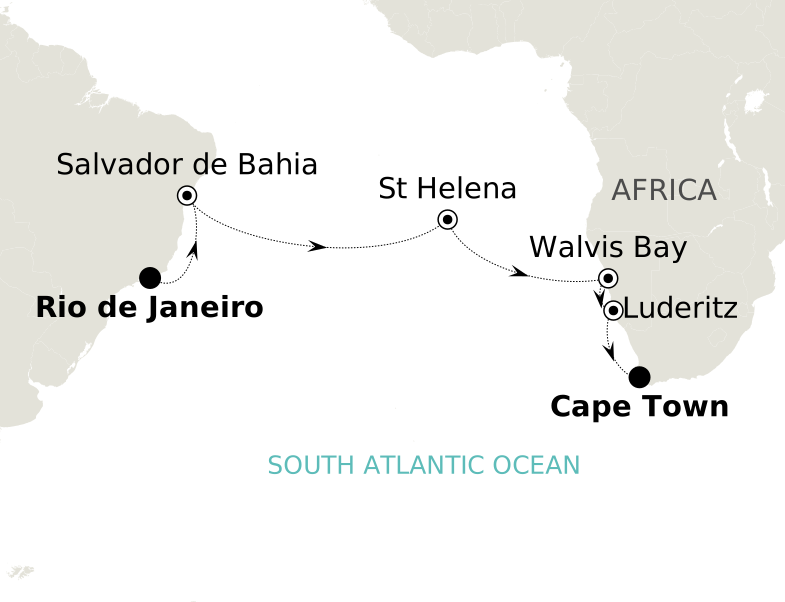
A 19-night ocean voyage aboard Silver Shadow, Rio de Janeiro, Brazil to Cape Town, South Africa. Destination: South America.
Operated by Silversea Cruises aboard Silver Shadow.
Rio de Janeiro
Salvador de Bahia
Recife
Praia
Santa Cruz de Tenerife
Arrecife, Canary Islands
Funchal, Madeira
Lisbon
Lie back on the golden sands to soak up the extraordinary setting - or watch on as muscled cariocas - locals - perform effortless athletic feats, during casual volleyball matches. A trip up to Rio de Janeiro’s iconic art-deco statue of Christ the Redeemer is, of course, a must do - offering an extraordinary view of the city rolling out before your eyes. You’ll also want to take a cable car to swing by the top of Sugarloaf Mountain, which juts sharply into the sky from nowhere. Brazil’s second largest city moves to an infectious samba beat, and the famous thumping Carnival floods colour and floats down its streets each year. Of course, Rio is also a city of sharp cultural contrasts – offering fun in the sun for some, while life goes on very much as it always has for others. Take a guided tour, led by a resident, to see the conditions inside these complex tapestries of colour and chaos first-hand. Tijuca National Park, offers easy-to-access tranquillity, immersing you in dense forestry and whopping birdsong. Later, watch the fiery shades of sunset spread across the sky in the city’s oh so famous evening light show. With so much to offer, you’ll quickly learn how Rio earned its other name ‘Cidade Maravilhosa’ – The Marvellous City.
Lie back on the golden sands to soak up the extraordinary setting - or watch on as muscled cariocas - locals - perform effortless athletic feats, during casual volleyball matches. A trip up to Rio de Janeiro’s iconic art-deco statue of Christ the Redeemer is, of course, a must do - offering an extraordinary view of the city rolling out before your eyes. You’ll also want to take a cable car to swing by the top of Sugarloaf Mountain, which juts sharply into the sky from nowhere. Brazil’s second largest city moves to an infectious samba beat, and the famous thumping Carnival floods colour and floats down its streets each year. Of course, Rio is also a city of sharp cultural contrasts – offering fun in the sun for some, while life goes on very much as it always has for others. Take a guided tour, led by a resident, to see the conditions inside these complex tapestries of colour and chaos first-hand. Tijuca National Park, offers easy-to-access tranquillity, immersing you in dense forestry and whopping birdsong. Later, watch the fiery shades of sunset spread across the sky in the city’s oh so famous evening light show. With so much to offer, you’ll quickly learn how Rio earned its other name ‘Cidade Maravilhosa’ – The Marvellous City.
Days at sea are the perfect opportunity to relax unwind and catch up with what you’ve been meaning to do. So whether that is going to the gym, visiting the spa, whale watching, catching up on your reading or simply topping up your tan these blue sea days are the perfect balance to busy days spent exploring shore side.
Days at sea are the perfect opportunity to relax unwind and catch up with what you’ve been meaning to do. So whether that is going to the gym, visiting the spa, whale watching, catching up on your reading or simply topping up your tan these blue sea days are the perfect balance to busy days spent exploring shore side.
A multicultured, multifaceted place, discover brilliant beach life, airy colonial plazas and infectious samba rhythms as you explore this Brazillian melting pot. Sat on a scenic peninsula, idyllic beaches coat the city on three sides, and a historic fort sits just offshore, watching the waters menacingly. One of the world’s biggest carnivals is thrown towards the end of February, but don’t worry if you miss it – there's always an excuse to celebrate something in Salvador de Bahia. The old town – with its lemon and duck egg blue colours - rises above the city, peppered with gold-leaf flourishes and carved historical churches. Pelourinho street is one of the town's most dazzling - a picturesque gathering of bright hues and uneven cobbled streets. Bahia’s capital and largest city was Brazil's first capital, built on the backs of slaves imported from Africa. Since then the cultures have fused to create a vibrant Afro-Brazilian cocktail. Moqueca is the local flavour here, a slow-cooked stew of coconut milk, seafood and bell peppers, its a creamy and delicious indulgence with a chilli kick. Enjoy a spot of relaxation on the city's beaches - and see a relatively rare phenomenon in Brazil - sunset dipping over the sea's waves, on the sands of the westerly facing Porto da Barra. Or, escape the crowds and recline below swaying coconut palms on the golden sands of beaches reaching up to the north, which are some of Brazil’s most picturesque and secluded.
Days at sea are the perfect opportunity to relax unwind and catch up with what you’ve been meaning to do. So whether that is going to the gym, visiting the spa, whale watching, catching up on your reading or simply topping up your tan these blue sea days are the perfect balance to busy days spent exploring shore side.
Named after the coral reefs that take the sting out of the waves rolling ashore, Recife is a gleaming city where some of Brazil’s best beach life plays out. A mesh of old waterways, three rivers and a lacy canal network add to the relaxed atmosphere and give the city its nickname as the Venice of Brazil. Sprawling out in the northeast of Brazil, Recife is the Pernambuco region’s capital and boasts a glorious coastal location. With a pulsating Carnaval to rival Rio de Janeiro's, and a charming colonial core, this city is a tropical stop of relaxation, which boasts plenty of old-time splendour and irrepressible energy. A busy, sprawling city, the golden Boa Viagem beach is the city’s outlet, where workers unload from glittering towers to the sandy embrace of its exhibitionist seafront. Lined by hotels, bars and restaurants, it’s one of Brazil’s longest and best urban beaches, and the city’s spot to see and be seen. The warm waters may tempt you to swim, but beware, as sharks do linger here. Three rivers run through the city, interlinked by canals and spanned by 49 bridges. Take a catamaran ride along them, to sail in the shadows of opulent colonial-era buildings. This is a city of coconut flesh flavours - whether you’re refreshing with a sweet coconut juice while tanning on the beach, or eating a noodle sauce of coconut and shrimp flavours. Olinda, just to the north, is a UNESCO World Heritage Site, and it sparkles with a collection of colonial architecture and beautiful baroque churches.
Days at sea are the perfect opportunity to relax unwind and catch up with what you’ve been meaning to do. So whether that is going to the gym, visiting the spa, whale watching, catching up on your reading or simply topping up your tan these blue sea days are the perfect balance to busy days spent exploring shore side.
Days at sea are the perfect opportunity to relax unwind and catch up with what you’ve been meaning to do. So whether that is going to the gym, visiting the spa, whale watching, catching up on your reading or simply topping up your tan these blue sea days are the perfect balance to busy days spent exploring shore side.
Days at sea are the perfect opportunity to relax unwind and catch up with what you’ve been meaning to do. So whether that is going to the gym, visiting the spa, whale watching, catching up on your reading or simply topping up your tan these blue sea days are the perfect balance to busy days spent exploring shore side.
Days at sea are the perfect opportunity to relax unwind and catch up with what you’ve been meaning to do. So whether that is going to the gym, visiting the spa, whale watching, catching up on your reading or simply topping up your tan these blue sea days are the perfect balance to busy days spent exploring shore side.
The capital of the Cape Verde archipelago, Praia on Santiago Island might be in African in body, but it is European in soul. In fact, when the Portuguese colonised the islands in the 15th century they found no human inhabitants. Thus Cape Verdeans have evolved with a highly unique blend of European and African ancestry, conversing in a sing-song language of Creole, African dialect and Portuguese. The islands only gained independence in 1975 (after a 15-year war), so Portuguese influence is rife and to some, relatively recent. At almost 300 miles off the coast of mainland west Africa, the remoteness of the islands has allowed the archipelago’s natural wildlife to flourish. Naturalists consider Cape Verde as a mini Galapagos, with many endemic species. That, along with astounding landscapes, warm climate and clear waters is reason enough to visit. Add the liveliest market in all of the islands and you’ll soon fall in love with Praia’s shabby grandeur. Originally named Praia de Santa Maria when it was first settled in 1615, the city is nation’s capital. The city is built on a plateau near the beach Santa Maria beach, the town centre still has monuments that attest to its rich history. Due to Santiago’s location between Africa, the soon-to-be-discovered America and Europe, Praia became a slave central for merchants returning to Europe. Buildings built for the dubious trade are still visible – including those with balconies overlooking the square where owners would negotiate the price of human property.
Days at sea are the perfect opportunity to relax unwind and catch up with what you’ve been meaning to do. So whether that is going to the gym, visiting the spa, whale watching, catching up on your reading or simply topping up your tan these blue sea days are the perfect balance to busy days spent exploring shore side.
Days at sea are the perfect opportunity to relax unwind and catch up with what you’ve been meaning to do. So whether that is going to the gym, visiting the spa, whale watching, catching up on your reading or simply topping up your tan these blue sea days are the perfect balance to busy days spent exploring shore side.
Although this busy port city is smaller, quieter and less attractive than Las Palmas in Gran Canaria, Santa Cruz has its own share of elegant monuments. Until 1837, the island's capital was La Laguna, not Santa Cruz, so there are only a few of the buildings in the city center that are any older than that. At the busy Plaza de España, there are several pedestrian streets leading north and to the area west of the port, where you'll find the city's stunning auditorium and maritime park. A real highlight of the city are its ramblas, long tree-lined boulevards that fall steeply from the north end of the city to the sea. Nightlife The core of Santa Cruz nightlife is Avenida Anaga, facing the port. For about seven blocks beginning at Plaza España, Anaga crawls with upscale disco-bars. The more traditional bars, where you can have drinks and tapas outdoors, are near Plaza España. Farther away from the plaza are the louder bars and dance clubs, dominated by the latest hits and filled with a younger crowd. Shopping By Canary Island standards, Santa Cruz de Tenerife is a major shopping center, although it doesn’t have the variety and number of stores found in Las Palmas. Calle Castillo, the main pedestrian street through the center of town, is lined with souvenir shops, trendy boutiques, and electronics stores. Calle del Pilar has higher-end fashions and the department stores Marks & Spencer and El Corte Inglés (another branch is next to the bus terminal). Dining El Lateral 27 This restaurant's key position in the main shopping street makes it a handy place to stop for a meal after sightseeing, especially since the kitchen is open from 11 am to midnight. If there are free tables, sit outside on the pleasant terrace in the leafy pedestrian street—inside is less pretty. Specialties include a wide range of salads such as ensalada de bacalao confitado con pimientos asados (slow-cooked cod with baked peppers) and fresh fish. Tasca Tagoror Opposite the Mencey Hotel, this tiny bar serves Canary cooking in abundant portions at reasonable prices. Tasca Tagoror (it means "meeting place" in Guanche) has a low, beamed ceiling with white walls dashed with gray rock. Seating is on wooden benches or stools around barrels, which doesn't exactly encourage lingering. Food is simple and unpretentious—daily specials might include fried fresh sardines with black potatoes or chicken breast with garlic and mushrooms. The wine list is surprisingly comprehensive. Shopping La Casa de Los Balcones Near Plaza España, this shop stocks colorful Canarian blankets, embroideries, jars of mojo sauce, and hefty bags of gofio. Artenerife Artenerife sells traditional crafts made by local artisans and guaranteed by the island's government as productos artesanos. The selection includes Tenerifan calado—exquisitely embroidered linen tablecloths and place mats—and clay pottery made using the same methods as those used by the island's aboriginal settlers. (The aborigines didn't use potter's wheels; rather, they rolled the clay into churros, or cylindrical strips, and hand-kneaded these into bowls. Pebbles, branches, and shells were used to buff the results.) La Cava La Cubana Local and foreign cigars are available at this tobacco shop. Sights Iglesia de Nuestra Señora de la Concepción The Iglesia de Nuestra Señora de la Concepción has a six-story Moorish bell tower. The church was renovated as part of an urban-renewal project that razed blocks of slums in this area. Chruch opening times vary, but you can generally visit before and after Mass. Mercado de Nuestra Señora de Africa This colorful city market is part bazaar and part food emporium. Stalls outside sell household goods; inside, stands displaying everything from flowers to canaries are arranged around a patio. Downstairs, a stroll through the seafood section will acquaint you with the local fish. A flea market with antiques and secondhand goods is held here on Sunday. Museo de Bellas Artes Old masters and modern works are in the two-story Museo de Bellas Artes, including canvases by Breughel and Ribera. Many works depict local events. The museum is on the Plaza Príncipe de Asturias. Museo de la Naturaleza y el Hombre Primitive ceramics and mummies are on display at the Museo de la Naturaleza y el Hombre. The ancient Guanches mummified their dead by rubbing the bodies with pine resin and salt and leaving them in the sun to dry for two weeks. Plaza de España The heart of Santa Cruz de Tenerife is the Plaza de España. The cross in the plaza is a monument to those who died in the Spanish civil war, which was actually launched from Tenerife by General Franco during his exile here. For two weeks before Lent each year, during Carnaval, Santa Cruz throbs to a Latin beat emanating from this plaza. Castillo San Cristóbal and the tourist office are both here. Playa de las Teresitas Santa Cruz's beach, Las Teresitas, is about 7 km (4½ miles) northeast of the city, near the town of San Andrés. The 1½ km of beach was created using white sand imported from the Sahara and planted with palms. A manmade barrier runs parallel to the sands and ensures safe bathing. Busy in the summer and on weekends, this beach is especially popular with local families. The 910 TITSA bus route connects the beach with Santa Cruz. There's a good choice of bars and restaurants, and plenty of lounge chairs for rent. Amenities: food and drink; lifeguards; showers; toilets. Good for: sunset; swimming; walking. Parque Marítimo César Manrique Just west of the auditorium, this maritime park with its three saltwater pools and tropical gardens is a favorite with locals. Designed by the Lanzarote architect César Manrique, the park combines volcanic rock with palms and local flora. Castillo San Cristóbal The walls of the city castle were uncovered when the car park under the Plaza de España was built. The site is now a museum that includes an 18th-century cannon, a shot from which reputedly cost Britain's Admiral Nelson his right arm in an attack he led in 1794. Entrance to the museum is via a stairway opposite the lake. Auditorio de Tenerife A magnificent white shell of an auditorium dominates the west end of the city. Built by the architect Santiago Calatrava in 2003, the auditorium has a year-round program of concerts and opera. If you want a guided tour, it's best to book one ahead of time. Tenerife Espacio de Artes Soon after it opened in 2008, this art museum became quickly became the main landmark for contemporary art on the islands due to its sleek low-rise design as well as its avant-garde exhibitions. Designed by the Swiss architects Herzog & Meuron, it's next to the Museo de la Naturaleza. The emphasis is on the 20th and 21st centuries, and art incorporating or commenting on modern technology. A major permanent exhibition is dedicated to the Tenerife surrealist artist, Oscar Domínguez.
Nestled on the east coast of Lanzarote, Arrecife takes its name from the rocky reefs and outcrops that dominate its coastline. This pretty working city has a friendly, authentic feel, and has managed to remain true to its roots as a historic fishing village. There’s a lot to explore, and whether you want to lie back on long swathes of opulent golden sand, or strap on hiking boots to crunch across Lanzarote’s scorched volcanic scenery, this versatile capital has so much to offer. With castles, caves, sleepy beaches, and a glittering saltwater lagoon, Arrecife is the perfect place to get acquainted with the sun-kissed appeal of the Canary Islands. Lanzarote’s charcoal desert vistas radiate a remarkable luna-like quality, but dotted cacti, waving palms, and bursts of vibrant wildflowers add an accent of colour to the canvas. Arrecife itself boasts apricot-coloured beaches and labyrinthine lanes of white-wash buildings within its Old Quarter, where you can smell fresh fish grilling, and see locals dipping delicious local salty potatoes - papas arrugadas - into colourful sauces. An evening stroll along El Charco de san Gines is a must for watching fishing boats bobbing gently on the lagoon, and watching spectacular sunsets burning across the sky. Standing tall for more than four centuries, Castillo De San Gabriel is located on the tiny island of Islote de los Ingleses, and was once a target for pirates, who would appear menacingly on the Atlantic’s horison. The stalwart 16th-century fortress now serves as the History Museum of Arrecife, and exhibitions inside explore the evolution of the city, and the ancient culture of Lanzarote. The International Museum of Contemporary Art, meanwhile, displays modern and abstract works within the 18th-century San José Castle’s refined setting. See works from Cesar Manrique - the prominent artist and architect whose slick sixties style flair can be admired across the island.
Days at sea are the perfect opportunity to relax unwind and catch up with what you’ve been meaning to do. So whether that is going to the gym, visiting the spa, whale watching, catching up on your reading or simply topping up your tan these blue sea days are the perfect balance to busy days spent exploring shore side.
The discovery of Madeira or the legend of the two lovers Although there are serious doubts as to whether the island was known as far back as antiquity, the official discovery of Madeira dates back to the 15th century and is attributed to Joao Goncalves Zarco. He set foot on Porto Santo in 1419 and on Madeira a year later. He named the island "Madeira"-wood in Portuguese- because of the immense forests that cover the island. However, legend has it that Zarco did not come here by chance. It is said that in the 14th century, a couple of lovers who were not bound by the sacred bonds of marriage fled by sea to live out their love. Their names were Anne d'Hertford, a Frenchwoman, and Robert MacKean, an Englishman. Their boat, pushed by a storm, ran aground on the island of Madeira. The two unfortunate lovers died shortly afterwards, one from illness, the other from sadness, but the sailors who were with them on the boat survived. Unfortunately for them, they were captured and sold into slavery in Morocco, where they recounted their adventures and the discovery of an island covered in forests with gigantic trees. The story reached the ears of the Portuguese, and it was thanks to them that João Gonçalves Zarco discovered Madeira and its precious wood.
Days at sea are the perfect opportunity to relax unwind and catch up with what you’ve been meaning to do. So whether that is going to the gym, visiting the spa, whale watching, catching up on your reading or simply topping up your tan these blue sea days are the perfect balance to busy days spent exploring shore side.
A glorious mosaic of beauty, freedom and authenticity, Portugal’s capital is a stirring artwork of a city. Known for the seven hills it spreads across, and its stirring fado music, Lisbon is a pastel-coloured blend of houses and beautiful tile artworks - and this creative city strikes a perfect harmony between natural and manmade beauty. Stroll along Alfama's steep, cobbled streets as you explore one of the city’s oldest neighbourhoods - where each house and door could be its own photograph. Look for the decorative tiles, with the distinctive blues and whites of Azulejo ceramics, and visit the dedicated museum to learn more. Afterwards, wind up to São Jorge Castle, where views out across Lisbon’s red rooftops unravel. Just one of many majestic viewpoints, you can also seek out Miradouro da Graça for perhaps Lisbon's finest panorama, with the copper-coloured suspension bridge stretching over sparkling water beyond the sea of buildings. The elegant Tower of Belém rises in the Tagus estuary and is a historic defender of these shores. The grand, carved cloisters of Jerónimos Monastery spread out close by, and there's another UNESCO recognised location close by at Sintra, where a colourful town is set amid thick gardens and towering mountains - capped by the royal Pena Palace. Later, relax and take a quick break to drink Ginjinha, a cherry liqueur made from chocolate cups instead of coffee. Lisboetas have a sweet tooth, and the famous Pastel de Nata's crumbling pastry and caramelised-custard topping is the essential accompaniment to any coffee stop.
From $9,900
per guest · 19 nights
Prices are a guide and vary with season, cabin category and party size. Your advisor will confirm the exact cost before anything is booked.
Grand 1 Bedroom
suite
Grand 2 Bedroom
suite
Medallion
suite
Owner 1 Bedroom
suite
Owner 2 Bedroom
suite
Royal 1 Bedroom
suite
Royal 2 Bedroom
suite
Silver
suite
Terrace
suite
Veranda 1
suite
Veranda 2
suite
Veranda 3
suite
Veranda 4
suite
Vista
suite








