




Prefer a conversation?
Our team is always available to guide you through the process and ensure your experience is perfectly matched to your preferences.
Our team is always available to guide you through the process and ensure your experience is perfectly matched to your preferences.
Duration
14 Nights
Price
From $18,550
Ship
Silver Wind Expedition
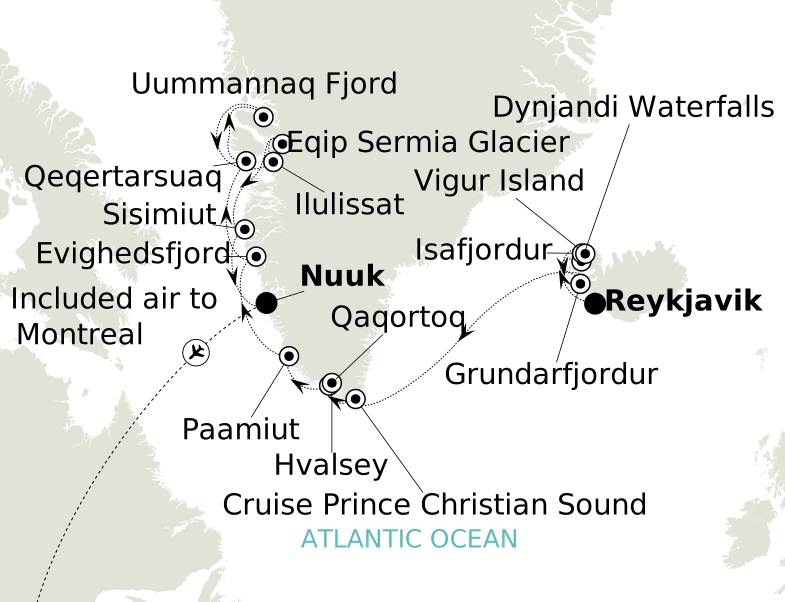
A 14-night expedition voyage aboard Silver Wind, Reykjavik, Iceland to Nuuk, Greenland. Destination: Arctic and Greenland.
Operated by Silversea Cruises aboard Silver Wind Expedition.
Reykjavik
Dynjandi Waterfalls
Isafjordur
Vigur Island
Grundarfjordur
Cruise Prince Christian Sound
Qaqortoq (Julianehåb)
Hvalsey
Paamiut
Evighedsfjord
Qeqertarsuaq
Uummannaq Fjord
Ilulissat
Eqip Sermia Glacier
Sisimiut
Nuuk (Godthab)
The capital of Iceland’s land of ice, fire and natural wonder, Reykjavik is a city like no other - blossoming among some of the world’s most vibrant and violent scenery. Home to two-thirds of Iceland’s population, Reykjavik is the island’s only real city, and a welcoming and walkable place - full of bicycles gliding along boulevards or battling the wind when it rears up. Fresh licks of paint brighten the streets, and an artistic and creative atmosphere embraces studios and galleries - as well as the kitchens where an exciting culinary scene is burgeoning. Plot your adventures in the city's hip bars and cosy cafes, or waste no time in venturing out to Iceland’s outdoor adventures. Reykjavik’s buildings stand together - below the whip of winter’s winds - together with the magnificent Hallgrímskirkja church, with its bell tower rising resolutely over the city. Iceland’s largest church's design echoes the lava flows that have shaped this remote land and boasts a clean and elegant interior. The Harpa Concert Hall’s sheer glass facade helps it to assimilate into the landscape, mirroring back the city and harbour. Its LED lights shimmer in honour of Iceland’s greatest illuminated performance – the northern lights. Walk in the crusts between continents, feel the spray from bursts of geysers and witness the enduring power of Iceland’s massive waterfalls. Whether you want to sizzle away in the earth-heated geothermal pools, or hike to your heart’s content, you can do it all from Reykjavik - the colourful capital of this astonishing outdoor country.
Iceland is well-known for its spectacular waterfalls. The iconic Dynjandi waterfall, located in the Westfjords region, is regarded as one of Iceland’s most impressive and majestic waterfalls. At the top, the cascading water is roughly 100 feet wide and tumbles down about 330 feet into the fjord. Its name Dynjandi means, “the thundering one” and its vast size, enormous sound, and sheer force is overwhelming. It has also been nicknamed, ‘The Bridal Veil’ because of the way the water sprays and spreads over the rocks.
Dwarfed by the gargantuan terraces of sloping mountains around it, Isafjordur hangs on to a spit that rolls out into the scenic fjord waters of the Skutulsfjörður. A population of 2,600 calls this remote, beautiful location in the Westfjords Peninsula home. The setting is colossal and otherworldly, with plunging mountains and gouged fjords jutting inland, but there's a lively feel in town, with an abundance of cafes and restaurants dotted between pretty, half-timber houses. Built on the waters of a deep natural harbour, sea-faring and fishing is written into the DNA here. Delve into these central traditions at the Maritime Museum, before getting a taste for Icelandic specialities like the divisive delicacy of fermented shark meat. Rich, troll-inspired folklore and feisty festivals add even more colour and intrigue throughout the year – from mud football mayhem to cross country skiing exhibitions. A place to get active and involved, hook fish from the frozen depths while ice fishing, strap on skis in powder-coated mountains, or crack golf balls along rolling courses while soaking in the gorgeous scenery. The wedding-veil falls of Tungudalur Valey Waterfall are close by, splashing down the blackened rocks. Further afield, Hornstrandir Nature Reserve's emerald marshes and wildflower sprinkled cliffs make for a refreshing shock of colour amid Iceland's moody, brooding monochrome palette. Excellent birdlife is waiting offshore on Vigur Island, where puffins and arctic terns chatter, and traditional farming traditions are kept alive.
Vigur Island is the second largest island in the Isafjardardjup Fjord, measuring 2 kilometers in length by 400 meters in width. It is home to a single sheep farming family, which ferries the sheep in summer across to the mainland, so that the Eider Ducks nesting on the island will not be disturbed. One of the export articles from this small island was eider down and one can still see where the Eider Ducks nest and how the down is collected and cleaned. The small settlement of a few houses is on the southern side, next to a small rocky beach, a concrete wall and floating pier. On approach grey seals can often be seen on the otherwise seaweed-covered boulders. Apart from the grey of the basalt and green of the grass, lichens add a splash of color. A path has been prepared and the grass cut, so that visitors can leisurely walk across the island to take in the beautiful scenery and to observe the large colony of Arctic Terns, Black Guillemots and Atlantic Puffins usually only seen during the summer months. A meticulously preserved historical landmark, a small windmill dating back to the 1840s was still in use in 1917 to grind wheat imported from Denmark. Viktoria House, one of the preserved wooden farm houses dating back to 1862, is used as a café where home-baked cakes and cookies are offered to guests.
As double acts go Kirkjufellsfoss Waterfall and Kirkjufell Mountain are hard to beat. Said to be Iceland's most photographed spot the perfectly symmetrical mountain taper of Kirkjufell complements the roaring waterfall and is said to be the most photographed spot in Iceland. That's a bold claim considering the country's abundance of natural assets but this natural duo is an undeniably unique and mesmerising sight. Occasionally as the sun fades away a stunning trio is formed with the northern lights dancing overhead casting its ethereal green haze over the scene below. Reach the stirring views with a short walk from Grundarfjordur town or head out into the wilderness on horseback along well-trampled bridleways. The mountain is known as Church Mountain due to its isolated peak which pierces the sky like a spire. You might recognise it as a 'mountain shaped like an arrowhead' however which is how it was described during its Game of Thrones cameo. In Grundarfjordur itself fishing boats gently bob amid the dramatic snow-flecked mountain scenery. With whales cruising the fjords and eagles diving overhead you're also at the centre of some of Iceland's most spectacular and atmospheric wildlife.
Days at sea are the perfect opportunity to relax unwind and catch up with what you’ve been meaning to do. So whether that is going to the gym, visiting the spa, whale watching, catching up on your reading or simply topping up your tan these blue sea days are the perfect balance to busy days spent exploring shore side.
The transit through the Sound is one of this voyage’s highlights. Connecting the Labrador Sea with the Irminger Seat, Prince Christian Sound or “Prins Christian Sund” in Danish is named after Prince (later King) Christian VII (1749-1808). 100 km (60 miles ), long and at times just 500 m (1500 ft) wide, this majestic and spectacular fiord throws you back into a Viking era – flanked by soaring snow-topped mountains, rock-strewn cliffs and rolling hills, it is as if time has stood still and one easily forgets that this is the 21st century. As you marvel at the sheer size of the mountains that surround you, with the Arctic waters lapping deceptively at the hull, revel in the silence enveloping you. Icebergs float serenely by, carrying with them the ages of time. Be sure to wear warm clothing as this is one spectacle that you do not want to miss.
The largest town in southern Greenland, Qaqortoq has been inhabited since prehistoric times. Upon arrival in this charming southern Greenland enclave, it's easy to see why. Qaqortoq rises quite steeply over the fjord system around the city, offering breath-taking panoramic vistas of the surrounding mountains, deep, blue sea, Lake Tasersuag, icebergs in the bay, and pastoral backcountry. Although the earliest signs of ancient civilization in Qaqortoq date back 4,300 years, Qaqortoq is known to have been inhabited by Norse and Inuit settlers in the 10th and 12th centuries, and the present-day town was founded in 1774. In the years since, Qaqortoq has evolved into a seaport and trading hub for fish and shrimp processing, tanning, fur production, and ship maintenance and repair.
18 kilometers northeast of Qaqortoq, Hvalsey is part of Qaqortukulooq, one of the five sites of the UNESCO World Heritage Arctic farming complex Kujataa. Between Eriksfjord to the north and Einarsfjord to the south, the Hvalseyfjord branches off from Einarsfjord. Although Hvalsey is better known for the well-preserved ruins of one of the sixteen churches in the Norse’s Eastern Settlement, the church was in a farmstead known as Thjodhild’s Stead. This farmstead at the northeastern end of the fjord included a large building with living quarters, a hall and livestock pens, as well as other livestock pens, a storage building and a warehouse –the ruins of which can still be seen. The Norse farming laid the foundation for the Inuit farming in later centuries, leading to the UNESCO World Heritage status in 2017. In the 14th century account “Descriptions of Greenland” the abundant fish, a reindeer farm on Reindeer Island and Hvalsey’s name “Whale Island” clearly indicate that the Norse had ample food sources at that time. The church was built in the Anglo-Norwegian style of the 13th century, but is known to have been built over an older graveyard. The farmstead is mentioned in the Icelandic “Book of Settlements” as property of the Kings of Norway, and the last documented event of the Norse in Greenland is a wedding which took place in the church in September 1408. After almost 600 years of abandonment, conservation work had to be done to prevent the seaward wall from collapsing.
Paamiut, in southwestern Greenland is definitely an off the beaten track destination but well worth the journey! The brightly coloured houses dotted around the port bring warmth to the artic scenery. The history of the community dates back to 1500 BC but it was in the 18th Century that Paamiut evolved into a major trading hub within Greenland. Seal fur, whale products and soapstone carving made it prosperous. Today the draw is the opportunity to immerse yourself in such an unspoiled, majestic landscape and to observe the rare wildlife within. During the warmer summer months, minke whales, fin whales and humped back whales are all common visitors and with sharp eyes, can be seen from the shore. Craggy mountains, ethereal glaciers and clear fjords offer endless possibilities for hiking and kayaking. Rare sea eagles - Nattoralik, have made their home in these remote parts and seeing one is said to bring you good luck. Guardians of this incredible natural legacy are the Paamiut people who are justifiably proud of their culture and extremely welcoming to visitors. There is a small museum where you can learn about the fascinating local customs, traditions and way of life.
Evighedsfjord (Eternity Fjord) is a large fjord northeast of Kangaamiut in southwest Greenland. The fjord has a length of 75 kilometers and several branches with numerous glaciers coming down from the Maniitsoq Ice Cap to the north can be seen. The Evighedsfjord has several bends and whenever the ship reaches the supposed end the fjord continues in another direction and seems to go on forever. Qingua Kujatdleq Glacier is at its southeastern end. At the northwestern end a U-shaped valley has seven glaciers coming down from the mountains but not reaching the water. The glaciers had their maximum extent around the year 1870 and have gone through several cycles of advance and retreat. The mountains on either side of the fjord can reach in excess of 2,000 meters and the fjord has a depth of up to 700 meters. Evighedsfjord’s snowline is at 1,100 meters and the Evighedsfjord region is famous as one of Greenland’s best heli-skiing areas.
During the morning Silver Cloud will ply the Disko Bay en route to our destination along Disko Island’s east coast. Our exploration of the Disko Bay area will head to an area north of the village of Qeqertarsuaq which is named after Disko Island’s local name –meaning “large island”. With more than 3 300 sq. miles Disko Island is Greenland’s second-largest island.
Enjoy this micro tour of Greenland’s most coveted destinations on this round trip from Kangerlussuaq. From the uniquely Greenlandic character of the country’s capital – Nuuk – to the still waters and eerie silence of the Uummannaq Fjord, this voyage offers oceans of emotions. Sail north of the Arctic Circle, cruise through skyscraper-sized icebergs in one of the northernmost UNESCO World Heritage Sites and even hike to Santa Claus’ summer house, on this, your voyage of a lifetime.
Known as the birthplace of icebergs the Ilulissat Icefjord produces nearly 20 million tons of ice each day. In fact the word Ilulissat means “icebergs” in the Kalaallisut language. The town of Ilulissat is known for its long periods of calm and settled weather but the climate tends to be cold due to its proximity to the fjord. Approximately 4 500 people live in Ilulissat the third-largest town in Greenland after Nuuk and Sisimiut. Some people here estimate that there are nearly as many sled dogs as human beings living in the town that also boasts a local history museum located in the former home of Greenlandic folk hero and famed polar explorer Knud Rasmussen.
Sisimiut ('The People of the Fox Holes') is Greenland's second city, the largest Arctic City in North America, and a hub between the warmer South and the frozen North of the country. With a young, dynamic population, including students from all over the country, Sisimiut is one of the fastest growing cities in Greenland. Inhabited for more than four and a half thousand years, the Danish Colonial Era saw the rapid development of the city into a trade centre, and the old buildings and artefacts can be seen at Sisimiut Museum, a collection of beautifully restored buildings displaying everything from ancient turf houses to modern Inuit art. The local artisans are considered some of the best in Greenland, and often sell their wares direct from their communal workshop in the harbour, where they barter with hunters for raw materials. Today, modern industry focussed on processing sea food and shipping; KNI, the state-run chain of general stores operating in even the most remote settlements is based in Sisimiut. Most residents still live in the colourful wooden houses Greenland is so well known for. Sisimiut's vast back country offers excellent opportunities for hiking and fishing, and the locals often use sled dogs or snowmobiles to get around their vast mountainous playground during the long winters. In the summer, one can walk as far as Kangerlussuaq International Airport, a trail also used for the gruelling Polar Circle Marathon, one of the toughest endurance events in the world.
In the bustling capital city of Greenland, you could be forgiven for forgetting you are in such a vast and isolated country. Nuuk is Greenland's economic and social hub, home to more than a third of Greenland's population, and although it feels like a world capital, scratch the surface, and a uniquely Greenlandic character can be found underneath. Nuuk Cathedral overlooks the gorgeous old Colonial Harbour district and the Greenland National Museum, resting place of the legendary Qilakitsoq mummies, the true highlight of the museum's archaeological collection. Above the Colonial Harbour sits downtown Nuuk, with lines of Scandistyle apartments, a bustling shopping district, the Greenlandic Parliament, Nuuk City Hall (which welcomes visitors to see its artwork) and even outdoor cafes selling locally produced food and beer. These nods to modernity compete for space with local artisan boutiques, the meat market selling the catch from Nuuk's vast fjord-lands, and the stunning Katuaq Cultural Centre, where blockbuster movies, as well as local and foreign performers entertain the people of Nuuk. Although Nuuk has long been a melting pot of Danish and Greenlandic ideas, this is a city where Greenland displays its sophistication, with the Country's only traffic lights, roundabouts and University. Most of all, expect to find a multitude of friendly people who are proud of who they are, and equally proud of the city they call home.
From $18,550
per guest · 14 nights
Prices are a guide and vary with season, cabin category and party size. Your advisor will confirm the exact cost before anything is booked.
Classic Veranda
suite
Deluxe Veranda
suite
Grand 1 Bedroom
suite
Grand 2 Bedroom
suite
Medallion
suite
Owner 1 Bedroom
suite
Owner 2 Bedroom
suite
Royal 1 Bedroom
suite
Royal 2 Bedroom
suite
Silver
suite
Vista
suite








