




Prefer a conversation?
Our team is always available to guide you through the process and ensure your experience is perfectly matched to your preferences.
Our team is always available to guide you through the process and ensure your experience is perfectly matched to your preferences.
Duration
12 Nights
Price
From $6,950
Ship
Silver Dawn
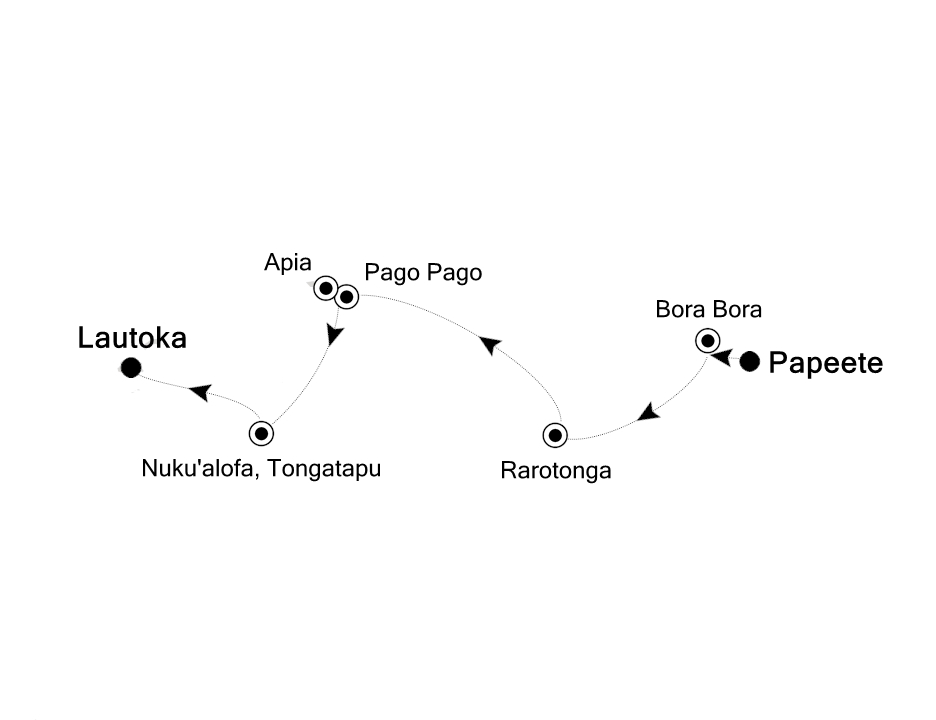
A 12-night ocean voyage aboard Silver Dawn, Papeete, French Polynesia to Lautoka, Fiji. Destination: French Polynesia & Pacific.
Operated by Silversea Cruises aboard Silver Dawn.
Papeete (Tahiti)
Bora Bora (Society Islands)
Huahine
Rarotonga
Pago Pago
Date Line lose a day
Apia
Lautoka
Papeete is the center of the tropical paradise of French Polynesia where islands fringed with gorgeous beaches and turquoise ocean await to soothe the soul. This spirited city is the capital of French Polynesia and serves as a superb base for onward exploration of Tahiti – an island of breathtaking landscapes and oceanic vistas. A wonderful lagoon of crisp clear water begs to be snorkelled stunning black beaches and blowholes pay tribute to the island's volcanic heritage and lush green mountains beckon you inland on adventures as you explore extraordinary Tahiti. Visit to relax and settle into the intoxicating rhythm of life in this Polynesian paradise.
If you have ever dreamt up your ideal island holiday, we suspect it goes something like this: Soapy blue seas? Check. Sparkling white beaches? Check. Thatched wooden huts, gently sloping palm trees and kaleidoscopic marine life? Check, check and check. And yet, even by ticking every box, first time viewing of Bora Bora still beggars belief. This tropical hideaway less than 12 m2 in the heart of the South Pacific has been toping travel wish lists for years. Long considered the realm of honeymooners – spectacularly romantic sunsets are a speciality – Bora Bora is not just for wandering with your love. If the prismatic shades of blue of the world’s most beautiful lagoon do not fill you up, then perhaps underwater scooters and aqua Safaris will charge your batteries. If exploring Bora Bora’s lush hinterland is more your glass of tequila sunrise, then trips around the island (often stopping off at the celebrity haunt Bloody Mary Restaurant & Bar) are a must. Bora Bora's peaceful ambience has not always been the case. The island was a US supply base, known as "Operation Bobcat" during WWII. During this time, Bora Bora was home to nine ships, 20,000 tons of equipment and nearly 7,000 men. Eight massive 7-inch naval cannons were installed around the island, all but one of which is still in place. Although little is known of the history of the island, it is known that Bora Bora was called Vava’u in ancient times. This supports belief that the island was colonised by Tongans prior to French annex in 1888.
Although it lies between Moorea and Bora Bora, Huahine (pronounced Hu-a-hee-nee or Wha-hee-nee) isn't on the tourist circuit just yet, but it should be. Its near-deserted roads and villages and wooded hills entwined with jungle vines beckon those looking for a little R&R.Huahine is two islands (Huahine Nui and Huahine Iti) joined by a bridge. What passes for action takes place in the main town of Fare (pronounced far-ay) on Huahine Nui, the northern and bigger island. Away from this little port, life is slow-paced and you'll be lucky to find anyone stirring on a lazy afternoon in any of the villages of Huahine Iti. Most locals ride bicycles and agriculture's still the main industry—plantations grow vanilla and melons. There are various legends surrounding the island's name. Some say that hua> means "sex" and hine means "woman," while others say the name means "pregnant woman" due to a rock outline on Huahine Nui's Fitii Peninsula. Then there's the legend of Hiro, Polynesia's most famous god. It's said that Hiro rammed his canoe into the island, splitting it down the middle. Not far from the town of Maroe is a rock spire called Te Moa o Hiro or "penis of Hiro"—you can't miss it. It's easy to explore Huahine (75 square km [47 square mi]) by rental car, as there is really only one road, albeit with a few forks in it. When you cross the bridge into Huahine Iti you can go either left to Maroe or right to Parea. The road to Haapu leads off to a dead end. When crossing from Huahine Iti to Nui the same rule applies. Take the left fork to the "busy" town of Fare and the right fork to the "sacred eel" village of Faaie, via the Belvedere lookout. Hiring your own boat allows you to circle the island and anchor at the motu; a couple of self-catering villas provide both a car and a boat. There are only one or two restaurants on Huahine Iti; you either eat at your pension, choose a pension with cooking facilities, or drive up to Fare for a wider, though still rather limited, choice. Dining Hotels and most pensions have restaurants and can offer half-board (MAP) options, while some small establishments include breakfast and airport transfers. Most of the island's independent restaurants are in Fare. You'll find similar menus at most restaurants and these usually include poisson cru, shrimp, and grilled fish, meat, and lobster—most accompanied with vanilla sauce—as well as desserts like coconut tart with vanilla ice cream. Independent restaurants tend to be cheaper and serve bigger portions. There are a couple of roulottes at the wharf in Fare, which sell chow mein, lemon chicken, stir-fries, rice, and pizza. Prices are around 1,100 CFP a dish and portions are big. Tipping is not expected, but will of course be accepted. Hotels Don't expect a variety of luxurious accommodations on Huahine. There are only two hotels and only one—the newly renamed Te Tiare Beach Pearl Resort—has overwater bungalows. There are, however, some funky accommodations in Huahine Iti, such as comfortable "tents" with fabulous furnishings and a couple of very good value for money self-catering villas on Huahine Nui where a car and boat come with the daily rate. Nightlife If you're looking for nightlife you've definitely come to the wrong place. Nightlife consists of dinner and a few drinks at your hotel or pension—most restaurants, both resort and independent, start closing their doors around 9 pm. Shopping If you're after jewelry, a pareo, or some surf gear—in Tahitian designs—you'll find them in Fare's port area; there's one long street of shops. You'll have to venture across the lagoon for pearls. Vivi et Vonvon Vivi et Vonvon is a restaurant with a small bookshop attached that specializes in children's books and books on French Polynesia—most are in French. Exotica Shop Exotica Shop has an eclectic mixture of clothes, jewelry, and gifts, but the range is not really Polynesian. It's on the second level of a small retail complex near the tourism bureau. Fare Super Nui Fare Super Nui is a huge supermarket that carries everything from wine and beer to milk, snorkeling gear, and clothes. It even has pigs ready for roasting. This is the hub of life in Huahine. Magasin Vaimoe Magasin Vaimoe is just one of several small "corner stores" that dot the island's main road. Usually called Magasins, they sell water, beer, snacks, and a limited (and often quite expensive) range of groceries. Huahine Pearl Farm Huahine Pearl Farm has loose pearls and pearl jewelry, as well as pottery crafted by ex-Californian Peter Owen and his Tahitian-born wife Ghislaine. Take the free boat transfer over to the motu off the village of Faaie, which leaves every 15 minutes. Mauariki Creations French artist Bertho Franck hand paints pareos in a little studio tucked away in a garden on the main road, a few miles away from Pension Mauarii. They are priced from 2,080 to 2,500 CFP. Just ring to see if it's open, or drive down—it's only 20 to 30 minutes from Fare by car and very scenic. Magasin Chez Hine A short drive from Pension Mauarii, this small "corner store" sells beer, water, soft drinks, ice cream, packaged snacks, and a small range of groceries such as tinned food and eggs. Local Style Local Style has a colorful range of surf gear including the Tahitian label, Hinano. There also are shorts, shirts, and bikinis.
Days at sea are the perfect opportunity to relax unwind and catch up with what you’ve been meaning to do. So whether that is going to the gym, visiting the spa, whale watching, catching up on your reading or simply topping up your tan these blue sea days are the perfect balance to busy days spent exploring shore side.
Life is laid back on Rarotonga the most populous of the Cook Islands but the residents are still an active bunch. Though there are plenty of white sandy beaches on which to laze—and people do with plenty of napping— locals love to get out and move. Join them in snorkeling diving riding—bikes horses scooters—fishing bush walking and playing squash and tennis. Another popular if odd and favorite activity is lining up along the sea wall adjacent to the airport's runway to be jetblasted.
Days at sea are the perfect opportunity to relax unwind and catch up with what you’ve been meaning to do. So whether that is going to the gym, visiting the spa, whale watching, catching up on your reading or simply topping up your tan these blue sea days are the perfect balance to busy days spent exploring shore side.
Days at sea are the perfect opportunity to relax unwind and catch up with what you’ve been meaning to do. So whether that is going to the gym, visiting the spa, whale watching, catching up on your reading or simply topping up your tan these blue sea days are the perfect balance to busy days spent exploring shore side.
The high, volcanic islands of American Samoa sit along the Pacific Ring of Fire; their cone-shaped mountains rise with abrupt steepness. These islands are stunningly green, the windward hillsides carpeted thickly with coconut palms, breadfruit and mango, while the leeward side is punctuated by steep cliffs. Pago Pago (pronounced Pahngo Pahngo), on the island of Tutuila, boasts one of the world's most beautiful natural harbors that thrusts as a fjordlike arm deep into the land. The harbor was formed when the seaward wall of a volcano collapsed, allowing the sea to rush in. The bay and encircling mountain peaks present spectacular evidence of nature's force and astounding beauty. Introduced to the world in 1722 by a Dutchman, these islands were then visited by English missionaries in 1831; the islanders took to Christianity with enthusiasm. In 1900, in spite of the Germans who controlled Western Samoa, the United States took possession and the U.S. Navy ran American Samoa until 1951. Since then it has been administered by the U.S. Department of the Interior as an Incorporated Territory and thus is a unique part of the United States. Its 50,000 residents are U.S. citizens with equal rights, except for voting in national elections. Pago Pago, along with Fagatogo, is called the Bay Area. It is here where Somerset Maugham's story in his famous novel Rain was set. The story, which was made into a movie with Joan Crawford, was so popular that a hotel was named for the heroine, Sadie Thompson. Today, the former hotel houses a restaurant. The lookout over the harbor and out to sea is stunning, and you can hike up to Mount Alava on what is now National Park Trail. On a clear day, the Manu'a Group and Western Samoa are visible. Back in Pago Pago just below Solo Hill is Maugaoalii, the hill of chiefs, where Government House is located; you may walk around the beautiful grounds or visit the courthouse past the village green. There are a number of good things to do here in the combined town of Pago Pago-Fagatogo; as the island is compressed, it won't take long to accomplish them at a leisurely pace. Pier Information The ship is scheduled to dock in Pago Pago, located near the centre of town and next to a busy container port. The local town is very compact and can be reached within a short walk. Taxis are available; we suggest you negotiate the rate before departing. Due to the strong role of religion in the community, women are advised not to wear shorts when visiting the countryside. Shopping Shopping is not particularly exciting in American Samoa. There are small Korean, Samoan and American stores that carry items residents need on a daily basis. A limited selection of handicrafts and Samoan T-shirts are also available. The local currency is the U.S. dollar. Cuisine Stone hearth baked foods such as breadfruit, pork, chicken and bananas are available in most villages, while more international fare is available at restaurants in Pago Pago. Other Sites Fono Building Home of the territory's legislature, its architecture combines traditional "fale" construction with modern materials. Naval Guns Hill. Located a short distance from the Rainmaker Hotel and requiring a short hike, two guns remain as relics from World War II. Silver Shore Privato: Pago Pago by Private SUV & Guide Explore Pago Pago at your leisure during your half-day sightseeing tour via private SUV, for either up to 2 or 4 guests. Customise your own itinerary or choose to see an overview of the area's highlights. Driver/Guides are able to assist with itinerary planning and provide some commentary. Guests who desire detailed commentary should reserve the services of a guide to accompany them. This may be requested on board the ship. Depart the pier with your English-speaking guide in an air-conditioned island SUV vehicle and discover the city and surrounding areas at your own pace. Your exclusive tour concludes back at the pier. Please note: This tour is non-refundable if cancelled within 48 hours prior to arrival in the port. Actual vehicle type varies depending on availability; guests should anticipate an older SUV model that is the best available. Locals acts as guides and provide basic commentary. Participation is limited to either up to 2 guests or up to 4 guests per SUV. The price, exclusive of meals, entrance fees and gratuities, is per vehicle. Therefore, when making your reservation, please indicate the number of vehicles, not the number of guests. Only one person in the party needs to reserve this programme. Charges may be split between suites on board. Please see the Shore Concierge Office on board the ship to arrange your individual itinerary. Service is based on minimal mileage between the pier and the city of Pago Pago and its surrounds. Guests wishing to travel further afield will be quoted for the additional mileage surcharge onboard. There is a very limited number of SUVs available. We thank you for your understanding. PRIVATE ARRANGEMENTS Other private arrangements for independent sightseeing may be arranged by emailing ShoreConcierge@silversea.com.
For two hours of every day (between 10 am and 12 pm GMT), the world has three different dates. Planet Earth is divided into 24-different time zones, meaning that when it is 11.30 pm in Samoa (GMT-11), it will be 6.30 am in New York City (GMT-4) and 12.30 am in Kiritimati (GMT +14)! So, for those who travel east, time moves faster over the time zones, and you suddenly find yourself one day older! Just to confuse matters even further, the IDL (International Date Line) is arbitrary, and countries can request to move it as they please! However, regardless of where you are on the planet, the time and date always changes at midnight.
As the first independent state of Polynesia, Samoa is considered the cradle of the nation, a place where the Earth and the heart seamlessly fuse together. Incidentally, were one to translate the word "Samoa" into the traditional Polynesia dialect, they would find that the words "Sa" and "Moa" mean exactly that: earth and centre. Apia, Samoa's only town, is found central north coast of Upolu, Samoa's second largest island. Originally a tiny village of just over 300 inhabitants (c. 1800), the town's population has grown to be just shy of 40,000. While a population of such size might mean forgetting traditional roots in favour of modern life, this has not been the case (too much) in Apria. The Samoan way of life is still very much the order of the day; traditional open-sided houses with thatched roofs on platforms of coral or concrete, also known as 'fales', can be seen everywhere and nearly all of the population (including the policemen) wear the typical local dress; skirts, or 'lavalavas' for men, and long, mumu-style dresses for women. The markets are bursting with culture and colour, selling everything from handicrafts to cuisine and local produce. If the idyllic setting of aquamarine pools of bluey green water, framed by low fringed palms and huge umbrella trees seems familiar, that's because it probably is. The island, and notably the southern resort of Lefaga, was used in the 1953 Gary Cooper classic Return to Paradise Beach. It is also the last place on Earth to see each day’s sunset.
Days at sea are the perfect opportunity to relax unwind and catch up with what you’ve been meaning to do. So whether that is going to the gym, visiting the spa, whale watching, catching up on your reading or simply topping up your tan these blue sea days are the perfect balance to busy days spent exploring shore side.
Days at sea are the perfect opportunity to relax unwind and catch up with what you’ve been meaning to do. So whether that is going to the gym, visiting the spa, whale watching, catching up on your reading or simply topping up your tan these blue sea days are the perfect balance to busy days spent exploring shore side.
It doesn’t get much sweeter than arriving on the sun-soaked shores of the Sugar City. Fiji’s second-biggest settlement opens up a world of blissful beaches and turquoise seascapes while its dense jungle lures the adventurous deep into its embrace. Experience rich Fijian life and see dramatic displays like warrior dances and remarkable local practices like firewalks which kick up burning embers into the night's sky. Legend says the city took its name after two chiefs faced each other in a duel. A spear pierced one of the chiefs leading to the shout of 'lau-toka!' or 'spear hit!' Sugar is Lautoka’s main trade but its botanical gardens are a sweet insight into the tropical plant life that thrives here - from pearl white lilies to tall fragrant orchids. Explore temples charming cafes and mills - or barter for some of the juiciest mangoes you’ll ever taste at the city’s lively market. You'll only be able to resist the beaches for so long and it doesn’t get much more stunning than the Blue Lagoon - a heavenly blend of woven together turquoise shades. Remote wild and unspoiled these are some of the best tropical beaches in the world. There's more rejuvenating relaxation at the mineral-rich mud pools and spas fuelled by the volcanic activity below. Savala Island is a teardrop of sand offshore and another beautiful place to wander with the soft powder between your toes - along sandy spits that peter out into the water. Or swim and snorkel among its envied reefs thronging with fish life.
From $6,950
per guest · 12 nights
Prices are a guide and vary with season, cabin category and party size. Your advisor will confirm the exact cost before anything is booked.
Classic Veranda
suite
Deluxe Veranda
suite
Grand 1 Bedroom
suite
Grand 2 Bedroom
suite
Owner 1 Bedroom
suite
Owner 2 Bedroom
suite
Panorama
suite
Royal 1 Bedroom
suite
Royal 2 Bedroom
suite
Silver
suite
Silver 2 Bedroom
suite
Superior Veranda
suite
Vista
suite








