




Prefer a conversation?
Our team is always available to guide you through the process and ensure your experience is perfectly matched to your preferences.
Our team is always available to guide you through the process and ensure your experience is perfectly matched to your preferences.
Duration
14 Nights
Price
From $10,600
Ship
Silver Shadow
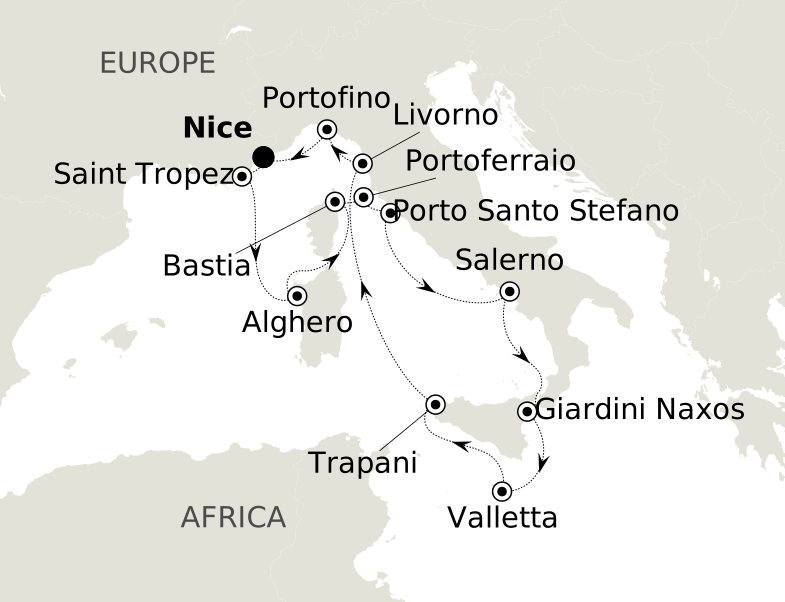
A 14-night ocean voyage aboard Silver Shadow, Nice, France to Nice, France. Destination: Mediterranean.
Operated by Silversea Cruises aboard Silver Shadow.
Nice
Saint Tropez
Alghero, Sardinia
Trapani, Sicily
Total Solar Eclipse - 12th August 2026
Valletta
Giardini Naxos (Sicily)
Agropoli
Naples
Porto Santo Stefano
Ajaccio (Corsica)
Livorno (Tuscany)
Portofino
Nice's sweeping bend of brilliant-blue seawater - which once tempted the aristocracies of Europe - continues to entice and entrance visitors to these sun-soaked shores. A refined city of airy ocean boulevards grandiose buildings and open spaces fountain-sprinkled parks and colourful floral displays add to the city's timeless appeal. Nice has lost none of its old-world lustre and there remains something of the divine in the Bay of Angels' endless sparkling waterfront. The vast open Promenade des Anglais remains Nice's magnificent crowning glory inviting the city out to jog wander and glide along the Mediterranean's most spectacular curve of seafront promenade. The crisp clear golden light also continues to make Nice a destination of creative pilgrimage and Matisse Picasso and Renoir are among the many artists to lavish in the city's eternal beauty. Drag yourself away from the waterfront to discover the old town punctuated with Baroque churches rising and the wafting scents of baking pastries and lavender bundles. Follow the floral odours to Nice's famous flower market which spills gorgeous colourful displays along Cours Saleya. There's a strong hint of Italy explained by the fact that Nice only aligned with France in 1860 - following 500 years under the House of Savoy. Walk in Nietzsche's footsteps and climb up to Colline du Château's charming green park and cascading waterfalls to relish the views down over the city and sparkling sea expanse.
A glitzy, glamorous coastal resort that needs no introduction, Saint Tropez is the French Riviera hotspot of choice for A-listers and flotillas of gleaming yachts. The sparkle of its beaches, and clarity of its light, continues to attract artists - but it was the famous presence of Brigitte Bardot that leant Saint Tropez its enduring glamour and steamy appeal. Nowadays, speedboats skim offshore, while fine vintages from the vineyards nearby are uncorked in top-notch restaurants, in this well-heeled highlight of the Cote d'Azur. Famous bars offer views of the port along Quai Jean Jaurès, with its iconic cherry-red directors' chairs. Here you can admire the monstrous wealth of yachts that sparkle on the waters. On the same corner, big-name brand labels glimmer in the shops of rue François Sibilli - which cuts inland from the charming waterfront. The earthier appeal of boules clinking and thumping into the ground can be enjoyed at Place des Lices, where sun-wrinkled locals compete. Saint Tropez has a few beaches of its own, but famous stretches like Pampelonne Beach draw the biggest crowds to relax on star-studded golden sands. La Ponche, the authentic fishing quarter, retains its cobbled, historic elegance, and a 17th-century, hexagon-shaped citadel watches over the city and coastline from above. Coastal walks in the sea air snake away from the city’s bustle, and a series of headlands shape the stunning riviera landscape surrounding Saint Tropez. The historic monochrome Cap Camarat lighthouse adds a pleasing accent to hikes above the sparkling Mediterranean’s waves.
Encircled by dramatic medieval walls, which rise abruptly from deep-blue waters, Alghero’s defences shelter one of Sardinia’s largest and most spectacular old towns. Uneven cobbled streets, rich history and a fiery Catalan flare provide a real depth of character, and the Coral Riviera’s pristine beaches, which stretch out nearby, help to make Alghero a real highlight of Sardinia. Alghero has changed hands numerous times over its tempestuous history, but it’s the Catalan influence that you’ll feel most acutely, as you explore. It was the Catalans who upgraded the defensive ramparts of the ‘Sardinian Barcelonetta’ into the spectacular, imposing fortress we see today, enclosing the old town’s evocative knot of narrow streets and rose-gold-coloured masonry. Wander the streets at your leisure, enjoying the cooling shade of the tight, cobblestone streets with lemon-gelato in hand, or enjoying fresh tuna steak at the bustling La Boqueria market. Alghero Cathedral is hidden amid the labyrinth of narrow streets, but it’s the distinctive Baroque-dome of Chiesa di San Michele that you’ll immediately notice peeking ostentatiously over the terracotta roofs of the old town, flaunting its rainbow-coloured patterning. Plush restaurants revel in Alghero’s historical collision of cultures and produce delicious fare like plump clams tangled in tagliatelle, and succulent porcetto pork – slowly roasted to perfection in smoky wood ovens. Wash it down with mirto, a crushed berry liqueur, or sample the fruits of local vineyards, with a platter of Sardinia’s renowned pecorino sheep’s cheese. The city dominates Sardinia’s Coral Riviera – so named because of the red coral found here that’s been used for jewellery since Roman times. Lie back and listen to the waves washing ashore at Spiaggia di Maria Pia beach, breathing in the smell of pine-needles on the breeze.
Days at sea are the perfect opportunity to relax unwind and catch up with what you’ve been meaning to do. So whether that is going to the gym, visiting the spa, whale watching, catching up on your reading or simply topping up your tan these blue sea days are the perfect balance to busy days spent exploring shore side.
Surrounded by glowing turquoise waters and rugged coastline Trapani invites you to explore western Sicily's ruins intense flavours and sun-soaked leisure pursuits. Built on salt and tuna exports Trapani is experiencing a renaissance having been lovingly spruced up as a sailing capital and an international airport bringing in visitors from far and wide. The town looks out over the Egadi Islands gazing west to witness some of Siciliy's most evocative sunset displays. Start exploring Trapani from its historic core a dense network of alleys hosting a collection of small shops restaurants and wine bars. You’ll encounter the Cathedral of San Lorenzo – where colourful artworks are spread below sweeping arches and a beautiful domed roof. Sicily feels like an island on the cusp of continents and Trapani practically has one foot in Africa as you soak in its pretty whitewash houses and fusion of foods and arts. Discover the Ancient Greek influence by venturing to rich archaeological sites nearby like Selinus and Segesta where the treasures from the past have been unearthed and displayed. Pyramids of white salt rise up at the Riserva Naturale Saline di Trapani e Paceco. These salt marshes and windmills are a symbol of Trapani and although sea salt production is much less important today the small white hills remain a Trapani landmark. Look out for the pink flamingos wading in the salt pans below. For beach days the Egadi Islands can be easily reached from Trapani - Favignana is the largest and most popular.
Perched high on the imposing Sciberras Peninsula, Valletta immediately presents its massive, protective walls and vertical bastions to visitors arriving by sea. Rising to 47 metres in places, the fortifications protect lavish palaces, grand domes and illustrious gardens. Built by the Knights of St John on the narrow peninsular, Valletta is a compact, richly historical treasure trove of Baroque wonders. Ascend to reach the restful, flower-filled Upper Barrakka Gardens, where cannons fire and boom in salute at noon each day, sending echoing cracks of noise out across the waves below. Recognised as 2018’s European Capital of Culture, Valletta is a fascinating and dense haven of history and intrigue. A busy, bustling capital, the breathtaking St John’s Cathedral - commissioned in 1572 - is almost concealed among its narrow streets. The relatively modest exterior is counterpointed by a staggeringly opulent, gold-leaf bathed interior, containing a Caravaggio masterpiece - the shadowy vision of the Beheading of St John. Cinematic and magnificent, Valletta has served as a filming location for Game of Thrones - but real epic history abounds on this rocky isle too. From the prehistoric and megalithic sites of the Hypogeum of Paola and Tarxien, to the fascinating War Museum at Fort St Elmo. Mdina also waits nearby, and the former medieval capital is a striking contrast to the island’s main city. Cars are barred from its streets, and it offers endlessly atmospheric old-time wanders. With a strategic positioning in the Mediterranean, Malta is a jewel that many have wrestled for over the centuries. Independence from Britain was finally achieved in 1964, but the close allegiance remains evident, with English recognised as an official language, cars driving on the left, and red post boxes and telephone gleaming in Malta’s sunshine.
Hugging a long, sweeping bay, Giardini Naxos welcomes you ashore to some of Sicily’s most scenic and historic sites. Naxos was the first Greek settlement on Sicily, and it is surrounded by remarkable remains and swirling mythology. With a long arc of sun-soaked golden sand, you can kick back by the waves - and cool off with a dip into the sea's refreshing embrace. Up above the seaside revelry, the spectacular Taormina hillside town perches - containing rich Roman and Greek history. Visit to encounter one of Sicily’s best views, as you look down over the rejuvenating blue of the sea, and the looming backdrop of Mount Etna rising in the distance. The majestic, honey-coloured Greek theatre is a highlight, standing before the distant loom of the volcano. Head towards the puffs of cloud, and wisps of smoke, that gather around the peak of Sicily’s mighty volcano, which is among the most active in Europe. Arrive through vineyards, thriving in this fertile soil, before taking the 1,737-metre incline to the summit of the legendary mountain of fire, across fields of solidified lava flows. Known to the Greeks as the home of the God of Fire, and the one-eyed Cyclops, the mountain continues to amaze and awe with its restless power. Vineyards carpet the scenery - interrupted by occasional cactai and citrus groves – and produce some of Sicily’s most refined flavours. Enjoy a glass of wine on Giardini Naxos’ seafront, and toast your time on these rich Sicilian shores
The legend of the Siren Parthenope Naples' foundation is not only shrouded in one but two legends, all having one 'person' in common: the siren Parthenope. She and her sisters, Leucosia and Ligaea, are the three resident sirens of the Galli Islands, with their "shores all bleached with human bones and debris", who lured sailors with their enchanting voices and music, only for them to run aground and perish. Parthenope was precisely this magical, murderous voice, while Leucosia and Ligaeus played the flute and citara. The first legend is linked to Ulysses, the first man not to succumb to the siren's call, thanks to Circe's advice. Curious but not mad, he ordered his sailors to plug their ears with wax and tie him firmly to the mast. In this way, he was able to enjoy the pleasure of hearing the music and songs without paying a high price. There are different stories here, some claiming that Parthenope fell in love with Ulysses, others not. In any case, the three sisters, in despair and humiliation, threw themselves into the sea and died. If you are surprised to read that, keep in mind that we're talking about sirens from Antiquity, young women transformed into half-woman half-bird monsters, punished by the goddess Demeter for not having stopped Hades, the god of the Underworld, from kidnapping their mistress Persephone (and daughter of Demeter). Mermaids with fish tails only appeared in the Middle Ages. So, Parthenope and her sisters perished. Their bodies were carried by the sea to Terina for Ligaea and Licosa for Leucosia. Parthenope's body was carried by the waves to the island of Megaride, Naples, where the Castel dell'Ovo stands today. She gave her name to the town and the inhabitants worshipped her, making her the town's patron saint. Another legend exists, from the 19th century. A centaur - Vesuvius - fell madly in love with our siren Parthenope, provoking the jealousy of Zeus. In revenge, he turned the centaur into a volcano. In despair, Parthenope committed suicide and her body washed up in Naples, allowing her to be close to her lover in death. Today there are three fountains dedicated to her: the Fontana delle Zizze (Neapolitan for 'nipples') beside Corso Umberto I with its winged mermaid, a second on the Piazza Jacopo Sannazzaro in Piedigrotta and a third, modern, near the shops at the Central Station. Naples is still referred to as the "Parthenopean city".
A summer escape for Rome’s historic elite the stacked waterfront of Porto Santo Stefano is a secluded taste of idyllic southern Tuscany. Physically closer to Rome than Florence the city is strung to Italy’s western coast by two sandy harnesses and sits on the unqiue peninsula of Monte Argentario - which was once an island. Flamboyant pink flamingos and herons stroll through the encased lagoon while Porto Santo Stefano’s waterfront hums with clinking cafes and strolling visitors. The luxury yachts in the harbour show that Porto Santo Stefano has lost none of its luxury appeals and with beaches wild hikes and waterfront beauty it continues to lure visitors to this secluded escape. Known for its fishing and cuisine - which is based around heavy use of the Tyrrhenian Sea’s juicy bounty. Stroll to Piazza dei Rioni for a dripping lemon gelato or wander the streets noticing the lingering World War II damage – the city was heavily bombed during the conflict. Fortunately the historic star-shaped Spanish fort was spared and it still watches out resolutely over the waters. Rugged coastline falls to secluded beaches with a wilder unkempt charm. Sail the coves - seeing cascading olive groves - or island-hop to Giglio and Giannuti which lie 12 miles from shore and can be seen from the monastery topped Argentario mountain. On the other side of the promontory you’ll find Porto Ercole - where the lifeless body of the Old Master Caravaggio was discovered.
Famed as the island birthplace of French Emperor, Napoléon Bonaparte, Ajaccio has made a towering contribution to European history. Bonaparte may be omnipresent in Ajaccio – with statues watching out over palm-tree lined boulevards bearing his name - but there is a lot more to this charming city, where an unhurried Mediterranean attitude mixes with the trendy buzz of a French Riviera resort. The stunning setting pairs glowing blue water with a dramatic backdrop of towering, snow-capped peaks. Bonaparte may have been famously short in stature, but he stands as a true giant of history. The National Bonaparte Museum is the ideal place to learn more of his life, in the very house where he was born in 1769. Just inside the modest Cathedral Notre-Dame-de-l'Assomption – surrounded by frescoed walls – you’ll also see the stone font where he was baptised. Elsewhere, the perched watchtower of Îles Sanguinaires is a short boat ride away, or Plage de Capo di Feno’s stunning, isolated band of white sand and transparent waters may tempt you outside of the historic city. Settle at a restaurant near the harbour to taste succulent wild boar, stewed in rich red wine casserole, or to crack into soft lobster meat. You also have to enjoy the famous fiadone cheesecake made from local brocciu cheese while you’re here, and to let the magic of unique Corsican Polyphony music carry you away. Three singers expertly blend harmonies to create a spine-tingling combination of melody – you’ll notice the distinctive style, as they each cover an ear to focus more clearly on their individual contribution.
The Tower of Matilde is an iconic structure of the city of Livorno. This medieval tower is said to have been built by the famous mathematician and astronomer Galileo Galilei. It is named after Matilde di Canossa, an influential noblewoman who played a key role in the political and religious conflicts of the 11th century. Matilde was a powerful figure in medieval Italy, and her legacy is still felt in Livorno today. The tower was built on her orders as a defensive stronghold to protect the city against invaders, and its strategic location on the coast made it an important part of the city's defenses. Over the centuries, the Tower of Matilde has been restored and renovated several times, but it still retains its original medieval charm. The tower is a classic example of medieval architecture, with its thick walls, narrow windows, and imposing structure. The tower was later used as a watchtower during World War II and is now a popular tourist attraction as visitors can climb to the top and enjoy panoramic views of the surrounding area. The Tower of Matilde is also an important cultural landmark in Livorno. It is often used as a venue for cultural events and exhibitions, and its unique atmosphere and ambiance make it a popular destination for artists and writers.
Effervescent and exclusive, Portofino rests on a privileged peninsular. Lavish yachts mingle together, seeking out sought-after berths in the harbour, while gelato drips onto the stone-paved streets in this, the most alluring and glamorous town of the Italian Riviera. This section of the Ligurian Coast is a protected area, and home to some of the country’s most picturesque, and jaw-dropping scenery - which is best viewed from the deck of a sailing boat. Crisp white villas roll out across the verdant green hillsides, surrounded by laden vineyards and olive groves. Down in Portofino itself, the buzz of chatter and the clatter of cutlery, provide the soundtrack to busy terrace bars and restaurants, which serve up fine food and delicious sea views. Portofino’s achingly beautiful harbour arcs around the lapping waves, with a warmly-hued waterfront of peach and apricot colours - which also adorns postcards and promotional travel guides of Italy. For the authentic Portofino experience, sail out onto the tranquil waters of the Gulf of Tigullio, to mingle amongst the privileged at play, or settle back in the shade as you take aperitivo on the picturesque waterfront Piazzetta. Here you can sip the famous Ligurian wines, and stave off hunger with focaccia con il formaggio - or platters of fine cheese and hams. Deeper into Portofino, you’ll find artisans crafting their wares and weaving together lace, or you can ascend to viewpoints like the lemon shaded Church of San Giorgio, to look over the pretty jumble from up above. A wander out along the headland to the tapering tip of the peninsular, rewards with the views of Portofino’s iconic white lighthouse beaming out light and welcoming ships to this slice of Riviera heaven.
Nice's sweeping bend of brilliant-blue seawater - which once tempted the aristocracies of Europe - continues to entice and entrance visitors to these sun-soaked shores. A refined city of airy ocean boulevards grandiose buildings and open spaces fountain-sprinkled parks and colourful floral displays add to the city's timeless appeal. Nice has lost none of its old-world lustre and there remains something of the divine in the Bay of Angels' endless sparkling waterfront. The vast open Promenade des Anglais remains Nice's magnificent crowning glory inviting the city out to jog wander and glide along the Mediterranean's most spectacular curve of seafront promenade. The crisp clear golden light also continues to make Nice a destination of creative pilgrimage and Matisse Picasso and Renoir are among the many artists to lavish in the city's eternal beauty. Drag yourself away from the waterfront to discover the old town punctuated with Baroque churches rising and the wafting scents of baking pastries and lavender bundles. Follow the floral odours to Nice's famous flower market which spills gorgeous colourful displays along Cours Saleya. There's a strong hint of Italy explained by the fact that Nice only aligned with France in 1860 - following 500 years under the House of Savoy. Walk in Nietzsche's footsteps and climb up to Colline du Château's charming green park and cascading waterfalls to relish the views down over the city and sparkling sea expanse.
From $10,600
per guest · 14 nights
Prices are a guide and vary with season, cabin category and party size. Your advisor will confirm the exact cost before anything is booked.
Grand 1 Bedroom
suite
Grand 2 Bedroom
suite
Medallion
suite
Owner 1 Bedroom
suite
Owner 2 Bedroom
suite
Royal 1 Bedroom
suite
Royal 2 Bedroom
suite
Silver
suite
Terrace
suite
Veranda 1
suite
Veranda 2
suite
Veranda 3
suite
Veranda 4
suite
Vista
suite








