

Prefer a conversation?
Our team is always available to guide you through the process and ensure your experience is perfectly matched to your preferences.
Our team is always available to guide you through the process and ensure your experience is perfectly matched to your preferences.
Duration
12 Nights
Price
From $17,000
Ship
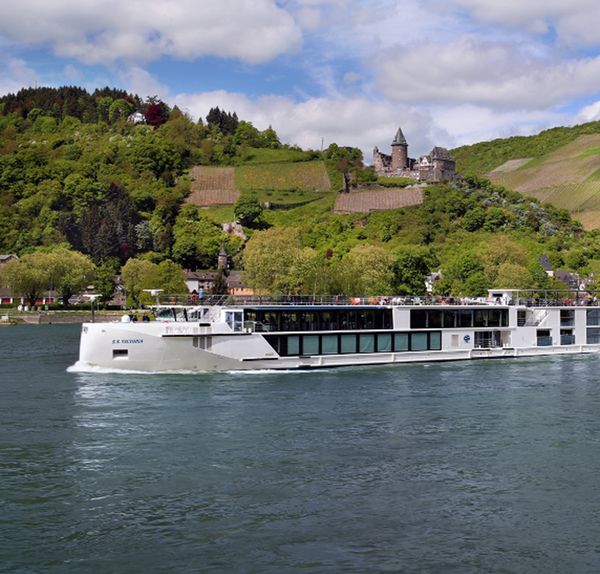
Silver Endeavour
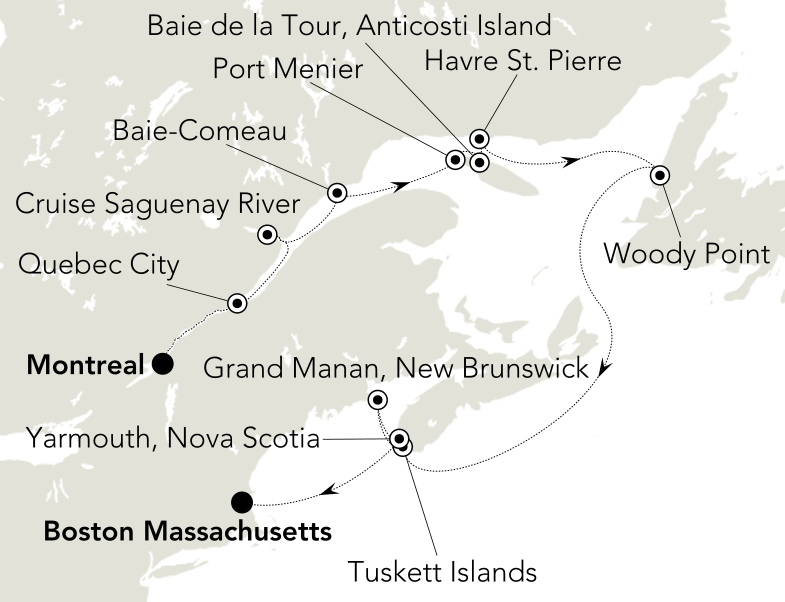
A 12-night expedition voyage aboard Silver Endeavour, Montreal, Canada to Boston Massachusetts, United States of America. Destination: Canada & New England.
Operated by Silversea Cruises aboard Silver Endeavour.
Montreal
Quebec City
Cruise Saguenay River (Quebec)
Baie-Comeau, Quebec
Port Menier, Anicosti Island
Baie de la Tour, Anticosti Island
Havre St. Pierre (Quebec)
Woody Point, Newfoundland
Tuskett Islands
Grand Manan, New Brunswick
Yarmouth, Nova Scotia
Boston Massachusetts
A festival and foodie heaven Montreal is a fascinating French flavoured destination of old-time European splendour and glittering urban charm. An elegant place of history pavement cafes and cobbled streets - Montreal wears its French heritage with a healthy dash of on-the-pulse Canadian cool. Set on the banks of the mighty St. Lawrence River you can head to beaches and elegant parks that open out onto the pretty waterfront. Mount Royal is a jewel of the city and on warm days locals spill out onto its sloping grasses to soak up the sun. Rise to the top to look down over the reaching skyscrapers of downtown. The city's massive botanical gardens are alive with the sounds of flowing water and surreal floral sculptures. The vivid colours of the impressive Notre-Dame Basilica's interior add more vibrancy while a diverse set of museums and galleries offer plenty of space for both traditional and contemporary art. The sounds of ivories tinkling and basslines wandering are ever-present in downtown – whether it’s street performers earning a living or jazz musicians riffing in dusty bars. The city’s musical swing ramps up a notch during the famous Montreal Jazz Festival which brings international talent to the city en-masse. It’s impossible to visit Montreal without sampling its ultimate comfort food poutine. French fries smothered in gravy cheese curd and your choice of topping. It’s as Québécois as ice hockey and bagels.
Established by the French settler Samuel de Champlain before the British landed on these shores Quebec City - initially known as New France - is one of North America's oldest cities. Towering over the banks of the Saint-Lawrence River Quebec City relishes in details and eccentricities and has reams of rich history and beautiful architecture - like the famous Château Frontenac. This chandelier-clad castle watches over the city and is said to be the world’s most photographed hotel. The wooden boardwalk of the canon-lined Dufferin Terrace offers stunning views of the city from its elevated standpoint. The French storybook feel has been delightfully protected and preserved in Quebec City's storied old quarter and a funicular links the upper and lower towns of this historic core. The 400-year-old fortified city is unique to North America and a celebrated UNESCO World Heritage Site. Mind your step as you wander through uneven cobbled streets to Place Royale - the charming spot where the city was founded - and between the bistros boulevards and boutiques of the dainty Quartier Petit Champlain area. There’s a wide variety of delicious international food to try and of course – greasy helpings of poutine. Taste local cheeses at the Marché du Vieux-Port indoor market where you’ll sink your teeth into buttery cakes pastries and encounter Canada’s fabled tree sap maple syrup - revered like wine in these parts.
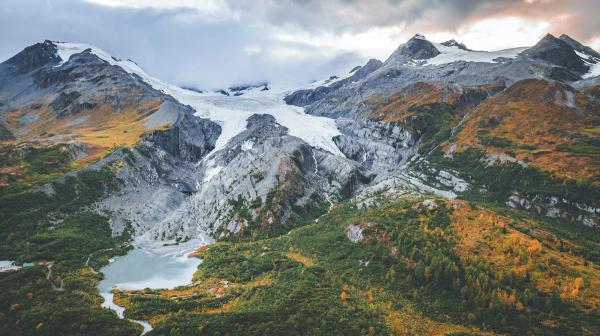
As Mother Nature combines all her efforts into producing a spectacle that could only exist in nature, enjoy the palate of autumnal colours against a late summer sky. Quiet and unspoilt, the Saguenay River (some might say fjord) was formed during the last Ice Age, and is the most southerly such terrain in the northern hemisphere. As the river gushes out into the massive St. Lawrence, its slightly warmer water mixes with the saltier, more frigid water of the mother river, creating massive volumes of krill, the basic food for whales. Hence whale sighting is reported to be excellent, so be on the lookout with your cameras, binoculars and notebooks at the ready. Forested hillsides, blazing with autumnal foliage, pastoral scenes with cattle and sheep grazing in grassy meadows below towering mountains and steep cliffs with sheer rock faces all contribute to the gorgeous scenery of a region of unsurpassed natural beauty.
Baie-Comeau, Quebec, Canada Located in the Côte-Nord region of the province of Quebec, Canada, the city of Baie-Comeau is nestled on the shores of the Saint Lawrence River near the mouth of the Manicouagan River, and is the seat of Manicouagan Regional County Municipality. The city is comprised of two urban centres, Baie-Comeau proper and Hauterive. The landscape of the Baie-Comeau region has been shaped by glacial retreats and other natural phenomena. Important geological features include the Manicouagan and St. Lawrence rivers in the Manicouagan-Uapishka World Biosphere Reserve, and the immense Manicouagan crater, which was formed by a meteorite. The oldest part of Baie-Comeau is the Old Post, or Vieux-Poste, an area near the mouth of the Amédée River. In 1889, the Saint-Eugène-de-Manicouagan Mission was founded by Eudists, and the first sawmill in the Côte-Nord region was built in 1898. In 1916, Route 138 was extended to Saint-Eugène-de-Manicouagan and in 1929, its post office opened with the English name of Comeau Bay. Eastern Baie-Comeau was founded in 1936 with the construction of a paper mill. The region's burgeoning timber, pulp and paper industries prompted remarkable growth, and the town of Baie-Comeau was incorporated the following year. In 1950, the village of Saint-Eugène-de-Manicouagan was incorporated as the Municipality of Hauterive. In 1982, Hauterive was merged into Baie-Comeau. As a result of its deep-water seaport and access to forestry, energy and mining in northeast Canada, Baie-Comeau combines sustainable industrial development with a thriving natural ecosystem. In fact, few others cities around the world possess a major industrial complex at the heart of a global reserve like the World Reserve Biosphere of Manicouagan-Uapishka. The Baie-Comeau region also boasts engineering masterpieces in the realm of hydroelectricity, including the Jean-Lesage Generating Station, Manic 2Central Dam, Manic 5 Generating Station and Daniel Johnson Dam. The development of the Baie-Comeau region was bolstered by the industrialization of modern Québec by means of its natural resources. The presence of the Saint Lawrence River, forestry, the creation of saw and paper mills, and the emergence of a world-class aluminum smelter all led to the expansion of the territory. Baie-Comeau and its environs are ideally-suited for a variety of popular inland and coastal excursions. Its proximity to the confluence of the Manicouagan and St. Lawrence rivers in the Manicouagan-Uapishka World Biosphere Reserve offers easy access to a vast natural paradise replete with exceptional geological phenomena, incredibly rich wildlife and forest habitats. Explore the exquisite coast and crystal-clear waters teeming with marine mammals and undersea treasures whilst boating, kayaking, scuba diving, fishing, and hunting. In the summer, an abundance of activities include golf, cycling and hiking trails, beaches, parks, flight-seeing, and more. Winter is no less exciting; the region's abundant snowfall is ideal for downhill skiing at the Centre de ski du Mont-Tibasse, and cross-country skiing and ski-skating at Sentier Norfond and Les Sentiers de la Rivière Amédée. Due to its compact size, Baie-Comeau can be easily explored in just a single day. Going Ashore in Baie Comeau Pier Information The ship is scheduled to dock at the Baie-Comeau Pier. Baie-Comeau's city centre can be reached via a 0.9-mile (1.5-kilometre) taxi-ride. Shopping In addition to its three shopping centres, Baie-Comeau offers a wealth of boutiques specialising in woven goods, pottery, paintings, and more. Included are the commercial arteries of the Plateau and Place La Salle, Les Galeries Baie-Comeau, Centre Manicouagan and Centre d'achat Laflèche. The local currency is the Canadian Dollar. Cuisine Baie-Comeau's cold, clean coastal waters and fertile land offer a wealth of sumptuous dining selections. Among the many local favourites are seafood, sea urchins, Stimpson's surf clams, fish, and venison, along with wild berries and Canadian dishes. Popular restaurants in-and-around Baie-Comeau include La Cache d'Amélie for gourmet food, fine dining, regional specialities, seafood, and table d'hôte, and the Resto-Pub L'Orange Bleue for grilled dishes, paninis, seafood, pasta, and regional specialities. Other Sights City Centre Baie-Comeau's city centre is easily accessible by taxi. It features historical buildings, charming boutiques, restaurants and renowned local landmarks. Symposium de Peinture de Baie-Comeau Baie-Comeau is a friendly and welcoming community offering a wide array of cultural activities; its Symposium de Peinture de Baie-Comeau is renowned throughout the province and country, and has been North America's largest painting symposium for the past two decades. Centre des Arts de Baie-Comeau This cultural complex is the hub for performing arts in Baie-Comeau, from classes to rehearsals to presentations. Audiences enjoy a rich variety of theatre, song, dance, jazz and other music, as well as productions for younger spectators. Galerie d'art Claude Bonneau One of Québec's most distinctive galleries, the Galerie d'art Claude Bonneau features paintings by artist Claude Bonneau displayed in a unique setting. Manicouagan-Uapishka Located north of Baie-Comeau in Manicouagan, this UNESCO World Heritage Site is a vast forested territory that includes Monts Groulx, the massive Manicouagan meteorite crater, Île René-Levasseur, and enormous hydroelectric facilities such as the breath-taking Barrage Daniel-Johnson. Parc des Pionniers Starting at the pier, visitors can take a delightful stroll along the shore of this beautiful park, which ranks among the most popular sites in Baie-Comeau. Garden of the Glaciers Located by the St. Lawrence River in the heart of a world biosphere reserve, Baie-Comeau's Garden of the Glaciers is a unique integrated site for interpretation, exploration and education. Journey through geological time to observe the evolution of the planet during the last Ice Age via activities such as Tyrolean traverses, hiking, sea kayaking, and interpretive cruises. Patrimonial Quarter Departing from the Maison du Patrimoine, a walking tour through the Patrimonial Quarter offers an ideal opportunity to discover Baie-Comeau's heritage area. The tour highlights history, architecture and several important landmarks interspersed with interesting boutiques and colourful art galleries. Manic-2 Hydroelectric Facilities Manic-2 is an important hollow-joint gravity dam and the first to be put in service at the Manic-Outardes complex. Tour the reception building, Georges-Dor Pavilion, which holds an actual turbine, Exhibit Hall, and a Multimedia Room that explains the construction and operation of the dam. Afterward, take a guided tour to the heart of Manic-2 and visit one of the station's powerful generators. Village Forestier d'Antan The forest industry was crucial to the development of Baie-Comeau's north shore. Activities such as cutting, hauling, driving and other aspects of life in the forest are presented at this interpretation centre. =Typical buildings, period objects and old photographs illustrate the lumberjacks' living conditions and way of life in this period. Boisé de la Pointe-Saint-Gilles Located in the heart of Baie-Comeau, this wooded area offers 11 vast walking paths amidst vegetation, ancient trees, rest-stops, sculptures, carved panels, La Fontaine's fables, wooden sidewalks, and more. Phare de Pointe-des-Monts Built on a rocky point at the mouth of the Gulf of the St. Lawrence, the Pointe-des-Monts Lighthouse is testament to a time when navigating this river was often a dangerous challenge. Exhibits can be viewed on all seven floors of the lighthouse; view furniture, interpretive panels and photos illustrating the living conditions of the guardians, and learn about the shipwrecks and survivors who sometimes had to stay here throughout the entire winter. Centre National des Naufrages du Saint-Laurent The National Centre for the St. Lawrence River Shipwrecks tells the story of numerous strange and extraordinary shipwrecks in the area. View a multimedia show, explore the artefacts exhibit, or simply stroll along the beach in search of whales or seals. Argile eau Mer The sea mud at this site contains particles purported to have important medicinal properties. Learn how the company's various products are made, and can contribute to one's health, beauty and vitality. Outdoor Activities Baie-Comeau's spectacular natural beauty combine to create a wonderful array of outdoor activities, including nature-watching, cycling, hiking, bird-watching, hunting, golfing at the Club de Golf de Baie-Comeau, and flight-seeing via the Labrador Air Safari. The city's scenic coast, beaches and teeming coastal waters are ideally-suited for kayaking, scuba diving, whale-watching and fishing. Private arrangements for independent sightseeing may be requested through the Shore Concierge Office on board the ship.
The otherworldly limestone structures of the Mingan Archipelago await at Havre St. Pierre Quebec's most northerly call. Perched on the northern shore of the mighty St Lawrence River's gaping jaws - and looking out across the vast stretch of water to the distant Anticosti Island - where white-tailed deer stalk dense forests - Havre St. Pierre is a feast of staggering scenery and diverse wildlife. The Mingan Archipelago's monolith treasures have been carefully painstakingly sculpted by Mother Nature's hand - using ocean wind and ice erosion to create towering rock outcrops which stand improbably counterweighted and precariously balanced over the waters. Sail between the scattered array of islands and formations and keep your eyes peeled - you may be joined by pods of friendly minke whales as you weave between skerries and rocky isles. Look out for eagles soaring overhead too and the colourful puffins which nest on the sheer cliffs. Back at Havre St. Pierre stroll isolated river beaches and wander the wooden boardwalk to soak in panoramas of the world's largest estuary - which lures the world's mightiest animal the blue whale to feast in its krill-rich depths. A walk out to the quaint lighthouse which crowns the shore is a pleasant way to spend an afternoon or you can take some time to learn a little more about the culture and traditions of the region's Inuit people.
Acclaimed for its unearthly landscape Woody Point is probably as close to Mars as you will ever get in this lifetime. Situated on the west coast of the island the Tablelands behind Woody Point in the Gros Morne National Park are composed of peridotite — like much of the surface of Mars — and NASA the Canadian Space Agency plus others are studying this unique land form searching for insights into possible bacterial life on the red planet. The story of the Tablelands earned Gros Morne its World Heritage Site status from UNESCO in 2010 and the area remains a geological wonder showcasing a time when the continents of Africa and North America collided. When the plates struck 485 million years ago the peridotite was pushed to the surface and remained above sea level. The rock lacks the nutrients to sustain plant life thus giving the Tablelands a barren isolated appearance. As the name suggests the flat topped mountains dwarf the tiny village (population 281!) yet Woody Point has retained its character and the historic houses and buildings dating from 1870 have been beautifully maintained.
Days at sea are the perfect opportunity to relax unwind and catch up with what you’ve been meaning to do. So whether that is going to the gym, visiting the spa, whale watching, catching up on your reading or simply topping up your tan these blue sea days are the perfect balance to busy days spent exploring shore side.
Grand Manan Island, located in the world famous Bay of Fundy, is the largest of the Fundy islands, but is only is 21 miles long and 11 miles wide at it widest point. Almost all the residents live on the eastern side of the island, since the western side has huge 300 foot cliffs and high winds. Reader’s Digest Magazine voted Grand Manan as one of the World’s 7 Best Small Islands because of its friendly people, scenic beauty and serenity. It is also a recognized world-wide as a North American birding hot spot. Ever since James John Audubon visited in 1833, birders have been coming to find some of the over 240 species of birds that make the island their home. The waters surrounding the island are an important feeding area for a number of whale species, including minke, fins, humpback whales, and the rare North Atlantic right whale.
Historic yet revolutionary, few places embody the American dream quite as well as Boston - and you’ll feel the strong independent streak, and pride in the founding ideals of freedom and independence wherever you go. Skyscrapers mingle harmoniously with cobbled streets, and every footstep here promises new tales of legend, daring and valour, as you walk through the pages of history and immerse yourself in the stories of one of the USA’s oldest cities. The flashing colours of Fall – a period when the foliage around Boston explodes with blazes of red, orange and purple – attract visitors from across the world, more than compensating for the northerly city’s harsh winters. Green open spaces like Boston Public Garden also decorate the city, offering breathing space, and the chance to enjoy blossom-perfumed sanctuary,as you sit among scampering squirrels and quiet boating lakes. At times, Boston feels like an open-air history museum, and the Freedom Trail links together the city’s many valuable historic sites. It’s no exaggeration to say that the world’s history pivoted significantly on this humble two-and-a-half-mile trail. Wander across incendiary sites like the Boston Massacre Site, and Bunker Hill - where the first shots of the American Revolutionary War were fired, eventually leading to independence from British rule. Fenway Park is the cathedral-like home of Boston’s famous Red Sox, and a must visit for any sports fan. You’ll also find plenty of acclaimed New England seafood to sample, including famous buttery clam chowder. Restaurants in the thriving Seaport District serve up freshly harvested crab and lobster, accompanied by spectacular views of the crashing Atlantic waves.
From $17,000
per guest · 12 nights
Prices are a guide and vary with season, cabin category and party size. Your advisor will confirm the exact cost before anything is booked.
Classic Veranda
suite
Deluxe Veranda
suite
Grand 1 Bedroom
suite
Owner 1 Bedroom
suite
Premium Veranda
suite
Silver
suite
Superior Veranda
suite