




Prefer a conversation?
Our team is always available to guide you through the process and ensure your experience is perfectly matched to your preferences.
Our team is always available to guide you through the process and ensure your experience is perfectly matched to your preferences.
Duration
10 Nights
Price
From $8,350
Ship
Silver Dawn
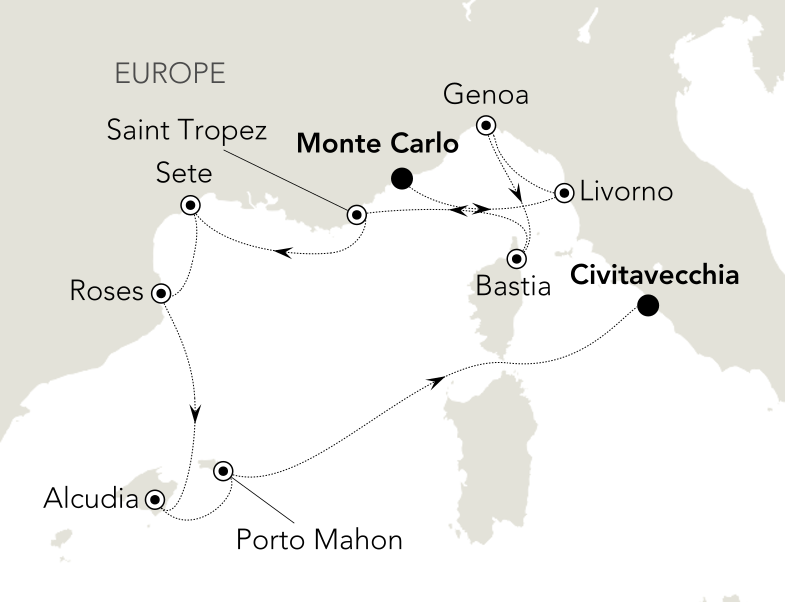
A 10-night ocean voyage aboard Silver Dawn, Monte Carlo, Monaco to Civitavecchia, Italy. Destination: Mediterranean.
Operated by Silversea Cruises aboard Silver Dawn.
Monte Carlo
Livorno (Tuscany)
Genoa
Bastia, Corsica
Saint Tropez
Sete
Roses
Alcudia, Mallorca
Porto Mahon
Civitavecchia (Rome)
Glitzy glamorous and unashamedly luxurious – live the high life in Monte Carlo. From the super-yachts jostling for position in the harbour to the lavish bars splashing out iced champagne tiny Monaco’s only city is a high rolling decadent affair - and a gloriously indulgent sun-soaked taste of the good life. Famed for its low tax status - and the Formula One race that roars through its hairpin bends and tight streets each year - Monaco is the ultimate playground of the rich and famous. Monaco may be the world’s second-smallest country - only the Vatican has a smaller footprint - but Monte Carlo has a confidence impact and appeal that few can match. The gilded Royal Palace adds an air of regal glory and whether you want to soak up the culture at the opera or raise the stakes at a casino - doing your finest 007 impressions - you’ll feel very much at home here. Soar above the high-rise hotels and glorious casinos in a helicopter to see the city from above and admire landmarks like the cathedral where Grace Kelly married the Prince of Monaco in 1956. High-end fashion fragrances and fancy adornments await in the gold-label shops of Monte Carlo's lavish shopping streets while the old town’s pink and lemon floral facades offer an authentic balance of historic character to counterpoint the well-heeled excesses. A wonderful escape revel in old-world glitz and glam as you admire twinkling chandeliers and wander between palatial architecture while enjoying your time in Monte Carlo's abundant wonderland.
The Tower of Matilde is an iconic structure of the city of Livorno. This medieval tower is said to have been built by the famous mathematician and astronomer Galileo Galilei. It is named after Matilde di Canossa, an influential noblewoman who played a key role in the political and religious conflicts of the 11th century. Matilde was a powerful figure in medieval Italy, and her legacy is still felt in Livorno today. The tower was built on her orders as a defensive stronghold to protect the city against invaders, and its strategic location on the coast made it an important part of the city's defenses. Over the centuries, the Tower of Matilde has been restored and renovated several times, but it still retains its original medieval charm. The tower is a classic example of medieval architecture, with its thick walls, narrow windows, and imposing structure. The tower was later used as a watchtower during World War II and is now a popular tourist attraction as visitors can climb to the top and enjoy panoramic views of the surrounding area. The Tower of Matilde is also an important cultural landmark in Livorno. It is often used as a venue for cultural events and exhibitions, and its unique atmosphere and ambiance make it a popular destination for artists and writers.
Most famous for being the birthplace of Christopher Columbus, Genoa is one of Italy’s true unsung heroes. Stretched out along the Mediterranean coast just over 100 miles from France, the city is the capital of Liguria, or the Italian Riviera, and has the history to prove it. Once the main trading centre for Italy, Genoa has a fine legacy of wealth behind it. The area once had complete control over the Tyrrhenian Sea, and its vast reach stretched as far as Nice to the west, Sardinia in the south and into the Piedmont mountains in the north. Exports were many, but perhaps the most lucrative of these was the rough denim cloth that sailors would wear, today more popularly known under the moniker blue jean. This affluence has left its mark on the city, think ornate gates, large, leafy palazzos, lavishly decorate churches and a Centro Storico – or Old Town – that speaks volumes. Grab your best hiking boots and wander the narrow alleys and steep hills and imbibe in the inherent Italianism of the city. No could talk about Genoa’s history without mentioning its food. Home of both Pesto and Focaccia, Genoa is considered by many to be one of the cornerstones of Italian gastronomy. The city’s cuisine is very much a product of its terrain: The Mediterranean yields freshly caught fish and seafood found on almost every menu, while the mountains supply the meat, cheese and above all herbs that flavour the dishes. It may not be fancy, but if you like good, simple Italian food, you have come to the right place.
Corsica's northern capital, Bastia, is the centre of commerce and industry and a thriving freight and passenger port. Commerce, more than tourism, is its main focus, providing employment for many Corsicans. Bastia's industrial sprawl, however, is offset by its aged charm. The presence of an overwhelming Italian atmosphere adds to the city's attraction. Two distinct areas comprise the city: Terra Vecchia, the old quarter, consisting of haphazard streets, flamboyant Baroque churches and lofty tenements, with their crumbling golden-grey walls set against a backdrop of fire-darkened hills; and the more orderly Terra Nova, the historic district favoured by prominent doctors, lawyers and architects. The city dates from Roman times, when a base was set up at Biguglia to the south. Under the Genoese, Bastia was the island's capital for four centuries and of major importance for the export of wine to the Italian mainland. They built a fortress (bastiglia), which gave the town its name. The Genoese also were responsible for laying the foundation for the area's prosperity by planting vines, olives, chestnut trees and other experimental crops. This resulted in an energetic and enterprising region, still a characteristic of today's northern Corsica. Although Napoleon had appointed Ajaccio the capital of the island in 1811- initiating a rivalry that still exists - Bastia established a stronger trading position with mainland France. As a result, the Nouveau Port was created in 1862 to cope with the increasing traffic with France and Italy. Bastia's economic prominence and a German division based here during World War II accounted for severe bombing attacks. Many buildings were destroyed, including much of the old governor's palace. Of the two largest towns on the island, Ajaccio and Bastia, the latter boasts a more genuine Corsican character. Visitors can experience an authentic feel of island life by wandering through the maze of narrow streets of Bastia's old quarter and by exploring its fortifications. Don't miss the vast Place Saint-Nicolas just north of the old quarter; it is the focal point of the city. Open to the sea and lined with shady trees and sidewalk cafes, it is a perfect place for people watching and for taking in the local ambiance. Pier Information The ship is scheduled to dock at the port of Bastia. The city's focal point, Place Saint-Nicolas, is a distance of 650 feet (200 metres) to walk. Taxis are generally available at the pier but it is highly recommended to book in advance if you want to be sure to get one. It is recommended to establish the fare before leaving the port. Shopping The main shopping streets, Boulevard Paoli and Rue Cesar Campinchi, are less than one half miles (500 metres) from the port terminal. Handicrafts and the area's specialties such as honey, wine and liqueurs may be of interest. Most shops are open from 9:00 a.m. to 12:00 p.m. and 2:30 p.m. to 7:00 p.m. Shops are closed for the day on Sundays and some shops may also close Monday mornings (some souvenirs shops may open Sundays during the high season of July-August). The local currency is the euro. Cuisine A variety of restaurants offer a good choice of eating possibilities. Some of the best restaurants are found around the Vieux Port and on the Quai des Martyrs. French cuisine and seafood feature prominently on menus as well as such Corsican specialties as wild boar, charcuterie and aziminu, a local version of bouillabaisse. Evidence of Bastia's strong Italian influence is apparent in the numerous pizza and pasta places in the Nouveau Port area. For outdoor dining and people watching, cafes around lively Place Saint-Nicolas are a perfect place. Other Sites Oratoire de Saint-Roch Located in the Terra Vecchia quarter, the chapel is a Genoese Baroque extravaganza built in 1604. The walls are covered with finely carved wooden panelling and the organ is magnificent with its decoration of gilt and wooden sculpture. Oratoire de L'Immaculee Conception Although its exterior is rather austere, the flamboyant interior of this 17th-century church with gilt and marble ceiling, frescoes and crystal chandeliers creates an ambiance of an opera house. Vieux Port Site of the original Porto Prado, the area around the Vieux Port is the most appealing part of town. Its soaring houses seem to bend inwards towards the water. Once busy with Genoese traders, the building of the ferry terminal and commercial docks have reduced much of the action at Vieux Port. Terra Nova As the administrative core of old Bastia, Terra Nova displays a distinct air of affluence. Its most impressive building is the 14th-century Governor's Palace. During the Genoese heyday the governor and the bishop lived here, entertaining foreign dignitaries and hosting massive parties. Private arrangements for independent sightseeing may be requested through the Tour Office on board, subject to the availability of English-speaking guides.
A glitzy, glamorous coastal resort that needs no introduction, Saint Tropez is the French Riviera hotspot of choice for A-listers and flotillas of gleaming yachts. The sparkle of its beaches, and clarity of its light, continues to attract artists - but it was the famous presence of Brigitte Bardot that leant Saint Tropez its enduring glamour and steamy appeal. Nowadays, speedboats skim offshore, while fine vintages from the vineyards nearby are uncorked in top-notch restaurants, in this well-heeled highlight of the Cote d'Azur. Famous bars offer views of the port along Quai Jean Jaurès, with its iconic cherry-red directors' chairs. Here you can admire the monstrous wealth of yachts that sparkle on the waters. On the same corner, big-name brand labels glimmer in the shops of rue François Sibilli - which cuts inland from the charming waterfront. The earthier appeal of boules clinking and thumping into the ground can be enjoyed at Place des Lices, where sun-wrinkled locals compete. Saint Tropez has a few beaches of its own, but famous stretches like Pampelonne Beach draw the biggest crowds to relax on star-studded golden sands. La Ponche, the authentic fishing quarter, retains its cobbled, historic elegance, and a 17th-century, hexagon-shaped citadel watches over the city and coastline from above. Coastal walks in the sea air snake away from the city’s bustle, and a series of headlands shape the stunning riviera landscape surrounding Saint Tropez. The historic monochrome Cap Camarat lighthouse adds a pleasing accent to hikes above the sparkling Mediterranean’s waves.
Set on a lagoon beside the Mediterranean's waves Sete's streets are interspersed with canals and the historic Canal du Midi terminates here. Canal boats joust on the river during August’s festival in this working city of breezy nautical charm. Known as the Venice of Languedoc house facades front up against canal banks while leisurely cruises offer romantic trips through this colourful maritime city. The ascent of Mount St-Clair is perhaps the best spot to appreciate this wonderful watery setting and you can also take in the bright frescoes of Chapel of Notre Dame de la Salette while you're there. Or absorb the town’s deep fishing heritage with a harbour walk among the bobbing little boats or within the preserved La Pointe Courte fisherman’s village. Sit down to sample the incredible sea life at fine restaurants which plate up mounds of juicy oysters and shellfish hauled ashore from the waters. Swing golf clubs on rollercoaster coastal courses or relax on mile after mile of golden beach which stretch out along the spit nearby. Inland discover rich medieval history beautifully preserved at the walled city of Aigues-Mortes. Mighty Carcassonne UNESCO World Heritage Site also stands within reach inviting you to enter a majestic fairy-tale citadel of fantasy turrets and imposing battlements. Step across the drawbridge and brush shoulders with armed soldiers and artisans inside this living timewarp's immense ramparts.
Located at the tip of Northern Spain - close to the French border - Roses is a city known for its magnificent beaches, and extraordinary history. Blessed with beaches painted with a broad brush, the long, wide stretches of golden sand here make it one of the Costa Brava's most desirable locations. Roses sits on the outward curve of the Bay of Roses - facing west - so it’s one of the few places on the coast where you can sit back to watch the sunset lighting up the waves with roaring oranges and pinks, as the night draws in. Exploring Roses Giant waves of inviting sandy beach offer plenty of space for everyone to stretch out and make the most of Roses’ glorious sunshine. The Bay of Roses is an undisturbed banana of golden sand, while Playa de Roses invites you to lie back, and watch ships slipping across the horizon. For a touch of colour, head out to Butterfly Park Empuriabrava, where gorgeous toucans, vivid flowers, and patterned butterflies flash brightly. Afterwards, wander into town for sangria, or to taste barbecued octopus. Should you somehow tire of endless golden beaches and the Med's lapping waves, then dig into the history that the bay has to offer. Founded by the Ancient Greeks in the 5th Century BC, the glorious ruins of Empúries lie exposed at the southern end of the Gulf of Roses – watching over Sant Marti de Empuries beach. The low walls, and eroded pathways of Greek and Roman ruins are beautifully preserved - with delicate octagon-patterning and mosaic floors to discover. Take the free audio guide to learn how the Roman and Greek settlements coexisted harmoniously. In Roses itself, explore rich medieval history at the Citadel. Facing repeated attacks from the pirates and privateers of North Africa, Roses constructed steep Medieval fortifications to seal off the city. Enter the walls to walk among the sprinkled wildflowers and littered ruins. If you're lucky, you might hear live music reflecting off the stone-work, during the soaring performances that are often held within the grounds. Roses can certainly do good food, and it was home to the legendary - almost mythological - restaurant elBulli. Repeatedly crowned the World's Best Restaurant, the three Michelin-starred restaurant closed its doors for the last time in 2011, serving a 49-course meal to go out with a bang. While there are talks of a comeback, in the meantime, satisfy your appetite with options like Els Brancs and La Llar - which both boast Michelin stars.
The first city to be located here was a Roman settlement, in 123 BC. The Moors reestablished a town, and after the Reconquest it became a feudal possession of the Knights Templar; the first ring of city walls dates to the early 14th century. Begin your visit at the Church of Sant Jaume and walk through the maze of narrow streets inside to the Porta de Xara, with its twin crenellated towers.
The capital of Menorca is a bashful member of Balearic Islands which wait off of the sunny Spanish coast. With atmospheric old towns tiny fishing villages and unspoiled beach coves this is one of the group’s lesser-known and explored gems – and all the richer for it. A UNESCO Biosphere Reserve there are wetlands and rolling sand dunes with diverse wildlife to explore - and 220 different birds soar and wade within. The designation helped to halt the threat of overdevelopment and with gloriously clear waters and leisurely boating trips to enjoy Porto Mahon welcomes you to a wonderfully preserved and characterful island. The island’s capital spills around the Med’s largest natural harbour which sprawls out for three miles. The majestic organ that fills the interior of Santa Maria church with over 3 000 pipes is a sight to see and can produce a wonderful gut-vibrating noise. Filled with pottery and cake shops there’s an artsy laid back and creative atmosphere to Porto Mahon’s streets. Swing a golf club and crack drives through the salty sea air of Porto Mahon or rumble along the paved bike paths that ring the island exploring between wildflower sprinkled fields and stone walls. Or head straight for the many beaches and turquoise seas which are blotched with dark blue patches. When it’s time for a sit down in the shade order up a refreshing pomada - gin and lemonade – before settling on your sandy nook of choice to watch the setting sun sinking into the warm of the waves of the Mediterranean.
Days at sea are the perfect opportunity to relax unwind and catch up with what you’ve been meaning to do. So whether that is going to the gym, visiting the spa, whale watching, catching up on your reading or simply topping up your tan these blue sea days are the perfect balance to busy days spent exploring shore side.
All roads lead to Rome, and with good reason - this city is one of the world’s most thrilling, offering unmatched history along every street. An evocative, inspiring and utterly artistic capital of unrivalled cultural impact, Rome is a city of back-to-back landmarks, which will take you on an exhilarating journey through the ages. This may be one of the world’s oldest cities, but it’s well and truly lived in. The ruins are punctuated with murmuring cafes, and the outdoor seating of restaurants sprawls out across piazzas, enticing you to sample tangles of creamy pasta and crispy pizzas. Rome’s incredible Roman Forum is littered with the ruins of its ancient administrations, which have stood firm for 2,000 years, since the times when the area was the centre of the Western world. Few sites are more simultaneously beautiful and haunting than that of the storied Colosseum, which looms deep into Rome’s rich blue sky. Take a tour to learn details of the grisly goings-on within. The best way to experience Rome is to wander its streets, gelato in hand. There is a lot to see here - whether it’s the domed spectacle of the Pantheon, or the elaborate flowing waters and artistry of the Trevi Fountain. Vatican City is an astonishing, colossal display of Catholic grandeur, while the Spanish Steps – crowned by the Trinità dei Monti church – offer a beautiful spot to gather and soak up the lively atmosphere of this humming city. With so much on the to-do list, you’ll relish the breaks you take, enjoying simple pleasures like a strong espresso, or fresh pasta with tomato sauce and ripped basil.
From $8,350
per guest · 10 nights
Prices are a guide and vary with season, cabin category and party size. Your advisor will confirm the exact cost before anything is booked.
Classic Veranda
suite
Deluxe Veranda
suite
Grand 1 Bedroom
suite
Grand 2 Bedroom
suite
Owner 1 Bedroom
suite
Owner 2 Bedroom
suite
Panorama
suite
Royal 1 Bedroom
suite
Royal 2 Bedroom
suite
Silver
suite
Silver 2 Bedroom
suite
Superior Veranda
suite
Vista
suite








