




Prefer a conversation?
Our team is always available to guide you through the process and ensure your experience is perfectly matched to your preferences.
Our team is always available to guide you through the process and ensure your experience is perfectly matched to your preferences.
Duration
16 Nights
Price
From $15,150
Ship
Silver Wind Expedition
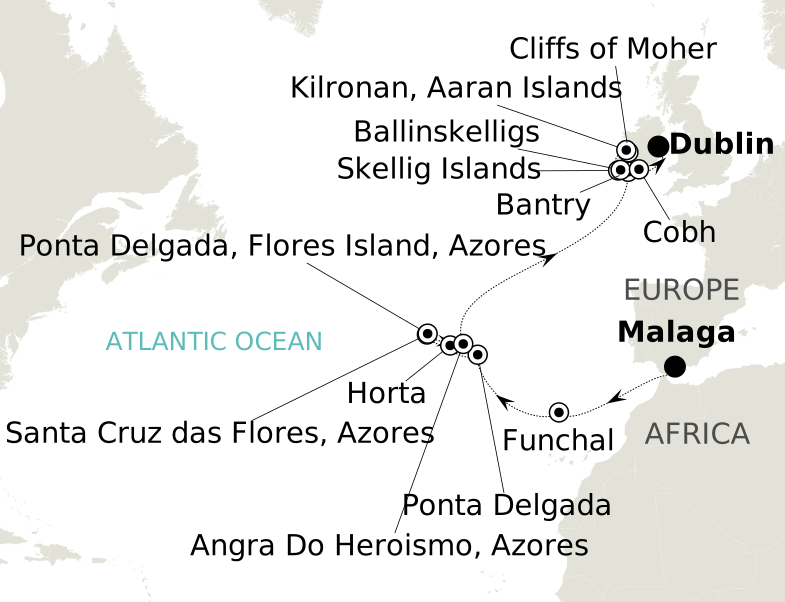
A 16-night expedition voyage aboard Silver Wind, Malaga, Spain to Dublin, Ireland. Destination: Mediterranean.
Operated by Silversea Cruises aboard Silver Wind Expedition.
Malaga (Costa del Sol)
Funchal, Madeira
Ponta Delgada (Sao Miguel Island)
Horta, Azores
Santa Cruz das Flores, Azores
Ponta Delgada, Flores Island, Azores
Angra Do Heroismo, Azores
Bantry
Cliffs of Moher
Kilronan, Aaran Islands
Skellig Islands
Ballinskelligs
Cork (Ringaskiddy)
Dublin
Bathing in the sunshine coast’s stunning subtropical climate, and laying out endless spectacular beaches, it’s no surprise that Malaga is one of Spain’s most popular cities. The already impressive cultural appeal of this holiday city has skyrocketed over recent years, and with a storied old town and Moorish fortifications, Malaga has a lot to offer. Nearby, you can recline on the renowned beaches of the Costa del Sol, or venture inland to discover the Moorish treasures of Granada and Cordoba. La Malagueta beach is Malaga’s spacious urban beach, perfect for a sunbathe and a dip in the warm water, before enjoying seaside cocktails or seafood tapas in the restaurants nearby. Malaga and the Costa del Sol may be best known for glorious weather and beaches, but Malaga can now stake a genuine claim as an artistic powerhouse too. Visit the renowned Picasso museum – housed in the artist’s birthplace – before exploring the freshly opened outpost of the Pompidou Centre. The art also spills out onto the streets in the colourful Soho district – splashed with vibrant street paintings. Known as La Manquita – or the one-armed woman – the city’s cathedral rises over the historic old town. Its huge bell tower stands tall, but an accompanying second tower was never completed - hence the nickname. The Alcazaba fortress palace looms over the waterfront and forms a spectacularly preserved remnant from the era when the Moors controlled the Andalucía region. Discover more of the Arabic influence by visiting Granada’s Alhambra palace, or Cordoba’s La Mezquita mosque. Together with Seville’s converted cathedral, the cities form Andalucía’s Golden Triangle of Moorish wonders.
Days at sea are the perfect opportunity to relax unwind and catch up with what you’ve been meaning to do. So whether that is going to the gym, visiting the spa, whale watching, catching up on your reading or simply topping up your tan these blue sea days are the perfect balance to busy days spent exploring shore side.
Days at sea are the perfect opportunity to relax unwind and catch up with what you’ve been meaning to do. So whether that is going to the gym, visiting the spa, whale watching, catching up on your reading or simply topping up your tan these blue sea days are the perfect balance to busy days spent exploring shore side.
The discovery of Madeira or the legend of the two lovers Although there are serious doubts as to whether the island was known as far back as antiquity, the official discovery of Madeira dates back to the 15th century and is attributed to Joao Goncalves Zarco. He set foot on Porto Santo in 1419 and on Madeira a year later. He named the island "Madeira"-wood in Portuguese- because of the immense forests that cover the island. However, legend has it that Zarco did not come here by chance. It is said that in the 14th century, a couple of lovers who were not bound by the sacred bonds of marriage fled by sea to live out their love. Their names were Anne d'Hertford, a Frenchwoman, and Robert MacKean, an Englishman. Their boat, pushed by a storm, ran aground on the island of Madeira. The two unfortunate lovers died shortly afterwards, one from illness, the other from sadness, but the sailors who were with them on the boat survived. Unfortunately for them, they were captured and sold into slavery in Morocco, where they recounted their adventures and the discovery of an island covered in forests with gigantic trees. The story reached the ears of the Portuguese, and it was thanks to them that João Gonçalves Zarco discovered Madeira and its precious wood.
Days at sea are the perfect opportunity to relax unwind and catch up with what you’ve been meaning to do. So whether that is going to the gym, visiting the spa, whale watching, catching up on your reading or simply topping up your tan these blue sea days are the perfect balance to busy days spent exploring shore side.
Providing a gorgeous green welcome to sailors venturing on the long journey across the Atlantic, Ponta Delgada’s shoreline is a reassuring sight, as it emerges into view. Sat on Sao Miguel Island, the largest of Portugal’s Azores islands - which wait on an outpost of western Europe, some 1,100 miles from the mainland. Ponta Delgada is the island’s largest city, and a place of spectacular volcanic vistas, steaming hot springs and impressive landscaped gardens. The city’s signature trio of arches welcomes you to Ponta Delgada, and its island of verdant volcanic contrasts. Wander between monochrome churches like the Gothic Church of St. Sebastian, and up to the Convent and Chapel of Our Lady of Hope – which houses the revered icon of Christ that is paraded through the streets annually, and believed to have miraculous powers by locals. Or, head for beaches offering sanctuary on charcoal-coloured sands, or the tropical António Borges Botanical Gardens, where tropical plants add extra shades to the Green Island's scenery. Now extinct, the mighty Caldeira das Sete Cidades is a truly awe-inspiring sight - and the colossal collapsed volcanic caldera blooms with lush greenery and scattered wildflowers. The vast crater has been taken over by a glowing, picturesque lake, which reflects the blue sky above. A full three miles wide - and with a circumference of eight miles - it’s a vast panorama to take in. The Lagoa de Fogo – or Lake of Fire – is another of the island’s calderas – rise up to see the crumpled scenery encasing a beautiful lake. São Miguel Island’s geothermal activity has practical uses too, and you can harness the powers to unwind any tired muscles after a long day, by sinking into the hot springs of Poca Da Dona.
Far adrift, in the Atlantic's vast sweep, Horta serves as a welcoming island respite for some truly epic ocean voyages. One of the most westerly parts of Europe, these Portuguese islands lie a full 1,100 miles from the coast of the mainland. The bustling marina here serves as the perfect stopover and a welcome respite for tired sailors and yachts embarking on transatlantic crossings. The colourful harbour is decorated with a multicoloured patchwork of their stories and flags, and adding to this massive, ever-growing mural is said to offer sailors protection while out on the seas. While Horta's clientele may come and go with the waves, there's nothing transient about the stunning volcanic cones and soaring wildflower-splashed hills that make up this beautiful Atlantic island pit-stop. Horta is the main city, and a charming welcome to dry land, as you step onto the pentagon-shaped island of Faial. On the frontier of continents, the violent meeting of the European and North American tectonic plates forged this beautiful archipelago - and the rich volcanic scenery here is ripe for exploration and adventure. The busy harbour lies before the dramatic backdrop of the neighbouring Pico Island's cloud-wisped peak - head up to Espalamaca Lookout for the best view of Horta's busy harbour and islands emerging nearby. Horta has a grand volcanic caldera of its own, and you can journey up through threads of cloud, to look down into the island's immense, bowl-shaped crater. The Lighthouse of Ponta dos Capelinhos is an island icon, having survived 1957's dramatic eruption. It now occupies a scenic location on a headland, surrounded by vast swathes of charred new land, which were churned out from the depths.
Flores means flowers and the island has been described as a floating green garden. This is due to the rich volcanic soils and the humid subtropical climate with frequent rainfall. Although not the original flowers, hydrangeas introduced to the Azores from Asia by the Portuguese have thrived—used as fences and even becoming the official flower of the Azores. The colour of the flowers depends on the acidity and mineral content of the soil, with the blue colour typically growing in acidic volcanic soils such as is found on Flores. Flores, along with the island of Corvo, form the western group of the Azores archipelago. The two islands are located on the North American Plate, west of the Mid-Atlantic Ridge where the central group of the Azores formed. Flores is a volcano whose last eruption was about 3000 years ago. Hiking reveals the central massif with deep valleys and high peaks, craters with lagoons and even a cavern and hot springs. Superimposed on the landscape are farms and vineyards. Flores is one of UNESCO’s Biosphere Reserves, supporting the partnership between ecology and the social use of the landscape for living and farming. Whaling was an industry in the Azores until the 1980s, with shore-based crews and local processing works. Sperm Whales were targeted and the deep waters around the Azores still support them and rarer beaked whales. Shallower water attracts Common, Bottlenose and Atlantic Spotted dolphins. Keep a look out for them from the ship when approaching and leaving the islands.
Sailing vessels needed a place to re-supply and repair on voyages between Europe and ports in Africa, the West Indies and the East Indies. Angra do Heroísmo (Angra) on Terceira Island in the Azores was the ideal port of call. But only if you were the correct nationality at the time. Angra has had shaky times both politically and literally. The Azores sit on the Azores Triple Junction, the spot where the North American, Eurasian and African tectonic plates are slowly pulling apart. This makes them vulnerable to tremors and volcanic eruptions. A severe earthquake hit the islands of Terceira and São Jorge in 1980 leaving scores dead and thousands homeless. In Angra, many historic buildings were damaged. The town was so faithfully restored that the town centre became a World Heritage Site in 1983. The town square and 400-year-old military fortifications are key historic features. Battles have been fought on Terceira twice. In the 1580s, the islanders fought against the Spanish occupation of the Azores, before eventually losing control to Spain. The Sao Joao Baptista do Monte Brasil Fortress was built by the Spanish, who defended it until the Portugal restoration in 1642. The fortifications are now protected in Monte Brasil Natural Park. During the Liberal Wars (civil war) of the 1820s, Angra served as the capital of Portugal for a government in exile. Angra’s citizens won a battle in 1829 which lead to Angra earning the honorary title of do Heroísmo "the Heroic”. Not a bad title to brag about.
Days at sea are the perfect opportunity to relax unwind and catch up with what you’ve been meaning to do. So whether that is going to the gym, visiting the spa, whale watching, catching up on your reading or simply topping up your tan these blue sea days are the perfect balance to busy days spent exploring shore side.
Days at sea are the perfect opportunity to relax unwind and catch up with what you’ve been meaning to do. So whether that is going to the gym, visiting the spa, whale watching, catching up on your reading or simply topping up your tan these blue sea days are the perfect balance to busy days spent exploring shore side.
Days at sea are the perfect opportunity to relax unwind and catch up with what you’ve been meaning to do. So whether that is going to the gym, visiting the spa, whale watching, catching up on your reading or simply topping up your tan these blue sea days are the perfect balance to busy days spent exploring shore side.
"They go to the cliffs of Moher rising out of the mist" … these words, written by great American poet Wallace Stevens, immortalised the cliffs of Moher in the best way imaginable. Romantic, wild, mysterious and beautiful, the cliffs of Moher are to Ireland what poetry is to prose. Located at the south western edge of: County Clare, the 300-million-year-old cliffs stretch for 14 km. They are by far the country’s most visited landmark, welcoming an astonishing 1.5 million visitors annually. The vistas are exceptional, and understandably the pride of Ireland. On a good day you can see for miles: all the way to the Aran Islands, Galway Bay, the caves, O’Brien’s tower and of course the many miles of cliffs themselves. Birdwatchers will be doubly blessed, as Moher is designated as a UNESCO Geo Park and enjoys a Special Protection status. Get your binoculars at the ready as the cliffs are filled with thousands of Guillemots, Razorbills, Fulmars and Kittiwakes, as well as the largest mainland colony of Puffins. The beautiful cliffs are rich with history and legend. Two theories surround why Irish Politician Sir Cornelius O’Brien commissioned his eponymous tower in 1835. The most common belief is that so he (and others) could benefit from the stunning views the cliffs have to offer. The more salacious believe that the tower was a place away from prying eyes for O'Brien to bring his lady friends! Whatever the reason, today the viewing platform on the roof still offers one of the best coastal views there is.
If you have ever wanted to imbibe in the Celtic legends of your past, then Kilronan is the answer to your prayers. Situated on the isle of Inishmore in the Aran Islands in County Galway, Cill Rónáin – the official Gaelic spelling – is all about history, spirituality and the kind of rejuvenation that can only be found on Irish soil. The first thing you should know about the Aran Isles is that they are exceptionally beautiful. National Geographic called them “one of the world’s top island destinations” and they are universally recognised as being the “islands of saints and scholars”. Windswept moors and craggy cliffs akin to a Victorian novel flank rolling seas that are Dantesque in their raw power. This is where nature comes home to roost (not to mention the 60,000 seabirds that call the islands their home). Inishmore (Inis Mor) is the biggest island of the archipelago, and as such has the most interesting Celtic history. Over 50 Celtic, Christian and pre-Christian sites are on Inishmore alone (with others on the other two islands that make up the rest of the archipelago). The most important of these site is perhaps the prehistoric fort of Dún Aonghasa, “the most magnificent barbaric monument extant in Europe”. Perched precariously on a 100-metre-high cliff, the fort dates back 3,000 years and is one of Ireland’s most ancient and sacred sites. Little is known of the history of Dún Aonghasa, not who Dún Aonghasa may have been, but a placing so close to the sea edge suggests ritualistic significance.
If you think that the Skellig Islands look familiar, that’s because they are. The Skelling Michal towers set the scene in episodes seven and eight of the Stars Wars franchise, and local tourism has been feeling the force ever since. Aside from being in a galaxy far, far, away, the magnificent the Skellig Michael towers have been a UNESCO World Heritage Site since 1996. The two Islands were (Great Skellig and Little Skellig) were part of a Gaelic Christian Monastic settlement from the 6th to the 12th century and the towers on Skellig Michael (Great Skellig) are a “unique example of an early religious settlement” (as well as being a final resting place for Jedis). The towers are surely the main attraction of the area and are simply fascinating. Built in a beehive shape to protect against the harsh elements, they use local stone and no mortar. Today, some 1,400 years later, they are still practically intact. There is also a graveyard on the island. Although be prepared for some walking; there are 618 steps winding up to the stone summit, which can get slippery in bad weather. However, like most things that require effort, you will be rewarded once you reach the top. The breathtaking views and photo opportunities are well worth it! Little Skelling is equally as important for birders too; the island is home to almost 30,000 pairs of gannets, the second largest colony of seabirds in the world. Guillemots, Puffins, Manx Shearwaters and Storm Petrels also nest on the island, making up the “Skellig Big Five”.
The proud city of Cork dates back to the 7th century when St. Finbarr founded a monastery on a small alluvial island in the River Lee, where the impressive St. Finbarr's Cathedral now stands. An extensive and wealthy settlement grew up around the monastic foundation, attracting the attention of the Viking pirates who raided and burned the infant city and later built a new settlement. The 12th century saw the invasion of the Normans, who fortified the area with massive stone walls that were destroyed during the Siege of Cork in 1690. During the Civil War, in 1920, large areas of the city were damaged by fire. As a result of this long history of war and destruction, no medieval buildings from Cork’s turbulent past remain. In between the depredations, Cork became fairly prosperous; shipping and butter helped fuel the city's growth. Today, Cork is a pleasant city to explore, with a relaxing ambiance and friendly people. The city centre, essentially an island bound on either side by the River Lee, has an unassuming charm, with pretty bridges and quiet quaysides underlining Cork's history as a great mercantile centre. Many of the streets were once waterways; St. Patrick's Street had quays for sailing ships, and on the pavement in Grand Parade you can still see moorings dating from the 18th century when Cork was the most important port in Europe for dairy products. Stately Gothic churches, colour-washed houses and tree-lined streets add to Cork's quaint character.
Atmospheric cobbled streets with buskers scraping fiddles and characterful pubs inviting passersby inside is Dublin in a snapshot. Horse-drawn carriages plod along cobbled centuries-old streets blending with an easy-going cosmopolitan outlook. Known for its fun-filled gathering of pubs any excuse works to enjoy a celebratory toast and chat among good company. Home to perhaps the world's most famous beer - slurp perfect pourings of thick dark Guinness - cranked out for the city's thirsty punters. Learn more of the humble pint's journey at the Guinness Storehouse. Dublin has come along way since the Vikings established a trading port here back in the 9th Century. In the time since the city became the British Empire's defacto second city and the Georgian imprint still adds oodles of historic character. Learn of 1916's Easter Uprising when the Irish rebelled and established their independence here as you visit the infamous haunting Kilmainham Gaol. The uprising's leaders were tried and executed in these dark confines. Dublin's St. Patrick's Cathedral has immense history below its steep spire which dates back to 1191. There's rich literary heritage to leaf through too and the city's streets were rendered vividly in James Joyce's classic Ullyses. The Museum of Literature celebrates the full scope of Dublin's lyrical talents. Trinity College also has a prestigious roll-call of alumni - visit to see the Book of Kells a beautifully illustrated bible of the medieval era.
From $15,150
per guest · 16 nights
Prices are a guide and vary with season, cabin category and party size. Your advisor will confirm the exact cost before anything is booked.
Classic Veranda
suite
Deluxe Veranda
suite
Grand 1 Bedroom
suite
Grand 2 Bedroom
suite
Medallion
suite
Owner 1 Bedroom
suite
Owner 2 Bedroom
suite
Royal 1 Bedroom
suite
Royal 2 Bedroom
suite
Silver
suite
Vista
suite








