

Prefer a conversation?
Our team is always available to guide you through the process and ensure your experience is perfectly matched to your preferences.
Our team is always available to guide you through the process and ensure your experience is perfectly matched to your preferences.
Duration
15 Nights
Price
From $7,200
Ship
Silver Spirit
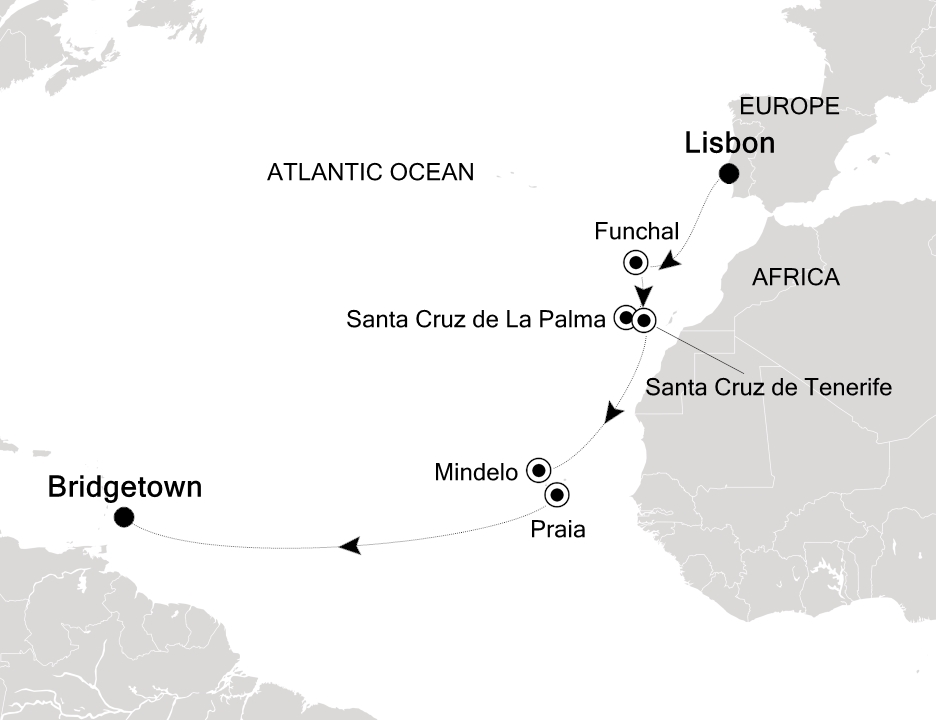
A 15-night ocean voyage aboard Silver Spirit, Lisbon, Portugal to Bridgetown, Barbados. Destination: Transoceanic.
Operated by Silversea Cruises aboard Silver Spirit.
Lisbon
Agadir
Arrecife, Canary Islands
Las Palmas, Canary Islands
Santa Cruz de La Palma (Canary Islands)
Mindelo
Praia
Bridgetown
A glorious mosaic of beauty, freedom and authenticity, Portugal’s capital is a stirring artwork of a city. Known for the seven hills it spreads across, and its stirring fado music, Lisbon is a pastel-coloured blend of houses and beautiful tile artworks - and this creative city strikes a perfect harmony between natural and manmade beauty. Stroll along Alfama's steep, cobbled streets as you explore one of the city’s oldest neighbourhoods - where each house and door could be its own photograph. Look for the decorative tiles, with the distinctive blues and whites of Azulejo ceramics, and visit the dedicated museum to learn more. Afterwards, wind up to São Jorge Castle, where views out across Lisbon’s red rooftops unravel. Just one of many majestic viewpoints, you can also seek out Miradouro da Graça for perhaps Lisbon's finest panorama, with the copper-coloured suspension bridge stretching over sparkling water beyond the sea of buildings. The elegant Tower of Belém rises in the Tagus estuary and is a historic defender of these shores. The grand, carved cloisters of Jerónimos Monastery spread out close by, and there's another UNESCO recognised location close by at Sintra, where a colourful town is set amid thick gardens and towering mountains - capped by the royal Pena Palace. Later, relax and take a quick break to drink Ginjinha, a cherry liqueur made from chocolate cups instead of coffee. Lisboetas have a sweet tooth, and the famous Pastel de Nata's crumbling pastry and caramelised-custard topping is the essential accompaniment to any coffee stop.
Days at sea are the perfect opportunity to relax unwind and catch up with what you’ve been meaning to do. So whether that is going to the gym, visiting the spa, whale watching, catching up on your reading or simply topping up your tan these blue sea days are the perfect balance to busy days spent exploring shore side.
شكرًا (Shookran) Merci ⵜⴰⵏⵎⵉⵔⵜ (Tanmirt) Although the official language spoken in Agadir is Classical Arabic, French, because of the country's history, is also widely spoken. But Agadir is also at the centre of a part of Morocco as big as Kentucky, where a third language is spoken: Tachelhit, the ancestral language of the Shilha people of Morocco. Spoken by almost 10 million Moroccans, the language is a variant of Berber, itself part of the Afro-Asiatic languages that include Semitic, Egyptian and Chadic, although certain characteristics may also link it to Central African dialects. It is one of the few living African languages with a literature dating back to before the colonial period. It consisted mainly of religiously inspired poetry and legends. The oldest surviving work is an Arab-Tachelhit dictionary dating from the twelfth century. Until the 16th century, however, Tifinagh ( ⵜⵉⴼⵉⵏⴰⵖ ) seems to have been used to write Tachelhit, an alphabet dating back to the 7th century BC, which was superseded by Arab domination. At the end of the 19th century, under French influence, the Latin alphabet was used, but recently there has been a very official return to Tifinagh to transcribe this language, which has been spoken since time immemorial. Although specialists still have doubts about the origin of this alphabet, it seems to have been influenced by Phoenician. ⴰ: A- ⴱ: B- ⴳ: G- ⴷ: D- ⴹ: Ḍ- ⴻ: E- ⴼ: F- ⴽ: K- ⵀ: H- ⵃ: Ḥ- ⵄ: Ɛ- ⵅ: X- ⵇ: Q- ⵉ: I- ⵊ: J- ⵍ: L- ⵎ: M- ⵏ: N- ⵓ: U- ⵔ: R- ⵕ: Ṛ- ⵖ: Ɣ- ⵙ: S- ⵚ: Ṣ- ⵛ: C- ⵜ: T- ⵟ: Ṭ- ⵡ: U- ⵢ: Y- ⵣ: Z- ⵥ: Ẓ
Nestled on the east coast of Lanzarote, Arrecife takes its name from the rocky reefs and outcrops that dominate its coastline. This pretty working city has a friendly, authentic feel, and has managed to remain true to its roots as a historic fishing village. There’s a lot to explore, and whether you want to lie back on long swathes of opulent golden sand, or strap on hiking boots to crunch across Lanzarote’s scorched volcanic scenery, this versatile capital has so much to offer. With castles, caves, sleepy beaches, and a glittering saltwater lagoon, Arrecife is the perfect place to get acquainted with the sun-kissed appeal of the Canary Islands. Lanzarote’s charcoal desert vistas radiate a remarkable luna-like quality, but dotted cacti, waving palms, and bursts of vibrant wildflowers add an accent of colour to the canvas. Arrecife itself boasts apricot-coloured beaches and labyrinthine lanes of white-wash buildings within its Old Quarter, where you can smell fresh fish grilling, and see locals dipping delicious local salty potatoes - papas arrugadas - into colourful sauces. An evening stroll along El Charco de san Gines is a must for watching fishing boats bobbing gently on the lagoon, and watching spectacular sunsets burning across the sky. Standing tall for more than four centuries, Castillo De San Gabriel is located on the tiny island of Islote de los Ingleses, and was once a target for pirates, who would appear menacingly on the Atlantic’s horison. The stalwart 16th-century fortress now serves as the History Museum of Arrecife, and exhibitions inside explore the evolution of the city, and the ancient culture of Lanzarote. The International Museum of Contemporary Art, meanwhile, displays modern and abstract works within the 18th-century San José Castle’s refined setting. See works from Cesar Manrique - the prominent artist and architect whose slick sixties style flair can be admired across the island.
Watch the stars glittering at night, climb jungled volcano calderas, and explore the historical allure of this entry point to the sun-gorged island of Gran Canaria. The sprawling capital of the Canaries is Spain's ninth biggest city, stretched out along the sparkling coastline. Visitors and locals alike blow off steam on the city's urban beaches, before filling out bustling, authentic tapas bars. An offshore barrier of lava strips waves of their power, making Las Canteras's urban beach expanse one of the best and calmest in the Canaries. Strap on your snorkel to explore the seabed, which blooms with colourful fish and tropical reefs. Or, settle back to soak in the warm glow of one of the best climates in the world, while reclining on the soft sand, which arcs along the capital's fringe. At the other end of town, La Vegueta old town is a charming stroll along cobbled streets, wandering past decorative doorways and balconies that beg to be photographed. The narrow 15th-century streets take on an extra romantic air in the evenings, as lanterns cast a soft glow over them. Calle Colon offers a hint of the street's history - and it's here where the handsome colonial house - turned museum - of Christopher Columbus stands. Columbus stayed here to recuperate, between his boundary-redefining voyages. Out of Las Palmas, diverse and exciting volcanic landscapes await, including the spectacular Caldera de Bandama, which plunges 200 metres into the earth. From the summit, views stretch out to the looming island of Fuerteventura unravel. You can also discover pretty white-wash fishing villages, dazzling gardens, and the sun-bathed vineyards that produce Gran Canaria's crispest wines.
Volcanoes dominate the island of La Palma. The island sits over a hot spot in the Earth’s crust. Beginning on the seabed 4,000 metres below sea level, the volcanoes grew to emerge above the waves and through the clouds to form a mountainous island. The highest point is 2,423 metres (7,950 feet) above sea level. The peak flanks La Caldera de Taburiente, a giant collapsed volcanic crater with a canyon exiting it. The ridge extending south of the Caldera erupted as recently as 1971, when Teneguía volcano sent slow lava flows to the sea. Roads reach lookouts where further exploration on foot begins. The Spanish port town of Santa Cruz de la Palma began in 1493 and supported the sea route from Europe to the New World. In the 16th century Santa Cruz was the third most important port in Europe, after Antwerp and Seville. But it attracted trouble. The pirate Françoise Le Clerc or ‘Peg Leg’, ransacked the town in 1553, leading to the construction of the forts Castillo de Santa Catalina and Castillo de la Virgen. History buffs should walk the cobbled town streets amongst colourful colonial buildings. Several vegetation zones are traversed if you travel up the mountains. Dry coastal scrub gives way to a woodland with large Canary Palms, a plant now grown worldwide. Higher slopes catch moisture from clouds, creating the lush laurel zone of semi-tropical forest. Next is a Canary Pine forest and finally an alpine zone of shrubs. The highlight here is the tall pink flowering spikes of the La Palma Bugloss.
Days at sea are the perfect opportunity to relax unwind and catch up with what you’ve been meaning to do. So whether that is going to the gym, visiting the spa, whale watching, catching up on your reading or simply topping up your tan these blue sea days are the perfect balance to busy days spent exploring shore side.
Days at sea are the perfect opportunity to relax unwind and catch up with what you’ve been meaning to do. So whether that is going to the gym, visiting the spa, whale watching, catching up on your reading or simply topping up your tan these blue sea days are the perfect balance to busy days spent exploring shore side.
Located 300 miles (483 km) off the coast of West Africa, the Cape Verde archipelago comprises ten islands and five islets, most of them of volcanic origin. They are divided into the windward and leeward groups and cover an area slightly larger than Rhode Island. Colonised by the Portuguese in the 15th century, they first settled on the island of Santiago to the south of São Vicente and established the town of Cidade Velha. It was from here that the main slave trade developed between the Cape Verde Islands, Europe and America. While Praia on the island of Santiago is the archipelago’s largest and capital city, Mindelo, with its brightly coloured colonial buildings, is considered the island’s prettiest town. It boasts an excellent deep-water harbour, Porto Grande, which is in close proximity to Mindelo. The official language is Portuguese, while the national language is Crioulo, a Creole dialect of archaic Portuguese mixed with many African elements and adapted English words. Going Ashore in Mindelo Pier Information The ship is scheduled to dock at the portof Mindelo. It is about two miles (3.2 km) to the centre of town. A few taxis may be available at the port gate, 500 yards (455 metres) from the ship. It is recommended to establish the fare with the driver before leaving the port area. Shopping Best buys are traditional handicrafts such as pottery, baskets and woven articles. Main shopping areas are found in the town centre. You may want to check out Art Criola and Art Africana for best selections. Most shops close for lunch between 12:00 p.m. and 3:00 p.m. The local currency is the escudos, but euro notes are currently accepted in all shops, bars and restaurants. Cuisine Cape Verdean specialties include cachupa, a tasty stew of several kinds of beans and meats and fish. Fish soup is also a good choice, as is pastry filled with a mixture of fresh tuna, onions and tomatoes. Mindelo has no lack of good restaurants, many offering Portuguese specialties. Other Sights The main sights are covered on the organised excursions. Private arrangements are not available in this port.
The capital of the Cape Verde archipelago, Praia on Santiago Island might be in African in body, but it is European in soul. In fact, when the Portuguese colonised the islands in the 15th century they found no human inhabitants. Thus Cape Verdeans have evolved with a highly unique blend of European and African ancestry, conversing in a sing-song language of Creole, African dialect and Portuguese. The islands only gained independence in 1975 (after a 15-year war), so Portuguese influence is rife and to some, relatively recent. At almost 300 miles off the coast of mainland west Africa, the remoteness of the islands has allowed the archipelago’s natural wildlife to flourish. Naturalists consider Cape Verde as a mini Galapagos, with many endemic species. That, along with astounding landscapes, warm climate and clear waters is reason enough to visit. Add the liveliest market in all of the islands and you’ll soon fall in love with Praia’s shabby grandeur. Originally named Praia de Santa Maria when it was first settled in 1615, the city is nation’s capital. The city is built on a plateau near the beach Santa Maria beach, the town centre still has monuments that attest to its rich history. Due to Santiago’s location between Africa, the soon-to-be-discovered America and Europe, Praia became a slave central for merchants returning to Europe. Buildings built for the dubious trade are still visible – including those with balconies overlooking the square where owners would negotiate the price of human property.
Days at sea are the perfect opportunity to relax unwind and catch up with what you’ve been meaning to do. So whether that is going to the gym, visiting the spa, whale watching, catching up on your reading or simply topping up your tan these blue sea days are the perfect balance to busy days spent exploring shore side.
Days at sea are the perfect opportunity to relax unwind and catch up with what you’ve been meaning to do. So whether that is going to the gym, visiting the spa, whale watching, catching up on your reading or simply topping up your tan these blue sea days are the perfect balance to busy days spent exploring shore side.
Days at sea are the perfect opportunity to relax unwind and catch up with what you’ve been meaning to do. So whether that is going to the gym, visiting the spa, whale watching, catching up on your reading or simply topping up your tan these blue sea days are the perfect balance to busy days spent exploring shore side.
Days at sea are the perfect opportunity to relax unwind and catch up with what you’ve been meaning to do. So whether that is going to the gym, visiting the spa, whale watching, catching up on your reading or simply topping up your tan these blue sea days are the perfect balance to busy days spent exploring shore side.
Days at sea are the perfect opportunity to relax unwind and catch up with what you’ve been meaning to do. So whether that is going to the gym, visiting the spa, whale watching, catching up on your reading or simply topping up your tan these blue sea days are the perfect balance to busy days spent exploring shore side.
Bridgetown, the captivating capital of Barbados, combines faded colonial history, captivating tradition, and vivid white beaches plucked directly from your richest imagination of Caribbean perfection. Recently listed as a UNESCO World Heritage site, thanks to its beautifully preserved colonial architecture, Bridgetown’s mask of modernity covers a core of complex history and fascinating culture. Sherbet coloured buildings line up to overlook the waterfront of the Constitution River at the ‘The Careenage’ - where gleaming ships bob on the blue water, and peaceful strolls along a wooden boardwalk await. Stop for a sobering moment at the commemorative plaque honouring the people traded at this spot, when Bridgetown was the British Empire’s most important harbour, and first stop on the Transatlantic Slave Trade crossing. Just five minutes’ stroll from here is Carlisle Bay - a postcard-perfect place where you'll find crystal-clear, turquoise seawater glowing in the Caribbean sun, and a mile of soft white powder sand. A treasure trove for divers, the shipwrecks scattered below the shallow water’s waves are now inhabited by turtles and swirling, rainbow-coloured tropical fish. Head to the backstreets, where street food vendors serve up spicy chicken soup, barbecued pigtails and thirst-quenching coconut water. There are bargains aplenty to be had on Broad Street, where duty-free malls and souvenir stalls cram together, vying for your attention. Roebuck Street is the spot where one of the Caribbean’s favourite drinks, rum, was discovered - having been created here from the by-products of the island’s booming sugarcane trade. Nowadays, it’s lined with bars splashing every variety of the deliciously spicy dark libation imaginable into glasses. For a touch more culture, visit one of the oldest synagogues in The Americas - Nidhe Israel Synagogue, which was built in 1654. The adjoining museum tells the story of Barbados’ Jewish immigrants, who were instrumental in the island’s development.
From $7,200
per guest · 15 nights
Prices are a guide and vary with season, cabin category and party size. Your advisor will confirm the exact cost before anything is booked.
Classic Veranda
suite
Deluxe Veranda
suite
Grand 1 Bedroom
suite
Grand 2 Bedroom
suite
Medallion
suite
Owner 1 Bedroom
suite
Owner 2 Bedroom
suite
Panorama
suite
Royal 1 Bedroom
suite
Royal 2 Bedroom
suite
Silver
suite
Silver 2 Bedroom
suite
Superior Veranda
suite
Vista
suite