




Prefer a conversation?
Our team is always available to guide you through the process and ensure your experience is perfectly matched to your preferences.
Our team is always available to guide you through the process and ensure your experience is perfectly matched to your preferences.
Duration
12 Nights
Price
From $12,700
Ship
Silver Dawn
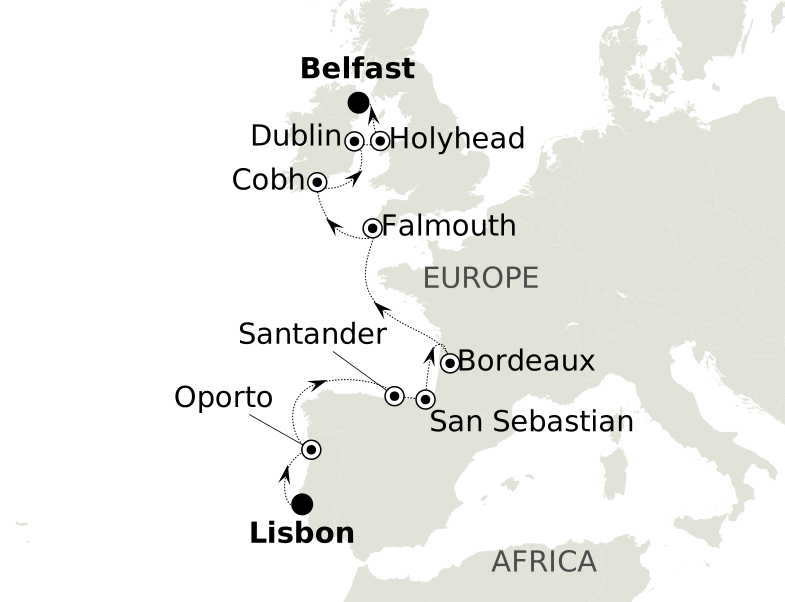
A 12-night ocean voyage aboard Silver Dawn, Lisbon, Portugal to Belfast, United Kingdom. Destination: Mediterranean.
Operated by Silversea Cruises aboard Silver Dawn.
Lisbon
Porto (Leixões)
Santander
Bilbao
Bordeaux
Falmouth, England
Cobh
Dublin (Dun Laoghaire)
Holyhead
Belfast
A glorious mosaic of beauty, freedom and authenticity, Portugal’s capital is a stirring artwork of a city. Known for the seven hills it spreads across, and its stirring fado music, Lisbon is a pastel-coloured blend of houses and beautiful tile artworks - and this creative city strikes a perfect harmony between natural and manmade beauty. Stroll along Alfama's steep, cobbled streets as you explore one of the city’s oldest neighbourhoods - where each house and door could be its own photograph. Look for the decorative tiles, with the distinctive blues and whites of Azulejo ceramics, and visit the dedicated museum to learn more. Afterwards, wind up to São Jorge Castle, where views out across Lisbon’s red rooftops unravel. Just one of many majestic viewpoints, you can also seek out Miradouro da Graça for perhaps Lisbon's finest panorama, with the copper-coloured suspension bridge stretching over sparkling water beyond the sea of buildings. The elegant Tower of Belém rises in the Tagus estuary and is a historic defender of these shores. The grand, carved cloisters of Jerónimos Monastery spread out close by, and there's another UNESCO recognised location close by at Sintra, where a colourful town is set amid thick gardens and towering mountains - capped by the royal Pena Palace. Later, relax and take a quick break to drink Ginjinha, a cherry liqueur made from chocolate cups instead of coffee. Lisboetas have a sweet tooth, and the famous Pastel de Nata's crumbling pastry and caramelised-custard topping is the essential accompaniment to any coffee stop.
Porto brings together Portugal’s Atlantic islands and seafaring heritage in a way that feels unmistakably its own. The atmosphere deepens around Porto wine and historic landmarks Porto, revealing a destination with more than one register and a natural elegance that grows clearer as you explore. This is the sort of destination that turns a port call into a story, thanks to its beauty, history, and the lived character that gives every scene greater resonance, and it feels worthy of more than a passing glance.
Days at sea are the perfect opportunity to relax unwind and catch up with what you’ve been meaning to do. So whether that is going to the gym, visiting the spa, whale watching, catching up on your reading or simply topping up your tan these blue sea days are the perfect balance to busy days spent exploring shore side.
Northern Spain might not have the same allure as the Mediterranean end of the country, yet as every traveller knows, often the best places are those that are the least known. Enter Santander. With heritage hailing from the prehistoric, Roman and Middle ages, suffice to say that Santander’s roots stretch very far back. As one of Spain’s more important ports during the New World trading era, Santander enjoyed great wealth during the Middle Ages. King Alfonso 13th (1886-1941) made the city his summer residence, bringing about a further economic boom and laying the foundations for modern Santander: a popular summer resort that enjoys one of the most beautiful bay in Spain, a fantastic art and cultural hub (don’t miss the Centro Botin) and a great lust for la vida. Tragically, a two-day fire in 1941 destroyed much of the city, including almost all the medieval heritage. Thus, Santander is today a city of two faces. One: an elegant seaside resort with at least six urban beaches, fabulous restaurants and all the fun in the sun you can muster. The other: a city with 15,000-year-old prehistoric roots that are visible in the cave paintings at Altamira or Puente Viesgo. If travelling the 30-minutes to see the real things seems too far, make sure you head to the fabulous Prehistory and Archaeology Museum of Cantabria, for extensive displays that take you on an interactive journey through time. Alternatively, make like a local and head to El Sardinero beach for a boho beach vibe that rivals Barcelona.
Whether it’s the flow of its boundary pushing architecture, delights of its finger food tapas, or sweeps of gorgeous shoreline nearby, Bilbao is a city that places a premium on aesthetics. The relentless drive to all things beautiful may be a reaction to the city’s industrial past, but it has led this Basque city to emerge as a new beacon of artistry. American architect Frank Gehry’s masterpiece of flowing metal is the shining standout here, a perfect harmony of smooth titanium and glass, and a thrilling piece in itself. Inside the Guggenheim Museum Bilbao, world-class exhibitions are exhibited in the bright, expansive interior - which practically begs you to explore more. The city has gorgeous historical presence too. Casco Viejo - the medieval area - is its historic core, and home to the original seven streets and cathedral, dating back to the 14thcentury. Tall banks of coloured buildings rise either side as you walk, dwarfed by a tide of pretty facades, overflowing flower boxes, and intricate rail balconies. Plaza Nueva is Bilbao’s neoclassical square, with a procession of arches all around you. Morning flea markets regularly overtake it, offering opportunities to pick through piles of coins, dusty books and rusted antiques on the hunt for bargains, in this most elegant setting. The titanic Mercado de la Ribera market looms tall by the river. Explore to eat your way through an endless pile of Basque pintxos – the local take on tapas. Cocktail sticks will quickly stack up as you gorge on plump olives, organic cheeses, and feather thin slices of curled hams, while orbiting Europe’s largest covered market. Described as a perfect blend of beauty and function by UNESCO, the Vizcaya Bridge is an unusual but spectacular piece of industrial architecture. The world’s oldest, gigantic transporter crane is still in use today, swinging cars and passengers from one side of the gaping Nervion River’s mouth to the other.
The name alone conjures images of sun-ripened grapes, splashes of refined flavour, and the joy of clinking glasses. Bordeaux is synonymous with quality and prestige, and the promise of endless opportunities to sample the city’s famous, full-bodied red wines makes a visit to this elegant French port city one to truly savour. Sprinkled with scenic, turret-adorned mansion castles, which stand above soil softened by the Atlantic and winding flow of the Garonne River, the vineyards of Bordeaux consistently produce revered wines, enjoyed right across the globe. Explore France’s largest wine region, walking through vineyards where dusty clumps of grapes hang, before descending into cellars to see the painstaking processes that make this region a global wine centre. The acclaimed, sensory experience of Cité du Vin wine museum lets you put your own nose to the test, learning more about the craft involved in producing world class vintages. Brush up on your wine knowledge, with our blog [insert You’ll Fall in Love with Wine in Bordeaux]. Bordeaux itself is an intoxicating blend of old and new – a fact perfectly illustrated by the Water Mirror. This living art installation has reinvigorated one of the city’s most important historical sites, and it feels as though you’re walking on water, as you step through the cooling mist of Place De La Bourse. The moisture generates a glorious mirrored composition of the 300-year-old elegant palatial architecture in front of you. Water also flows freely from the magnificent Monument aux Girondins statue, where horses rear up to extol the values of the Girondin revolutionaries. Marche des Quais – the city’s lively fish market – is the spot to try this wine capital’s freshest lemon-drizzled oysters and juicy prawns.
The name alone conjures images of sun-ripened grapes, splashes of refined flavour, and the joy of clinking glasses. Bordeaux is synonymous with quality and prestige, and the promise of endless opportunities to sample the city’s famous, full-bodied red wines makes a visit to this elegant French port city one to truly savour. Sprinkled with scenic, turret-adorned mansion castles, which stand above soil softened by the Atlantic and winding flow of the Garonne River, the vineyards of Bordeaux consistently produce revered wines, enjoyed right across the globe. Explore France’s largest wine region, walking through vineyards where dusty clumps of grapes hang, before descending into cellars to see the painstaking processes that make this region a global wine centre. The acclaimed, sensory experience of Cité du Vin wine museum lets you put your own nose to the test, learning more about the craft involved in producing world class vintages. Brush up on your wine knowledge, with our blog [insert You’ll Fall in Love with Wine in Bordeaux]. Bordeaux itself is an intoxicating blend of old and new – a fact perfectly illustrated by the Water Mirror. This living art installation has reinvigorated one of the city’s most important historical sites, and it feels as though you’re walking on water, as you step through the cooling mist of Place De La Bourse. The moisture generates a glorious mirrored composition of the 300-year-old elegant palatial architecture in front of you. Water also flows freely from the magnificent Monument aux Girondins statue, where horses rear up to extol the values of the Girondin revolutionaries. Marche des Quais – the city’s lively fish market – is the spot to try this wine capital’s freshest lemon-drizzled oysters and juicy prawns.
Days at sea are the perfect opportunity to relax unwind and catch up with what you’ve been meaning to do. So whether that is going to the gym, visiting the spa, whale watching, catching up on your reading or simply topping up your tan these blue sea days are the perfect balance to busy days spent exploring shore side.
Falmouth, United Kingdom Cornwall stretches west into the sea, with plenty of magnificent coastline to explore. The predominantly cliff-lined Cornish coast, interspersed with broad expanses of sand, has many tempting places to stop, including Padstow (for a seafood feast), Newquay (a surfing and tourist center), or St. Ives, a delightful artists' colony. From Land's End, the westernmost tip of Britain, you'll discover savage land- and seascapes and panoramic views. The Channel coast is less rugged than the northern coast, with more sheltered beaches. Cornwall has managed to retain a touch of its old insularity, despite the annual invasion of thousands of tourists. It's the birthplace of King Arthur and holds the greatest concentration of Arthurian links. Sights The bustle of this resort town's fishing harbor, yachting center, and commercial port only adds to its charm. In the 18th century Falmouth was the main mail-boat port for North America, and in Flushing, a village across the inlet, you can see the slate-covered houses built by prosperous mail-boat captains. A ferry service now links the two towns. On Custom House Quay, off Arwenack Street, is the King's Pipe, an oven in which seized contraband was burned. National Maritime Museum Cornwall. The granite-and-oak-clad structure by the harbor is an excellent place to come to grips with Cornish maritime heritage, weather lore, and navigational science. You can view the collection of 140 or so boats, examine the tools associated with Cornish boatbuilders, and gaze down from the lighthouselike lookout, which is equipped with maps, telescopes, and binoculars. In the glass-fronted Tidal Zone below sea level, you come face-to-face with the sea itself. Discovery Quay, Falmouth. Admission charged. Pendennis Castle. At the end of its own peninsula stands this formidable castle, built by Henry VIII in the 1540s and improved by his daughter Elizabeth I. You can explore the defenses developed over the centuries. In the Royal Artillery Barracks, the Pendennis Unlocked exhibit explores the castle's history and its connection to Cornwall and England. The castle has sweeping views over the English Channel and across to St. Mawes Castle, designed as a companion fortress to guard the roads. There are also concerts, plays, jousting, and shows for kids. Pendennis Head, Falmouth. Admission charged. Trelissick. Trelissick is known for the colorful Trelissick Garden, owned by the National Trust. King Harry Ferry. A chain-drawn car ferry, the King Harry runs to the scenically splendid Roseland Peninsula each day three times an hour. From its decks you can see up and down the Fal, a deep, narrow river with steep, wooded banks. The river's great depth provides mooring for old ships waiting to be sold; these mammoth shapes lend a surreal touch to the riverscape. B3289, Trelissick. Admission charged. Trelissick Garden. ornwall's mild climate has endowed it with some of the country's most spectacular gardens, among which is this garden on the banks of the Rivre Fal. Famous for its camellias, azaras, and photinias, the terraced garden is set within 375 acres of wooded parkland, offering wonderful panoramic views and making this a paradise for walkers. B3289, Feock. Admission charged. St. Mawes. At the tip of the Roseland Peninsula is the quiet, unspoiled village of St. Mawes, where subtropical plants thrive. The peninsula itself is a lovely backwater with old churches, a lighthouse, and good coast walking. St. Just in Roseland. One of the most beautiful spots in the West Country, this tiny hamlet has a 13th-century church set within a subtropical garden, often abloom with magnolias and rhododendrons, as well as a holy well and a graveyard on the banks of a secluded creek. Roseland. St. Mawes Castle. Outside the village, the well-preserved Tudor-era castle has a cloverleaf shape that makes it seemingly impregnable, yet during the Civil War its Royalist commander surrendered without firing a shot. A3078. Admission charged. Truro. The county seat and Cornwall's only real city, Truro is a good option mostly for food and shopping, and for cathedral and museum buffs. For an overview of the Georgian houses, take a stroll down steep, broad Lemon Street. The elegant 18th-century facades are of pale stone-unusual for Cornwall, where granite predominates. Like Lemon Street, Walsingham Place is a typical Georgian street, a curving, flower-lined pedestrian oasis. Cathedral Church of St. Mary. Although built between 1880 and 1910, this cathedral evokes a medieval church, with an exterior in Early English Gothic style. It's filled with relics from the 16th-century parish church that stood on this site, part of which has been incorporated into a side chapel. An open, cobbled area called High Cross lies in front of the west porch, and the city's main shopping streets fan out from here. 14 St. Mary's St.. Admission charged. Royal Cornwall Museum. This museum displays some fine examples of Cornwall-inspired art, a sampling of Cornish archaeology, an absorbing hodgepodge of local history, and an extensive collection of minerals. There's also a shop and a small café. River St.. Admission charged. Lizard Peninsula. The southernmost point on mainland Britain, this peninsula is a government-designated Area of Outstanding Natural Beauty, named so for the rocky, dramatic coast rather than the flat and boring interior. The huge, eerily rotating dish antennae of the Goonhilly Satellite Communications Earth Station are visible from the road as it crosses Goonhilly Downs, the backbone of the peninsula. There's no coast road, unlike Land's End, but the coastal path offers marvelous opportunities to explore on foot-and is often the only way to reach the best beaches. With no large town (Helston is the biggest, but isn't a tourist center), it's far less busy than the Land's End peninsula. Kynance Cove. A path close to the tip of the peninsula plunges down 200-foot cliffs to this tiny cove dotted with a handful of pint-size islands. The sands here are reachable only during the 2½ hours before and after low tide. The cliffs are made of greenish serpentine rock, interspersed with granite; souvenirs are carved out of the stone. St. Ives. James McNeill Whistler came here to paint his landscapes, Barbara Hepworth to fashion her modernist sculptures, and Virginia Woolf to write her novels. Today sand, sun, and superb art continue to attract thousands of vacationers to the fishing village of St. Ives, named after Saint Ia, a 5th-century female Irish missionary said to have arrived on a floating leaf. The town has long played host to a well-established artists' colony, and there are plenty of craftspeople, too.Tip: Many come to St. Ives for the sheltered beaches; the best are Porthmeor, on the northern side of town, and, facing east, Porthminster-the choice for those seeking more space to spread out. Barbara Hepworth Museum and Sculpture Garden. The studio and garden of Dame Barbara Hepworth (1903-75), who pioneered abstract sculpture in England, are now a museum and sculpture garden. London's prominent Tate gallery runs the museum. The artist lived here for 26 years. Trewyn Studio, Barnoon Hill. Admission charged. Geevor Tin Mine. Now a fascinating mining heritage center, the early-20th-century mine employed 400 men, but in 1985 the collapse of the world tin market wiped Cornwall from the mining map. Wear sturdy footwear for the surface and underground tours. A museum, shop, and café are on the site. B3306, Pendeen. Admission charged. St. Ives Society of Artists Gallery. Local artists display selections of their current work for sale at this gallery in the former Mariners' Church. The Crypt Gallery in the basement is used for private exhibitions. Norway Sq. Tate St. Ives. The spectacular sister of the renowned London museum displays the work of artists who lived and worked in St. Ives, mostly from 1925 to 1975. There's also a selection of pieces from the museum's rich collection. It occupies a modernist building-a fantasia of seaside art deco-period architecture with a panoramic view of rippling ocean. The rooftop café is excellent for the food and views. Porthmeor Beach. Admission charged. St. Michael's Mount. Rising out of Mount's Bay just off the coast, this spectacular island is one of Cornwall's greatest natural attractions. The 14th-century castle perched at the highest point-200 feet above the sea-was built on the site of a Benedictine chapel founded by Edward the Confessor. In its time, the island has served as a church, a fortress, and a private residence. Around the base of the rock are buildings from medieval to Victorian, but they appear harmonious. Fascinating gardens surround the Mount, and many kinds of plants flourish in its microclimate. To get to the island, walk the cobbled causeway from the village of Marazion or, when the tide is in during summer, take the ferry. There are pubs and restaurants in the village, but the island also has a café and restaurant. A394, 3 miles east of Penzance, Marazion. Admission charged. Braunton Burrows. Bird-watching and miles of trails through the dunes are the draws at this sanctuary on the north side of the Taw estuary, the core of the UNESCO-designated North Devon Biosphere Reserve. Empty stretches of sand dunes have vistas of marram grass and the sea, and bird-watching is first-class, especially in winter. The flora is most colorful between May and August. Talks about wildlife and the local habitats are held in the Braunton's Countryside Centre in September and October. Off B3231, 2 miles west of Braunton, Braunton.
Rows of pastel-coloured homes sit like macaroons ready to be plucked from the box of this beloved waterfront town in County Cork. On sleepy mornings a peek outside the window reveals a pastoral scene of bright fishing boats chugging out along the glinting estuary all overlooked by the soaring bell tower of Cobh’s show-stealing cathedral. Recently named one of Europe's most beautiful small towns this is an enchanting place to drop anchor - enjoy strolls by the natural harbour or head down the road to kiss the Blarney Stone as you explore some of storybook Ireland's best scenery. Cobh was also the final port of call for the tragic voyage of the RMS Titanic and visitors can take a walk through the small sombre museum which marks the event housed inside the former White Star Line ticket office. Cobh sparkles in the sunshine but there's something even more evocative about the place during a salt-whipped drizzle as the seagulls cry above you and the warm lights of a welcoming pub beckon. Nearby Spike Island is Ireland's very own version of Alcatraz starting life as a monastery in the 7th century before becoming a smugglers' haven and eventually a spot to stash convicts. Back on the mainland an Irish pub lunch is a must. Thick pints of Guinness and steaming bowls of creamy seafood chowder - served with hunks of butter-smothered soda bread - will get you into an authentic maritime mood and leave you feeling full up for days.
Atmospheric cobbled streets, with buskers scraping fiddles and characterful pubs inviting passersby inside, is Dublin in a snapshot. A city of irrepressible energy and lust for life, Ireland's capital is as welcoming a place as you'll find. Horse-drawn carriages plod along cobbled centuries-old streets, blending with an easy-going, cosmopolitan outlook. Known for its fun-filled gathering of pubs, any excuse works to enjoy a celebratory toast and chat among good company. Home to perhaps the world's most famous beer - slurp perfect pourings of thick, dark Guinness - cranked out for the city's thirsty punters. Learn more of the humble pint's journey at the Guinness Storehouse. Dublin has come along way since the Vikings established a trading port here, back in the 9th Century. In the time since, the city became the British Empire's defacto second city, and the Georgian imprint still adds oodles of historic character. Learn of 1916's Easter Uprising, when the Irish rebelled and established their independence here, as you visit the infamous, haunting Kilmainham Gaol. The uprising's leaders were tried and executed in these dark confines. Dublin's St. Patrick's Cathedral has immense history below its steep spire, which dates back to 1191. There's rich literary heritage to leaf through too, and the city's streets were rendered vividly in James Joyce's classic Ullyses. The Museum of Literature celebrates the full scope of Dublin's lyrical talents. Trinity College also has a prestigious roll-call of alumni - visit to see the Book of Kells, a beautifully illustrated bible of the medieval era.
Once a major defence point against Irish invaders Holyhead now extends the hand of friendship across the Irish Sea and is a major ferry port connecting the two countries. Discover a scenic and spectacular place whatever the weather – whether the sun’s bouncing off the blotched blue sea or the waves are swelling moodily as rain thrashes down. Set on the windswept coast of North Wales South Stack Lighthouse is a stunningly perched bright white lighthouse which has been casting its gaze out across the water for more than 200 years. A rugged picturesque site to explore you can wander out across the small aluminium bridge to reach the island where it rises. Be warned there’s a steep climb down 400 steps and then a spiral of another 100 up once you’re inside but if you’re up to the physical demands the views are magnificent from the beacon that has guarded these waters for so long. Ellin's Tower also stands over the crumbling cliffs nearby and this small castellated hideout is adorned with binoculars - perfect for getting a closer look at the crowds of nesting seabirds and puffins who cling to the coastline’s stark cliffs. In Holyhead itself enthusiastic volunteers will relay the region’s seafaring history to you at the compact Maritime Museum or you can explore Breakwater Country Park - another coastal hiking spot that sits below the gentle Holyhead Mountain. Enjoy views of the Irish Sea stretching as far as the Skerries seven miles out to sea and as far as Ireland on clear days.
Reborn as a cool modern city Belfast has successfully left its troubles behind emerging as a hotbed of culture and architecture where the comfort of a cosy pub is never far away. A walk across the Lagan Weir Footbridge brings you to Belfast’s fascinating Titanic District – an area of the city devoted to its rich ship-building heritage. The state-of-the-art Titanic Museum brings the story of the doomed vessel to life and is the largest museum dedicated to the infamously ‘unsinkable’ ship. There’s just enough time to give the 10-metre long Salmon of Knowledge sculpture a quick peck for luck before continuing to explore. A stark barbed wire and graffitied sheet metal barrier marks an abrupt scar through the city’s residential areas. The Peace Line was constructed during the height of the Troubles when Belfast was plagued by sectarian divisions between Protestants and Catholics. Nowadays you can jump in a black taxi tour to see the colourful murals and living history of the walls which stand as a stark reminder of the fragility of peace. After exploring the city’s historic divisions a reminder of Belfast’s uniting creativity can be found at the Metropolitan Arts Centre – a seven-storey tall building which invites light to gloriously cascade inside. The Cathedral Quarter is a cobbled blend of flower-adorned pubs restaurants and theatres and venues where music spills out onto the streets at night and many a pint is cheerily shared.
From $12,700
per guest · 12 nights
Prices are a guide and vary with season, cabin category and party size. Your advisor will confirm the exact cost before anything is booked.
Classic Veranda
suite
Deluxe Veranda
suite
Grand 1 Bedroom
suite
Grand 2 Bedroom
suite
Owner 1 Bedroom
suite
Owner 2 Bedroom
suite
Panorama
suite
Royal 1 Bedroom
suite
Royal 2 Bedroom
suite
Silver
suite
Silver 2 Bedroom
suite
Superior Veranda
suite
Vista
suite








