




Prefer a conversation?
Our team is always available to guide you through the process and ensure your experience is perfectly matched to your preferences.
Our team is always available to guide you through the process and ensure your experience is perfectly matched to your preferences.
Duration
12 Nights
Price
From $10,000
Ship
Silver Spirit
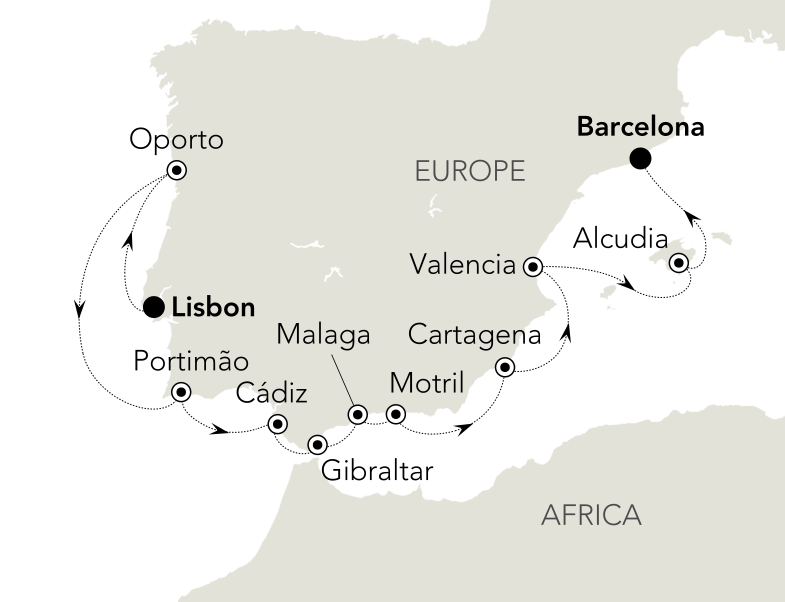
A 12-night ocean voyage aboard Silver Spirit, Lisbon, Portugal to Barcelona, Spain. Destination: Mediterranean.
Operated by Silversea Cruises aboard Silver Spirit.
Lisbon
Porto (Leixões)
Portimão
Cádiz
Gibraltar
Malaga (Costa del Sol)
Motril
Cartagena (Spain)
Valencia
Alcudia, Mallorca
Barcelona
A glorious mosaic of beauty, freedom and authenticity, Portugal’s capital is a stirring artwork of a city. Known for the seven hills it spreads across, and its stirring fado music, Lisbon is a pastel-coloured blend of houses and beautiful tile artworks - and this creative city strikes a perfect harmony between natural and manmade beauty. Stroll along Alfama's steep, cobbled streets as you explore one of the city’s oldest neighbourhoods - where each house and door could be its own photograph. Look for the decorative tiles, with the distinctive blues and whites of Azulejo ceramics, and visit the dedicated museum to learn more. Afterwards, wind up to São Jorge Castle, where views out across Lisbon’s red rooftops unravel. Just one of many majestic viewpoints, you can also seek out Miradouro da Graça for perhaps Lisbon's finest panorama, with the copper-coloured suspension bridge stretching over sparkling water beyond the sea of buildings. The elegant Tower of Belém rises in the Tagus estuary and is a historic defender of these shores. The grand, carved cloisters of Jerónimos Monastery spread out close by, and there's another UNESCO recognised location close by at Sintra, where a colourful town is set amid thick gardens and towering mountains - capped by the royal Pena Palace. Later, relax and take a quick break to drink Ginjinha, a cherry liqueur made from chocolate cups instead of coffee. Lisboetas have a sweet tooth, and the famous Pastel de Nata's crumbling pastry and caramelised-custard topping is the essential accompaniment to any coffee stop.
Porto brings together Portugal’s Atlantic islands and seafaring heritage in a way that feels unmistakably its own. The atmosphere deepens around Porto wine and historic landmarks Porto, revealing a destination with more than one register and a natural elegance that grows clearer as you explore. This is the sort of destination that turns a port call into a story, thanks to its beauty, history, and the lived character that gives every scene greater resonance, and it feels worthy of more than a passing glance.
Days at sea are the perfect opportunity to relax unwind and catch up with what you’ve been meaning to do. So whether that is going to the gym, visiting the spa, whale watching, catching up on your reading or simply topping up your tan these blue sea days are the perfect balance to busy days spent exploring shore side.
Sprawl out and relax across thick wedges of glorious, golden sands, in Portugal’s sun-worshipping paradise. Portimão is a beachy heaven and a perfect encapsulation of the Algarve’s Atlantic appeals, offering easy access to the wonderful Praia da Rocha. Head straight for the long and wide expanse of this famous beach, where you can kick back and enjoy soft, honey-coloured sands and gentle waves rolling ashore. A spectacular and spacious sandy expanse – located at the point where the Arade River unloads into the Atlantic – relax, or wander the wooden boardwalk to a string of neighbouring beaches, as you explore among dramatic, tank-like rock formations. Taste juicy hauls of sardines, cooked over open fires, with glasses of wine pressed from the vineyards nearby - as you lavish under the sunshine of the Algarve’s prime holiday region. Surrounded by offbeat fishing villages, stunning coastline and quaintly tiled old towns, there is a rich medley of life, culture and flavours to indulge in. Attractive mosaics pattern the scenic Ribeirinha promenade, breathing new life into Portimão’s rugged old docks and creating a charming riverside stroll that leads to the showpiece beach. Elsewhere, the arches and sea-eroded limestone stacks of the monumental Ponta da Piedade coastline are close by, or you can make for Silves, a historical former capital of the Kingdom of the Algarve, crowned with a soaring sandy castle. The Moorish trading outpost of Lagos is also within reach, where you can visit a coastline dotted with gaping sea caves.
More than a hundred watchtowers gaze out across the waves surrounding this ancient Andalusian city. Sprinkled with evocative cobbled side streets, you’ll explore 3,000 years’ worth of history, while stumbling across palm-tree lined plazas of shaded coffee sippers. Cadiz claims the mantle of Western Europe’s oldest city, and every piece of architecture - and every wrong turn - offers a chance to discover fascinating new tales. Founded by the Phoenicians in 1100BC, Christopher Columbus used the city as a base for his exploratory, map-defining voyages of 1493 and 1502. The port grew in importance and wealth as Cadiz’s strategic location close to Africa’s northern tip helped it blossom into a centre for New World trade. Catedral de Cádiz, is a display of the city’s wealth and importance, looming spectacularly over the Atlantic’s waves, with cawing seagulls sweeping between its twin bell towers. Inside, treasures from the city’s trading exploits in the West Indies and beyond - which helped fuel the growth of this historically prosperous city – are on display. Enveloped by ocean on almost every side, Cadiz has something of an island feel, and you can cool off from southern Spain’s unrelenting sunshine on the sweeping golden sand beach of Playa Victoria. The two towers of the new El Puente de la Constitución de 1812 mark a contemporary landmark in this most ancient of cities, in the form of a spectacular new road bridge. Torre Tavira, meanwhile, is the most famous of Cadiz’s army of watchtowers, and the highest point in the city. Reach the top for a view of the ocean fringing the city’s expanse, and to learn about the towers - constructed so trading merchants could survey the harbour from their lavish homes. The Central Market is a chaotic place of bartering, where flashing knives dissect fresh fish. Stop in at the orbiting bars to enjoy tapas, freshly prepared with the market’s produce.
A curious slice of Britain - picked up and plonked into the sun sea and sand of southern Spain - Gibraltar is a unique and historic peninsula crowned by the iconic Rock of Gibraltar mountain. Bright red phone boxes gleam Union Jacks flutter in the breeze and cones of fish and chips are scoffed in the sun in this most British of outposts. At times a surreal and strange juxtaposition you can be gazing at the African shoreline from the beach one moment and carefully treading across the runway of a crammed-in international airport the next. Gibraltar's cathedral-like Rock towers 400 metres above the waves and the stark limestone mountain watches out across a narrow strategic strait between the European and African continents. The pointed Rock is a symbol of this unique place and you can hike it - or take the convenient cable car - to enjoy the views and meet the mischievous colony of Barbary macaques who live on its slopes. Europe's only wild monkeys roam free and loose on the mountain. The Siege Tunnels bring to life the struggles for this land with the plucky British boring tunnels through the rock by hand effectively converting it into a giant watchtower capable of defending the distant territory. Natural caves inside droop with stalactites while a squat Moorish castle stands proudly at its summit. Grand Casemates Square is a sunbathed plaza and drizzly old Britain feels a world away as you sit back and sip ice-cold beers and cocktails in Gibraltar's historic centre.
Bathing in the sunshine coast’s stunning subtropical climate, and laying out endless spectacular beaches, it’s no surprise that Malaga is one of Spain’s most popular cities. The already impressive cultural appeal of this holiday city has skyrocketed over recent years, and with a storied old town and Moorish fortifications, Malaga has a lot to offer. Nearby, you can recline on the renowned beaches of the Costa del Sol, or venture inland to discover the Moorish treasures of Granada and Cordoba. La Malagueta beach is Malaga’s spacious urban beach, perfect for a sunbathe and a dip in the warm water, before enjoying seaside cocktails or seafood tapas in the restaurants nearby. Malaga and the Costa del Sol may be best known for glorious weather and beaches, but Malaga can now stake a genuine claim as an artistic powerhouse too. Visit the renowned Picasso museum – housed in the artist’s birthplace – before exploring the freshly opened outpost of the Pompidou Centre. The art also spills out onto the streets in the colourful Soho district – splashed with vibrant street paintings. Known as La Manquita – or the one-armed woman – the city’s cathedral rises over the historic old town. Its huge bell tower stands tall, but an accompanying second tower was never completed - hence the nickname. The Alcazaba fortress palace looms over the waterfront and forms a spectacularly preserved remnant from the era when the Moors controlled the Andalucía region. Discover more of the Arabic influence by visiting Granada’s Alhambra palace, or Cordoba’s La Mezquita mosque. Together with Seville’s converted cathedral, the cities form Andalucía’s Golden Triangle of Moorish wonders.
Seeing the Alhambra palace sprawling majestically beneath the snow-sprinkled backdrop of the Sierra Nevada's range's peaks is one of Spain’s most enchanting vistas. White sandy beaches welcome you ashore at Motril, and it’s a short jaunt to the legendarily beautiful, sun-soaked setting of Granada - where the famous and lush Moorish palace stands. Fountains sprinkle, archways soar, and intricate mosaics sparkle at the Alhambra - a fairy-tale palace, fortress and treasure of Spain’s Moorish architecture. The best view can be found opposite, at the magical Mirador de San Nicolas viewpoint - but you’ll need your wits about you to find it. The square sits perched amid the steep, historic labyrinth of the Moorish Albaicín district - a fiendishly labyrinthine - and gorgeously authentic quarter. You’ll also find Sacromonte mountain rising opposite, punctuated with cave dwellings. It's here, within these atmospheric caves, where rhythmic claps echo, guitars are stabbed and strummed, and sultry flamenco performances play out by candle-light. They say there’s no such thing as a free lunch, but that’s not entirely the case in Granada - one of the last cities in Spain where you will usually receive a free plate of tapas when ordering. Everything from sandwiches to healthy helpings of carne con salsa – meat in tomato sauce – is dished out accompanying drinks. Enjoy a culinary tour of the city’s many tapas bars before heading back to Motril – no one leaves Granada hungry.
On the crossroads of mighty cultures, this Murcian port has endless ancient stories to share. A valuable natural harbour attracted many civilisations to this sun-bathed, southeasterly setting - following its foundation by the Carthaginians in 227 BC. Blending the imprints left by countless cultures on this global junction, the presence of everyone from the Vandals to the Phoenicians and Moors can be felt as you explore, walking between ruins and celebrated modernist architecture along Calle Mayor. Cartagena is crowned by the soaring Castillo de la Concepcion - rise to the stout castle aboard a panoramic lift. Inside, look through reams of archaeological treasures, or admire the rolling views down over the port and across the waters. Watch out for the electric blue peacocks who strut flamboyantly. Cartagena's emergence as a visitor destination coincided with a stunning discovery in 1988 - the bowl of a gloriously preserved Roman Theatre. Enter to sit among the grandiose ancient venue, so evocative, you can't help but imagine the historic performances that have graced its stage. Wander the breezy waterfront, looking across the narrow strait towards Africa's distant haze, and spotting gleaming warships. Cartagena's perfect harbour means it has been one of Spain's oldest strategic navy positions since the 16th century. Settle to enjoy the joys of tapas in lively bars - sampling crisped paella, squid and honeyed-aubergine. Easter's Semana Santa festivities are typically lively here, as hooded processions, lavish floats and sombre fiery displays roll through the streets.
Days at sea are the perfect opportunity to relax unwind and catch up with what you’ve been meaning to do. So whether that is going to the gym, visiting the spa, whale watching, catching up on your reading or simply topping up your tan these blue sea days are the perfect balance to busy days spent exploring shore side.
Spain's third largest city basks in a self-assured glow of its very own - not least because of the glorious sunshine that illuminates striking architecture and sweeping beaches. In this city of contrasts, you can discover the Holy Grail in the confines of the cathedral, before heading out to the City of Arts and Sciences' sci-fi vision of architectural ambition. The city crackles with energy all year round, but reaches a cacophonous fever pitch during Las Fallas festival - which welcomes spring with an almighty bang, and a riotous celebration of flame, firework and fiesta. A glorious belt of green parkway also snakes through the city, having flourished in the former river bed left behind when the Turia was redirected to spare the city from history's devastating floods. Perfect for cycling, it winds towards Valencia's contemporary showpiece, an unapologetically futuristic complex of structures - which rise like gleaming white rib cages from the shimmering pools surrounding them.The food is no less thrilling, with experimentation complementing rich tradition. Jewelled with succulent ingredients from the surrounding fields - you may be surprised that Valencia's famous paella contains rabbit and chicken meat rather than seafood. Do your self a favour, while also impressing the locals, by scraping off the 'socarrat' - the prized crunchy crust that sweetens as it forms at the bottom of the pan.
The first city to be located here was a Roman settlement, in 123 BC. The Moors reestablished a town, and after the Reconquest it became a feudal possession of the Knights Templar; the first ring of city walls dates to the early 14th century. Begin your visit at the Church of Sant Jaume and walk through the maze of narrow streets inside to the Porta de Xara, with its twin crenellated towers.
Having attracted over 82 million visitors in 2017, Spain is gaining popularity as a travel destination. The country lures travellers from across the world with its promise of authenticity, charisma, and memorable moments. Spain’s culture is a celebration of the finer things in life, an expression of spirit, heritage and fun: colourful fiestas, delectable cuisine, age-defining art, music, dance, sport and so much more. Each region of the country has evolved a character of its own, meaning the country is unified by a sense of cultural multiplicity. Barcelona, the capital of Catalonia, is a masterpiece that embellishes the Spanish canvas. The fact that the Barcelona’s iconic cathedral, La Sagrada Familia, is still under construction over 141 years after construction commenced pays testament to the city’s artistic perfectionism, which pervades all aspects of life here. Apparent in the city’s architecture, layout, and cultural practices, aestheticism retains its value here. Antoni Gaudí, whose iconic style of modernist architecture is among Barcelona’s leading attractions, could perhaps be credited with designing the face of this magnificent city. Enjoy getting to know the vivacious personality behind Barcelona’s beauty.
From $10,000
per guest · 12 nights
Prices are a guide and vary with season, cabin category and party size. Your advisor will confirm the exact cost before anything is booked.
Classic Veranda
suite
Deluxe Veranda
suite
Grand 1 Bedroom
suite
Grand 2 Bedroom
suite
Medallion
suite
Owner 1 Bedroom
suite
Owner 2 Bedroom
suite
Panorama
suite
Royal 1 Bedroom
suite
Royal 2 Bedroom
suite
Silver
suite
Silver 2 Bedroom
suite
Superior Veranda
suite
Vista
suite








