




Prefer a conversation?
Our team is always available to guide you through the process and ensure your experience is perfectly matched to your preferences.
Our team is always available to guide you through the process and ensure your experience is perfectly matched to your preferences.
Duration
12 Nights
Price
From $10,150
Ship
Silver Spirit
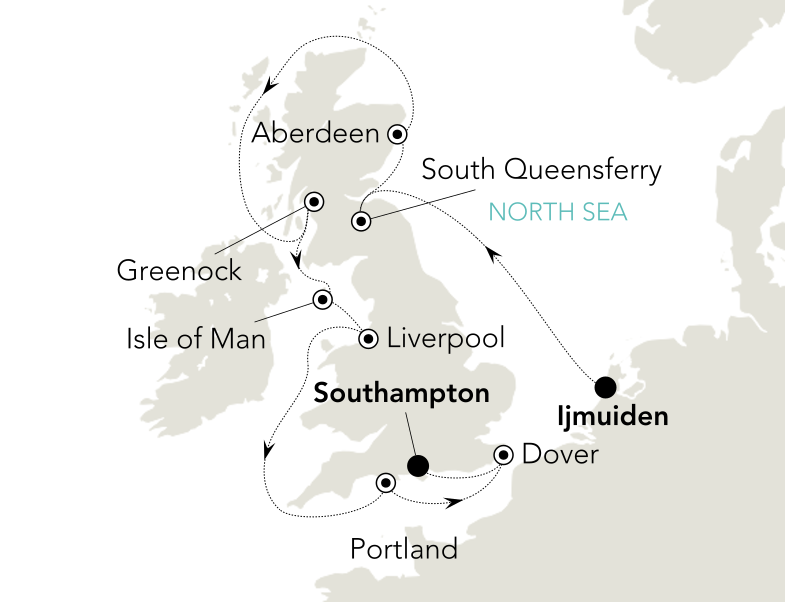
A 12-night ocean voyage aboard Silver Spirit, Ijmuiden, Netherlands to Southampton, United Kingdom. Destination: Northern Europe & British Isles.
Operated by Silversea Cruises aboard Silver Spirit.
Ijmuiden (Amsterdam)
Dover (London), England
Newhaven (Edinburgh), Scotland
Aberdeen
Greenock (Glasgow), Scotland
Isle of Man (Douglas)
Liverpool
Portland, England
Southampton
The famous white chalk cliffs cradle England’s southeast’s principal cross-Channel port of Dover. It lies only twenty-one miles from the continent, and on a clear day the low cliffs of Calais are visible. The Romans put Dover on the map when, having conquered Europe, they decided to move on toward Britannia, using the natural harbor of Dover as the base for their northern fleet. They erected a lighthouse to guide their ships into port. Following their withdrawal from England in the 4th century when the Normans constructed the keep that now presides over the bulk of Dover Castle. This superbly positioned fortress had been in continuous use as some sort of military installation until 1958. A network of tunnels constructed beneath the castle during the Napoleonic wars was extended during World War II for use as headquarters for the Dunkirk evacuation. More recently, sections of the 3.5 miles of tunnels were provisioned as a refuge for Kent’s elite in the event of nuclear war. Now that there seems no longer a need for such facilities, the tunnels have been restored and opened to the public. Pier Information The ship is scheduled to dock at Dover’s Western Docks. The distance to downtown Dover is two miles. Taxis may have to be called for pierside pickup. Dover is 85 miles from London. Frequent train service connects the port with London; traveling time is approximately 90 minutes (subject to traffic conditions). Shopping Stores in Dover are limited interest to visitors. Serious shoppers will want to set time aside to explore the endless shopping opportunities in London. Some of the most exclusive shops are found along Oxford, Bond and Regent Streets. Upscale department stores such as Harrods, Selfridges and Liberty offer convenient shopping with everything under one roof. Designer clothing, china and antiques may be of interest. Purchases are subject to a 17.5% VAT (value-added tax). Guests not residing in one of the EU countries can obtain a partial refund of the VAT after spending a certain amount of money. Proper forms have to be requested from the shop at the time of purchase. The refund can be claimed at the airport VAT Refund Desk; if leaving the ship, check on board with the Purser’s Office for procedures. The local currency is the British pound. Cuisine The town of Dover has a limited selection of pubs and restaurants and more can be found in the surrounding countryside, serving meals cooked from locally grown produce and accompanied by a wide variety of bars and wines. Other Sites The county of Kent is a fascinating part of England that is dotted with Castles, historic houses, beautiful gardens and bustling market towns. Dover Castle Dominating the town from its hilltop location, this is Europe’s oldest concentrically-planned castle. From its position you can enjoy a fine panorama of Dover, its white cliffs and the English Channel. Inside the castle is Hellfire, a secret underground war room used by Winston Churchill. In addition to Dover Castle, other attractions include the Old Town Goal, a new museum, the White Cliffs Experience and the Roman Painted House. This ancient guest house was discovered during the construction of a car park. The excavated rooms feature the finest Roman wall paintings in England. Guests in transit to the next cruise may check with the Tour Office on board for additional sightseeing possibilities or arrangements by private car.
Days at sea are the perfect opportunity to relax unwind and catch up with what you’ve been meaning to do. So whether that is going to the gym, visiting the spa, whale watching, catching up on your reading or simply topping up your tan these blue sea days are the perfect balance to busy days spent exploring shore side.
Edinburgh is to London as poetry is to prose, as Charlotte Brontë once wrote. One of the world's stateliest cities and proudest capitals, it's built—like Rome—on seven hills, making it a striking backdrop for the ancient pageant of history. In a skyline of sheer drama, Edinburgh Castle watches over the capital city, frowning down on Princes Street’s glamour and glitz. But despite its rich past, the city’s famous festivals, excellent museums and galleries, as well as the modern Scottish Parliament, are reminders that Edinburgh has its feet firmly in the 21st century.Nearly everywhere in Edinburgh (the burgh is always pronounced burra in Scotland) there are spectacular buildings, whose Doric, Ionic, and Corinthian pillars add touches of neoclassical grandeur to the largely Presbyterian backdrop. Large gardens are a strong feature of central Edinburgh, where the city council is one of the most stridently conservationist in Europe. Arthur's Seat, a mountain of bright green and yellow furze, rears up behind the spires of the Old Town. This child-size mountain jutting 822 feet above its surroundings has steep slopes and little crags, like a miniature Highlands set down in the middle of the busy city. Appropriately, these theatrical elements match Edinburgh's character—after all, the city has been a stage that has seen its fair share of romance, violence, tragedy, and triumph.Modern Edinburgh has become a cultural capital, staging the Edinburgh International Festival and the Fringe Festival in every possible venue each August. The stunning Museum of Scotland complements the city’s wealth of galleries and artsy hangouts. Add Edinburgh’s growing reputation for food and nightlife and you have one of the world’s most beguiling cities.Today the city is the second most important financial center in the United Kingdom, and the fifth most important in Europe. The city regularly is ranked near the top in quality-of-life surveys. Accordingly, New Town apartments on fashionable streets sell for considerable sums. In some senses the city is showy and materialistic, but Edinburgh still supports learned societies, some of which have their roots in the Scottish Enlightenment. The Royal Society of Edinburgh, for example, established in 1783 "for the advancement of learning and useful knowledge," remains an important forum for interdisciplinary activities.Even as Edinburgh moves through the 21st century, its tall guardian castle remains the focal point of the city and its venerable history. Take time to explore the streets—peopled by the spirits of Mary, Queen of Scots; Sir Walter Scott; and Robert Louis Stevenson—and pay your respects to the world's best-loved terrier, Greyfriars Bobby. In the evenings you can enjoy candlelit restaurants or a folk ceilidh (pronounced kay-lee, a traditional Scottish dance with music), though you should remember that you haven't earned your porridge until you've climbed Arthur's Seat. Should you wander around a corner, say, on George Street, you might see not an endless cityscape, but blue sea and a patchwork of fields. This is the county of Fife, beyond the inlet of the North Sea called the Firth of Forth—a reminder, like the mountains to the northwest that can be glimpsed from Edinburgh's highest points, that the rest of Scotland lies within easy reach.
With close to 220,000 inhabitants, Aberdeen is Scotland's third most populous city. Locally quarried grey granite was used during the mid-18th to mid-20th centuries for many of Aberdeen's buildings, and hence the nicknames it has earned as the Granite City, or the Grey City. Aberdeen granite was also used to build the terraces of the Houses of Parliament and Waterloo Bridge in London. Since the discovery of North Sea oil in the 1970s, Aberdeen has also been called the Oil Capital of Europe or the Energy Capital of Europe. It is no wonder that because of the oil fields in the North Sea, Aberdeen's seaport is very important. The Heliport with its flights to the oil fields is one of the busiest commercial heliports in the world.
Days at sea are the perfect opportunity to relax unwind and catch up with what you’ve been meaning to do. So whether that is going to the gym, visiting the spa, whale watching, catching up on your reading or simply topping up your tan these blue sea days are the perfect balance to busy days spent exploring shore side.
A titan of culture and character, with a disarmingly warm welcome, Glasgow is a lively, Scottish city with bucket-loads of personality. Built on a bedrock of hard-work, and deep industrial roots, the city is a fascinating balance of old and new. Architectural treasures like the elegant Glasgow City Chambers of 1888 blend with new, angular shocks like the Riverside Museum and armadillo-shaped Clyde Auditorium - both part of a clutch of exciting new developments along the River Clyde’s banks. Also towering over the river - and perhaps Glasgow’s mightiest symbol - is the Titan - a colossal crane and an almighty reminder of Glasgow’s heritage as a constructor of giant battleships and cruise liners. It is far from a grey industrial city these days, however, and leafy parks, manicured gardens and stacked galleries douse the city with its colour and cultural intrigue. George Square is at the heart of it all, overlooked by Glasgow City Chambers and adorned with memorials, columns and statues honouring influential Scots and Prime Ministers of history. The sounds of shoppers and searing bagpipes rattle along the bustling Buchanan Street, where you can stroll and shop to your heart’s content. Stumble across the West End - Glasgow’s quirkier side - which is brimming with brightly painted cafes and pubs of character and characters, and the perfect spot for a sit-down. Glasgow’s Medieval Cathedral is the city’s oldest building and one of Scotland’s oldest cathedrals, while the university is an immaculate, turreted and vaulted temple of learning. With enormous concert halls, overflowing museums and storied castles, Glasgow is one of the United Kingdom’s most characterful, rewarding cities.
The Isle of Man, off England’s west coast (and Ireland’s east) needs no introduction. Its Celtic history is legendary, its political past labyrinthine and its national symbol – a three legged figure with neither body nor head – an enigma that has been foxing historians for centuries. Do not confuse the Isle of Man with the United Kingdom. It does have “crown dependency” similar to Jersey, but the 32-mile-long island is entirely self-governed. It changed hands between England and Scotland many times during the middle ages but fell under British rule in 1399. However, when the feudal lordship was revested in 1765, the island never became part of the United Kingdom. And has remained independent ever since.
Who can say Liverpool with thinking of the Beatles? Home to the fab four, Penny Lane, Strawberry Fields and the Cavern Club, this northern English city is undoubtedly one of the most important places on the 20th century music scene. Even UNESCO agrees - Liverpool became a City of Music (one of only 19 in the world) in 2015. So understandably, it’s bursting with pride. Not only for its most famous former residents but also its football team, its maritime heritage and its thriving cultural scene (it was Capital of Culture in 2008). A huge regeneration project over the past two decades has seen Liverpool blossom from being a below-par northern English city to a somewhere buzzing with charm. The arrival of the Tate Liverpool paved the way – quickly followed by the restoration of some 2,500 plus listed buildings (that’s more than any English city outside London). The waterfront revitalisation came next with bars, clubs, galleries and independent boutiques, giving Liverpool some of the best dining and shopping there is. Don’t leave here without tasting Scouse – a traditional beef stew – and from where Livepudlians draw their nickname “Scousers”. Culturally speaking, Liverpool is “bang on” as Scousers would say. The three Graces (named after the Greek goddesses of charm, beauty and creativity) line the waterfront, and are responsible in part for Liverpool’s second UNESCO gong as a World Heritage Site. Further afield, the lovely parks and Crosby Beach offer welcome respite from the urban hub.
Who can say Liverpool with thinking of the Beatles? Home to the fab four, Penny Lane, Strawberry Fields and the Cavern Club, this northern English city is undoubtedly one of the most important places on the 20th century music scene. Even UNESCO agrees - Liverpool became a City of Music (one of only 19 in the world) in 2015. So understandably, it’s bursting with pride. Not only for its most famous former residents but also its football team, its maritime heritage and its thriving cultural scene (it was Capital of Culture in 2008). A huge regeneration project over the past two decades has seen Liverpool blossom from being a below-par northern English city to a somewhere buzzing with charm. The arrival of the Tate Liverpool paved the way – quickly followed by the restoration of some 2,500 plus listed buildings (that’s more than any English city outside London). The waterfront revitalisation came next with bars, clubs, galleries and independent boutiques, giving Liverpool some of the best dining and shopping there is. Don’t leave here without tasting Scouse – a traditional beef stew – and from where Livepudlians draw their nickname “Scousers”. Culturally speaking, Liverpool is “bang on” as Scousers would say. The three Graces (named after the Greek goddesses of charm, beauty and creativity) line the waterfront, and are responsible in part for Liverpool’s second UNESCO gong as a World Heritage Site. Further afield, the lovely parks and Crosby Beach offer welcome respite from the urban hub.
Days at sea are the perfect opportunity to relax unwind and catch up with what you’ve been meaning to do. So whether that is going to the gym, visiting the spa, whale watching, catching up on your reading or simply topping up your tan these blue sea days are the perfect balance to busy days spent exploring shore side.
The tied island of Portland sprawls out attractively into the English Channel linked to the mainland by just the Chesil barrier beach’s thin sliver of sand. Portland forms part of England’s dramatic Jurassic Coast a UNESCO World Heritage Site of limestone cliffs coastal rock formations and beautiful bays. It may be a tiny teardrop of an island but with pirate heritage historic castles and soaring lighthouses there’s a lot to keep you busy as you soak in Dorset’s relentlessly wonderful coastal appeals. Photograph the handsome white and red-banded lighthouse which watches out over the rock-interrupted waves on a breathtakingly photogenic outcrop. Flashing out warnings of a hull-shredding offshore bank the lighthouse marks the southern tip of this island and lurches out five miles towards the Channel Islands. Rock mined from Portland has been used to create some of the most famous buildings in the world including St Paul’s Cathedral and the United Nations' Building of New York. The stunning natural arch of Durdle Door is close by - looming over a scenic cove it is undoubtedly one of England’s prettiest beaches and most beautiful natural landmarks. A 16th-century Tudor castle stands guard over Portland’s harbour and was one of London 2012’s more unusual Olympic venues hosting sailing events. You can also learn of D-Day history and the role this area played in one of the most important land invasions ever seen at Castletown D-Day Centre.
Home of the ill-fated Titanic departure, Southampton has a long maritime history. Henry V’s fleet bound for the battle of Agincourt left from here, as did the Mayflower (not from Plymouth as many believe) and the great British ocean liners, Queen Elizabeth 2 and Queen Mary both departed on their maiden voyages from the port. So suffice to say, that Southampton is a seafearing place. Today Southampton is the cruise capital of Northern Europe, so expect a city that understands how to have fun. This comes in a variety of ways: a castellated old city that has lots of charm, some excellent museums (the most notable of which is the Sea City Museum) and extensive green spaces. Authentic Tudor remains provide a fascinating insight to 15th century living while other landmarks date back even further. A stroll around the city is generous in its attractions, so there is no better way to see Southampton than on foot. Culture wise, the city’s bustling Guildhall Square is the centre for art, education and food and drink. Southampton’s location of the south coast of England means just a short distance away lie some interesting spots. Pre-historic enigma Stonehenge is less than an hour away while the quintessentially English market town Salisbury is perfect for a bit of shopping. Both are well worth a visit. For those who prefer their entertainment crafted by Mother Nature, a short ride to the New Forest will give you peace; think idyllic glades, ancient woodland, open moors, heathland and cliff top walks.
From $10,150
per guest · 12 nights
Prices are a guide and vary with season, cabin category and party size. Your advisor will confirm the exact cost before anything is booked.
Classic Veranda
suite
Deluxe Veranda
suite
Grand 1 Bedroom
suite
Grand 2 Bedroom
suite
Medallion
suite
Owner 1 Bedroom
suite
Owner 2 Bedroom
suite
Panorama
suite
Royal 1 Bedroom
suite
Royal 2 Bedroom
suite
Silver
suite
Silver 2 Bedroom
suite
Superior Veranda
suite
Vista
suite








