

Prefer a conversation?
Our team is always available to guide you through the process and ensure your experience is perfectly matched to your preferences.
Our team is always available to guide you through the process and ensure your experience is perfectly matched to your preferences.
Duration
11 Nights
Price
From $5,750
Ship
Silver Whisper
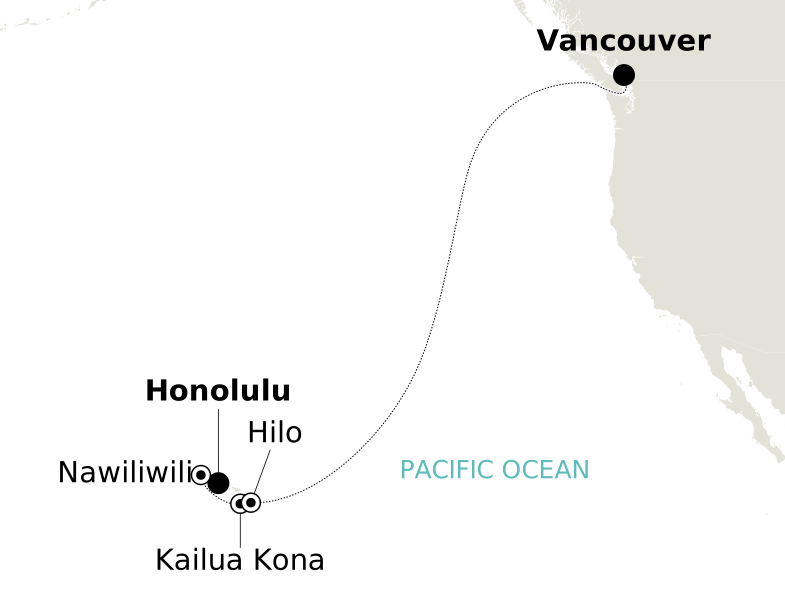
A 11-night ocean voyage aboard Silver Whisper, Honolulu, United States of America to Vancouver, Canada. Destination: French Polynesia & Pacific.
Operated by Silversea Cruises aboard Silver Whisper.
Honolulu, Oahu, Hawaii
Nawiliwili, Kauai, Hawaii
Hilo, Hawaii
Kailua Kona, Hawaii
Vancouver
Honolulu is the capital and largest city of Hawaii. It is located on the southeast coast of the island of Oahu, and is considered to be the most remote major city in the world. The closest point on the US is the Point Arena Lighthouse in California, about 2,045 nautical miles (3,787 km) away. Honolulu's name derives from the native words meaning "sheltered harbour". Archaeological evidence shows that Polynesian migrants first settled here in the 11th century. Although Captain Cook noted this island during his voyage in 1778, the first European to sail into Honolulu Harbour was Captain William Brown of Great Britain in 1794. Soon, the port of Honolulu became a focal point for merchant ships trading between North America and Asia. Hawaii has been subject to strong pressures from many forces, including American missionaries, who arrived in 1820, and opportunistic whalers. These whalers played an important role in the development of Honolulu by bringing trade, commerce, and prosperity that led to expansion into the sugar and pineapple industries. The Honolulu area was bombed by Japan in a surprise attack on the unprepared U.S. naval base at Pearl Harbor on Dec. 7, 1941
Honolulu is the capital and largest city of Hawaii. It is located on the southeast coast of the island of Oahu, and is considered to be the most remote major city in the world. The closest point on the US is the Point Arena Lighthouse in California, about 2,045 nautical miles (3,787 km) away. Honolulu's name derives from the native words meaning "sheltered harbour". Archaeological evidence shows that Polynesian migrants first settled here in the 11th century. Although Captain Cook noted this island during his voyage in 1778, the first European to sail into Honolulu Harbour was Captain William Brown of Great Britain in 1794. Soon, the port of Honolulu became a focal point for merchant ships trading between North America and Asia. Hawaii has been subject to strong pressures from many forces, including American missionaries, who arrived in 1820, and opportunistic whalers. These whalers played an important role in the development of Honolulu by bringing trade, commerce, and prosperity that led to expansion into the sugar and pineapple industries. The Honolulu area was bombed by Japan in a surprise attack on the unprepared U.S. naval base at Pearl Harbor on Dec. 7, 1941
Known as the Garden Isle, Kauai is the northernmost and geologically oldest of the Hawaiian Islands. Nearly circular in shape, only three percent of the land area has been developed for residential and commercial use, with the remaining 97 percent divided between agriculture and conservation. The majority of the island’s population of 52,000 lives and works in the coastal areas. The interior of the island is spectacularly beautiful and pristine. In the centre rises Mount Waialeale, a remnant of an extinct volcano that gave birth to the island. In 1778, Captain Cook anchored the Resolution and Discovery off Kauai at the mouth of the Waimea River, 25 miles (40 km) west of the capital of Lihue. This was Hawaii’s first contact with Western civilisation. Nawiliwili Harbor was established as Kauai’s principal port in 1930. It was named for the Wiliwili trees that were once abundant in the area. Kauai’s near perfect year-round temperatures and the refreshing breezes from the northeast trade winds attract thousands of travellers each year to this island paradise. Pier Information The ship is scheduled to dock at Pier 2 at the Nawiliwili Boat Harbor. It is about three miles (five km) to Lihue. Taxis are generally available at the pier. Shopping The closest shopping area to the pier is Anchor Cove and Harbor Mall across from Kalapaki Beach. Free shuttle service is provided to both shopping areas. Another shuttle is available to the Coconut Market Place at Lihue, where good buys can be found in island fashions and Kauai coffee. The local currency is the U.S. dollar. Cuisine Menus feature locally grown produce, island-raised beef and lamb, and freshly caught fish. There are several good restaurants in Nawiliwili and at Poipu Beach, offering a wide choice of food in every price category. Other Sites Lihue Located three miles (five km) from Nawiliwili, Lihue is Kauai’s county seat as well as the business and transportation centre. It is home to the Kauai Museum, a local history and art museum with exhibits showcasing geology, flora, fauna and artefacts from the missionary and plantation periods. Nearby is Kalapaki Beach with its white sands and gentle waters that make it ideal for swimming and sailing. The Kauai Lagoons serve as a sanctuary for exotic wildlife. Poipu Beach The beaches in this area on the southern-most tip of the island are favourites for snorkelling and scuba diving. Private arrangements for independent sightseeing may be requested through the Tour Office onboard.
In comparison to Kailua-Kona, Hilo is often described as "the old Hawaii." With significantly fewer visitors than residents, more historic buildings, and a much stronger identity as a long-established community, this quaint, traditional town does seem more authentic. It stretches from the banks of the Wailuku River to Hilo Bay, where a few hotels line stately Banyan Drive. The characteristic old buildings that make up Hilo's downtown have been spruced up as part of a revitalization effort. Nearby, the 30-acre Liliuokalani Gardens, a formal Japanese garden with arched bridges and waterways, was created in the early 1900s to honor the area's Japanese sugar-plantation laborers. It also became a safety zone after a devastating tsunami swept away businesses and homes on May 22, 1960, killing 60 people. With a population of almost 50,000 in the entire district, Hilo is the fourth-largest city in the state and home to the University of Hawaii at Hilo. Although it is the center of government and commerce for the island, Hilo is clearly a residential town. Mansions with yards of lush tropical foliage share streets with older, single-walled plantation-era houses with rusty corrugated roofs. It's a friendly community, populated primarily by descendants of the contract laborers—Japanese, Chinese, Filipino, Puerto Rican, and Portuguese—brought in to work the sugarcane fields during the 1800s. One of the main reasons visitors have tended to steer clear of the east side of the island is its weather. With an average rainfall of 130 inches per year, it's easy to see why Hilo's yards are so green and its buildings so weatherworn. Outside of town, the Hilo District has rain forests and waterfalls, a terrain unlike the hot and dry white-sand beaches of the Kohala Coast. But when the sun does shine—usually part of nearly every day—the town sparkles, and, during winter, the snow glistens on Mauna Kea, 25 miles in the distance. Best of all is when the mists fall and the sun shines at the same time, leaving behind the colorful arches that earn Hilo its nickname: the City of Rainbows. The Merrie Monarch Hula Festival takes place in Hilo every year during the second week of April, and dancers and admirers flock to the city from all over the world. If you're planning a stay in Hilo during this time, be sure to book your room well in advance. Hotels Hilo is the wetter, more lush eastern side of the Big Island, which means if you stay here you'll be close to waterfalls and rain-forest hikes, but not to the warm, dry, white-sand beaches of the Kohala Coast. Locals have taken a greater interest in Hilo; signs of that interest are showing in new restaurants, restored buildings, and a handful of clean and pleasant parks. Hilo has a few decent hotels, but none of the high-end resorts that are the domain of the west side. So, get into the groove at one of Hilo's fantastic bed-and-breakfasts. Some have taken over lovely historic homes and serve breakfast comprising ingredients from backyard gardens. The volcano is only a 30-minute drive, as are the sights of the Puna region. There are also a number of nice beaches and surf spots, though not in the class of the resort beaches of South Kohala. Dining Ken's House of Pancakes For years, this 24-hour diner on Banyan Drive between the airport and the hotels has been a gathering place for Hilo residents and visitors. Breakfast is the main attraction: Ken's serves 11 types pancakes, plus all kinds of fruit waffles (banana, peach) and popular omelets, like Da Bradda, teeming with meats. The menu features 180 other tasty local specialties (loco moco, tripe stew, oxtail soup) and American-diner-inspired items from which to choose. Sunday is all-you-can-eat spaghetti night, Tuesday is all-you-can-eat tacos, and Wednesday is prime rib night. Kuhio Grille There's no atmosphere to speak of and water is served in unbreakable plastic, but if you're searching for local fare—that undefinable fusion of ethnic cuisines—this the place. Sam Araki serves a 1-pound laulau (a steamed bundle of taro leaves and pork) that is worth the trip. Other grindz include loco moco, oxtail soup, plate lunches, pork chops, steaks, saimin, stir-fry, and daily specials. At the edge of Hilo's largest mall, above the parking lot near Longs, this local diner opens at 6 am. Pescatore With dim lights, stately high-back chairs, and dark-wood paneling, Pescatore conjures up an Italian trattoria. The food is good, with plenty of Italian basics such as lasagna, chicken marsala, and chicken or veal parmigiana. Families love the simple pastas made to please choosy children. Lunch is served on Sundays only from 10 to 2. The Seaside Restaurant & Aqua Farm The Nakagawa family has been running this eatery since the early 1920s. The latest son to manage it has transformed both the menu and the decor, and that, paired with the setting (on a 30-acre natural, brackish fishpond) makes this one of the most interesting places to eat in Hilo. Islanders travel great distances for the fried aholehole (young Hawaiian flagtail), and mullet raised at the aqua farm. Other great dishes from the sea include furikake salmon, miso butterfish, and macadamia nut–crusted mahimahi, but the Pacific Rim menu includes plenty for landlubbers, too, like prime rib, chicken, and salads. Arrive before sunset and request a table by the window for a view of egrets roosting around the fishpond. Café Pesto Located in a beautiful and historic venue, Café Pesto offers exotic pizzas (with fresh Hamakua mushrooms, artichokes, and rosemary Gorgonzola sauce, for example), Asian-inspired pastas and risottos, fresh seafood, delicious salads, and appetizers you can make a meal of. Products from local farmers feature heavily on the menu—Kulana free-range beef, Kawamata Farms tomatoes, and Kapoho Farms lehua-blossom honey are all made on the island. Local musicians provide entertainment at dinner Wednesday through Sunday. On the island's west side, another Café Pesto is located above Kawaihae Harbor. Café 100 Established in 1948, this family-owned restaurant is famous for its tasty loco moco, prepared in more than three dozen ways, and its dirt-cheap breakfast and lunch specials. (You can stuff yourself for $3 if you order right.) The word "restaurant," or even "café," is used liberally here—you order at a window and eat on one of the outdoor benches provided—but you come here for the food, prices, and authentic, old Hilo experience. Blane's Drive-In With a vast menu second only to Ken's House of Pancakes, Blane's serves up everything from standard hamburgers to popular chicken katsu to a gravy burger—comfort food for the local palate. A mean plate lunch with tons of fresh fish is only $7. At one point this was a real drive-in, with car service. Now, customers park, order at the window, and eat at one of the few picnic tables or take their food to go. There is a second location in Industrial Hilo (150 Wiwoole St.), and two others in Honokaa and Orchidland. Happy Valley Seafood Restaurant Don't let the name fool you. Though Hilo's best Chinese restaurant does specialize in seafood (the salt-and-pepper prawns are fantastic), it also offers a wide range of other Cantonese treats, including a sizzling lamb platter, salt-and-pepper pork, Mongolian beef or chicken, and vegetarian specialties like garlic eggplant and crispy green beans. The food is decent, portions are large, and the price is right, but don't come here expecting any ambience—this is a funky and cheap Chinese restaurant, with a few random pieces of artwork tacked up here and there. Sombat's Fresh Thai Cuisine There's a reason why locals flock to this hideaway for the best Thai cuisine in Hilo, and the name says it all. Fresh local ingredients highlight proprietor Sombat Saenguthai's menu (many of the herbs come from her own garden) to create authentic and tasty Thai treats like coconut curries, fresh basil rolls, eggplant stir-fry, and green papaya salad. Most dishes can be prepared with your choice of tofu, pork, beef, chicken, squid, or fish. The weekday lunch plate special is a steal ($7–$9). And if you can't leave the island without it, Sombat's famous pad thai sauce is available to take home in jars. Bears' Coffee This favorite breakfast spot is much loved for its fresh-fruit waffles and tasty morning coffee. Service can be a little slow, but where are you running off to anyway? For lunch the little diner serves up huge deli sandwiches and decent entrée-size salads. In keeping with its name, it's full of stuffed bears, ceramic bears, even bear wallpaper. Big Island Pizza Gourmet pizza is the star here, topped with things like shrimp and smoked salmon, but sandwiches, wraps, pastas, and salads are also served. There are only a handful of tables for eating in, but there's a brisk take-out business as well as delivery to the eastern side of the island. At another location above Costco in Kailua-Kona, the specialty is European-style pizzas with artisan crusts. Reuben's Mexican Restaurant It's not the best Mexican food you've ever had, but if you're jonesing for some carne asada or chicken flautas, Reuben's has you pretty well covered. You can make a meal out of the warm chips and salsa alone. Known for pouring a stiff margarita in all sorts of interesting flavors, like lilikoi (passion fruit), guava, mango, coconut, and watermelon, the restaurant makes its own margarita mix. This is a lively place to spend an afternoon or evening. Verna's Drive-In Verna's is a favorite among locals, who come for the moist homemade burgers and filling plate lunches. The price is right with a burger combo that includes fries and a drink for just $5.50. If you're hungry for more, try the traditional Hawaiian plate with laulau, beef stew, chicken long rice, lomilomi salmon; or the smoked meat plate (a local specialty) smothered in onions and served with rice and macaroni salad. Whatever you choose, you won't leave hungry. Late-night revelers take note: Verna's is one of the only joints in Hilo that's open 24 hours every day. Full Moon Cafe This cozy restaurant in a historic bayfront building offers a small menu of American choices like burgers, fish, and steak, but where the eatery stands out is its fresh and tasty traditional Thai fare. The owners grow their own spices, herbs, and papayas organically on their Puna farm. The chefs sauté with olive oil to keep things heart-healthy. Good choices are the hot and sour Tom Yum soup, loaded with fresh veggies; the pineapple curry; green papaya salad; and steamed salmon. There's outdoor seating on the lanai, and the adjacent Full Moon Coffee serves breakfast beginning at 6. Ocean Sushi What this restaurant lacks in ambience it certainly makes up for in quality and value. We're talking about light and crispy tempura; tender, moist teriyaki chicken; and about 25 specialty sushi rolls that, on average, cost a mere $5 per roll. Sushi lovers enjoy the "hospital roll," with shrimp tempura, cream cheese, cucumber, and spicy ahi, and the "volcano roll," akin to a California roll topped with flying-fish eggs, dried fish shavings, green onions, and spicy mayo. Don't let the low price fool you—the service is quick and the food is fresh and filling. Hilo Bay Café This popular restaurant, previously located in a Walmart strip mall, now overlooks Hilo Bay from its towering perch on the waterfront. The sophisticated second-floor dining room looks like it's straight out of Manhattan. While some of the menu items have changed, old favorites are still available, including the traditional Blue Bay burger, shoestring fries, and eggplant Parmesan custard. A sushi bar now complements the excellent selection of fresh fish, gourmet sake, and premium wines. Ponds Hilo Perched on the waterfront overlooking a scenic and serene pond, this restaurant has the look and feel of an old-fashioned, harborside steak house and bar. The menu features a good range—burgers and salads, steak and seafood. Every Thursday is lobster night, with 8-ounce lobster tails served a variety of ways. Live music happens most evenings. Nightlife Cronie's Bar & Grill A sports bar by night and hamburger joint by day, Cronie's is a local favorite. When the lights go down, the bar gets packed. The Mask-querade Bar Hidden away in an unassuming strip mall, this is one of the Big Island's most venerable gay bars. Drag shows, hot DJs, live music, drink specials, fiestas, and Sunday barbecues are included in the roster of weekly events. All are welcome. Shopping Hilo Shopping Center Among this shopping plaza's 40 shops are a day spa, a pharmacy, a trendy boutique, and popular Lanky's Pastries and Island Naturals Market and Deli, plus Sunlight Cafe and Restaurant Miwa. There's plenty of free parking. Prince Kuhio Plaza The Big Island's most comprehensive mall has indoor shopping, entertainment (a multiplex), and dining, including KFC, Hot Dog on a Stick, Cinnabon, the island's only IHOP, and Maui Tacos. The kids might like the arcade (near the food court), while you enjoy the stores, anchored by Macy's, Sports Authority, and Sears. Basically Books More than a bookstore, this bayfront shop stocks one of Hawaii's largest selections of maps, including topographical and relief maps, and Hilo's largest selection of Hawaiian music. Of course, it also has books about Hawaii, including great choices for children. Most Irresistible Shop This place lives up to its name by stocking unique gifts from around the Pacific, be it pure Hawaiian ohia lehua honey, ka'u coffee, aloha wear, or tinkling wind chimes. Dragon Mama Step into this charming downtown Hilo spot to find authentic Japanese fabrics, futons, and gifts along with an elegant selection of clothing, sleepwear, slippers, and tea-service accoutrements. Handmade comforters, pillows, and futon pads are sewn of natural fibers on site. Dan DeLuz's Woods Master bowl-turner Dan DeLuz creates works of art from 50 types of exotic wood grown on the Big Island. The shop features a variety of items—from picture frames to jewelry boxes—made from koa, monkeypod, mango, kiawe, and other fine hardwoods. The store is closed Tuesdays. Kimura's Lauhala Shop Originally a general store built in 1914, this historic shop features handmade products crafted by local lauhala weavers. Among the offerings are hats, baskets, containers, and mats, many of which are woven by the proprietors. Owner Alfreida Kimura-Fujita was born in the house behind the shop, and her daughter Renee is also an accomplished weaver. Holualoa Gallery One of several excellent galleries along the narrow highway in this historic artists' village, this shop carries stunning contemporary raku pottery, original paintings by local artists, and other collectibles, including gallery owner Matt Lovein's famous Wish Keepers ceramic sculptures. Sig Zane Designs This acclaimed boutique sells distinctive island wearables with bold colors and motifs designed by the legendary Sig Zane, known for his artwork honoring native flora and fauna. All apparel is handcrafted in Hawaii, and is often worn by local celebrities and businesspeople. Hilo Farmers Market The 200 vendors here—stretching a couple of blocks—sell a profusion of tropical flowers, locally grown produce, aromatic honey, tangy goat cheese, hot breakfast and lunch items, and fresh baked specialties at extraordinary prices. This colorful, open-air market—the most popular on the island—opens for business Wednesday and Saturday from 6 am to 4 pm. A smaller version on the other days features 20 to 30 vendors. Big Island Candies A local legend in the cookie- and chocolate-making business, Big Island Candies is a must-see if you have a sweet tooth. Enjoy a free cookie sample and a cup of Kona coffee as you watch sweets being made through a window. The store has a long list of interesting and tasty products, but it is best known for its chocolate-dipped shortbread cookies. Antiques and Orchids Antique Mall Housed in a historic building in Captain Cook, this boutique lives up to its name by offering a comprehensive collection of local antiques and Hawaiiana (check out the Duke Kahanamoku memorabilia) interspersed with orchids of assorted colors and varieties. Enjoy a cup of Kona coffee served in the store's quaint coffee shop. Hilo Hattie Set in an indoor mall, the east-side outlet of the well-known clothier is slightly smaller than its Kailua-Kona cousin, but offers plenty of the same his-and-her aloha wear, casual clothes, slippers, jewelry, and souvenirs. Two Ladies Kitchen This hole-in-the-wall confections shop has made a name for itself thanks to its pillowy mochi (Japanese rice pounded into a sticky paste and molded into shapes). The proprietors are best known for their huge ripe strawberries wrapped in a white mochi covering, which won't last as long as a box of chocolates—most mochi items are only good for two or three days. To guarantee you get your fill, call and place your order ahead of time. It's closed Sunday and Monday. Cliff Johns Gallery Woodworker Cliff Johns has a knack for sourcing unique fine art handcrafted by Big Island artisans. The gallery features wood sculptures, paintings, carvings, and other crafts different from the standard fare. South Kona Green Market A favorite in Captain Cook, this Sunday farmers' market offers great hot breakfast and lunch items, produce from local farms, and artists selling their goods. Kona Stories With more than 10,000 titles, this bookstore also sells Hawaiiana, children's toys, and whimiscal gifts. Special events, such as readings and book signings, are held weekly. Hilo Coffee Mill In addition to a fantastic coffee-farm tour, the Hilo Coffee Mill sells coffee from a variety of local producers, along with locally made baked goods, candies, artwork, and gifts. Free coffee samples are offered. The mill is closed Wednesday and Sunday and hosts a farmers' market Saturday 8 to 1. Sights Banyan Drive More than 50 enormous banyan trees with aerial roots dangling from their limbs were planted some 60 to 70 years ago by visiting celebrities. Names such as Amelia Earhart and Franklin Delano Roosevelt can be seen on plaques affixed to the trees. A scenic loop beginning at the Hawaii Naniloa Resort makes a nice walk. Lyman Museum & Mission House Built in 1839, the beautifully restored Lyman Mission House is the oldest frame building on the island. (Tours are offered.) An adjacent museum has wonderful exhibits on volcanoes, island formation, island habitats and wildlife, marine shells, and minerals and gemstones. It also showcases native Hawaiian culture and immigrant ethnic groups, including a life-size replica of a traditional Korean home. The gift shop has great Hawaiian items. Nani Mau Gardens The name means "forever beautiful" in Hawaiian, and that's a good description of this 20-acre botanical garden filled with several varieties of fruit trees and hundreds of varieties of ginger, orchids, anthuriums, and other exotic plants. The restaurant has a lunch buffet. Wailuku River State Park (Rainbow Falls ) After a hard rain, these falls thunder into the Wailuku River gorge, often creating magical rainbows in the mist. Sometimes known as the "Hilo Town Falls," they are located just above downtown Hilo. Take Waianuenue Avenue west for a mile; when the road forks, stay right and look for the Hawaiian warrior sign. Open daylight hours. S. Hata Building Built as a general store in 1912 by Sadanosuke Hata and his family, this historic structure now houses galleries, a restaurant, and other small shops. During World War II, Hata family members were interned and the building was confiscated by the U.S. government. When the war was over, a daughter repurchased it for $100,000. A beautiful example of Renaissance-Revival architecture, it won an award from the state for the authenticity of its restoration. Liliuokalani Gardens Designed to honor Hawaii's first Japanese immigrants, Liliuokalani Gardens' 30 acres of fish-filled ponds, stone lanterns, half-moon bridges, elegant pagodas, and a ceremonial teahouse make it a favorite Sunday destination. The surrounding area, once a busy residential neighborhood, was destroyed by a 1960 tsunami that caused widespread devastation and killed 61 people. Pacific Tsunami Museum In downtown Hilo, businesses tend to be far from the bayfront. There's a reason for this. Tsunamis have killed more people in Hawaii than any other natural event, especially in Hilo. A small but informative museum in a 1931 building provides tsunami education and scientific information, and chronicles the poignant history of these devastating disasters, with accounts taken from tsunami survivors from Hawaii and worldwide. Exhibits include a wave machine and tsunami warning center simulation as well as detailing recent tsunamis in Japan, Alaska, and Indonesia. Moku Ola This small island, just offshore from Liliuokalani Gardens, is accessible via a footbridge. It was considered a place of healing in ancient times. Today children play in the tide pools while fisherfolk try their luck. Mauna Loa Macadamia Nut Corporation Acres of macadamia-nut trees lead to a giant roasting facility and processing plant with viewing windows and self-guided tours. A video depicts the harvesting and preparation of the nuts, and there are free samples and plenty of gift boxes with mac nuts in every conceivable form of presentation for sale in the visitor center. There is no factory processing on weekends or holidays. Children can burn off extra energy on a nature trail. Panaewa Rainforest Zoo & Gardens Billed as "the only natural tropical rainforest zoo in the United States," this sweet zoo is the home of white Bengal tiger Namaste, whose daily 3:30 feeding is quite a sight. Among the other animals here are such native Hawaiian species as the state bird, the nene goose, and the io (hawk), as well as lots of other rare birds, monkeys, and lemurs. To get here, turn left on Mamaki off Highway 11; it's just past the "Kulani 19, Stainback Hwy." sign. Haili Church Constructed in 1859 by New England missionaries, this church is known for its choir, which sings hymns in Hawaiian during services. In 1902, Hawaiian musical legends Harry K. Naope, Sr., and Albert Nahalea, Sr., began the choral traditions still practiced by their descendants. Kalakaua Park King Kalakaua, who revived the hula, was the inspiration for Hilo's Merrie Monarch Festival. A bronze statue, erected in 1988, depicts the king with a taro leaf in his left hand to signify the Hawaiian peoples' bond with the land. The park also has a huge spreading banyan tree and small fishponds, but no picnic or recreation facilities. In a local tradition, families of military personnel often leave leftover floral displays and funeral wreaths along the fishpond walkway as a way of honoring and celebrating their loved ones.§ Keawe Street Buildings here have been restored to their original 1920s and '30s plantation styles. Although most shopping is along Kamehameha Avenue, the ambience on Keawe Street offers a nostalgic sampling of Hilo as it might have been 80 years ago. Downtown Hilo won a major paint retailer's contest, so you might see painting of these historic properties in progress. Naha and Pinao stones These two huge, oblong stones are legendary. The Pinao stone is purportedly an entrance pillar of an ancient temple built near the Wailuku River. King Kamehameha is said to have moved the 5,000-pound Naha stone when he was still in his teens. Legend decreed that he who did so would become king of all the islands. They're in front of the Hilo Public Library. Wailuku River State Park (Boiling Pots) Four separate streams fall into a series of circular pools here, forming the Peepee Falls. The resulting turbulent action—best seen after a good rain—has earned this stretch of the Wailuku River the nickname Boiling Pots. There's no swimming allowed at Peepee Falls or anywhere in the Wailuku river, due to dangerous currents and undertows. The falls are 3 miles northwest of Hilo off Waianuenue Avenue; keep to the right when the road splits and look for the sign. Open daylight hours. Wailoa Center In Wailoa State Recreation Area, this circular exhibition center mounts monthly shows featuring local artists. Work ranges from photography, contemporary painting, and woodworking to musical instruments and artwork depicting Hawaii's native species. Hilo Downtown Improvement Association An excellent and free self-guided walking tour to downtown Hilo includes historical information, a map, and directions to 18 historic sites. You can obtain one from the association's website or downtown Hilo office. Hilo Coffee Mill With all the buzz about Kona coffee, it's easy to forget that coffee is produced throughout the rest of the island. The Hilo Coffee Mill is a pleasant reminder of that. In addition to farming its own coffee on-site, the mill has partnered with several small coffee farmers in East Hawaii in an effort to put the region on the world's coffee map. You can sample their efforts, tour the mill, and watch the roasters in action. Imiloa Astronomy Center Part Hawaiian cultural center, part astronomy museum, this center provides an educational and cultural complement to the research being conducted atop Mauna Kea. Although visitors are welcome at Mauna Kea, its primary function is as a research center—not observatory, museum, or education center. Those roles have been taken on by Imiloa in a big way. With its interactive exhibits, full-dome planetarium shows, and regularly scheduled talks and events, the center is a must-see for anyone interested in the stars, the planets, or Hawaiian culture and history. Five minutes from downtown Hilo, the center also provides an important link between the scientific research being conducted at Mauna Kea and its history as a sacred mountain for the Hawaiian people. Admission includes one planetarium show and an all-day pass to the exhibit hall, which features more than 100 interactive displays. The lunch buffet at the adjoining Sky Garden Cafe is popular and affordable. Reeds Bay Beach Park Safe swimming, proximity to downtown Hilo, and a freshwater-fed swimming hole, called the Ice Pond, that flows into the backwaters of Hilo Bay are the enticements of this cove. No, there really isn't ice in the swimming hole; it just feels that way on a hot sultry day. The large pond, between Hilo Seaside Hotel and Harrington's Restaurant, is a favorite of local kids, who enjoy jumping into and frolicking in the chilly fresh- and saltwater mix. The water is usually calm. Amenities: parking (no fee); showers. Best for: swimming. Onekahakaha Beach Park Shallow, rock-wall-enclosed tide pools and an adjacent grassy picnic area make this park a favorite among Hilo families with small children. The protected pools are great places to look for Hawaiian marine life like sea urchins and anemones. There isn't much white sand, but access to the water is easy. The water is usually rough beyond the line of large boulders protecting the inner tide pools, so be careful if the surf is high. This beach gets crowded on weekends. Amenities: lifeguards (weekends, holidays, and summer only); parking (no fee); showers; toilets. Best for: swimming. Mokupapapa Discovery Center This informative center teaches about the Papahanaumokuakea Marine National Monument, which encompasses about 140,000 square miles in the waters northwest of the main Hawaiian Islands and is a UNESCO World Heritage site. Giant graphics, murals, and 3-D maps depict the monument's extensive coral reefs and the more than 7,000 marine species that live there, one in four of which are found only in the Hawaiian archipelago. Knowledgeable staff or volunteers are on hand to answer questions. Interactive programs, a new aquarium, and short films give insight into marine life and environmental impact. It's worth a stop just to get an up-close look at the center's huge stuffed albatross, with wings outstretched. Kaumana Caves Park Thanks to Hilo's abundant rainfall, this lava tube is lush with plant life. Concrete stairs lead down to the 2½-mile-long tube. Bring a flashlight and explore as far as you dare to go. There are restrooms and a covered picnic table at the cave, and parking across the street. Please heed all warning signs when entering. Waiolena and Wailua Beach Parks and Richardson Ocean Center Just east of Hilo, almost at the end of the road, three adjacent parks make up one beautiful spot with a series of bays, protected inlets, lagoons, and pretty parks. This is one of the best snorkeling sites on this side of the island, as rocky outcrops provide shelter for schools of reef fish, sea turtles, and dolphins. Local kids use the small black-sand pocket beach for body boarding. The shaded grassy areas are great for picnics. Be warned, this place is very crowded on weekends. Amenities: lifeguards (weekends, holidays, and summer only); parking (no fee); showers; toilets. Best for: snorkeling; walking. Big Island Visitors Bureau Marked by a red-and-white Hawaiian warrior sign, the bureau is worth a visit for brochures, maps, and up-to-date, friendly insider advice.
The Kona coast, on Hawaii’s western shore, divides into two distinct areas – the north with spectacular sandy beaches followed farther up by a long bleak slope of barren lava trails from dormant Mauna Kea all the way down to the sea. Southwards, the hillsides are more fertile and there is still a feel of the old Hawaii. The Big Island’s main resort is officially called Kailua, but mostly everyone simply refers to it as Kona, or Kailua-Kona. It is by far the island’s most developed area. Whilst the main road, Ali’i Drive, is lined with shops, hotels and condominiums, most of the shoreline vista remains intact thanks to low-rise buildings. To show just how fertile lava can be when tended, miles of multi-hued bougainvillea and poinsettias line Ali’i Drive like a colourful lei. East of town is the 8,271-foot (2,521-metre) Mount Hualalai, where local people still earn a living growing vegetables and taro on small farms spreading over the side of the mountain. In the centre of Kona stands the Hulihee Palace built as the governor’s residence in 1838. The relatively simple dwelling was heavily damaged during the last big storm and is now under restoration. The north end of downtown is home to Ahuena Heiau, where King Kamehameha spent the last years of his life. A dozen miles south of Kona at Kealakekua Bay is the site where Captain Cook was killed on his second voyage to Hawaii. South Kona is also the prime source of the famous Kona coffee.
Days at sea are the perfect opportunity to relax unwind and catch up with what you’ve been meaning to do. So whether that is going to the gym, visiting the spa, whale watching, catching up on your reading or simply topping up your tan these blue sea days are the perfect balance to busy days spent exploring shore side.
Days at sea are the perfect opportunity to relax unwind and catch up with what you’ve been meaning to do. So whether that is going to the gym, visiting the spa, whale watching, catching up on your reading or simply topping up your tan these blue sea days are the perfect balance to busy days spent exploring shore side.
Days at sea are the perfect opportunity to relax unwind and catch up with what you’ve been meaning to do. So whether that is going to the gym, visiting the spa, whale watching, catching up on your reading or simply topping up your tan these blue sea days are the perfect balance to busy days spent exploring shore side.
Days at sea are the perfect opportunity to relax unwind and catch up with what you’ve been meaning to do. So whether that is going to the gym, visiting the spa, whale watching, catching up on your reading or simply topping up your tan these blue sea days are the perfect balance to busy days spent exploring shore side.
Days at sea are the perfect opportunity to relax unwind and catch up with what you’ve been meaning to do. So whether that is going to the gym, visiting the spa, whale watching, catching up on your reading or simply topping up your tan these blue sea days are the perfect balance to busy days spent exploring shore side.
Days at sea are the perfect opportunity to relax unwind and catch up with what you’ve been meaning to do. So whether that is going to the gym, visiting the spa, whale watching, catching up on your reading or simply topping up your tan these blue sea days are the perfect balance to busy days spent exploring shore side.
Boasting mountains, sea, culture, art and so much more, many cities claim to have it all, but few can back it up like Vancouver. Famously livable, just visiting this highrise city - surrounded by staggering natural beauty - is a thrill. Offering all of the creature comforts of an ultra-modern, worldly metropolis - even downtown has a hint of mountain-freshness to its air - and part of Vancouver's appeal is how easily you can swap the skyscrapers for whale-filled oceans and mountain-punctured skies. Head up to the Vancouver Lookout Tower for the ultimate 360-degree views of the city glistening, amid the beautiful embrace of the beckoning wilderness beyond. But what to see first? Art lovers might choose the Vancouver Art Gallery or the Contemporary Art Gallery. Nature lovers might rush for the ferry to visit Vancouver Island - where they can encounter grizzly bears, whales and orcas. Culture vultures, on the other hand, will probably head for the sights and sounds of Canada's biggest Chinatown. From steaming dim sum for lunch to Chinese apothecaries offering herbs to soothe any illness, it’s all here thanks to the migrant workers of the 19th century. The one-of-a-kind treasure of Stanley Park brings wild wonder and natural beauty to this cosmopolitan city's doorstep, and the pine-tree clad park offers isolated trails and amazing views. Wander the Seawall that encircles it - a 20-mile coastal path, full of joggers, whizzing skaters and wandering couples. Grab a bike and cycle between Coal Harbour and Kitsilano Beach. You can top up your tan on the shore, as you soak in the glorious views of the mountains and cityscape from the sands.
From $5,750
per guest · 11 nights
Prices are a guide and vary with season, cabin category and party size. Your advisor will confirm the exact cost before anything is booked.
Classic Veranda
suite
Deluxe Veranda
suite
Grand 1 Bedroom
suite
Grand 2 Bedroom
suite
Medallion
suite
Owner 1 Bedroom
suite
Owner 2 Bedroom
suite
Royal 1 Bedroom
suite
Royal 2 Bedroom
suite
Silver
suite
Superior Veranda
suite
Vista
suite