




Prefer a conversation?
Our team is always available to guide you through the process and ensure your experience is perfectly matched to your preferences.
Our team is always available to guide you through the process and ensure your experience is perfectly matched to your preferences.
Duration
13 Nights
Price
From $7,950
Ship
Silver Whisper
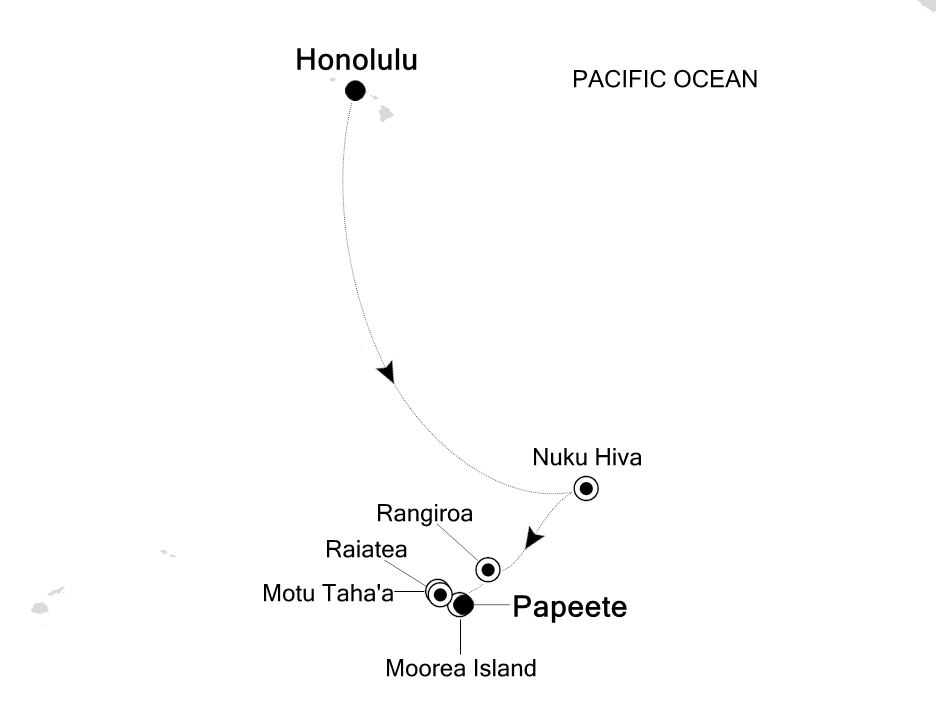
A 13-night ocean voyage aboard Silver Whisper, Honolulu, United States of America to Papeete, French Polynesia. Destination: French Polynesia & Pacific.
Operated by Silversea Cruises aboard Silver Whisper.
Honolulu, Oahu, Hawaii
Nuku Hiva, Marquesas Islands
Fatu Hiva, Marquesas Islands
Rangiroa
Motu Taha'a
Raiatea
Moorea Island
Papeete (Tahiti)
Honolulu is the capital and largest city of Hawaii. It is located on the southeast coast of the island of Oahu, and is considered to be the most remote major city in the world. The closest point on the US is the Point Arena Lighthouse in California, about 2,045 nautical miles (3,787 km) away. Honolulu's name derives from the native words meaning "sheltered harbour". Archaeological evidence shows that Polynesian migrants first settled here in the 11th century. Although Captain Cook noted this island during his voyage in 1778, the first European to sail into Honolulu Harbour was Captain William Brown of Great Britain in 1794. Soon, the port of Honolulu became a focal point for merchant ships trading between North America and Asia. Hawaii has been subject to strong pressures from many forces, including American missionaries, who arrived in 1820, and opportunistic whalers. These whalers played an important role in the development of Honolulu by bringing trade, commerce, and prosperity that led to expansion into the sugar and pineapple industries. The Honolulu area was bombed by Japan in a surprise attack on the unprepared U.S. naval base at Pearl Harbor on Dec. 7, 1941
Days at sea are the perfect opportunity to relax unwind and catch up with what you’ve been meaning to do. So whether that is going to the gym, visiting the spa, whale watching, catching up on your reading or simply topping up your tan these blue sea days are the perfect balance to busy days spent exploring shore side.
Days at sea are the perfect opportunity to relax unwind and catch up with what you’ve been meaning to do. So whether that is going to the gym, visiting the spa, whale watching, catching up on your reading or simply topping up your tan these blue sea days are the perfect balance to busy days spent exploring shore side.
Days at sea are the perfect opportunity to relax unwind and catch up with what you’ve been meaning to do. So whether that is going to the gym, visiting the spa, whale watching, catching up on your reading or simply topping up your tan these blue sea days are the perfect balance to busy days spent exploring shore side.
Days at sea are the perfect opportunity to relax unwind and catch up with what you’ve been meaning to do. So whether that is going to the gym, visiting the spa, whale watching, catching up on your reading or simply topping up your tan these blue sea days are the perfect balance to busy days spent exploring shore side.
Days at sea are the perfect opportunity to relax unwind and catch up with what you’ve been meaning to do. So whether that is going to the gym, visiting the spa, whale watching, catching up on your reading or simply topping up your tan these blue sea days are the perfect balance to busy days spent exploring shore side.
Think of French Polynesia and you are automatically transported to the white sands of Tahiti, the blue seas of Bora Bora or, at the very least, the iconic statues of Easter Island. Now, imagine a place that is home to that majestic trinity, but has no crowds and is full of island authenticity that is rare in these global times. You have just imagined Nuku Hiva. The island is the second largest after Tahiti in the archipelago, but is yet to be discovered by tourism. As part of the Marquesas Islands, Nuku Hiva is technically French, but don’t expect to find any blue and white striped shirts here! In fact, even though French is the “official” language of the island, a sing-song dialect of Tahitian mixed with Marquesan is more widely spoken. The younger generations also speak English. Undeniably, Nuku Hiva has been blessed by the Gods. With towering mountains, eight magnificent harbours, and one of the world's highest waterfalls, Nuku Hiva is rich with Mother Nature’s jewels. The island could lay claim to a great many claims to fame, such as its deep, unpolluted waters, its lush forests bursting with vitality or its fascinating assortment of archaeological interests including tikis (sacred statues) and pae pae (stone platforms that formed the foundations of houses). Yet for those in the know, the island’s primary claim to fame is that author Herman Mellville deserted his ship in order to live among the natives of the island and his books Typee and Omoo were inspired by his experiences on Nuku Hiva.
Fatu Hiva is the southernmost and most remote island in the Marquesas Group. First seen by Europeans in 1595 when Mendaña went to colonize the Solomon Islands the island again gained some fame through the visit of Thor Heyerdahl in the mid-1930s. Steep cliffs sharp mountain peaks and many narrow valleys form an impressive obstacle when exploring this volcanic island. The two villages of Omoa and Hana Vave have combined some 650 inhabitants and are both located on the more protected western side of the island. They are connected by a 17 kilometer long road that climbs up to the central plateau. Omoa has a protected little harbor for local boats but Hana Vave has the Bay of Virgins one of the most photographed bays in the Marquesas Islands if not French Polynesia. Islanders are known for their tapa (bark cloth) paintings and wood carvings –which are highly sought after in Tahiti.
Days at sea are the perfect opportunity to relax unwind and catch up with what you’ve been meaning to do. So whether that is going to the gym, visiting the spa, whale watching, catching up on your reading or simply topping up your tan these blue sea days are the perfect balance to busy days spent exploring shore side.
Rangiroa is French Polynesia’s largest atoll. More than 400 motu (islets) enclose the lagoon, which is so wide and long that one cannot see the southern row of motu from the two main islets in the north –hence the local name Rangiroa meaning wide or long sky, sometimes taken as “immense sky”. There are several passes from the ocean into the lagoon and the two main villages of Avatoru and Tiputa are located next to the passes of the same names. Drift diving and snorkeling the incoming tides looking for sharks and manta rays at these passes is one of Rangiroa’s main touristic draws. Government jobs, ecotourism and pearl farming are the main sources of income on the atoll. The lagoon’s calm turquoise waters, rich marine underwater world and relaxed atmosphere attract visitors year-round to the many local guesthouses and a few hotels. Both Avatoru and Tiputa also feature schools for the other Tuamotu Islands which have no higher education possibilities. One of Rangiroa’s most unusual attractions is the white and rose wine produced on the islet immediately west of Avatoru –the wine has won several awards.
Known as the "Sacred Island," Raiatea is a fascinating haunt for archaeologists and historians as it's one of the islands in the Pacific where Polynesian culture can trace its roots. Visitors will find many of the older Polynesian structures still in place and are fascinating places to explore. In the 16th century, Raiatea developed a powerful cult dedicated to Oro the God of War and built a large meeting ground, the Taputaputea Marae, which is still intact. Human sacrifice was practiced until around the middle of the 18th century and visitors should look for the sacrificial stone. Several tour operators run visits to the marae (ancient temples) along with some degree of informed commentary—although in fairness Polynesian storytelling can embellish things a little. The Faaroa River is the only navigable waterway in French Polynesia and it can be traveled by powerboat or outrigger canoe. Running through the Faaroa Gorge it passes some spectacular scenery with steep-walled jungle foliage holding dozens of bird species and wild hibiscus. Trekking up Mount Temehani, a well-known landmark that's said to be Oro's birthplace, is relatively demanding. Keep a lookout for the rare, five-petal tiare apetahi. Said to be impossible to grow anywhere else, this white, indigenous flower can only be found above 1,300 feet (396 meters). Look, but don't touch. It's against the law to pick them. Dining Raiatea has a good selection of restaurants with an across-the-board selection of food ranging from French to Polynesian, Chinese, and Italian. This is a "boatie" or "yachtie" type environment with a number of the better-known dining places clustered around Uturoa's harbor; things can get quite busy on Friday and Saturday nights. Seafood is always outstanding on the menu but the selection should satisfy most diners, though they may find the wine list more constricting. It should perhaps be pointed out that many of the restaurants are as much noted for their outstanding views or sunsets as for the food. Another way of dining are les roulottes which are found here and on other islands in Polynesia. The name means basically "rolling food trucks" and they supply simple island food, usually on the cheap side. They are a favorite of many locals who either eat at the truck or take the food home. Hotels There are only two hotels on the island but a number of pensions or lodging places. Shopping As is typical across the Pacific, the locals in Raiatea shop for fresh food, including fish, at the local market. Located near the harbor on the main street, the market also sells arts and crafts. It opens at sunrise, and Wednesday and Friday are the busiest days. The freshest produce is sold on Sunday, but before dawn—the market closes at 7 am on Sunday. Jean Luc Liaut Both islands have an active community of artisans, but one of the more unusual is Jean Luc Liaut, a native Raiatean whose fishing boat Te Manu Ata is based in Uturoa and is available for charter. He has turned handmade fishing lures into an art form, and his products are sought globally. Hawaiki Nui Federation The usual art and handicraft shops sell a wide variety of woodcarvings and shell and pearl items, with most guaranteed to have been locally made. Local artists often sell at the Hawaiki Nui Federation at Uturoa airport and the Maritime Harbor.
Known as the "Sacred Island," Raiatea is a fascinating haunt for archaeologists and historians as it's one of the islands in the Pacific where Polynesian culture can trace its roots. Visitors will find many of the older Polynesian structures still in place and are fascinating places to explore. In the 16th century, Raiatea developed a powerful cult dedicated to Oro the God of War and built a large meeting ground, the Taputaputea Marae, which is still intact. Human sacrifice was practiced until around the middle of the 18th century and visitors should look for the sacrificial stone. Several tour operators run visits to the marae (ancient temples) along with some degree of informed commentary—although in fairness Polynesian storytelling can embellish things a little. The Faaroa River is the only navigable waterway in French Polynesia and it can be traveled by powerboat or outrigger canoe. Running through the Faaroa Gorge it passes some spectacular scenery with steep-walled jungle foliage holding dozens of bird species and wild hibiscus. Trekking up Mount Temehani, a well-known landmark that's said to be Oro's birthplace, is relatively demanding. Keep a lookout for the rare, five-petal tiare apetahi. Said to be impossible to grow anywhere else, this white, indigenous flower can only be found above 1,300 feet (396 meters). Look, but don't touch. It's against the law to pick them. Dining Raiatea has a good selection of restaurants with an across-the-board selection of food ranging from French to Polynesian, Chinese, and Italian. This is a "boatie" or "yachtie" type environment with a number of the better-known dining places clustered around Uturoa's harbor; things can get quite busy on Friday and Saturday nights. Seafood is always outstanding on the menu but the selection should satisfy most diners, though they may find the wine list more constricting. It should perhaps be pointed out that many of the restaurants are as much noted for their outstanding views or sunsets as for the food. Another way of dining are les roulottes which are found here and on other islands in Polynesia. The name means basically "rolling food trucks" and they supply simple island food, usually on the cheap side. They are a favorite of many locals who either eat at the truck or take the food home. Hotels There are only two hotels on the island but a number of pensions or lodging places. Shopping As is typical across the Pacific, the locals in Raiatea shop for fresh food, including fish, at the local market. Located near the harbor on the main street, the market also sells arts and crafts. It opens at sunrise, and Wednesday and Friday are the busiest days. The freshest produce is sold on Sunday, but before dawn—the market closes at 7 am on Sunday. Jean Luc Liaut Both islands have an active community of artisans, but one of the more unusual is Jean Luc Liaut, a native Raiatean whose fishing boat Te Manu Ata is based in Uturoa and is available for charter. He has turned handmade fishing lures into an art form, and his products are sought globally. Hawaiki Nui Federation The usual art and handicraft shops sell a wide variety of woodcarvings and shell and pearl items, with most guaranteed to have been locally made. Local artists often sell at the Hawaiki Nui Federation at Uturoa airport and the Maritime Harbor.
Moorea is a high mountainous island with two nearly symmetrical bays found on the north coast. The island’s triangular shape has been likened to a heart or a bat. Eight mountain peaks reaching a height of up to 1,207 meters give Moorea a very rugged silhouette. The reef surrounding the island encloses a narrow lagoon –a RAMSAR Wetland- and has barely any motu (reef islets). Sharks and rays are some of the lagoon’s attractions. The island is only one eighth the size of neighboring Tahiti and has a more relaxed life-style. A road leads around Moorea, passing small villages with their churches and the resorts and smaller hotels mainly found on the north coast. A detour into the interior will show large pineapple plantations, French Polynesia’s only agricultural school, ancient marae (stone platforms) and splendid views of the island from Belvedere above Cook’s Bay or the Magic Mountain above Papetoai, Opunohu Bay. Many of the 18,000 residents work in Tahiti, taking one of the ferries plying between Vaiare on the east coast and Papeete. This led to Papeete being one of France’s busiest ports in passenger volume. Foreign visitors either come into Temae airport, tucked in-between the Green Pearl golf course and Temae’s public beach, or by ship entering one of the two bays on the north coast. Both bays are connected to Captain Cook’s visit in 1777: he stayed in Opunohu Bay, but to honor him Pao Pao Bay has been named Cook’s Bay.
Papeete is the center of the tropical paradise of French Polynesia where islands fringed with gorgeous beaches and turquoise ocean await to soothe the soul. This spirited city is the capital of French Polynesia and serves as a superb base for onward exploration of Tahiti – an island of breathtaking landscapes and oceanic vistas. A wonderful lagoon of crisp clear water begs to be snorkelled stunning black beaches and blowholes pay tribute to the island's volcanic heritage and lush green mountains beckon you inland on adventures as you explore extraordinary Tahiti. Visit to relax and settle into the intoxicating rhythm of life in this Polynesian paradise.
Papeete is the center of the tropical paradise of French Polynesia where islands fringed with gorgeous beaches and turquoise ocean await to soothe the soul. This spirited city is the capital of French Polynesia and serves as a superb base for onward exploration of Tahiti – an island of breathtaking landscapes and oceanic vistas. A wonderful lagoon of crisp clear water begs to be snorkelled stunning black beaches and blowholes pay tribute to the island's volcanic heritage and lush green mountains beckon you inland on adventures as you explore extraordinary Tahiti. Visit to relax and settle into the intoxicating rhythm of life in this Polynesian paradise.
From $7,950
per guest · 13 nights
Prices are a guide and vary with season, cabin category and party size. Your advisor will confirm the exact cost before anything is booked.
Classic Veranda
suite
Deluxe Veranda
suite
Grand 1 Bedroom
suite
Grand 2 Bedroom
suite
Medallion
suite
Owner 1 Bedroom
suite
Owner 2 Bedroom
suite
Royal 1 Bedroom
suite
Royal 2 Bedroom
suite
Silver
suite
Superior Veranda
suite
Vista
suite








