




Prefer a conversation?
Our team is always available to guide you through the process and ensure your experience is perfectly matched to your preferences.
Our team is always available to guide you through the process and ensure your experience is perfectly matched to your preferences.
Duration
12 Nights
Price
From $8,550
Ship
Silver Muse
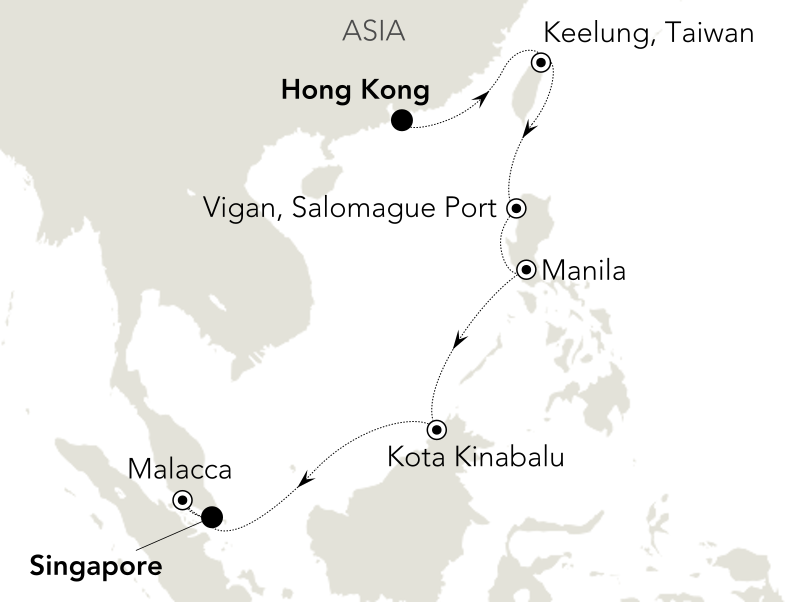
A 12-night ocean voyage aboard Silver Muse, Hong Kong, China to Singapore, Singapore. Destination: Asia.
Operated by Silversea Cruises aboard Silver Muse.
Hong Kong
Keelung, Taiwan
Vigan, Salomague Port
Manila
Kota Kinabalu (Sabah)
Malacca
Singapore
A spectacular, serrated skyline of soaring towers and neon lights, Hong Kong is a vibrant, immersive metropolis and cultural hub. Dramatic harbour-front light shows transform the waterfront’s gleaming buildings into a colourful canvas – best seen from the Star Ferry, when the Symphony of Lights blares into life each evening. A city where future and tradition collides - perhaps best illustrated by the skyscrapers that feature gaping holes, designed to allow spirit dragons to soar from the hills to the waterfront unimpeded. Wander flowing shopping streets, wade through sprawling markets and soak up the neon glory of this one-of-a-kind city - which continues to reach for the sky. Hong Kong's dense jumble of activity is one of its main appeals, but once you've felt the thrill of rising to towering observation decks, to see the soaring city from above, it's surprisingly easy to find peace among Hong Kong's intense urban wonders. Victoria Peak is the highest point and it offers staggering views down over the city and harbour. The Peak Tram funicular can ferry you to the top, to the vantage point which was historically adored by the rich for the cooler air found here, away from the busy bustle of the city streets. Many elaborate temples add a tranquil element to Hong Kong’s whirr, and Tin Hau temple has a surprisingly urban location, considering its dedication to the Goddess of the Sea. It did once occupy the shorefront, but the city's growth saw land reclaimed from the sea around it, leaving the temple marooned inland. Having been leased to the British for 99 years, milky tea is a revered tradition here - enjoy your cup with a serving of local dim sum.While it's easy to think all the bright lights are the sum of today's Hong Kong, you need only walk or board a tram for the short jaunt west into Western to discover a side of Hong Kong that is more traditionally Chinese but no less high-energy. You'll discover the real Hong Kong to the east of Central, too, in Wan Chai, Causeway Bay, and beyond. Amid the residential towers are restaurants, shopping malls, bars, convention centers, a nice smattering of museums, and—depending on fate and the horse you wager on—one of Hong Kong's luckiest or unluckiest spots, the Happy Valley Racecourse. Kowloon sprawls across a generous swath of the Chinese mainland across Victoria Harbour from Central. Tsim Sha Tsui, at the tip of Kowloon peninsula, is packed with glitzy shops, first-rate museums, and eye-popping views of the skyline across the water. Just to the north are the teeming market streets of Mong Kok and in the dense residential neighborhoods beyond, two of Hong Kong's most enchanting spiritual sights, Wong Tai Sin Temple and Chi Lin Nunnery. As you navigate this huge metropolis (easy to do on the excellent transportation network), keep in mind that streets are usually numbered odd on one side, even on the other. There's no baseline for street numbers and no block-based numbering system, but street signs indicate building numbers for any given block.
Days at sea are the perfect opportunity to relax unwind and catch up with what you’ve been meaning to do. So whether that is going to the gym, visiting the spa, whale watching, catching up on your reading or simply topping up your tan these blue sea days are the perfect balance to busy days spent exploring shore side.
Located on the north coast of Taiwan, and embraced by lush green mountains, Keelung City is Taiwan’s second-biggest port and a major gateway to Taipei's glittering lights and spectacular skyscrapers. It can get a little damp here at times - the city is known as the 'Rainy Port' after all - but even the elements fail to dampen the spirits in this Taiwanese hotbed of tradition, modernity and rich culture. Keelung is famous for its Mid-Summer Ghost festival – when dragons decorated with flowers and spitting pyrotechnics are paraded through the streets. Flickering lanterns glitter on the water’s waves, creating a beautiful, ethereal scene. If you do linger in Keelung, witness the city coming to life as the sun dips - and Keelung Miaokou night market floods with people below a blinding wash of lights. Most will choose to take the ride to the country's capital, Taipei, and visit this mesmerising modern city, which blends influences from around the world. A quirky city of museums and countless bustling markets. Stands and stalls work late into the night, serving up every food you can imagine. Wander between the salivating smells and rising flames of open fires, which cook up everything from fried oysters to chicken and fish pastries - as you ride the all-out sensory assault of the city's bustling markets. Incredible temples are sprinkled across Taipei, such as Bao-An Temple, a peaceful, incense-infused place of colourful artistry. The country's heritage is reflected in towering new architecture like the tiered pagoda of the Taipei 101 skyscraper, which dominates the skyline from every angle.
Days at sea are the perfect opportunity to relax unwind and catch up with what you’ve been meaning to do. So whether that is going to the gym, visiting the spa, whale watching, catching up on your reading or simply topping up your tan these blue sea days are the perfect balance to busy days spent exploring shore side.
Vigan, the capital of the Province of Ilocos Sur, is located on the west coast of Luzon Island. It has the most intact examples of a planned Spanish colonial town in Asia, which was established in the 16th century. Vigan’s location at the river delta of the Abra River along the north-western coastline of the main island of Luzon, made this an important trading post before the colonial era. The city’s architecture reflects the melding of cultural elements from within the Philippines and China region with those of Europe and Mexico. This combination has created a unique culture and townscape unique within East and South-East Asia. The City is unique for having preserved much of its Hispanic colonial character and historic urban lay out.
Known as the Pearl of the Orient, Manila is the Philippine's sprawling capital city and a chaotic scramble of intoxicating urban energy. A megacity of culture and creativity, there's a lot to discover amid these chockablock streets. The delicious food wins many fans, but it’s the friendly Filipinos - always eager to help - who ensure that Manila takes a special place in the hearts of many visitors. The Baywalk is one of the city's best places for catching a legendarily intense sunset - or wandering among joggers and leisurely strollers. The city's Intramuros area is its cobbled historic core - and was the centre of power when the Spanish ruled these lands. Decorated with colonial architecture and citadels, the district is known for its rumbling horsedrawn carriages and storied history. Head to Fort Santiago, which aims canons out across the water from its chunky stone walls. The UNESCO World Heritage Site stands against the odds, despite World War II bombardments, fires and earthquakes - a true testament to Manila's incredible resilience. As one of the most densely populated places in the world, Manilla can be manically busy at times, but you can always escape to Rizal Park. With Chinese and Japanese gardens and plenty of room for open-air events, it's a beautiful oasis within the city. It's also an incredibly important national symbol, as the location where the hero of independence, Jose Rizal, was executed. A large statue now memorialises him here, and the park was renamed in his honour.
Known as the Pearl of the Orient, Manila is the Philippine's sprawling capital city and a chaotic scramble of intoxicating urban energy. A megacity of culture and creativity, there's a lot to discover amid these chockablock streets. The delicious food wins many fans, but it’s the friendly Filipinos - always eager to help - who ensure that Manila takes a special place in the hearts of many visitors. The Baywalk is one of the city's best places for catching a legendarily intense sunset - or wandering among joggers and leisurely strollers. The city's Intramuros area is its cobbled historic core - and was the centre of power when the Spanish ruled these lands. Decorated with colonial architecture and citadels, the district is known for its rumbling horsedrawn carriages and storied history. Head to Fort Santiago, which aims canons out across the water from its chunky stone walls. The UNESCO World Heritage Site stands against the odds, despite World War II bombardments, fires and earthquakes - a true testament to Manila's incredible resilience. As one of the most densely populated places in the world, Manilla can be manically busy at times, but you can always escape to Rizal Park. With Chinese and Japanese gardens and plenty of room for open-air events, it's a beautiful oasis within the city. It's also an incredibly important national symbol, as the location where the hero of independence, Jose Rizal, was executed. A large statue now memorialises him here, and the park was renamed in his honour.
Days at sea are the perfect opportunity to relax unwind and catch up with what you’ve been meaning to do. So whether that is going to the gym, visiting the spa, whale watching, catching up on your reading or simply topping up your tan these blue sea days are the perfect balance to busy days spent exploring shore side.
Swampy rivers, soaring mountains and a lush, sheltered location combine to make Kota Kinabalu a diverse and beautiful Borneo destination. Capital of the Malaysian state of Sabah, and settled on the north-west coast, it’s a perfect starting point for exploring Sabah's riches. Venture ashore to discover extraordinary wildlife and fascinating human heritage within the dense rainforest. The City Mosque features a pure white facade and cobalt blue patterned dome, and it appears as if floating, casting a beautiful reflection onto the lake beside it. Immerse yourself in the sights and sounds of the Gaya Street Sunday Market – where everything from reams of fabrics to fresh honey and piles of bright vegetables is up for sale. For an insight into North Borneo's ethnic cultures, venture into the rainforest to seek out authentic villages. Learn of life in these isolated communities and hear tales of the jungle's tribes - as well as the truth behind grisly headhunting whispers. Scattered islands of sandy beaches and popular dive sites lie offshore, while gentle river rafting rides along burbling waterways offer the perfect introduction to Sabah's verdant scenery and wildlife. Adventure seekers will be drawn to the revered peak of the massive Mount Kinabalu - Southeast Asia's highest. Towering up more than 4,000 metres, it is a UNESCO World Heritage Site due to the thousands of diverse plants that grow here. The Mount Kinabalu Botanic garden hike is suitable for all levels, surrounding you with colourful blooms of blossoming flowers and plants. A little fog often shrouds the elevated gardens, adding an atmospheric wisp to some of Malaysia's most sumptuous scenery.
Days at sea are the perfect opportunity to relax unwind and catch up with what you’ve been meaning to do. So whether that is going to the gym, visiting the spa, whale watching, catching up on your reading or simply topping up your tan these blue sea days are the perfect balance to busy days spent exploring shore side.
Days at sea are the perfect opportunity to relax unwind and catch up with what you’ve been meaning to do. So whether that is going to the gym, visiting the spa, whale watching, catching up on your reading or simply topping up your tan these blue sea days are the perfect balance to busy days spent exploring shore side.
Melaka (or Malacca) is Malaysia's most historic city. Its origins can be traced to the 14th century with the founding of a fishing kampung (village) by a fugitive prince from Sumatra. Thanks to its strategic location on the Strait that bears its name, Melaka was, from its earliest days, an intermediary centre of trade. Sheltered from the monsoons by the island of Sumatra, the settlement was perfectly located for merchants to take advantage of the trade winds. When Singapore was still a fishing village, Melaka had already achieved fame and, by the beginning of the 16th century, was the most important port in the region. Foreign merchants traded in Indian and Persian textiles, spices from the Moluccas, silk and porcelain from China, as well as gold, pepper, camphor, sandalwood, and tin. The prosperity of Melaka attracted the Portuguese who ousted the Sultan and established themselves as the new lords under whose rule the city continued to thrive. In the mid-1600s, a Dutch blockade and a six-month siege of the city forced the surrender of the last Portuguese governor. Over the next hundred years, the Dutch carried out an extensive building program; some of the buildings still stand in Dutch Square. When the Dutch trade began to bother the English East India Company, England's objective for control of Melaka was satisfied in the Treaty of London. In 1826, the port became a part of the British Straits Settlement along with Penang and Singapore. In the 19th century, Melaka faded into obscurity until the first rubber estate in Malaysia was established with some seedlings from Singapore's Botanical Garden. The idea caught on among Chinese and European planters and Melaka soon became one of the country's leading rubber producers. Exploration of Melaka includes temples, churches, old Dutch houses and, close to the waterfront, a village of traditional Melakan houses. An interesting trail, called the Jerak Warison Heritage Trail, features many of the historic sights. Jonkers Street is renowned for its antique shops. Pier Information The ship is scheduled to anchor off Melaka. Guests are taken ashore via tenders. The landing pier, Shah Bandar Jetty, is less than one mile (about one kilometre) from the town centre. Taxis are generally available, but be sure to agree on the fare before leaving the jetty. Shopping Melaka is best known for its antique shops along Jonkers Street (Jln Hang Jebat). Other items of interest may include local handicrafts, batik and pewter, leather goods, electronics, watches and jewellery. Most shops are open from 10:00 a.m. to 10:00 p.m. The local currency is the ringgit. Cuisine With its multicultural background, Melaka has a wide range of ethnic food restaurants. You can find Malay, Indian, Thai and Portuguese cuisine, as well as international fare and seafood. You may even spot Kentucky Fried Chicken and McDonalds. Other Sites Tang Beng Swee Clock Tower Though Dutch in appearance, the clock tower was built by a wealthy Strait's Chinese family in 1886. Melaka Cultural Museum A replica of a 15th-century palace houses now a museum with exhibits focusing on Melakan culture, including clothes, games, weapons, musical instruments and a diorama of a 15th-century Sultan's court. Proclamation of Independence Memorial Dating from the early 1900s, this old, Dutch colonial building was formerly home to the Melaka Club. It was the social centre of British colonial Melaka and now contains a collection of photographs and exhibits depicting the events leading to Malaysian independence in 1957. Private Arrangements For those guests interested in touring at your leisure, we are pleased to offer full-day private arrangements by private car or van. Due to the distance required to bring vehicles and guides to Melaka, the minimum hourly charge is for eight hours. You may book this in advance at www.silversea.com or it may be purchased on board, subject to availability. Other private arrangements for independent sightseeing may be requested through the Tour Office on board.
Advanced, airy and elevated, Singapore is a spectacular, futuristic vision of utopian city life. A healthy population of almost six million call it home, but this is a city designed with space to breathe, and gorgeous outdoor parks, massive indoor greenhouses and beautiful recreational spaces spread between the City of Gardens' skyscrapers and soaring structures. Once a quiet fishing village, now a glistening island city-state and an international beacon of science, education and technology. Singapore is almost intimidatingly clean - and the hyper-efficient public transport system whips residents and visitors across the city's neighbourhoods in a heartbeat. Glorious fountains and audacious skyscrapers loom up - nodding to traditional feng shui beliefs - and putting on dazzling illuminated displays after dark. The lush green botanical gardens are a spectacular UNESCO World Heritage Site, covering 52 hectares and decorated with impressive colourful orchids. Or breathe in more of the freshest air by heading up to wander the canopy strung bridges of MacRitchie Reservoir Park. Head for the iconic Marina Bay - a landmark of the city crowned by three interconnected towers, which watch out over island sprinkled waters. Jaunt between Little India and the atmospheric Chinatown in minutes, where beautiful temples - like the Chinese Thian Hock Keng Temple and Hindu Sri Mariamman Temple add rich cultural intrigue. Singapore's cuisine is a mouthwatering fusion of its Indian, Chinese, Indonesian, and Malay influences, taking and enhancing the best of each. Enjoy dishes in towering restaurants, or toast the glowing skyline with the city's eponymous gin-soaked cocktail - a Singapore Sling.
From $8,550
per guest · 12 nights
Prices are a guide and vary with season, cabin category and party size. Your advisor will confirm the exact cost before anything is booked.
Classic Veranda
suite
Deluxe Veranda
suite
Grand 1 Bedroom
suite
Grand 2 Bedroom
suite
Medallion
suite
Owner 1 Bedroom
suite
Owner 2 Bedroom
suite
Panorama
suite
Royal 1 Bedroom
suite
Royal 2 Bedroom
suite
Silver
suite
Superior Veranda
suite
Vista
suite








