




Prefer a conversation?
Our team is always available to guide you through the process and ensure your experience is perfectly matched to your preferences.
Our team is always available to guide you through the process and ensure your experience is perfectly matched to your preferences.
Duration
12 Nights
Price
From $9,050
Ship
Silver Shadow
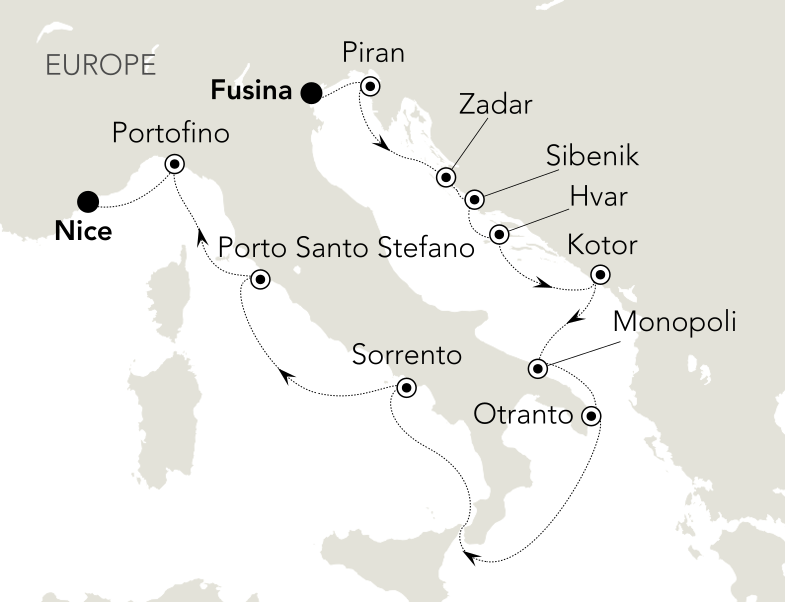
A 12-night ocean voyage aboard Silver Shadow, Fusina, Italy to Nice, France. Destination: Mediterranean.
Operated by Silversea Cruises aboard Silver Shadow.
Fusina (Venice)
Piran
Zadar
Sibenik
Hvar
Kotor
Monopoli
Otranto
Sorrento
Bastia, Corsica
Portofino
Nice
Losing none of its allure over the years, this floating city of canals, bridges and masks is a place of eternal beauty and enduring elegance. The lagoon of more than 100 islands is a heavenly sight, transporting visitors on a journey through time - from its Roman inception, through centuries of trade to the modern face we see today. Navigate Venice’s sparkling waterways by romantic gondola, or on cruises along wide canal boulevards. Span the Grand Canal over its iconic original crossing, the Rialto Bridge, which - with its parade of tiny shops - gives some of the city’s most endearing views. If the crowds unsettle you at any point, take two turns away from the main thoroughfares to find peace alone, amid the city's labyrinth of tiny streets. Hurry to Piazza San Marco to be immersed in Venice’s elegant glory. Basilica San Marco transports you back to the wealthy days of the Doges, who ruled for over 1,000 years. Initially their private chapel, it’s now decorated with beautiful Byzantine mosaics. Nearby the Campanile di San Marco bell tower offers views over the higgledy-piggledy rooftops of times gone by. Just a hop skip and a jump around the corner is the Doge’s Palace, where the levels of opulence ramp up even further. Justice was meted out in this stunning Palace, with the guilty walking to the cells across the covered Bridge of Sighs. Vaporetto trips to local islands offer even more adventures to float your boat, whether it’s Murano with its world-famous glass, Torcello with its amazing Cathedrals, or Burano with its handmade lace and delightfully colourful painted houses.
Piran: a tormented history Once a rural homes area of the Roman Empire, Piran Peninsula became an attractive fortress under Byzantine rule by the 7th century. Conquered by the Franks in 788, the city then became a part of the Holy Roman Empire in 952. In 1283, Piran got into the Republic of Venice and was governed by a council of noble men assisting the Venetian delegate. This Venetian era lasted five centuries and ended in 1797 when Piran was annexed by the Austrian Empire. It remained Austro-Hungarian until 1918, except from a a short period of time when it was ceded to the Napoleonic Empire, from 1806 to 1814. At the end of WWI, Piran became Italian until the end of WWII when it was assigned to the Free Territory of Triest, Zone B, under Yugoslavian regulation. In 1954, the town was annexed by Yugoslavia, resulting in the Istrian-Dalmatian exodus, when a significant part of Piran inhabitant chose to migrate to Italy rather than stay in a socialist country. Nowadays, and since 1991, Piran is part of independent Slovenia.
Zadar: a city like a history book In turn Roman, Byzantine, Venetian, Austro-Hungarian, Yugoslav and then Croatian, Zadar is an ancient settlement dating back to prehistoric times. Architectural evidence of its history is scattered throughout the streets and maze of alleyways of its historic centre. A must-see for those wishing to discover all the charms of one of the jewels of the Adriatic. At the heart of the city are the Roman remains of Zadar. This huge forum, built between the 1st century BC and the 3rd century, is the heart of the city. Its ruins - carved stones and columns, including the Column of Shame and its chains - still whisper the memory of a time when Zadar was one of the great naval centres of the Adriatic. It was a time when the Romans gave the city its forum and temples, and equipped it with thermal baths and its first sewers, thanks to a feat of Roman engineering: the construction of an aqueduct over 40 kilometres long linking the city to the waters of Lake Vransko. A stone's throw from the ruins of the forum, the church of St Donatus has stood since the 9th century, with its unique and remarkable architectural design. The church, now a concert hall after having been a warehouse and then an archaeological museum, is a circular structure made up of three concentric rings of columns, with 12 columns for the outermost ones, 16 for those in the middle and 20 for the central circle. The result is a fascinating visual effect, particularly for a building over a thousand years old. St Donatus, which has not heard a mass for 200 years, is open to visitors and has preserved some of its relics as well as its pulpit and baptismal font. From its forecourt, you can hear the strange sounds of one of Zadar's other attractions: the Sea Organ, just a few hundred metres away. The only one of its kind in the world, this organ consists of a system of bellows inserted into steps that sink into the waters of the Adriatic. The result is a symphony of sounds created by the waves and air currents. Also worth seeing - Sainte-Anastasie Cathedral and its bell tower Dating from the 12th and 13th centuries, the cathedral was badly hit by bombing during the Second World War. Now fully restored, it boasts a wealth of architectural treasures, including its façade, 3 naves, sculptures and relics. You can climb to the top of its bell tower for a panoramic view of the town. - Church of Saint-Siméon A Baroque church dating back to the 5th century, its bell tower was added in the 17th century. The ochre-coloured monument contains a priceless piece: the sarcophagus covered with gold-plated silver reliefs housing the relics of Saint Simeon. - The Place des Cinq-Puits Built in 1574, the Place des Cinq-Puits takes its name... from the 5 wells located there. For many years, they were the water supply for the inhabitants of Zadar. Just behind it, Queen Jelena Madijevka's garden is the ideal place for a break, with its shady paths, café and peaceful atmosphere. - Port of Foša and Gateway to Terra Firma From the garden, you can see the authentic little port of Foša. Right next door, the Porte de la Terre Ferme (Farmland Gate) has stood since 1543. Long the town's main gateway, it was once equipped with a drawbridge. [Pictures in : Zadar>Tour>Zadar, Nin Slat Works & Royal Vineyards (ZAD-G) starting picture #5 and Zadar>Tour>Dalmatian Panoramas and Rural Estate (ZAD-H) starting picture #5]
Set on the dazzling Adriatic where the Krka River opens out into the blue island-peppered waters Šibenik is a stone-clad city that oozes Dalmatian medieval charm. Gorgeous Krka National Park gushes with famously picturesque waterfalls close by while the World Heritage Sites of Croatia’s oldest native town have endless stories to tell. Rising from the shadow of popular neighbours Split and Zadar Šibenik is successfully establishing itself as an unmissable Dalmatian city thanks to its timeless grace and 30 hidden churches and monasteries - which ring their bells above a wash of terracotta roofs. Dominating the tight streets of the charming old town - where ice cream vendors spoon out fruity flavours and footsteps rattle along stone streets - is the magnificent Cathedral St. James UNESCO World Heritage site. Taking more than a century to construct it is built from stone in a Gothic-Renaissance style and adorned with 71 sculptured heads - each displaying its own personality. St. Michael’s Fortress stands on a hill above the city providing the perfect viewpoint to see Šibenik rolling towards the stunning archipelago which punctuates the turquoise Adriatic. Part of the fortress is now used as an open-air stage forming an ethereal venue for performances. St. Nicholas Fortress is another UNESCO protected site and was built where the monastery of St. Nicholas once stood. Further afield the beautiful old town of Trogir is close by along with the Roman ruins of Salona.
One of the most popular of the island escapes sprinkled across the turquoise Adriatic, Hvar is a glorious idyll of hidden coves, electric blue waters and quietly contented port towns. In recent years, it’s gathered something of a reputation as a party island - mainly earned from Hvar Town’s nocturnal exuberances, and the transient day-tripping yachts that drop by. Soak up the energy, exuberance and fine dining, or sidestep the hedonism to explore a richly refined, rural and historic island – utterly spoiled with sunshine, and hidden beaches, which dazzle with colourful intensity. Bike rides along long sweeping coastal paths, boat journeys from pretty harbours, walks through fields of purple lavender - it’s all waiting for you on heavenly Hvar. Relish the sunshine and explore deserted, idyllic inlets, before sharing strong espressos in quiet harbour towns, surrounded by welcoming, sun-wrinkled locals. There’s also rich Medieval history – the sleepy town of Stari Grad is said to be Croatia’s oldest, dating back to 384 BC. Elsewhere, Jelsa is a postcard perfect place – settle in for a bite to eat, with nothing but the sound of harbour waters lapping and sandpaper scraping boats hulls for company. You can walk to look out over glorious views across to Brac, sometimes watching on as thunderstorms rage and flash, an eternity away over the mainland’s crumpled mountains. You’re also just a short ferry ride from the incredible Golden Horn - an evocative spike of brilliant sand which juts out evocatively into the cobalt-blue sea.
Embedded into the slopes of the steep Lovćen mountain and overlooking the deep blue Adriatic the fortified town of Kotor boasts a spectacular imposing staging that few can match. Sq Squeezing in through the tight Bay of Kotor is a daunting and impressive approach in itself as you arrive via one of Europe’s most stunning waterways. A pearl of Montenegro and the Adriatic Kotor's warren-like streets drip with history and authenticity. Under Venetian influence for four centuries the city's UNESCO World Heritage Site old town invites you to wander amid atmospheric stone-clad streets overlooked by a sea of terracotta roofs and the double towers of the cathedral. Many favour Kotor for its compact layout smaller crowds and authenticity however - having been spared from shelling during Yugoslavia's breakup. The tightknit streets here are patrolled by a slinking population of feline residents who were adopted as the town’s mascots after being left behind by transient trader ships. Learn of the city's extensive heritage on the waves in the dedicated maritime museum that is contained within Grgurina Palace. Pick your way through tight alleys of workshops and studios walking below fresh laundry strung from windows before settling into shiny paved piazzas for an afternoon coffee or seafood meal. If you’re up for an aerobic challenge tackle the 1 350 steps up the steep walls to St John's fortress. The views over the gorgeous bay make the arduous slog worth it.
Located in the heel of Italy’s boot, Monopoli is a Puglia port town that knows how to make a splash. In fact, the words Monos and Polis mean singularly unique – and Monopoli’s special blend of part historical, part functional is most definitely that. The city might lack some of the more aesthetic elements of its neighbours, but that only means good things for those who do discover it: far from the tourist route you’ll be greeted with medieval churches and castles, white stone buildings (contrasting perfectly with the azure of the sea and sky) and authenticity in buckets. Founded by the Greeks in 500 BC, then taken over by the Romans (and beset by various invaders), Monopoli was – and still is – a thriving port town. It’s position in Puglia between the seas made it strategic, while its placement on the Via Traiana (which led all the way to Rome) made it prosperous. The city came under Venetian control in 1484 and much of Monopoli’s architecture can be attributed to this period. The charming Old Town is dominated by Castello Carlo V, built in 1552, while the still solid Baroque-Romanesque cathedral, built in 1693, is considered as positively modern. Like most of Italy, the food here is as important as religion. As a port town, fish and seafood are deliciously fresh. Do not miss tasting “scapece” (small fish covered in flour, deep-fried, put in layers with breadcrumbs and saffron, then soaked with vinegar) for a tasty treat that you will find nowhere else in the country.
With its stern, steep fortifications, Otranto is an imposing, elevated and alluring port call. Learn a little of the history here, and you'll soon realise that this is a town that's right to be wary, having been conquered by - and repelled - many hostile visitors over its turbulent past. Visit Otranto to enjoy the heel of Italy's generous weather, bright white beaches, and the tug-of-war history between east and west. The turquoise seawater offers an enticing welcome, but this is a town haunted by past events. The darkest chapter occurred in 1480, when 813 were slaughtered after refusing to convert when Ottoman invaders conquered the city - following a fierce 15 days of resistance. The bones and skulls of the Martyrs of Otranto now watch over the altar of the cathedral, where they are stacked up behind a wall of glass. They were canonised by Pope Francis In 2012, and are recognised as Otranto's patron saints. Less macabre, the cathedral’s wonderful rose window and mosaic floor are gloriously beautiful, dating back to the 12th century. Head to the beach to soak up some sun and views of the sparkling Adriatic in Italy's most easterly town, or wander the pretty, cafe-lined streets of the historic old town amid the stout round towers of the extraordinary ramparts. Enjoy the leisurely pace of life along these tight, history-steeped alleyways, and try some of Puglia's delicious food, like the deceptively simple pasta cacio e pepe – pasta with cheese and pepper, or fresh hauls of prawns. Hidden beaches, gaping caves, and scattered fortifications litter the surrounding coastline.
Days at sea are the perfect opportunity to relax unwind and catch up with what you’ve been meaning to do. So whether that is going to the gym, visiting the spa, whale watching, catching up on your reading or simply topping up your tan these blue sea days are the perfect balance to busy days spent exploring shore side.
Sorrento's colourful, sun-faded facades cascade down from green hills and cliffs to the Bay of Naples' gently lapping waters. The perfect base for exploring this Italian corner of outstanding natural beauty, venture to the curvaceous roads of the Amalfi coast - or enjoy leisurely jaunts across the shimmering waves to Capri's gem of an island. While it makes for a fantastic jumping-off point, Sorrento itself has oodles of rustic fishing town charm, so don't rush off too quickly. Piazza Tasso is the locals’ main meeting spot and a starting point for a wander through the picturesque streets. Throw back a quick espresso caffeine kick at a standing cafe, before strolling through Corso Italia - Sorrento's spine - which is lined with boutiques, museums, bars and restaurants. The historic Church of San Francesco blossoms with colourful celebrations of weddings, which spill out into its gorgeous ivy-tangled cloisters. Or head down to relax by the small beach and fishing-boat filled harbours. The looming, cloud-wisped cone of Mount Vesuvius is unlikely to escape your attention, and this now docile volcano was responsible for a famous tale of destruction when it wiped out the ancient city of Pompeii in a heartbeat. Known for the haunting, frozen casts of the city’s unfortunate inhabitants - the massive site is a miraculous snapshot of an Ancient Roman city in its pomp. Wander the stone slabs streets, visit the beautiful theatre, and the columns of the sprawling ancient forum – painstakingly recovered and rendered from below the ash. If you’re feeling a little peckish, enjoy quick and delicious flame-cooked pizzas of oil, basil, tomato, and buffalo mozzarella. The volcanic soil imbues the local wines with rich flavour – soak in the waterfront views while savouring Taurasi and Lacryma Christi flavours. Or sample the luminous lemony-hit of ubiquitous limoncellos.
Corsica's northern capital, Bastia, is the centre of commerce and industry and a thriving freight and passenger port. Commerce, more than tourism, is its main focus, providing employment for many Corsicans. Bastia's industrial sprawl, however, is offset by its aged charm. The presence of an overwhelming Italian atmosphere adds to the city's attraction. Two distinct areas comprise the city: Terra Vecchia, the old quarter, consisting of haphazard streets, flamboyant Baroque churches and lofty tenements, with their crumbling golden-grey walls set against a backdrop of fire-darkened hills; and the more orderly Terra Nova, the historic district favoured by prominent doctors, lawyers and architects. The city dates from Roman times, when a base was set up at Biguglia to the south. Under the Genoese, Bastia was the island's capital for four centuries and of major importance for the export of wine to the Italian mainland. They built a fortress (bastiglia), which gave the town its name. The Genoese also were responsible for laying the foundation for the area's prosperity by planting vines, olives, chestnut trees and other experimental crops. This resulted in an energetic and enterprising region, still a characteristic of today's northern Corsica. Although Napoleon had appointed Ajaccio the capital of the island in 1811- initiating a rivalry that still exists - Bastia established a stronger trading position with mainland France. As a result, the Nouveau Port was created in 1862 to cope with the increasing traffic with France and Italy. Bastia's economic prominence and a German division based here during World War II accounted for severe bombing attacks. Many buildings were destroyed, including much of the old governor's palace. Of the two largest towns on the island, Ajaccio and Bastia, the latter boasts a more genuine Corsican character. Visitors can experience an authentic feel of island life by wandering through the maze of narrow streets of Bastia's old quarter and by exploring its fortifications. Don't miss the vast Place Saint-Nicolas just north of the old quarter; it is the focal point of the city. Open to the sea and lined with shady trees and sidewalk cafes, it is a perfect place for people watching and for taking in the local ambiance. Pier Information The ship is scheduled to dock at the port of Bastia. The city's focal point, Place Saint-Nicolas, is a distance of 650 feet (200 metres) to walk. Taxis are generally available at the pier but it is highly recommended to book in advance if you want to be sure to get one. It is recommended to establish the fare before leaving the port. Shopping The main shopping streets, Boulevard Paoli and Rue Cesar Campinchi, are less than one half miles (500 metres) from the port terminal. Handicrafts and the area's specialties such as honey, wine and liqueurs may be of interest. Most shops are open from 9:00 a.m. to 12:00 p.m. and 2:30 p.m. to 7:00 p.m. Shops are closed for the day on Sundays and some shops may also close Monday mornings (some souvenirs shops may open Sundays during the high season of July-August). The local currency is the euro. Cuisine A variety of restaurants offer a good choice of eating possibilities. Some of the best restaurants are found around the Vieux Port and on the Quai des Martyrs. French cuisine and seafood feature prominently on menus as well as such Corsican specialties as wild boar, charcuterie and aziminu, a local version of bouillabaisse. Evidence of Bastia's strong Italian influence is apparent in the numerous pizza and pasta places in the Nouveau Port area. For outdoor dining and people watching, cafes around lively Place Saint-Nicolas are a perfect place. Other Sites Oratoire de Saint-Roch Located in the Terra Vecchia quarter, the chapel is a Genoese Baroque extravaganza built in 1604. The walls are covered with finely carved wooden panelling and the organ is magnificent with its decoration of gilt and wooden sculpture. Oratoire de L'Immaculee Conception Although its exterior is rather austere, the flamboyant interior of this 17th-century church with gilt and marble ceiling, frescoes and crystal chandeliers creates an ambiance of an opera house. Vieux Port Site of the original Porto Prado, the area around the Vieux Port is the most appealing part of town. Its soaring houses seem to bend inwards towards the water. Once busy with Genoese traders, the building of the ferry terminal and commercial docks have reduced much of the action at Vieux Port. Terra Nova As the administrative core of old Bastia, Terra Nova displays a distinct air of affluence. Its most impressive building is the 14th-century Governor's Palace. During the Genoese heyday the governor and the bishop lived here, entertaining foreign dignitaries and hosting massive parties. Private arrangements for independent sightseeing may be requested through the Tour Office on board, subject to the availability of English-speaking guides.
Effervescent and exclusive, Portofino rests on a privileged peninsular. Lavish yachts mingle together, seeking out sought-after berths in the harbour, while gelato drips onto the stone-paved streets in this, the most alluring and glamorous town of the Italian Riviera. This section of the Ligurian Coast is a protected area, and home to some of the country’s most picturesque, and jaw-dropping scenery - which is best viewed from the deck of a sailing boat. Crisp white villas roll out across the verdant green hillsides, surrounded by laden vineyards and olive groves. Down in Portofino itself, the buzz of chatter and the clatter of cutlery, provide the soundtrack to busy terrace bars and restaurants, which serve up fine food and delicious sea views. Portofino’s achingly beautiful harbour arcs around the lapping waves, with a warmly-hued waterfront of peach and apricot colours - which also adorns postcards and promotional travel guides of Italy. For the authentic Portofino experience, sail out onto the tranquil waters of the Gulf of Tigullio, to mingle amongst the privileged at play, or settle back in the shade as you take aperitivo on the picturesque waterfront Piazzetta. Here you can sip the famous Ligurian wines, and stave off hunger with focaccia con il formaggio - or platters of fine cheese and hams. Deeper into Portofino, you’ll find artisans crafting their wares and weaving together lace, or you can ascend to viewpoints like the lemon shaded Church of San Giorgio, to look over the pretty jumble from up above. A wander out along the headland to the tapering tip of the peninsular, rewards with the views of Portofino’s iconic white lighthouse beaming out light and welcoming ships to this slice of Riviera heaven.
Nice's sweeping bend of brilliant-blue seawater - which once tempted the aristocracies of Europe - continues to entice and entrance visitors to these sun-soaked shores. A refined city of airy ocean boulevards grandiose buildings and open spaces fountain-sprinkled parks and colourful floral displays add to the city's timeless appeal. Nice has lost none of its old-world lustre and there remains something of the divine in the Bay of Angels' endless sparkling waterfront. The vast open Promenade des Anglais remains Nice's magnificent crowning glory inviting the city out to jog wander and glide along the Mediterranean's most spectacular curve of seafront promenade. The crisp clear golden light also continues to make Nice a destination of creative pilgrimage and Matisse Picasso and Renoir are among the many artists to lavish in the city's eternal beauty. Drag yourself away from the waterfront to discover the old town punctuated with Baroque churches rising and the wafting scents of baking pastries and lavender bundles. Follow the floral odours to Nice's famous flower market which spills gorgeous colourful displays along Cours Saleya. There's a strong hint of Italy explained by the fact that Nice only aligned with France in 1860 - following 500 years under the House of Savoy. Walk in Nietzsche's footsteps and climb up to Colline du Château's charming green park and cascading waterfalls to relish the views down over the city and sparkling sea expanse.
From $9,050
per guest · 12 nights
Prices are a guide and vary with season, cabin category and party size. Your advisor will confirm the exact cost before anything is booked.
Grand 1 Bedroom
suite
Grand 2 Bedroom
suite
Medallion
suite
Owner 1 Bedroom
suite
Owner 2 Bedroom
suite
Royal 1 Bedroom
suite
Royal 2 Bedroom
suite
Silver
suite
Terrace
suite
Veranda 1
suite
Veranda 2
suite
Veranda 3
suite
Veranda 4
suite
Vista
suite








