




Prefer a conversation?
Our team is always available to guide you through the process and ensure your experience is perfectly matched to your preferences.
Our team is always available to guide you through the process and ensure your experience is perfectly matched to your preferences.
Duration
12 Nights
Price
From $8,800
Ship
Silver Dawn
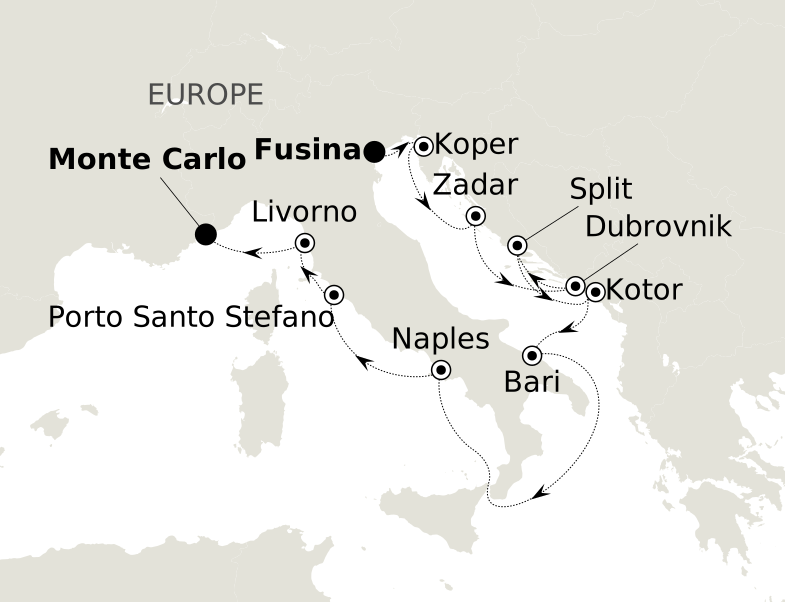
A 12-night ocean voyage aboard Silver Dawn, Fusina, Italy to Monte Carlo, Monaco. Destination: Mediterranean.
Operated by Silversea Cruises aboard Silver Dawn.
Fusina (Venice)
Koper
Zadar
Dubrovnik
Split
Kotor
Bari
Naples
Porto Santo Stefano
Livorno (Tuscany)
Monte Carlo
Losing none of its allure over the years, this floating city of canals, bridges and masks is a place of eternal beauty and enduring elegance. The lagoon of more than 100 islands is a heavenly sight, transporting visitors on a journey through time - from its Roman inception, through centuries of trade to the modern face we see today. Navigate Venice’s sparkling waterways by romantic gondola, or on cruises along wide canal boulevards. Span the Grand Canal over its iconic original crossing, the Rialto Bridge, which - with its parade of tiny shops - gives some of the city’s most endearing views. If the crowds unsettle you at any point, take two turns away from the main thoroughfares to find peace alone, amid the city's labyrinth of tiny streets. Hurry to Piazza San Marco to be immersed in Venice’s elegant glory. Basilica San Marco transports you back to the wealthy days of the Doges, who ruled for over 1,000 years. Initially their private chapel, it’s now decorated with beautiful Byzantine mosaics. Nearby the Campanile di San Marco bell tower offers views over the higgledy-piggledy rooftops of times gone by. Just a hop skip and a jump around the corner is the Doge’s Palace, where the levels of opulence ramp up even further. Justice was meted out in this stunning Palace, with the guilty walking to the cells across the covered Bridge of Sighs. Vaporetto trips to local islands offer even more adventures to float your boat, whether it’s Murano with its world-famous glass, Torcello with its amazing Cathedrals, or Burano with its handmade lace and delightfully colourful painted houses.
With a sweeping old town of Venetian architecture sing-song Italian emanating from its cafes and even a fountain that honours the Rialto Bridge - you could be forgiven for thinking that you’d stepped off the boat into the Floating City itself while exploring Koper. Formerly an island Koper was linked artificially to the Slovenian mainland in 1825. It now serves as the only major port of Slovenia and basks in the sun of the Istrian coast which offers an alluring blend of the best of Croatian Slovenian and Italian. The nation’s capital Ljubljana also lies within easy reach. A working city with plenty of charm below its sea of terracotta roofs the picturesque Tito square lies at Koper’s heart. The Cathedral of Assumption rises above the square and towers over the narrow streets nearby. Take a deep breath and climb the 200 steps for a stunning panorama of the city. Or simply soak up the atmosphere with a wander through Čevljarska Ulica – a set of cobbled streets adorned with artisan shops small bars and restaurants. Soak up the sights of Koper the country’s oldest town or make for the Slovenian capital Ljubljana - to discover a lively city of green parks leafy open spaces and pedestrianised boulevards. The pretty Ljubljana River stretches through the city’s heart providing casual strolls and charming bike rides. Nearby encounter a scene from a fairy-tale as you see the breathlessly picturesque Bled Castle emerging from a tiny island in the centre of a cloudy-blue alpine lake.
Zadar: a city like a history book In turn Roman, Byzantine, Venetian, Austro-Hungarian, Yugoslav and then Croatian, Zadar is an ancient settlement dating back to prehistoric times. Architectural evidence of its history is scattered throughout the streets and maze of alleyways of its historic centre. A must-see for those wishing to discover all the charms of one of the jewels of the Adriatic. At the heart of the city are the Roman remains of Zadar. This huge forum, built between the 1st century BC and the 3rd century, is the heart of the city. Its ruins - carved stones and columns, including the Column of Shame and its chains - still whisper the memory of a time when Zadar was one of the great naval centres of the Adriatic. It was a time when the Romans gave the city its forum and temples, and equipped it with thermal baths and its first sewers, thanks to a feat of Roman engineering: the construction of an aqueduct over 40 kilometres long linking the city to the waters of Lake Vransko. A stone's throw from the ruins of the forum, the church of St Donatus has stood since the 9th century, with its unique and remarkable architectural design. The church, now a concert hall after having been a warehouse and then an archaeological museum, is a circular structure made up of three concentric rings of columns, with 12 columns for the outermost ones, 16 for those in the middle and 20 for the central circle. The result is a fascinating visual effect, particularly for a building over a thousand years old. St Donatus, which has not heard a mass for 200 years, is open to visitors and has preserved some of its relics as well as its pulpit and baptismal font. From its forecourt, you can hear the strange sounds of one of Zadar's other attractions: the Sea Organ, just a few hundred metres away. The only one of its kind in the world, this organ consists of a system of bellows inserted into steps that sink into the waters of the Adriatic. The result is a symphony of sounds created by the waves and air currents. Also worth seeing - Sainte-Anastasie Cathedral and its bell tower Dating from the 12th and 13th centuries, the cathedral was badly hit by bombing during the Second World War. Now fully restored, it boasts a wealth of architectural treasures, including its façade, 3 naves, sculptures and relics. You can climb to the top of its bell tower for a panoramic view of the town. - Church of Saint-Siméon A Baroque church dating back to the 5th century, its bell tower was added in the 17th century. The ochre-coloured monument contains a priceless piece: the sarcophagus covered with gold-plated silver reliefs housing the relics of Saint Simeon. - The Place des Cinq-Puits Built in 1574, the Place des Cinq-Puits takes its name... from the 5 wells located there. For many years, they were the water supply for the inhabitants of Zadar. Just behind it, Queen Jelena Madijevka's garden is the ideal place for a break, with its shady paths, café and peaceful atmosphere. - Port of Foša and Gateway to Terra Firma From the garden, you can see the authentic little port of Foša. Right next door, the Porte de la Terre Ferme (Farmland Gate) has stood since 1543. Long the town's main gateway, it was once equipped with a drawbridge. [Pictures in : Zadar>Tour>Zadar, Nin Slat Works & Royal Vineyards (ZAD-G) starting picture #5 and Zadar>Tour>Dalmatian Panoramas and Rural Estate (ZAD-H) starting picture #5]
Croatia’s crowning glory rears up vertically from the tranquil waters of the Adriatic, and Dubrovnik’s daunting fortresses town is a truly imposing sight to behold. Encircled by chunky stone walls so thick and dramatic they could have been purpose-built as a film set, this city’s unmatched old town is the setting for countless films and shows - from Star Wars to Robin Hood, Game of Thrones and every production in-between seeking a truly authentic medieval flavour. This fantasy fortress’s walls - which are no less than 12-metres thick at places - are certainly not just for show, however. They kept Dubrovnik safe when it was a maritime republic and they were besieged as recently as 1991, when Serbian and Montenegrin forces attacked, as Yugoslavia broke apart. Fully restored now, the stone streets of the city take you through a beautiful mosaic of architectural splendour, baroque churches and splashing fountains. Tapering alleys rocket up from the central boulevard of Stradun, offering spectacular views down, but you’ll need to walk the city walls to appreciate the fortress city’s full scale. Banking up sharply to the rear, you can gaze across an ocean of terracotta roofs and church spires, clamouring together before the sparkling Adriatic. Visit the neighbouring fort of Lovrijenac, for another perspective, or swing up to Srd fortress’s glorious panorama on a cable car. Dubrovnik’s streets are crammed with eateries and candlelit tables, where couples splash wine into glasses and enjoy gnocchi mixed with creamy truffle sauces. Nearby beaches like Banje are also close by, and hidden bays reward the intrepid who venture out beyond the old town. Take sunset drinks to sit back and watch as flotillas of sea kayaks roll by, or sail on the pristine waters to explore island gems like Lokrum - where peacocks are the only permanent residents.
Bathing in the Dalmatian Coast’s generous sunshine and overlooking sparkling island-studded waters Split is a city of romantic beauty built around an extraordinary - still beating - historical heart. The setting may be spectacular but it’s the Diocletian’s Palace - a Roman remain of incredible scale and detail that is truly bewitching. With a natural backdrop of dramatic limestone mountains and Croatia’s trademark scenic wonders all around Split is a true heavyweight of the Adriatic. To enter Split’s Diocletian’s Palace is to step into a beautiful time warp. Head first to the Cathedral of Saint Domnius where a hollow bell tower rockets up puncturing the sky. The perfume of lavender hangs heavy wherever you walk in the old town where tucked shops offer artisan chocolates dried figs and freshly-ground coffees. The expansive seafront promenade is all palm trees buzzing bars and eateries and further out you’ll find the peace of Marion Hill - where you can climb to some of the best views in town. Or take the far less exerting wander to Sustipan cemetery’s breathtaking panorama of sea city and distant islands. Trips to island paradises like Hvar and Brac are tempting as are longer excursions to sites like Krka National Park’s Waterfalls - where wide terraces of frothing water thunder into cooling swimmable splash pools below. Nearby Trogir is another UNESCO World Heritage Site offering a cosier no less charming old town and historic port.
Embedded into the slopes of the steep Lovćen mountain and overlooking the deep blue Adriatic the fortified town of Kotor boasts a spectacular imposing staging that few can match. Sq Squeezing in through the tight Bay of Kotor is a daunting and impressive approach in itself as you arrive via one of Europe’s most stunning waterways. A pearl of Montenegro and the Adriatic Kotor's warren-like streets drip with history and authenticity. Under Venetian influence for four centuries the city's UNESCO World Heritage Site old town invites you to wander amid atmospheric stone-clad streets overlooked by a sea of terracotta roofs and the double towers of the cathedral. Many favour Kotor for its compact layout smaller crowds and authenticity however - having been spared from shelling during Yugoslavia's breakup. The tightknit streets here are patrolled by a slinking population of feline residents who were adopted as the town’s mascots after being left behind by transient trader ships. Learn of the city's extensive heritage on the waves in the dedicated maritime museum that is contained within Grgurina Palace. Pick your way through tight alleys of workshops and studios walking below fresh laundry strung from windows before settling into shiny paved piazzas for an afternoon coffee or seafood meal. If you’re up for an aerobic challenge tackle the 1 350 steps up the steep walls to St John's fortress. The views over the gorgeous bay make the arduous slog worth it.
Explore further afield to immerse yourself in Puglia’s beauty and cultural wonders - or simply soak up the atmosphere roaming the crooked streets of Bari’s old town - Bari Vecchia - where matriarchs roll out sheets of pasta in open doorways footballs rattle along dusty streets and sun-wrinkled old men lay out hands of cards. The photogenic old town’s streets are crowned by the chalky white Cattedrale di San Sabino where vaulted archways pretty mosaics and a large rose window await. Wander along the ruler-straight Lungomare Promenade to breathe in fresh salty air and look up at the slowly twirling ferris wheel - take a ride for some of the best views out over Bari’s waterfront. Feeling hungry? Enjoy some local cucina povera - cooking of the poor – deeply traditional food that is simple and rich in elemental flavours. Warm focaccia bread pasted with fruity local olive oil and ear-shaped orecchiette pasta tangled with sun-gorged cherry tomatoes and creamy ricotta cheese is all on the menu. Puglia’s whitewashed ancient villages stunning beaches and laid-back down-to-earth approach to life means you’ll most likely want to explore further than just Bari. Powdery white sand beaches await at Salento - punctuated by arching rock formations. The incredible cave dwellings of Matera – 2019’s European Capital of Culture - are also easily within your grasp as is Polignano a Mare’s spectacularly scenic narrow wedge of urban beach.
Days at sea are the perfect opportunity to relax unwind and catch up with what you’ve been meaning to do. So whether that is going to the gym, visiting the spa, whale watching, catching up on your reading or simply topping up your tan these blue sea days are the perfect balance to busy days spent exploring shore side.
The legend of the Siren Parthenope Naples' foundation is not only shrouded in one but two legends, all having one 'person' in common: the siren Parthenope. She and her sisters, Leucosia and Ligaea, are the three resident sirens of the Galli Islands, with their "shores all bleached with human bones and debris", who lured sailors with their enchanting voices and music, only for them to run aground and perish. Parthenope was precisely this magical, murderous voice, while Leucosia and Ligaeus played the flute and citara. The first legend is linked to Ulysses, the first man not to succumb to the siren's call, thanks to Circe's advice. Curious but not mad, he ordered his sailors to plug their ears with wax and tie him firmly to the mast. In this way, he was able to enjoy the pleasure of hearing the music and songs without paying a high price. There are different stories here, some claiming that Parthenope fell in love with Ulysses, others not. In any case, the three sisters, in despair and humiliation, threw themselves into the sea and died. If you are surprised to read that, keep in mind that we're talking about sirens from Antiquity, young women transformed into half-woman half-bird monsters, punished by the goddess Demeter for not having stopped Hades, the god of the Underworld, from kidnapping their mistress Persephone (and daughter of Demeter). Mermaids with fish tails only appeared in the Middle Ages. So, Parthenope and her sisters perished. Their bodies were carried by the sea to Terina for Ligaea and Licosa for Leucosia. Parthenope's body was carried by the waves to the island of Megaride, Naples, where the Castel dell'Ovo stands today. She gave her name to the town and the inhabitants worshipped her, making her the town's patron saint. Another legend exists, from the 19th century. A centaur - Vesuvius - fell madly in love with our siren Parthenope, provoking the jealousy of Zeus. In revenge, he turned the centaur into a volcano. In despair, Parthenope committed suicide and her body washed up in Naples, allowing her to be close to her lover in death. Today there are three fountains dedicated to her: the Fontana delle Zizze (Neapolitan for 'nipples') beside Corso Umberto I with its winged mermaid, a second on the Piazza Jacopo Sannazzaro in Piedigrotta and a third, modern, near the shops at the Central Station. Naples is still referred to as the "Parthenopean city".
The legend of the Siren Parthenope Naples' foundation is not only shrouded in one but two legends, all having one 'person' in common: the siren Parthenope. She and her sisters, Leucosia and Ligaea, are the three resident sirens of the Galli Islands, with their "shores all bleached with human bones and debris", who lured sailors with their enchanting voices and music, only for them to run aground and perish. Parthenope was precisely this magical, murderous voice, while Leucosia and Ligaeus played the flute and citara. The first legend is linked to Ulysses, the first man not to succumb to the siren's call, thanks to Circe's advice. Curious but not mad, he ordered his sailors to plug their ears with wax and tie him firmly to the mast. In this way, he was able to enjoy the pleasure of hearing the music and songs without paying a high price. There are different stories here, some claiming that Parthenope fell in love with Ulysses, others not. In any case, the three sisters, in despair and humiliation, threw themselves into the sea and died. If you are surprised to read that, keep in mind that we're talking about sirens from Antiquity, young women transformed into half-woman half-bird monsters, punished by the goddess Demeter for not having stopped Hades, the god of the Underworld, from kidnapping their mistress Persephone (and daughter of Demeter). Mermaids with fish tails only appeared in the Middle Ages. So, Parthenope and her sisters perished. Their bodies were carried by the sea to Terina for Ligaea and Licosa for Leucosia. Parthenope's body was carried by the waves to the island of Megaride, Naples, where the Castel dell'Ovo stands today. She gave her name to the town and the inhabitants worshipped her, making her the town's patron saint. Another legend exists, from the 19th century. A centaur - Vesuvius - fell madly in love with our siren Parthenope, provoking the jealousy of Zeus. In revenge, he turned the centaur into a volcano. In despair, Parthenope committed suicide and her body washed up in Naples, allowing her to be close to her lover in death. Today there are three fountains dedicated to her: the Fontana delle Zizze (Neapolitan for 'nipples') beside Corso Umberto I with its winged mermaid, a second on the Piazza Jacopo Sannazzaro in Piedigrotta and a third, modern, near the shops at the Central Station. Naples is still referred to as the "Parthenopean city".
A summer escape for Rome’s historic elite the stacked waterfront of Porto Santo Stefano is a secluded taste of idyllic southern Tuscany. Physically closer to Rome than Florence the city is strung to Italy’s western coast by two sandy harnesses and sits on the unqiue peninsula of Monte Argentario - which was once an island. Flamboyant pink flamingos and herons stroll through the encased lagoon while Porto Santo Stefano’s waterfront hums with clinking cafes and strolling visitors. The luxury yachts in the harbour show that Porto Santo Stefano has lost none of its luxury appeals and with beaches wild hikes and waterfront beauty it continues to lure visitors to this secluded escape. Known for its fishing and cuisine - which is based around heavy use of the Tyrrhenian Sea’s juicy bounty. Stroll to Piazza dei Rioni for a dripping lemon gelato or wander the streets noticing the lingering World War II damage – the city was heavily bombed during the conflict. Fortunately the historic star-shaped Spanish fort was spared and it still watches out resolutely over the waters. Rugged coastline falls to secluded beaches with a wilder unkempt charm. Sail the coves - seeing cascading olive groves - or island-hop to Giglio and Giannuti which lie 12 miles from shore and can be seen from the monastery topped Argentario mountain. On the other side of the promontory you’ll find Porto Ercole - where the lifeless body of the Old Master Caravaggio was discovered.
The Tower of Matilde is an iconic structure of the city of Livorno. This medieval tower is said to have been built by the famous mathematician and astronomer Galileo Galilei. It is named after Matilde di Canossa, an influential noblewoman who played a key role in the political and religious conflicts of the 11th century. Matilde was a powerful figure in medieval Italy, and her legacy is still felt in Livorno today. The tower was built on her orders as a defensive stronghold to protect the city against invaders, and its strategic location on the coast made it an important part of the city's defenses. Over the centuries, the Tower of Matilde has been restored and renovated several times, but it still retains its original medieval charm. The tower is a classic example of medieval architecture, with its thick walls, narrow windows, and imposing structure. The tower was later used as a watchtower during World War II and is now a popular tourist attraction as visitors can climb to the top and enjoy panoramic views of the surrounding area. The Tower of Matilde is also an important cultural landmark in Livorno. It is often used as a venue for cultural events and exhibitions, and its unique atmosphere and ambiance make it a popular destination for artists and writers.
Glitzy glamorous and unashamedly luxurious – live the high life in Monte Carlo. From the super-yachts jostling for position in the harbour to the lavish bars splashing out iced champagne tiny Monaco’s only city is a high rolling decadent affair - and a gloriously indulgent sun-soaked taste of the good life. Famed for its low tax status - and the Formula One race that roars through its hairpin bends and tight streets each year - Monaco is the ultimate playground of the rich and famous. Monaco may be the world’s second-smallest country - only the Vatican has a smaller footprint - but Monte Carlo has a confidence impact and appeal that few can match. The gilded Royal Palace adds an air of regal glory and whether you want to soak up the culture at the opera or raise the stakes at a casino - doing your finest 007 impressions - you’ll feel very much at home here. Soar above the high-rise hotels and glorious casinos in a helicopter to see the city from above and admire landmarks like the cathedral where Grace Kelly married the Prince of Monaco in 1956. High-end fashion fragrances and fancy adornments await in the gold-label shops of Monte Carlo's lavish shopping streets while the old town’s pink and lemon floral facades offer an authentic balance of historic character to counterpoint the well-heeled excesses. A wonderful escape revel in old-world glitz and glam as you admire twinkling chandeliers and wander between palatial architecture while enjoying your time in Monte Carlo's abundant wonderland.
From $8,800
per guest · 12 nights
Prices are a guide and vary with season, cabin category and party size. Your advisor will confirm the exact cost before anything is booked.
Classic Veranda
suite
Deluxe Veranda
suite
Grand 1 Bedroom
suite
Grand 2 Bedroom
suite
Owner 1 Bedroom
suite
Owner 2 Bedroom
suite
Panorama
suite
Royal 1 Bedroom
suite
Royal 2 Bedroom
suite
Silver
suite
Silver 2 Bedroom
suite
Superior Veranda
suite
Vista
suite








