




Prefer a conversation?
Our team is always available to guide you through the process and ensure your experience is perfectly matched to your preferences.
Our team is always available to guide you through the process and ensure your experience is perfectly matched to your preferences.
Duration
11 Nights
Price
From $7,900
Ship
Silver Spirit
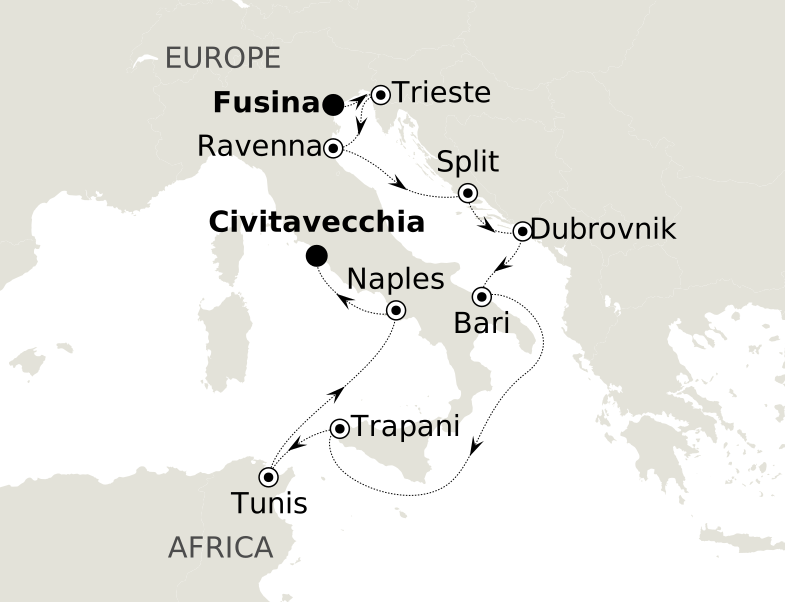
A 11-night ocean voyage aboard Silver Spirit, Fusina, Italy to Civitavecchia, Italy. Destination: Mediterranean.
Operated by Silversea Cruises aboard Silver Spirit.
Fusina (Venice)
Trieste
Ravenna
Split
Dubrovnik
Bari
Trapani, Sicily
Tunis (La Goulette)
Naples
Civitavecchia (Rome)
Losing none of its allure over the years, this floating city of canals, bridges and masks is a place of eternal beauty and enduring elegance. The lagoon of more than 100 islands is a heavenly sight, transporting visitors on a journey through time - from its Roman inception, through centuries of trade to the modern face we see today. Navigate Venice’s sparkling waterways by romantic gondola, or on cruises along wide canal boulevards. Span the Grand Canal over its iconic original crossing, the Rialto Bridge, which - with its parade of tiny shops - gives some of the city’s most endearing views. If the crowds unsettle you at any point, take two turns away from the main thoroughfares to find peace alone, amid the city's labyrinth of tiny streets. Hurry to Piazza San Marco to be immersed in Venice’s elegant glory. Basilica San Marco transports you back to the wealthy days of the Doges, who ruled for over 1,000 years. Initially their private chapel, it’s now decorated with beautiful Byzantine mosaics. Nearby the Campanile di San Marco bell tower offers views over the higgledy-piggledy rooftops of times gone by. Just a hop skip and a jump around the corner is the Doge’s Palace, where the levels of opulence ramp up even further. Justice was meted out in this stunning Palace, with the guilty walking to the cells across the covered Bridge of Sighs. Vaporetto trips to local islands offer even more adventures to float your boat, whether it’s Murano with its world-famous glass, Torcello with its amazing Cathedrals, or Burano with its handmade lace and delightfully colourful painted houses.
Trieste: the past grandeur of the Empire Nestling between the Adriatic and the foothills of the Dinaric Alps, Trieste is the last Italian city before Slovenia. It was here that Jason and his Argonauts are said to have searched for the Golden Fleece... The city cannot hide its deeply maritime DNA and the wealth it has drawn from it over the centuries. The tall buildings lining the seafront are statuesque, while the plush apartment blocks and wide, straight avenues offer passers-by a successful mix of Art Nouveau, neoclassical, Empire-style and more baroque architecture. In the alleyways, the styles blend together and also offer a typical ancestral style. For a long time, Trieste was one of the maritime capitals of southern Europe, first as the main Mediterranean port of the Holy Roman Empire, then as the only port in the entire Austro-Hungarian Empire. Shipowners' money flowed here before the city became Italian and "the last city in the north-east". Despite its lost grandeur, Trieste remains a city whose main activities are still maritime with a slightly old-fashioned charm that is nonetheless undeniable. The relative austerity of its streets makes the architectural and decorative nuggets that can be found on the pediment of a building, at a bend in the road or behind a carriage door all the more dazzling. A curious eye is a must here. Settlement of the region dates back at least two millennia BC, with evidence at various times of the presence of Venetians, Ilyrians and Celts. What began as a small fishing village became a major Roman colony under Julius Caesar, and the city acquired a number of typically Roman features, including a forum and theatre - still visible today on the hill of San Giusto - an aqueduct, some sections of which are still visible today, and Riccardo's Arch, built in the 1st century AD and visible in via del Trionfo, a 15-minute walk from the ship. Over the centuries, the city was plundered by the barbarians, came under Byzantine rule, fell into the hands of the Franks and then joined the Republic of Venice. In 1382, it gave itself to the House of Austria. This would be the foundation of Trieste's wealth, and for centuries it would remain the only port in the whole of Austro-Hungarian Empire. Its grandeur reached its peak at the end of the 19th century. After the First World War, Trieste became Italian and gradually fell into decline. This economically depressed area became the birthplace of the National Fascist Party. When Italy left the Axis in 1943, Trieste became the capital of the Adriatische Küstenland, a province of the Third Reich, which set up the infamous Risiera di San Sabba concentration camp there. In 1945, Tito's Communist partisans took control of the town and - despite the rather passive presence of the Allied forces - carried out a bloody and expeditious purge of the town's fascists and their families. The city and its region were eventually separated into two parts, administered on one side by the British and Americans and on the other by Tito's Yugoslavia. This division led to a mass exodus of people refusing to be under Communist rule, just a few months after the massacres at the end of the war. Despite its troubled history, Trieste is a great place to live. Strolling through its historic centre is a delight that can be savoured by taking the time to observe, stopping off at a terrace for a Spritz and a pizza or visiting its monuments. Santuario di Monte Grisa This truncated pyramid on the hill just outside the town is a church. The "Santuario Nazionale a Maria Madre e Regina" was built in the 1960s at the instigation of the Bishop of Trieste. He had vowed to build a church if Trieste escaped the destruction of the liberation. Its shape is said to evoke the letter M, from the Virgin Mary. Faro della Vittoria Another benchmark for sailors, The Vittoria Light was built in 1920 as a tribute to the victims of the First World War. At its summit, almost 70 metres high, a 7.20 metre high copper statue depicts the winged Victory by the sculptor Giovani Mayer. Its crystal lantern has a range of 35 nautical miles on a clear day. The Miramare Castle Perched atop a rocky cliff overlooking the Adriatic Sea, the Miramare Castle is a majestic architectural marvel that once served as the residence of Archduke Ferdinand Maximilian of Austria. Piazza Unità d'Italia Trieste's central square, Piazza Unità d'Italia, is one of the largest and most scenic in Europe. Flanked by impressive Neo-Classical and Art Nouveau buildings, it offers breathtaking views of the sea. Molo Audace This is one of the city's favourite walks. The jetty that divides the port in two offers a unique view of the city and the ships that dock there. Rowers from the city Rowing Club train along the mole in the morning. Caffè San Marco: The historic Caffè San Marco is a literary haven, where renowned writers and intellectuals, including Italo Svevo and Umberto Saba, once congregated to exchange ideas and engage in profound discussions. [Pictures on request to Olivier]
Wander the historic streets of Ravenna and you may not immediately realise the wealth of artistry contained here. Leave the sun’s glow and let your eyes adjust to the interior of the city’s churches however and you'll discover some of the world’s finest Byzantine mosaics waiting for you. Decorated with spectacular explosions of colour even the humblest church facade can conceal momentous and magnificent artistic displays in this city which harbours 1 500 years of extraordinary history. Ravenna is home to a plethora of UNESCO World Heritage Site designated buildings and no fewer than eight have received protection. Basilica di San Vitale of 525 AD stands as the town’s pièce de résistance - itself a precious mosaic of influence where Byzantine meets Baroque. Glorious light spills in vibrantly illuminating and highlighting the craftwork of its knaves and archways. The Mausoleum of Galla Placido is another noble achievement described by UNESCO as ‘the earliest and best-preserved of all mosaic monuments'. Look up at the glittering stars of the night sky from within and you may be inspired just as Cole Porter was when he penned Night and Day. Ravenna’s beauty has always been stimulating and Dante finished his masterpiece Paradiso here during exile from Florence. Sangiovese wines and prosciutto-filled piadina flatbreads will keep you fed and watered during your stay. Don't miss a taste of the local olive oil either which bursts with intense fruity flavours.
Bathing in the Dalmatian Coast’s generous sunshine and overlooking sparkling island-studded waters Split is a city of romantic beauty built around an extraordinary - still beating - historical heart. The setting may be spectacular but it’s the Diocletian’s Palace - a Roman remain of incredible scale and detail that is truly bewitching. With a natural backdrop of dramatic limestone mountains and Croatia’s trademark scenic wonders all around Split is a true heavyweight of the Adriatic. To enter Split’s Diocletian’s Palace is to step into a beautiful time warp. Head first to the Cathedral of Saint Domnius where a hollow bell tower rockets up puncturing the sky. The perfume of lavender hangs heavy wherever you walk in the old town where tucked shops offer artisan chocolates dried figs and freshly-ground coffees. The expansive seafront promenade is all palm trees buzzing bars and eateries and further out you’ll find the peace of Marion Hill - where you can climb to some of the best views in town. Or take the far less exerting wander to Sustipan cemetery’s breathtaking panorama of sea city and distant islands. Trips to island paradises like Hvar and Brac are tempting as are longer excursions to sites like Krka National Park’s Waterfalls - where wide terraces of frothing water thunder into cooling swimmable splash pools below. Nearby Trogir is another UNESCO World Heritage Site offering a cosier no less charming old town and historic port.
Croatia’s crowning glory rears up vertically from the tranquil waters of the Adriatic, and Dubrovnik’s daunting fortresses town is a truly imposing sight to behold. Encircled by chunky stone walls so thick and dramatic they could have been purpose-built as a film set, this city’s unmatched old town is the setting for countless films and shows - from Star Wars to Robin Hood, Game of Thrones and every production in-between seeking a truly authentic medieval flavour. This fantasy fortress’s walls - which are no less than 12-metres thick at places - are certainly not just for show, however. They kept Dubrovnik safe when it was a maritime republic and they were besieged as recently as 1991, when Serbian and Montenegrin forces attacked, as Yugoslavia broke apart. Fully restored now, the stone streets of the city take you through a beautiful mosaic of architectural splendour, baroque churches and splashing fountains. Tapering alleys rocket up from the central boulevard of Stradun, offering spectacular views down, but you’ll need to walk the city walls to appreciate the fortress city’s full scale. Banking up sharply to the rear, you can gaze across an ocean of terracotta roofs and church spires, clamouring together before the sparkling Adriatic. Visit the neighbouring fort of Lovrijenac, for another perspective, or swing up to Srd fortress’s glorious panorama on a cable car. Dubrovnik’s streets are crammed with eateries and candlelit tables, where couples splash wine into glasses and enjoy gnocchi mixed with creamy truffle sauces. Nearby beaches like Banje are also close by, and hidden bays reward the intrepid who venture out beyond the old town. Take sunset drinks to sit back and watch as flotillas of sea kayaks roll by, or sail on the pristine waters to explore island gems like Lokrum - where peacocks are the only permanent residents.
Explore further afield to immerse yourself in Puglia’s beauty and cultural wonders - or simply soak up the atmosphere roaming the crooked streets of Bari’s old town - Bari Vecchia - where matriarchs roll out sheets of pasta in open doorways footballs rattle along dusty streets and sun-wrinkled old men lay out hands of cards. The photogenic old town’s streets are crowned by the chalky white Cattedrale di San Sabino where vaulted archways pretty mosaics and a large rose window await. Wander along the ruler-straight Lungomare Promenade to breathe in fresh salty air and look up at the slowly twirling ferris wheel - take a ride for some of the best views out over Bari’s waterfront. Feeling hungry? Enjoy some local cucina povera - cooking of the poor – deeply traditional food that is simple and rich in elemental flavours. Warm focaccia bread pasted with fruity local olive oil and ear-shaped orecchiette pasta tangled with sun-gorged cherry tomatoes and creamy ricotta cheese is all on the menu. Puglia’s whitewashed ancient villages stunning beaches and laid-back down-to-earth approach to life means you’ll most likely want to explore further than just Bari. Powdery white sand beaches await at Salento - punctuated by arching rock formations. The incredible cave dwellings of Matera – 2019’s European Capital of Culture - are also easily within your grasp as is Polignano a Mare’s spectacularly scenic narrow wedge of urban beach.
Days at sea are the perfect opportunity to relax unwind and catch up with what you’ve been meaning to do. So whether that is going to the gym, visiting the spa, whale watching, catching up on your reading or simply topping up your tan these blue sea days are the perfect balance to busy days spent exploring shore side.
Surrounded by glowing turquoise waters and rugged coastline Trapani invites you to explore western Sicily's ruins intense flavours and sun-soaked leisure pursuits. Built on salt and tuna exports Trapani is experiencing a renaissance having been lovingly spruced up as a sailing capital and an international airport bringing in visitors from far and wide. The town looks out over the Egadi Islands gazing west to witness some of Siciliy's most evocative sunset displays. Start exploring Trapani from its historic core a dense network of alleys hosting a collection of small shops restaurants and wine bars. You’ll encounter the Cathedral of San Lorenzo – where colourful artworks are spread below sweeping arches and a beautiful domed roof. Sicily feels like an island on the cusp of continents and Trapani practically has one foot in Africa as you soak in its pretty whitewash houses and fusion of foods and arts. Discover the Ancient Greek influence by venturing to rich archaeological sites nearby like Selinus and Segesta where the treasures from the past have been unearthed and displayed. Pyramids of white salt rise up at the Riserva Naturale Saline di Trapani e Paceco. These salt marshes and windmills are a symbol of Trapani and although sea salt production is much less important today the small white hills remain a Trapani landmark. Look out for the pink flamingos wading in the salt pans below. For beach days the Egadi Islands can be easily reached from Trapani - Favignana is the largest and most popular.
Tunisia's capital lies at the western end of the shallow Lake Tunis which opens to the sea at La Goulette. This is the first of a string of beach suburbs that stretches away to the north it is here that the city's port is located. This coastal area includes the ruins of ancient Carthage and the picturesque suburb of Sidi Bou Said places that attract more visitors than Tunis itself. As far as capital cities go Tunis has an easy-going unhurried air about it. It is a very liberal city by Islamic standards and certainly leading the way in Western trends for the rest of the country. In Tunisia the struggle for independence didn't take the violent course that it did in Algeria. Ruler Ahmed Bey who governed from 1837 to 1855 encouraged Westernization and brought in military and other advisors to this end. In 1861 during the reign of Mohammed Sadiq a constitution - the first in the Arab world - was proclaimed. Until the time of the French protectorate the medina was very much the center of things. Then under the French influence the ville nouvelle (new city) emerged with its major banks department stores and administrative services. The main focus of ville nouvelle is the wide tree-lined Avenue Habib Bourguiba. At its western end this major thoroughfare becomes the Avenue de France terminating in the Place de la Victoire and the entrance to the medina.
Days at sea are the perfect opportunity to relax unwind and catch up with what you’ve been meaning to do. So whether that is going to the gym, visiting the spa, whale watching, catching up on your reading or simply topping up your tan these blue sea days are the perfect balance to busy days spent exploring shore side.
The legend of the Siren Parthenope Naples' foundation is not only shrouded in one but two legends, all having one 'person' in common: the siren Parthenope. She and her sisters, Leucosia and Ligaea, are the three resident sirens of the Galli Islands, with their "shores all bleached with human bones and debris", who lured sailors with their enchanting voices and music, only for them to run aground and perish. Parthenope was precisely this magical, murderous voice, while Leucosia and Ligaeus played the flute and citara. The first legend is linked to Ulysses, the first man not to succumb to the siren's call, thanks to Circe's advice. Curious but not mad, he ordered his sailors to plug their ears with wax and tie him firmly to the mast. In this way, he was able to enjoy the pleasure of hearing the music and songs without paying a high price. There are different stories here, some claiming that Parthenope fell in love with Ulysses, others not. In any case, the three sisters, in despair and humiliation, threw themselves into the sea and died. If you are surprised to read that, keep in mind that we're talking about sirens from Antiquity, young women transformed into half-woman half-bird monsters, punished by the goddess Demeter for not having stopped Hades, the god of the Underworld, from kidnapping their mistress Persephone (and daughter of Demeter). Mermaids with fish tails only appeared in the Middle Ages. So, Parthenope and her sisters perished. Their bodies were carried by the sea to Terina for Ligaea and Licosa for Leucosia. Parthenope's body was carried by the waves to the island of Megaride, Naples, where the Castel dell'Ovo stands today. She gave her name to the town and the inhabitants worshipped her, making her the town's patron saint. Another legend exists, from the 19th century. A centaur - Vesuvius - fell madly in love with our siren Parthenope, provoking the jealousy of Zeus. In revenge, he turned the centaur into a volcano. In despair, Parthenope committed suicide and her body washed up in Naples, allowing her to be close to her lover in death. Today there are three fountains dedicated to her: the Fontana delle Zizze (Neapolitan for 'nipples') beside Corso Umberto I with its winged mermaid, a second on the Piazza Jacopo Sannazzaro in Piedigrotta and a third, modern, near the shops at the Central Station. Naples is still referred to as the "Parthenopean city".
All roads lead to Rome, and with good reason - this city is one of the world’s most thrilling, offering unmatched history along every street. An evocative, inspiring and utterly artistic capital of unrivalled cultural impact, Rome is a city of back-to-back landmarks, which will take you on an exhilarating journey through the ages. This may be one of the world’s oldest cities, but it’s well and truly lived in. The ruins are punctuated with murmuring cafes, and the outdoor seating of restaurants sprawls out across piazzas, enticing you to sample tangles of creamy pasta and crispy pizzas. Rome’s incredible Roman Forum is littered with the ruins of its ancient administrations, which have stood firm for 2,000 years, since the times when the area was the centre of the Western world. Few sites are more simultaneously beautiful and haunting than that of the storied Colosseum, which looms deep into Rome’s rich blue sky. Take a tour to learn details of the grisly goings-on within. The best way to experience Rome is to wander its streets, gelato in hand. There is a lot to see here - whether it’s the domed spectacle of the Pantheon, or the elaborate flowing waters and artistry of the Trevi Fountain. Vatican City is an astonishing, colossal display of Catholic grandeur, while the Spanish Steps – crowned by the Trinità dei Monti church – offer a beautiful spot to gather and soak up the lively atmosphere of this humming city. With so much on the to-do list, you’ll relish the breaks you take, enjoying simple pleasures like a strong espresso, or fresh pasta with tomato sauce and ripped basil.
From $7,900
per guest · 11 nights
Prices are a guide and vary with season, cabin category and party size. Your advisor will confirm the exact cost before anything is booked.
Classic Veranda
suite
Deluxe Veranda
suite
Grand 1 Bedroom
suite
Grand 2 Bedroom
suite
Medallion
suite
Owner 1 Bedroom
suite
Owner 2 Bedroom
suite
Panorama
suite
Royal 1 Bedroom
suite
Royal 2 Bedroom
suite
Silver
suite
Silver 2 Bedroom
suite
Superior Veranda
suite
Vista
suite








