




Prefer a conversation?
Our team is always available to guide you through the process and ensure your experience is perfectly matched to your preferences.
Our team is always available to guide you through the process and ensure your experience is perfectly matched to your preferences.
Duration
7 Nights
Price
From $7,050
Ship
Silver Ray
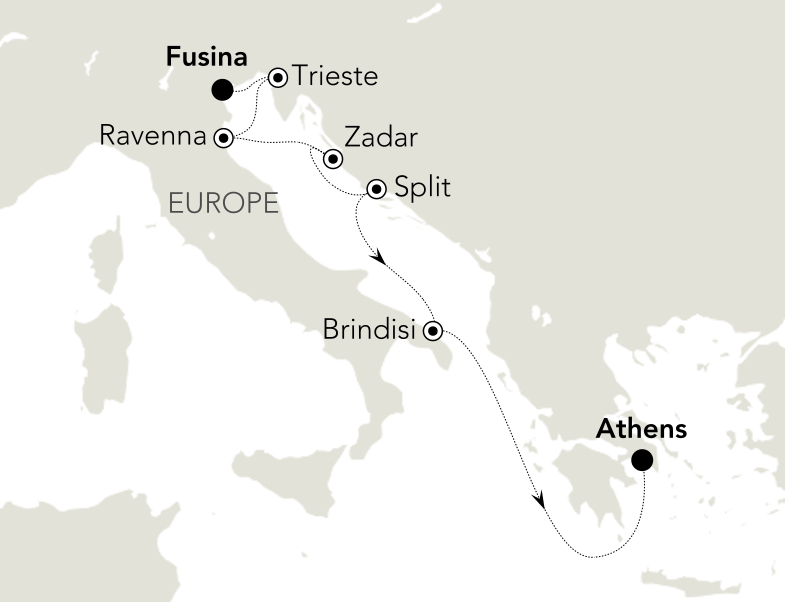
A 7-night ocean voyage aboard Silver Ray, Fusina, Italy to Athens, Greece. Destination: Mediterranean.
Operated by Silversea Cruises aboard Silver Ray.
Fusina (Venice)
Trieste
Ravenna
Zadar
Split
Brindisi
Athens (Piraeus)
Losing none of its allure over the years, this floating city of canals, bridges and masks is a place of eternal beauty and enduring elegance. The lagoon of more than 100 islands is a heavenly sight, transporting visitors on a journey through time - from its Roman inception, through centuries of trade to the modern face we see today. Navigate Venice’s sparkling waterways by romantic gondola, or on cruises along wide canal boulevards. Span the Grand Canal over its iconic original crossing, the Rialto Bridge, which - with its parade of tiny shops - gives some of the city’s most endearing views. If the crowds unsettle you at any point, take two turns away from the main thoroughfares to find peace alone, amid the city's labyrinth of tiny streets. Hurry to Piazza San Marco to be immersed in Venice’s elegant glory. Basilica San Marco transports you back to the wealthy days of the Doges, who ruled for over 1,000 years. Initially their private chapel, it’s now decorated with beautiful Byzantine mosaics. Nearby the Campanile di San Marco bell tower offers views over the higgledy-piggledy rooftops of times gone by. Just a hop skip and a jump around the corner is the Doge’s Palace, where the levels of opulence ramp up even further. Justice was meted out in this stunning Palace, with the guilty walking to the cells across the covered Bridge of Sighs. Vaporetto trips to local islands offer even more adventures to float your boat, whether it’s Murano with its world-famous glass, Torcello with its amazing Cathedrals, or Burano with its handmade lace and delightfully colourful painted houses.
Trieste: the past grandeur of the Empire Nestling between the Adriatic and the foothills of the Dinaric Alps, Trieste is the last Italian city before Slovenia. It was here that Jason and his Argonauts are said to have searched for the Golden Fleece... The city cannot hide its deeply maritime DNA and the wealth it has drawn from it over the centuries. The tall buildings lining the seafront are statuesque, while the plush apartment blocks and wide, straight avenues offer passers-by a successful mix of Art Nouveau, neoclassical, Empire-style and more baroque architecture. In the alleyways, the styles blend together and also offer a typical ancestral style. For a long time, Trieste was one of the maritime capitals of southern Europe, first as the main Mediterranean port of the Holy Roman Empire, then as the only port in the entire Austro-Hungarian Empire. Shipowners' money flowed here before the city became Italian and "the last city in the north-east". Despite its lost grandeur, Trieste remains a city whose main activities are still maritime with a slightly old-fashioned charm that is nonetheless undeniable. The relative austerity of its streets makes the architectural and decorative nuggets that can be found on the pediment of a building, at a bend in the road or behind a carriage door all the more dazzling. A curious eye is a must here. Settlement of the region dates back at least two millennia BC, with evidence at various times of the presence of Venetians, Ilyrians and Celts. What began as a small fishing village became a major Roman colony under Julius Caesar, and the city acquired a number of typically Roman features, including a forum and theatre - still visible today on the hill of San Giusto - an aqueduct, some sections of which are still visible today, and Riccardo's Arch, built in the 1st century AD and visible in via del Trionfo, a 15-minute walk from the ship. Over the centuries, the city was plundered by the barbarians, came under Byzantine rule, fell into the hands of the Franks and then joined the Republic of Venice. In 1382, it gave itself to the House of Austria. This would be the foundation of Trieste's wealth, and for centuries it would remain the only port in the whole of Austro-Hungarian Empire. Its grandeur reached its peak at the end of the 19th century. After the First World War, Trieste became Italian and gradually fell into decline. This economically depressed area became the birthplace of the National Fascist Party. When Italy left the Axis in 1943, Trieste became the capital of the Adriatische Küstenland, a province of the Third Reich, which set up the infamous Risiera di San Sabba concentration camp there. In 1945, Tito's Communist partisans took control of the town and - despite the rather passive presence of the Allied forces - carried out a bloody and expeditious purge of the town's fascists and their families. The city and its region were eventually separated into two parts, administered on one side by the British and Americans and on the other by Tito's Yugoslavia. This division led to a mass exodus of people refusing to be under Communist rule, just a few months after the massacres at the end of the war. Despite its troubled history, Trieste is a great place to live. Strolling through its historic centre is a delight that can be savoured by taking the time to observe, stopping off at a terrace for a Spritz and a pizza or visiting its monuments. Santuario di Monte Grisa This truncated pyramid on the hill just outside the town is a church. The "Santuario Nazionale a Maria Madre e Regina" was built in the 1960s at the instigation of the Bishop of Trieste. He had vowed to build a church if Trieste escaped the destruction of the liberation. Its shape is said to evoke the letter M, from the Virgin Mary. Faro della Vittoria Another benchmark for sailors, The Vittoria Light was built in 1920 as a tribute to the victims of the First World War. At its summit, almost 70 metres high, a 7.20 metre high copper statue depicts the winged Victory by the sculptor Giovani Mayer. Its crystal lantern has a range of 35 nautical miles on a clear day. The Miramare Castle Perched atop a rocky cliff overlooking the Adriatic Sea, the Miramare Castle is a majestic architectural marvel that once served as the residence of Archduke Ferdinand Maximilian of Austria. Piazza Unità d'Italia Trieste's central square, Piazza Unità d'Italia, is one of the largest and most scenic in Europe. Flanked by impressive Neo-Classical and Art Nouveau buildings, it offers breathtaking views of the sea. Molo Audace This is one of the city's favourite walks. The jetty that divides the port in two offers a unique view of the city and the ships that dock there. Rowers from the city Rowing Club train along the mole in the morning. Caffè San Marco: The historic Caffè San Marco is a literary haven, where renowned writers and intellectuals, including Italo Svevo and Umberto Saba, once congregated to exchange ideas and engage in profound discussions. [Pictures on request to Olivier]
Wander the historic streets of Ravenna and you may not immediately realise the wealth of artistry contained here. Leave the sun’s glow and let your eyes adjust to the interior of the city’s churches however and you'll discover some of the world’s finest Byzantine mosaics waiting for you. Decorated with spectacular explosions of colour even the humblest church facade can conceal momentous and magnificent artistic displays in this city which harbours 1 500 years of extraordinary history. Ravenna is home to a plethora of UNESCO World Heritage Site designated buildings and no fewer than eight have received protection. Basilica di San Vitale of 525 AD stands as the town’s pièce de résistance - itself a precious mosaic of influence where Byzantine meets Baroque. Glorious light spills in vibrantly illuminating and highlighting the craftwork of its knaves and archways. The Mausoleum of Galla Placido is another noble achievement described by UNESCO as ‘the earliest and best-preserved of all mosaic monuments'. Look up at the glittering stars of the night sky from within and you may be inspired just as Cole Porter was when he penned Night and Day. Ravenna’s beauty has always been stimulating and Dante finished his masterpiece Paradiso here during exile from Florence. Sangiovese wines and prosciutto-filled piadina flatbreads will keep you fed and watered during your stay. Don't miss a taste of the local olive oil either which bursts with intense fruity flavours.
Zadar: a city like a history book In turn Roman, Byzantine, Venetian, Austro-Hungarian, Yugoslav and then Croatian, Zadar is an ancient settlement dating back to prehistoric times. Architectural evidence of its history is scattered throughout the streets and maze of alleyways of its historic centre. A must-see for those wishing to discover all the charms of one of the jewels of the Adriatic. At the heart of the city are the Roman remains of Zadar. This huge forum, built between the 1st century BC and the 3rd century, is the heart of the city. Its ruins - carved stones and columns, including the Column of Shame and its chains - still whisper the memory of a time when Zadar was one of the great naval centres of the Adriatic. It was a time when the Romans gave the city its forum and temples, and equipped it with thermal baths and its first sewers, thanks to a feat of Roman engineering: the construction of an aqueduct over 40 kilometres long linking the city to the waters of Lake Vransko. A stone's throw from the ruins of the forum, the church of St Donatus has stood since the 9th century, with its unique and remarkable architectural design. The church, now a concert hall after having been a warehouse and then an archaeological museum, is a circular structure made up of three concentric rings of columns, with 12 columns for the outermost ones, 16 for those in the middle and 20 for the central circle. The result is a fascinating visual effect, particularly for a building over a thousand years old. St Donatus, which has not heard a mass for 200 years, is open to visitors and has preserved some of its relics as well as its pulpit and baptismal font. From its forecourt, you can hear the strange sounds of one of Zadar's other attractions: the Sea Organ, just a few hundred metres away. The only one of its kind in the world, this organ consists of a system of bellows inserted into steps that sink into the waters of the Adriatic. The result is a symphony of sounds created by the waves and air currents. Also worth seeing - Sainte-Anastasie Cathedral and its bell tower Dating from the 12th and 13th centuries, the cathedral was badly hit by bombing during the Second World War. Now fully restored, it boasts a wealth of architectural treasures, including its façade, 3 naves, sculptures and relics. You can climb to the top of its bell tower for a panoramic view of the town. - Church of Saint-Siméon A Baroque church dating back to the 5th century, its bell tower was added in the 17th century. The ochre-coloured monument contains a priceless piece: the sarcophagus covered with gold-plated silver reliefs housing the relics of Saint Simeon. - The Place des Cinq-Puits Built in 1574, the Place des Cinq-Puits takes its name... from the 5 wells located there. For many years, they were the water supply for the inhabitants of Zadar. Just behind it, Queen Jelena Madijevka's garden is the ideal place for a break, with its shady paths, café and peaceful atmosphere. - Port of Foša and Gateway to Terra Firma From the garden, you can see the authentic little port of Foša. Right next door, the Porte de la Terre Ferme (Farmland Gate) has stood since 1543. Long the town's main gateway, it was once equipped with a drawbridge. [Pictures in : Zadar>Tour>Zadar, Nin Slat Works & Royal Vineyards (ZAD-G) starting picture #5 and Zadar>Tour>Dalmatian Panoramas and Rural Estate (ZAD-H) starting picture #5]
Bathing in the Dalmatian Coast’s generous sunshine and overlooking sparkling island-studded waters Split is a city of romantic beauty built around an extraordinary - still beating - historical heart. The setting may be spectacular but it’s the Diocletian’s Palace - a Roman remain of incredible scale and detail that is truly bewitching. With a natural backdrop of dramatic limestone mountains and Croatia’s trademark scenic wonders all around Split is a true heavyweight of the Adriatic. To enter Split’s Diocletian’s Palace is to step into a beautiful time warp. Head first to the Cathedral of Saint Domnius where a hollow bell tower rockets up puncturing the sky. The perfume of lavender hangs heavy wherever you walk in the old town where tucked shops offer artisan chocolates dried figs and freshly-ground coffees. The expansive seafront promenade is all palm trees buzzing bars and eateries and further out you’ll find the peace of Marion Hill - where you can climb to some of the best views in town. Or take the far less exerting wander to Sustipan cemetery’s breathtaking panorama of sea city and distant islands. Trips to island paradises like Hvar and Brac are tempting as are longer excursions to sites like Krka National Park’s Waterfalls - where wide terraces of frothing water thunder into cooling swimmable splash pools below. Nearby Trogir is another UNESCO World Heritage Site offering a cosier no less charming old town and historic port.
Set right in the heel of Italy’s boot, Brindisi is a pretty little maritime port, fringed with palm trees and most definitely carries its moniker of “Gateway to the East” with pride. An Italian province packed with fascination and the relics of vanished civilization, Brindisi’s cultural inheritance ranges from the relics of ancient Roman highways to Gothic and Baroque churches, cathedrals, frowning battlements of Swabian castles and fortresses which date back to the 13th century, reign of the Holy Roman Emperor, Frederick II. Life continues in Brindisi as if the 21st century hadn’t arrived. Visually, the landscape is as stunning as one would expect in southern Europe. Villages set on sunlit hilltops rise like islands above a rolling landscape of olive groves and vineyards. The coastline is a striking mixture of ruggedly beautiful cliffs and grottoes interspersed with a scattering of long, sandy beaches. Together with the wealth of historical artefacts and spectacular landscapes, Brindisi is one of Italy’s best kept secrets. Naturally, the cuisine is rich with its pickings from both land and sea and visitors can expect the best pasta, Caprese salad, local lemon loaf and spaghetti al vogole they have ever had!
Days at sea are the perfect opportunity to relax unwind and catch up with what you’ve been meaning to do. So whether that is going to the gym, visiting the spa, whale watching, catching up on your reading or simply topping up your tan these blue sea days are the perfect balance to busy days spent exploring shore side.
A city of legend, civilisation and enduring culture, Athens is a majestic and magical urban sprawl. Extraordinary elegance and grace combine with grit and graft in Greece's capital, where highways encase ruins from antiquity, and gleaming museums and galleries stand beside concrete sprayed with edgy street art. These contrasts enhance and elevate the wonders of this 2,500-year-old city, however, which can count notable contributions to philosophy, drama and democracy, among its global legacy. Piraeus' giant port and naval base welcome you to the edge of the Athens' urban area. From there it's a simple jaunt to the centre. The majestic ancient citadel of the Acropolis dominates an elevated platform and is a constant presence as you explore the city. The wonderful remains of the columned temple of the Parthenon - which date back to the 5th century BC - stand here, representing the pinnacle of classical architecture. The nearby Acropolis Museum adds context to your visit and frames the broad views from its giant glass windows. Or rise up Mount Lycabettus, to be rewarded with perhaps Athens' best panorama of the Acropolis sitting high over the city on its grand stage. See the marble horseshoe of the Old Olympic Stadium, where the first modern Olympics were held in 1896, for more of the city's enduring legacy. Elsewhere, golden beaches and temples stretch out along the coastline, should you wish to explore a little further afield. Coffee is an art form to the Greeks, and it's an unwritten rule that coffee time must never be rushed. So prepare to settle down for a couple of hours and lose yourself in a good chat. Feeling hungry - try traditional souvlaki made with sauces handed from generation to generation.
From $7,050
per guest · 7 nights
Prices are a guide and vary with season, cabin category and party size. Your advisor will confirm the exact cost before anything is booked.
Classic Veranda
suite
Deluxe Veranda
suite
Grand 1 Bedroom
suite
Junior Grand 1 Bedroom
suite
Junior Grand 2 Bedroom
suite
Master
suite
Medallion
suite
Otium
suite
Owner 1 Bedroom
suite
Owner 2 Bedroom
suite
Premium Medallion
suite
Premium Veranda
suite
Signature
suite
Silver
suite
Superior Veranda
suite








