




Prefer a conversation?
Our team is always available to guide you through the process and ensure your experience is perfectly matched to your preferences.
Our team is always available to guide you through the process and ensure your experience is perfectly matched to your preferences.
Duration
23 Nights
Price
From $22,950
Ship
Silver Cloud
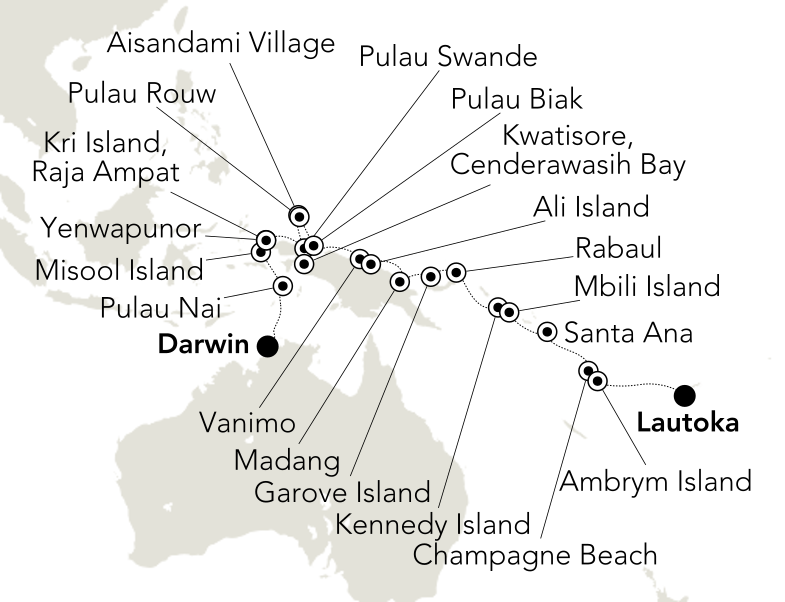
A 23-night expedition voyage aboard Silver Cloud, Darwin, Australia to Lautoka, Fiji. Destination: French Polynesia & Pacific.
Operated by Silversea Cruises aboard Silver Cloud.
Darwin
Pulau Nai
Misool Island, Raja Ampat
Yenwapunor, Gam Island
Kri Island, Raja Ampat
Pulau Swande
Kwatisore, Cenderawasih Bay
Aisandami Village
Pulau Rouw
Pulau Biak
Vanimo
Ali Island
Madang
Garove Island
Rabaul
Kennedy Island
Mbili Island
Santa Ana
Champagne Beach
Ambrym Island
Lautoka
Australia's capital of the north is a uniquely tropical city, and a historically isolated outpost of this vast, diverse country. Reaching up towards the equator, a full 2,000 miles from Sydney and Melbourne, the city was named in honour of Charles Darwin by the British settlers who established a frontier outpost here. With a unique history, beautiful islands nearby, and a palette of sizzling Pacific flavours, colourful Darwin is an enchanting and exotic Australian destination. Crocodiles patrol the jungled waterways and tropical rainforests around Australia's gateway to the Top End. Explore via airboat to look down on the veiny waterways of the mist-laced Kakadu National Park. The sounds of chattering birdlife and the gentle splash of fountains and waterfalls will fill your ears in George Brown Darwin Botanic Gardens. Soak it all in, before kicking back and relaxing with a picnic and a crackling barbecue. The sunshine and famous tropical pink sunsets mean many visitors naturally gravitate to the city's soft sands to relax at spots like pretty Mindil Beach, as evening approaches. The adjoining market is filled with souvenirs and crafts stands and is the perfect great place to enjoy some fiery Asian flavours. Stroll the stalls, grab some food, and crack open an ice-frosted beer as the sunset show begins. It may be remote, but Darwin found itself on the front line during the Pacific War, as the Japanese air force unloaded their bombs onto the city in 1942. This relaxed unassuming city has a deeply resilient backbone, however, and you can explore the museums to learn more of the war's impact on Darwin, as well as the devastating effects of one of Australia's worst natural disasters, Cyclone Tracy in 1973.
Days at sea are the perfect opportunity to relax unwind and catch up with what you’ve been meaning to do. So whether that is going to the gym, visiting the spa, whale watching, catching up on your reading or simply topping up your tan these blue sea days are the perfect balance to busy days spent exploring shore side.
Pulau Nai or Nai Island belongs to the Moluccas archipelago, the so-called “Spice Islands”. It is a mere dot in the eastern limits of the Banda Sea, yet brimming with the key elements of paradise: sun, coconut palms and white sands. The abundant coconut palms provide the raw ingredient for one of the primitive local industries, the drying of coconut kernels to produce copra, from which coconut oil is later extracted. The other main industry on the island also makes use of the natural bounty. Agar seaweed is sprouted on long ropes anchored in the sea and then harvested and dried. Birders will enjoy listening for and spotting some of the local birdlife like the Kancilan Pulau (Island Whistler) and the Kehicap Kai (White-tailed Monarch). Maybe they will even confirm the presence of the Papuan Pitta, attired imperial-like with splendid blues and reds. The waters around Pulau Nai also offer their own idyllic experience. Snorkelling will allow you to cross the divide into the world of tropical coral ecosystems. Look for the different coral formations like brain, staghorn, fire and plate corals, as well as a range of fish that associate with these surreal coral gardens. If you cannot tell the difference between a wrasse and a damselfish, or a parrotfish and a surgeonfish, then rest assured your Expedition staff will be there to help you, allowing you to just enjoy the magical experience as you float along almost effortlessly.
The Raja Ampat region of West Papua, with its multiple islands and intricate system of reefs lies in the heart of the Coral Triangle. This region has been called the most biodiverse area of ocean on the planet. One of the four larger islands is Misool, and the mystery and beauty of the deep aqua lagoons and mysterious vertical jutting rock formations defy description. Underwater surrounding Misool are steep coral walls and drop-offs that are festooned with table corals, staghorn corals, and orange and purple sea squirts. Snorkellers may see giant clams nestled into the coral formations while fish in rainbow colors sprinkle the reef above. On land visitors may enjoy beach activities and bird watching, or a nature walk to observe the marsupial fauna that live on Misool.
Kwatisore Bay is a 2 km wide bay located west of Kwatisore Peninsula at the southwestern end of the wide Cenderawasih (bird of paradise) Bay. An area of 1,453,500 hectares, a great part of the bay, has been declared a national park. Within the national park is Indonesia’s largest marine national park. Some dive companies claim that Cenderawasih Bay is the whale shark capital of the world, and the area near Kwatisore Bay is one of the few places in the world where encounters can almost be guaranteed. The whale sharks seem to be permanent residents of the protected marine park and as the locals believe whale sharks are under the protection of spirits and will bring good luck, not only has fishing them been traditionally prohibited, the fishermen actively encourage their presence by feeding them small amounts of their catch. Therefor the best places and time to look for the whale sharks –and to swim or dive with them- are the local fishing pontoons during the early morning hours.
To say that Pulau Biak was unspoiled would be an understatement. Located in the Cendrawasih Bay of Papua (Irian Jaja), west of Papua New Guinea, Biak Island itself is the biggest island in the Biak-Numfor archipelago. The archipelago proper is made up of 67 islands, each more stunning than the last. One of PNG’s biggest offshore islands, people here are relaxed and friendly and open to the many opportunities that foreign visitors can offer. Those wishing for full immersion should try anything cooked by Barapen (warm rocks). Delicious! Unsurprisingly for a remote island in the Bismark Sea, waters here are a diver’s paradise. Not only are they clear and teeming with marine life, but the sunken M/V Pacific Gas is home to a coral reef, lionfish, ghost pipefish, schooling jacks, snapper, sweetlips and batfish. However, if diving, snorkelling, kayaking and general beach life is not your bag, Pulau Biak does offer other opportunities. The island’s’ colourful past as a sanctuary for Japanese soldiers during WWII means that those wishing to explore more onshore will enjoy a trip to the Biak cave museum, a Karst cave used by Japanese soldiers as a hiding place and for storage. Bird lovers will also enjoy exploring the island's large and lovely bird park, which is home to Cendrawasihs (Papua Birds of Paradise) and the endemic species of Kasuaris and Mambruk.
Days at sea are the perfect opportunity to relax unwind and catch up with what you’ve been meaning to do. So whether that is going to the gym, visiting the spa, whale watching, catching up on your reading or simply topping up your tan these blue sea days are the perfect balance to busy days spent exploring shore side.
Only about 30 kilometers (19 miles) from the Indonesian border, Vanimo is the capital of the Sandaun (or Sundown) Province. It is one of only two towns in this remote region of Papua New Guinea. Although the Sepik River originates in the province, it bypasses Vanimo far to the south. The Sandaun Province is relatively undeveloped, but Vanimo has lovely beaches and some picturesque villages in the vicinity. The interior is covered in rainforest and logging is an important activity putting to use Vanimo’s port and protected bay.
Ali Island is one of the four islands located close to Aitape, off the northern coast of Papua New Guinea. The eastern shore of Ali Island has a beautiful white sandy beach and offers swimming and snorkeling. The five villages on the island connect via well-maintained trails that lead to the school and Catholic church closer to the northern end of the island. The indigenous populations of this island are welcoming to guests and yet maintain their unique way of living and dressing, with colorful ceremonial headdresses, arm bands and grass skirts. A village walk will take visitors past the clean local homes and gardens, to the Catholic church with its interesting paintings of the via crucis. Chat with the islanders or relax on the beach.
The very first houses of Madang were located on a small peninsula jutting into the Bismarck Sea –the land between today’s port and the Forum Park. The site had been chosen for its deep harbor and the fresh sea breeze. Found some 40 kilometers south of Cape Croisilles, the northern point of Astrolabe Bay, the port and station were originally called “Friedrich Wilhelms-Hafen” after the Prussian Crown Prince. The station had been built in 1891 to be the provincial headquarters of German New Guinea from 1892 onwards. After WWI and the eviction of the Germans, the town’s name was changed to Madang. Madang was occupied by the Japanese during WWII and to honor the coastwatchers working behind enemy lines, the Coastwatchers Memorial Lighthouse was inaugurated at the entrance to Madang Harbor at Kalibobo in 1959. Not only is this a shining light for shipping, it has also become an iconic feature of Madang. Today the town has a population of some 36,000 inhabitants and is connected by road to Hansa Bay in the north and Lae and the highlands to the south. Cattle, cocoa and copra are important produces from Madang Province. With more than 170 languages spoken in the province, the small museum holds interesting pieces relating to the history and cultures of Madang and surrounding areas. Several of the trees along Modilon Road show hundreds of resting fruit bats waiting for the evening’s flights, some of them find their way to the Main Market.
The volcanic island of Garove is part of the Witu Islands and once had a 5-kilometer-wide (3.1 miles) caldera. The island was historically used to produce copra and cocoa and in fact still is today. Most of the villages are located around the exterior of the volcano. Steep cliffs explain why there is only one area settled on the inside. A promontory at the entrance’s southwestern corner is taken up by the school and the catholic church of the village of Widu the only village inside the caldera.
If surreal and unique experiences are your thing, then the Papua New Guinean town of Rabaul should tick your travel boxes. Found on the north eastern tip of New Britain Island (the largest island off mainland PNG) Rabaul, the former provincial capital, has quite a remarkable location. The town is inside the flooded caldera of a giant volcano and several sub-vents are still quite active today! The lively city was almost entirely devastated by Mount Tavurvur in 1994, covering the city in ashfall, but thankfully costing no lives. Since then, thanks to Rabaul's deep-water port, commerce has been on the up, and a few shops and hotels have managed to find an audience. However, Rabaul's remote location together with the volcano still being one of the most active and dangerous in Papua New Guinea means tourism in not rife. Rabaul has an impressive WWII history which includes a 300-mile network of tunnels dug by Japanese POW designed to conceal munitions and stores. After the Pearl Harbour bombings, the Japanese used Rabaul as their South Pacific base for the last four years of WWII, and by 1943 there were about 110,000 Japanese troops based in Rabaul. Post war, the island was returned to Australia, before it was granted independence in 1975. It should be noted that patience is a virtue here. However, that is not all bad. The slow pace of transportation allows travellers to marvels at the quite astonishing landscape. Divers will also be richly rewarded – the marine life of the island is extraordinary.
Days at sea are the perfect opportunity to relax unwind and catch up with what you’ve been meaning to do. So whether that is going to the gym, visiting the spa, whale watching, catching up on your reading or simply topping up your tan these blue sea days are the perfect balance to busy days spent exploring shore side.
Wild, uninhabited and historical, Kennedy Island is a tiny piece of land in the middle of the Pacific Ocean. Part of the remote Solomon Islands, the island is situated 15 min away by boat from Gizo, which is capital of the Western Province. Kennedy Island was formerly known as Plum Pudding Island, after an incident dating back to World War II. Incident involving one of the most famous figures of history. John F. Kennedy, a lieutenant at the time, was a castaway on the island with his crew when their torpedo ship, PT 109, was shot sunk by the Japanese troops in August 1943. It is said that the future president swam dragging an injured crewmate by holding the strap of his life jacket in his teeth until reaching the island. He and his crew fed themselves with coconuts during two days before being found by Solomon Islanders. JFK even kept a coconut shell from the island on his desk in the Oval Office throughout his presidency. For our history buffs, some artefacts dating from the crew’s passage can still be found on site. An island marked by history in short, but not only. Discovering Kennedy Island is an experience not to be missed for diving and nature lovers. The waters that surround the island are a submerged world of great richness and variety of colourful fishes and corals.
Port Mary is the name of the bay adjacent to Ghupuna the main village in Santa Ana. A bright white sand beach with huge shade-giving trees runs along the shoreline in front of the tidy village. The houses here are made with local materials and most are built on stilts. Islanders generally welcome visitors with traditional songs and dances performed by members of the three different villages on Santa Ana. Some local people will also set up stands offering souvenirs for purchase. The Solomons are best known for strings of traditional shell money and elegant carvings based on local stories and legends.
Days at sea are the perfect opportunity to relax unwind and catch up with what you’ve been meaning to do. So whether that is going to the gym, visiting the spa, whale watching, catching up on your reading or simply topping up your tan these blue sea days are the perfect balance to busy days spent exploring shore side.
As world famous beaches go, Champagne Beach is one of the big hitters. In 2003, CNN ranked it number nine in its list of top 100 beaches and independent travel specialists permanently include it on their list of 50 best beaches worldwide. It’s one of the world’s greatest natural beauties: picture-perfect beach white sand, turquoise water and nothing – save for the occasional cow or curious turtle - around. With only coconut plantations and a few friendly locals to keep you company, this might just be the island of your dreams. The glorious name “Champagne Beach” was given to the island in the 17th century, when Pedro de Quirós believed he had reached the famous unknown southern land or the “Tierra Australis Incognita” (or Australia as we now know it). He believed the effervescent bubbles of volcanic origin that bubble up from the crystal clear waters were reminiscent of the bubbles of Champagne. Additionally, the coastline is shaped like an art deco Champagne saucer, so the name stuck! The beach is located on the largest yet least populated island in the 40-island Vanuatu archipelago, near the village of Hog Harbor on Espiritu Santo Island. If you want to venture beyond the beach, then Espiritu Santu is also famed for its blue holes. The island is home to some of the clearest waters on Earth, benefiting from natural filtering from underground limestone caves. Ride or paddle your way through emerald green rainforest amid the sound of birdsong for an experience that will make your soul sing.
Unlike Espiritu Santo with its raised coral reefs and white sand Ambrym is a volcanically active island with dark sand beaches. Ambrym is known as the island of magic and is the source of five local languages that all evolved on Ambrym. This handful of languages contributes to the well over 100 languages of Vanuatu. Some of Ambrym’s magic takes place in the lush greenery of the local community of Ranon. Here the people perform a very special and traditional ‘Rom’ dance. Participants prepare their masks and costumes in secrecy and the dance is reserved for special occasions.
Days at sea are the perfect opportunity to relax unwind and catch up with what you’ve been meaning to do. So whether that is going to the gym, visiting the spa, whale watching, catching up on your reading or simply topping up your tan these blue sea days are the perfect balance to busy days spent exploring shore side.
It doesn’t get much sweeter than arriving on the sun-soaked shores of the Sugar City. Fiji’s second-biggest settlement opens up a world of blissful beaches and turquoise seascapes while its dense jungle lures the adventurous deep into its embrace. Experience rich Fijian life and see dramatic displays like warrior dances and remarkable local practices like firewalks which kick up burning embers into the night's sky. Legend says the city took its name after two chiefs faced each other in a duel. A spear pierced one of the chiefs leading to the shout of 'lau-toka!' or 'spear hit!' Sugar is Lautoka’s main trade but its botanical gardens are a sweet insight into the tropical plant life that thrives here - from pearl white lilies to tall fragrant orchids. Explore temples charming cafes and mills - or barter for some of the juiciest mangoes you’ll ever taste at the city’s lively market. You'll only be able to resist the beaches for so long and it doesn’t get much more stunning than the Blue Lagoon - a heavenly blend of woven together turquoise shades. Remote wild and unspoiled these are some of the best tropical beaches in the world. There's more rejuvenating relaxation at the mineral-rich mud pools and spas fuelled by the volcanic activity below. Savala Island is a teardrop of sand offshore and another beautiful place to wander with the soft powder between your toes - along sandy spits that peter out into the water. Or swim and snorkel among its envied reefs thronging with fish life.
From $22,950
per guest · 23 nights
Prices are a guide and vary with season, cabin category and party size. Your advisor will confirm the exact cost before anything is booked.
Grand 1 Bedroom
suite
Grand 2 Bedroom
suite
Medallion
suite
Midship Veranda
suite
Owner 1 Bedroom
suite
Owner 2 Bedroom
suite
Royal 1 Bedroom
suite
Royal 2 Bedroom
suite
Silver
suite
Veranda
suite
Vista
suite








