




Prefer a conversation?
Our team is always available to guide you through the process and ensure your experience is perfectly matched to your preferences.
Our team is always available to guide you through the process and ensure your experience is perfectly matched to your preferences.
Duration
14 Nights
Price
From $16,000
Ship
Silver Endeavour
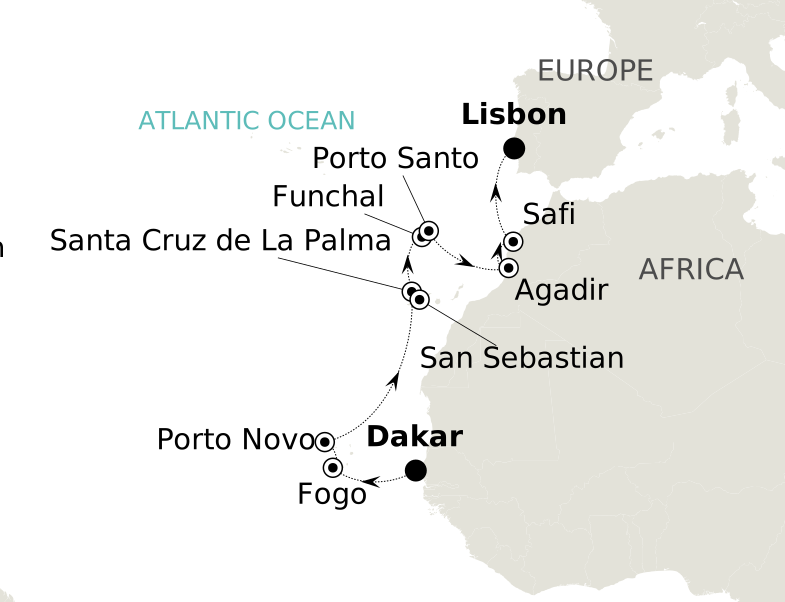
A 14-night expedition voyage aboard Silver Endeavour, Dakar, Senegal to Lisbon, Portugal. Destination: Africa & Indian Ocean.
Operated by Silversea Cruises aboard Silver Endeavour.
Dakar
Fogo
Porto Novo
Santa Cruz de La Palma (Canary Islands)
San Sebastian (La Gomera)
Funchal, Madeira
Porto Santo, Madeira
Agadir
Safi
Lisbon
Capital of Senegal, and a major gateway to Western Africa, the former colonial trading post of Dakar stamps the Cap-Vert peninsular with glorious surf-fringed beaches. Enjoy the thrum of markets - where colourful textiles are exchanged - and wander streets where jazz, sambar and mbalax spill from every ajar door. Offering tropical island-style beaches in an incongruous urban setting, Dakar is a wild and urgent experience for the senses. Watch on as surfers revel in consistent rollers on this, the most westerly peninsula of continental Africa. Scuba divers can explore worlds below the surface in Dakar's diving areas, or you can head to sandy beaches like Plage des Mamelles' cove, which provide endless options for cooling off. Looking for a little more activity, loosen up and play on golf courses that unroll along the sun-kissed Senegalese coastline, or visit startling natural sites like the vivid pink water of the salty pink Lake Retba. Cultural relevance abounds in Dakar - those wanting to delve a little deeper into the dark history of Senegal should visit the House of Slaves on the UNESCO World Heritage Site listed Goree Island, or duck into the Theodore Monod Museum to pour over an incredible collection of masks, artefacts, and treasures. Sandaga Market is a full-on experience of choreographed chaos, sound and flavours. Tear into fish fresh off the boat, and don't be afraid to get your hands a little greasy while handling Dibi - the national street food - soft mutton, simmered with onions and zesty orange spice.
Days at sea are the perfect opportunity to relax unwind and catch up with what you’ve been meaning to do. So whether that is going to the gym, visiting the spa, whale watching, catching up on your reading or simply topping up your tan these blue sea days are the perfect balance to busy days spent exploring shore side.
Fogo and neighboring Ilha Brava are the southernmost islands of Cape Verde and at the western end of the Sotavento group. Unlike some of the other islands in the archipelago which were named after saints, Fogo’s name goes back to the volcanic activity of its dominant feature Pico do Fogo, at 2,829 meters the highest elevation of Cape Verde and also its largest volcano. The third Cape Verde island to be settled by Portuguese –there is no indication of human activity before the Portuguese voyages of exploration - the discovery of Fogo is celebrated with horse races and the “Festas do São Filipe” on May 1. Sao Filipe is Fogo’s largest city with 20,000 inhabitants and the fourth-largest of Cape Verde. Sao Filipe lies on the western flank of a giant volcano which in his 9 kilometer wide caldera has the Pico do Fogo, an active stratovolcano which last erupted in 2014-15 and still today emits sulphur vapor through its fumaroles.
Porto Novo is found on Sao Antonio, the northwesternmost of the Cape Verde Islands, and is the island’s largest town with approximately 17,400 inhabitants. Located on Sao Antonio’s southeastern and arid side, Porto Novo began as a fishing village and only in 2005 it was recognized as a city. Since the island has no airport and Porto Novo faces the town of Mindelo on the island of Sao Vicente, this harbor is the main link to the other islands in Cape Verde and the outside world. A monument above the port shows a woman waving goodbye to those emigrating from the Cape Verde Islands. Roads leading out of Porto Novo have to either go along the impressive northeast coast or cross the island’s mountains through a rugged and even more spectacular landscape. The third highest peak of the Cape Verde islands at 1,979 meters is the Tope de Coroa to the west of Porto Novo.
Days at sea are the perfect opportunity to relax unwind and catch up with what you’ve been meaning to do. So whether that is going to the gym, visiting the spa, whale watching, catching up on your reading or simply topping up your tan these blue sea days are the perfect balance to busy days spent exploring shore side.
Days at sea are the perfect opportunity to relax unwind and catch up with what you’ve been meaning to do. So whether that is going to the gym, visiting the spa, whale watching, catching up on your reading or simply topping up your tan these blue sea days are the perfect balance to busy days spent exploring shore side.
Volcanoes dominate the island of La Palma. The island sits over a hot spot in the Earth’s crust. Beginning on the seabed 4,000 metres below sea level, the volcanoes grew to emerge above the waves and through the clouds to form a mountainous island. The highest point is 2,423 metres (7,950 feet) above sea level. The peak flanks La Caldera de Taburiente, a giant collapsed volcanic crater with a canyon exiting it. The ridge extending south of the Caldera erupted as recently as 1971, when Teneguía volcano sent slow lava flows to the sea. Roads reach lookouts where further exploration on foot begins. The Spanish port town of Santa Cruz de la Palma began in 1493 and supported the sea route from Europe to the New World. In the 16th century Santa Cruz was the third most important port in Europe, after Antwerp and Seville. But it attracted trouble. The pirate Françoise Le Clerc or ‘Peg Leg’, ransacked the town in 1553, leading to the construction of the forts Castillo de Santa Catalina and Castillo de la Virgen. History buffs should walk the cobbled town streets amongst colourful colonial buildings. Several vegetation zones are traversed if you travel up the mountains. Dry coastal scrub gives way to a woodland with large Canary Palms, a plant now grown worldwide. Higher slopes catch moisture from clouds, creating the lush laurel zone of semi-tropical forest. Next is a Canary Pine forest and finally an alpine zone of shrubs. The highlight here is the tall pink flowering spikes of the La Palma Bugloss.
Wander between San Sebastian's faded pastel hues which spill across the coastline and bathe in this seaside city's warm sunshine as waves splash onto sunny beaches. A sleepy capital city travellers have been resting relaxing and rejuvenating here for centuries – including Christopher Columbus whose presence remains in museums dedicated to his visit. Silbo an extraordinary whistling language used to communicate over great distances adds even more cultural fascination to this luscious island’s mountain scenery crafts and traditions. Head to beaches like Playa de San Sebastian to revel in the black volcanic sand that the Canaries are known for and Playa de la Cueva where you can look across to Tenerife’s soaring cone. Or explore this island's own natural wonders at the verdant terraced landscapes of La Gomera’s UNESCO World Heritage Site Garajonay National Park. Trek through the trails of Laurisilva forests laurel plants and heather trees. La Laguna Grande is another elegant location of colourful natural beauty where island legends of witchcraft swirl. Discover ceramic traditions - handed down through generations - at El Cercado where glazed jugs used to store chestnuts are moulded by hand. Squeeze more local charms into your bulging suitcase along San Sebastian’s pretty Calle Real street - where everything from palm honey to woven baskets and local snacks are up for grabs. Or settle into city squares where life plays out in palm tree shade and café gatherings.
The discovery of Madeira or the legend of the two lovers Although there are serious doubts as to whether the island was known as far back as antiquity, the official discovery of Madeira dates back to the 15th century and is attributed to Joao Goncalves Zarco. He set foot on Porto Santo in 1419 and on Madeira a year later. He named the island "Madeira"-wood in Portuguese- because of the immense forests that cover the island. However, legend has it that Zarco did not come here by chance. It is said that in the 14th century, a couple of lovers who were not bound by the sacred bonds of marriage fled by sea to live out their love. Their names were Anne d'Hertford, a Frenchwoman, and Robert MacKean, an Englishman. Their boat, pushed by a storm, ran aground on the island of Madeira. The two unfortunate lovers died shortly afterwards, one from illness, the other from sadness, but the sailors who were with them on the boat survived. Unfortunately for them, they were captured and sold into slavery in Morocco, where they recounted their adventures and the discovery of an island covered in forests with gigantic trees. The story reached the ears of the Portuguese, and it was thanks to them that João Gonçalves Zarco discovered Madeira and its precious wood.
The small island of Porto Santo lies 21 miles northeast from Madeira, a two and a half hour trip by local ferry.As a result of this close proximity, Porto Santo’s history has been associated with that of its larger sister island since the 14th century, when both appear on a Genoese map. It was in the early 15th century that the Portuguese explorer, Joao Goncalves Zarco, landed on uninhabited Porto Santo after being blown off course while exploring the coast of Africa. He returned the following year on a voyage sponsored by Henry the Navigator; this time he spotted Madeira on the horizon. Compared to Madeira, Porto Santo still remains largely unspoiled, with beautiful sand beaches. Its climate is fairly predictable - dry and warm with few differences in temperature between the seasons, which allows swimming almost year-round. In addition to fine beaches, the island’s major claim to fame is based on the fact that Christopher Columbus lived here for some time and was married to the daughter of the local governor. In the small capital,Vila Baleira, the house of Columbus has been converted into a museum.Another attraction on Porto Santo is the Pico do Castelo. The fort, standing on the highest point of the island, was erected in the 16th century to ward off attacks by French and Algerian pirates. In recent years, thousands of trees have been planted in various parts of the island in an effort to stem the erosion of precious soil. Results so far offer pleasingly green patches in an otherwise dry and arid landscape. Remote Porto Santo still offers visitors an air of tranquility and a look at an unhurried way of life, where stress has not yet had its effect on the 5,000 or so islanders. On the other hand, one must also keep in mind that tourist facilities on Porto Santo are not of the same high standard as on the sister island, Madeira. Pier Information The ship is scheduled to dock at the port of Santo. The pier is about two miles from Vila Baleira, the island’s small capital.Taxis may be found in limited supply for the short ride to town or for a trip around the island. Rates should be agreed on before leaving the pier. Facilities at the port include telephone and fax services, a pharmacy and a rental car office. Shopping Local souvenirs include objects made from straw such as miniature windmills and dolls. They can be found in shops around Vila Baleira. Opening hours are generally from 9:00 a.m. to 1:00 p.m., opening again at 3:00 p.m. Most shops accept U.S. dollars. The local currency is the euro. Cuisine If you feel like having lunch ashore, seafood is your best choice, which you can find at either Mar e Sol or Por do Sol in Vila Baleira. Other Sites Of interest in town are several churches, the town hall square, a monument dedicated to Portuguese discoveries and the Museum “Casa Colombo.” Around the island you find ruins of 16th-century fortifications and a geological monument at Pico Ana Ferreira. Most of these sights are covered on the tour.
Days at sea are the perfect opportunity to relax unwind and catch up with what you’ve been meaning to do. So whether that is going to the gym, visiting the spa, whale watching, catching up on your reading or simply topping up your tan these blue sea days are the perfect balance to busy days spent exploring shore side.
شكرًا (Shookran) Merci ⵜⴰⵏⵎⵉⵔⵜ (Tanmirt) Although the official language spoken in Agadir is Classical Arabic, French, because of the country's history, is also widely spoken. But Agadir is also at the centre of a part of Morocco as big as Kentucky, where a third language is spoken: Tachelhit, the ancestral language of the Shilha people of Morocco. Spoken by almost 10 million Moroccans, the language is a variant of Berber, itself part of the Afro-Asiatic languages that include Semitic, Egyptian and Chadic, although certain characteristics may also link it to Central African dialects. It is one of the few living African languages with a literature dating back to before the colonial period. It consisted mainly of religiously inspired poetry and legends. The oldest surviving work is an Arab-Tachelhit dictionary dating from the twelfth century. Until the 16th century, however, Tifinagh ( ⵜⵉⴼⵉⵏⴰⵖ ) seems to have been used to write Tachelhit, an alphabet dating back to the 7th century BC, which was superseded by Arab domination. At the end of the 19th century, under French influence, the Latin alphabet was used, but recently there has been a very official return to Tifinagh to transcribe this language, which has been spoken since time immemorial. Although specialists still have doubts about the origin of this alphabet, it seems to have been influenced by Phoenician. ⴰ: A- ⴱ: B- ⴳ: G- ⴷ: D- ⴹ: Ḍ- ⴻ: E- ⴼ: F- ⴽ: K- ⵀ: H- ⵃ: Ḥ- ⵄ: Ɛ- ⵅ: X- ⵇ: Q- ⵉ: I- ⵊ: J- ⵍ: L- ⵎ: M- ⵏ: N- ⵓ: U- ⵔ: R- ⵕ: Ṛ- ⵖ: Ɣ- ⵙ: S- ⵚ: Ṣ- ⵛ: C- ⵜ: T- ⵟ: Ṭ- ⵡ: U- ⵢ: Y- ⵣ: Z- ⵥ: Ẓ
Lying in a natural harbour to the west of Morocco, Safi (formerly Asafi) carries the weight of legend. As one of the oldest cities in Morocco, it is thought to have been founded by Hanno the Navigator in the 5th or 6th century BC. The etymology of the city’s name allegedly comes from a sailor who got lost and sighed as he passed Safi’s coastline (Safi meaning “oh my regret”). However, there could be another, more literal translation. In Berber, the word Asafi means to spill or flood, undoubtedly referring to the rich sea that makes Safi one of the biggest and safest seaports in the country. The city has been - and still is - a major player in Morocco’s trading industry. Its port has seen everything from gold in the 11th century to today’s principal export, sardines. Portuguese rule in the 1500s saw the Castelo do Mar be built, an imposing fortress that still presides over the city today. Under Portuguese rule, other Europeans came and by the mid-16th century, Safi was Morocco’s principal trading hub. This would all cease however under Sultan Mohammed ben Abdallah in the mid-18th century, who would order that all foreign trade must take place in his newly built city of Mogador (Essaouira). Famous for its pottery of all shapes and sizes, Safi is one destination where you will want to support the local economy. The potter’s quarter, just out of the city walls, boasts the country’s oldest kilns and is a mecca for all those who love both ceramics and tradition.
Days at sea are the perfect opportunity to relax unwind and catch up with what you’ve been meaning to do. So whether that is going to the gym, visiting the spa, whale watching, catching up on your reading or simply topping up your tan these blue sea days are the perfect balance to busy days spent exploring shore side.
A glorious mosaic of beauty, freedom and authenticity, Portugal’s capital is a stirring artwork of a city. Known for the seven hills it spreads across, and its stirring fado music, Lisbon is a pastel-coloured blend of houses and beautiful tile artworks - and this creative city strikes a perfect harmony between natural and manmade beauty. Stroll along Alfama's steep, cobbled streets as you explore one of the city’s oldest neighbourhoods - where each house and door could be its own photograph. Look for the decorative tiles, with the distinctive blues and whites of Azulejo ceramics, and visit the dedicated museum to learn more. Afterwards, wind up to São Jorge Castle, where views out across Lisbon’s red rooftops unravel. Just one of many majestic viewpoints, you can also seek out Miradouro da Graça for perhaps Lisbon's finest panorama, with the copper-coloured suspension bridge stretching over sparkling water beyond the sea of buildings. The elegant Tower of Belém rises in the Tagus estuary and is a historic defender of these shores. The grand, carved cloisters of Jerónimos Monastery spread out close by, and there's another UNESCO recognised location close by at Sintra, where a colourful town is set amid thick gardens and towering mountains - capped by the royal Pena Palace. Later, relax and take a quick break to drink Ginjinha, a cherry liqueur made from chocolate cups instead of coffee. Lisboetas have a sweet tooth, and the famous Pastel de Nata's crumbling pastry and caramelised-custard topping is the essential accompaniment to any coffee stop.
From $16,000
per guest · 14 nights
Prices are a guide and vary with season, cabin category and party size. Your advisor will confirm the exact cost before anything is booked.
Classic Veranda
suite
Deluxe Veranda
suite
Grand 1 Bedroom
suite
Owner 1 Bedroom
suite
Premium Veranda
suite
Silver
suite
Superior Veranda
suite








