




Prefer a conversation?
Our team is always available to guide you through the process and ensure your experience is perfectly matched to your preferences.
Our team is always available to guide you through the process and ensure your experience is perfectly matched to your preferences.
Duration
7 Nights
Price
From $9,700
Ship
Silver Nova
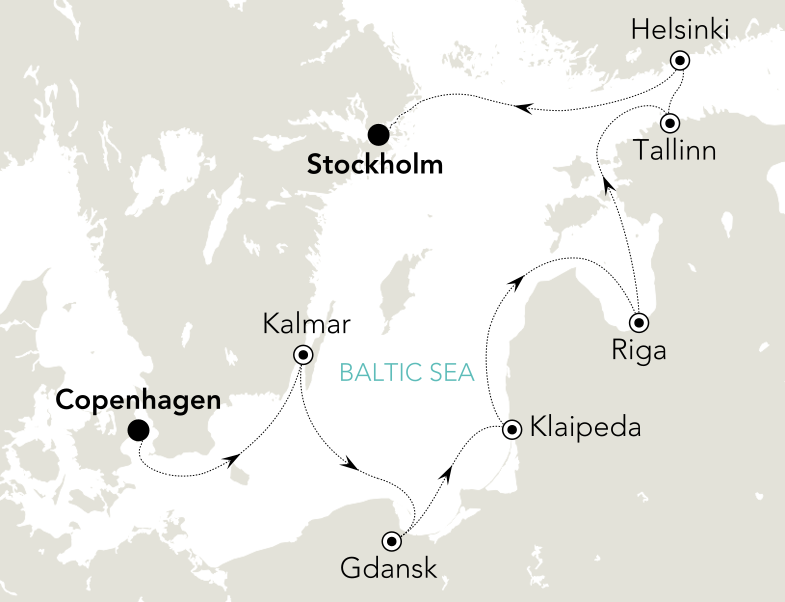
A 7-night ocean voyage aboard Silver Nova, Copenhagen, Denmark to Stockholm, Sweden. Destination: Northern Europe & British Isles.
Operated by Silversea Cruises aboard Silver Nova.
Copenhagen
Kalmar
Gdansk
Klaipeda
Riga
Tallinn
Helsinki
Stockholm
Effortlessly cool and down to earth, Copenhagen is a contemporary, clean and classy highlight of Scandinavia. A city built to be liveable, Copenhagen has refused to compromise, resulting in a forward-thinking metropolis that’s green and clean. Swim in the waters of Havnebadet Islands during summer, or shelter from winter’s bite by snuggling in beside a roaring open fire during winter. You can even hop on a train to Sweden, traversing the famous span of a Nordic Noir star - the Öresund Bridge. It takes just a touch over half an hour to step off the train in Malmö. There’s only one way to truly explore Copenhagen and that’s on two wheels. Easy bike hire schemes will get you moving across this flat city, designed with bikes at the forefront of the mind. Choose a model with electronic assistance to take the strain out of any journey, giving you the freedom to whizz around and explore the modern angular architecture of the centre, and the pastoral colours of Nyhavn waterfront. Head out to the Little Mermaid statue, inspired by Hans Christian Andersen’s fairy tale - the strikingly-restrained statue is the perfect landmark for Copenhagen; unshowy, self-assured and utterly irresistible. The Danish concept of hygge is very much alive here, and you’ll feel that warm cosy feeling as you visit cafes illuminated by the warm glow of hanging filament bulbs, and stuffed to the brim with thick, dusty books. Home to mega-brewer Carlsberg, Copenhagen is also a city for hop enthusiasts, and there is a thriving craft brewing scene to sample. Danish Smørrebrød sandwiches are a must try, or for something a little more substantial, settle in for a culinary voyage and try a taster menu – the city’s restaurants are littered with Michelin stars.
Southern Sweden is considered, even by many Swedes, to be a world of its own. Once a part of Denmark, the region is clearly distinguished from the rest of the country by its geography, culture, and history. Småland, the northernmost of Sweden's southern provinces, is also the largest, but its harsh countryside and poorer, bleaker way of life led thousands to emigrate to the United States in the 19th and 20th centuries. Those who stayed behind developed a reputation for inventiveness. The area has many small glassblowing firms, and it is these glassworks, such as the world-renowned Kosta Boda and Orrefors, that have given the area the nickname the Kingdom of Glass. Kalmar was a rather important outpost from the 13th to the 17th centuries because it was one of the southernmost cities in Sweden. However, in the Treaty of Roskilde, the King of Denmark–Norway was forced to cede what is now southern Sweden, and the town's importance diminished gradually over the years as its fortress no longer defended the country's southern border. Now the Öland Bridge makes it the gateway to that island. Better known for its heavy industry and university, Kalmar still has several good examples of classical Swedish architecture, and its magnificent Renaissance-style castle. Sights Kalmar Slott The attractive coastal town of Kalmar, opposite the Baltic island of Öland, is dominated by the imposing Kalmar Slott. Built in the 12th century, it was rebuilt in the 16th century by the Vasa kings. It remains the best preserved Renaissance castle in Northern Europe today. The living quarters, chapel, and dungeon can be visited—it's definitely worth a stop on your way in or out of Öland. Kalmar Domkyrkan This is highly impressive building was designed by Nicodemus Tessin the Elder in 1660 in the Italian baroque style. Inside, the massive open spaces create stunning light effects. There are noon concerts on weekdays. Kalmar Läns Museum In addition to good archaeological and ethnographic collections, this museum contains the remains of the royal ship Kronan, which sank in 1676. Cannons, wood sculptures, and old coins were all raised from the seabed in 1980. Another exhibit focuses on Jenny Nyström, famous for her paintings of gnomes.
Gdansk, one of Poland’s oldest and most beautiful cities, sits on the edge of the Baltic Sea. Looking around today, it’s difficult to imagine that during World War II, much of the city was reduced to rubble. Painstakingly reconstructed with great skill, the Hanseatic architecture and historical treasures rose like a phoenix from the ruins. Head to the city centre and walk in the footsteps of Polish royalty down the Royal Route, which leads to many of Gdansk’s best-preserved treasures. Passing through majestic stone gates is the wonderful Amber Museum. Learn all you need to know about amber or Baltic gold as it’s known. It’s been collected and worked for over 6000 years in Gdansk, a major contributor to the city’s wealth. Through the Golden Gate lies Dluga street, peek behind the exquisite facades and visit some of the beautifully restored town houses. Stroll on past landmark buildings like the soaring Town Hall, ending up on the very photogenic Mariacka street. Along the waterfront is the striking, modern architecture of the World War II Museum, a poignant space, in the very city where the first shots of the war were fired. The excellent exhibitions leave few unmoved and has rapidly become one of Gdansk’s top attractions. More recent history is explained wonderfully at the European Solidarity Centre down by the shipyards. The trade union “Solidarity” was formed in the 1980’s and Poland’s’ struggle to topple Communism began. Gdansk has certainly earnt its place in the history books of Europe.
When thinking of countries of legends, tumult and fabulous architecture, Lithuania does not immediately spring to mind. And yet, it should – particularly Klaipeda, Lithuania’s third largest city (and only seaport). As one of the few eastern ports to not freeze during the cold Baltic Sea winters, Klaipeda has always been a coveted spot. Once known as Memel, the city has had a chequered past. Founded in 1252 by the Teutonic Order, Memel was the capital of Prussia during the Napoleonic wars. It was a German state until 1919, when the signing of the Treaty of Versailles commandeered it for Lithuania. It then surrendered to German hands before and during WWII, but was liberated along with the rest of the country in 1945. As you walk around the pretty town centre, you would be forgiven for thinking that you were not even in Lithuania. The Germanic influence is most apparent in the well-ordered centre, with its fachwerk, (half-timbered) style buildings and cobbled streets. Much of the original architecture was destroyed during WWII, but head for the Art Yard and you’ll not only find examples of what is left from Memel’s past, but also a buzzing hub of street art, coffee shops and independent boutiques. Much of the city’s tourism is focused around neighbouring Spit National Park. This UNESCO World Heritage site of 5,000-year-old peninsula of woods and beach separates the Baltic Sea from the Curonian Lagoon and is a prime example of outstanding universal value to the region.
Centred around a charming UNESCO World Heritage Site listed Old Town Latvia’s capital is a quirky and artistic place - with an extensive collection of gleaming art-deco architecture. With a quirky underbelly and beautifully preserved fairytale architecture it’s no wonder Riga is affectionately known as the Baltic Berlin. Ascend the tower of St. Peter's Church for a view down over the gingerbread-architecture below. The House of Blackheads is one of the city’s standouts a historic trade guild’s meeting place it adds grace and grandeur to the spacious town square. The much-photographed Three Brothers lean together with their pastel-shaded facades and idiosyncratic personalities. Look out across the River Daugava for an example of modern Riga - the steel and glass of the National Library building. The Freedom Monument stands a full 42 meters tall and is a proud statue marking Lativa’s incredibly hard-won independence. Cavernous hangers – that once housed bomber zeppelins from the First World War – now host one of Europe’s biggest and best food markets. Soak up the smells and sights of Riga Central Market where you can taste pickles smoked herring and piragis – local rolls stuffed with bacon. Take time out in brightly painted cafes and flower-laced courtyards which serve up refreshments and dizzyingly strong self-brewed craft beers. Or head to the greenery of Bastejkalna Park to stroll the banks of the canal and over ornate bridges.
A fairytale city of new and old, Tallinn boasts one of the best-preserved UNESCO listed old towns in Northern Europe, and balances the traditional and contemporary astutely. A beautiful Baltic capital of storied culture and history, Tallinn is riding the wave of a burgeoning reputation as Europe's hidden gem, and it boasts a picturesque allure that few cities can rival. Having endured countless occupations in its history, Estonia finally gained independence from the Soviet Union in 1991 and has been hell-bent on progressive, forward-thinking policies ever since. The European City of Culture award in 2011 was a symbol of the country's increasing integration with the European Union, and offered Tallinn a chance to showcase and upgrade its cultural marvels. Walk into the old town through Viru Gates, past flower vendors and the smells of roasting nuts. Town Hall Square is the heart and soul of Tallinn, and when you walk the narrow cobbled streets that open out into it, you’re walking the same pathways that Tallinn's people have walked since the 13th century. Surrounded by practically complete medieval walls, lose yourself in deep museums, and visit pretty churches like St. Olaf church - one of the city's most famous, with its sharp green spire puncturing the sky. Head to Kohtuotsa platform in the upper town for views of the city's sea of red roofs, interrupted by church towers and rounded turrets. From here, climb Toompea Castle's central hill, before visiting the Alexander Nevsky Cathedral - easily recognisable by its bold colours and trio of black onion domes.
"A thriving, flawlessly-designed seaside city, Helsinki is famously livable and inspiring. A regional powerhouse of outstanding design and creativity, Helsinki lies across a confetti scattering of 300 islands and skerries in the Gulf of Finland. Known for the light granite hue of its buildings - which lend the city a bright, whitewashed appearance - traditional buildings mingle seamlessly with bold new structures, showcasing Finland's celebrated design outlook. Helsinki Cathedral is the crowning glory - rising high over the city's waterfront with its pearly white domes gleaming. A city that reveres knowledge and creativity above all else, artworks and statues litter the streets and parks, honouring creative minds of the past. Open parks offer space to lie back and soak up summer's sun, while sculptures like the abstract organs of the Sibelius Monument celebrate national heroes like composer Jean Sibelius - whose music gave Finland national identity in the quest for independence. Feel the stunning acoustics of the incredible Rock Church deep in your gut, as you witness a performance in this collaboration between man and nature. Built into the rock underground, the amphitheatre's soaring copper bowl roof is suspended dramatically on a bed of glass windows. One of Helsinki's many incredible buildings, the Design Museum offers a comprehensive insight into the city's balance of style, function and form. Helsinki's easy-going, forward-thinking way of life was hard fought for, and the spectacular Suomenlinna fortress rears out of the waves as a reminder of the historical struggles that have played out in this stretch of sea. The chain of forts covers six islands and was built to defend the archipelago when it fell under Swedish rule. Sail out to the quaint little beaches, and waterfront pathways that now lend a calm, peaceful ambience to this UNESCO World Heritage Site."
Emerald spires puncture the sky across Sweden’s alluring capital, a leafy place of history, culture and waterfront perfection. Innovative and inventive, Stockholm is a city looking to the future, but with a firm grip of its envied past. Stylish Stockholm has enough to occupy you for a lifetime, from cathedral-like food markets to simmering baths and natural escapes. Visit the staggeringly beautiful interior of Stockholm's City Hall, or learn more about one of Sweden’s best-known exports – with a visit to the ABBA museum. The history is deep, and the architecture typically stylish, as you explore this capital of Scandi cool. The Gamla Stan old town is a storied historic core of cobbled streets and brightly hued, towering townhouses standing side by side. Attractive squares fill with the smells of fried herring from traditional restaurants, while the latest culinary trends sweep through the city's revered kitchens. Breathe in the crisp, clean air and relish the tranquillity and atmosphere of a truly great and grand Baltic city. Stockholm's visitors and residents spill outdoors in the summertime, to the city's beaches, and the archipelago's scattering of 24,000 islands and islets nearby. Steamboats puff scenic routes between them. Stockholm itself sprawls across 14 islands, interlinked with dozens of arching bridges. Shimmering canals and leafy green parks offer peace and sanctuary within the city, while trendy bars, coffee shops and rooftop cocktail joints add to the hip and happening appeal. Stockholm's bustling shopping streets also showcase cutting edge trends for the fashion-conscious.
From $9,700
per guest · 7 nights
Prices are a guide and vary with season, cabin category and party size. Your advisor will confirm the exact cost before anything is booked.
Classic Veranda
suite
Deluxe Veranda
suite
Grand 1 Bedroom
suite
Junior Grand 1 Bedroom
suite
Junior Grand 2 Bedroom
suite
Master
suite
Medallion
suite
Otium
suite
Owner 1 Bedroom
suite
Owner 2 Bedroom
suite
Premium Medallion
suite
Premium Veranda
suite
Signature
suite
Silver
suite
Superior Veranda
suite








