

Prefer a conversation?
Our team is always available to guide you through the process and ensure your experience is perfectly matched to your preferences.
Our team is always available to guide you through the process and ensure your experience is perfectly matched to your preferences.
Duration
13 Nights
Price
From $11,900
Ship
Silver Spirit
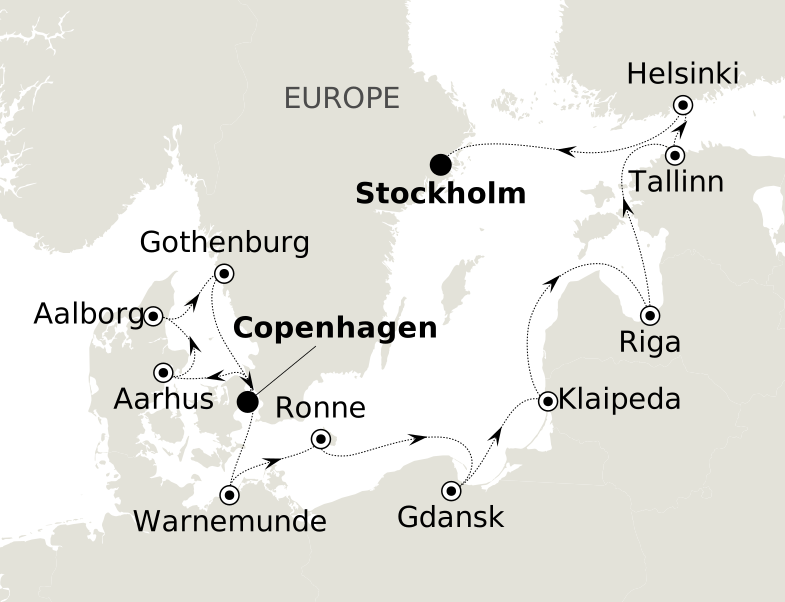
A 13-night ocean voyage aboard Silver Spirit, Copenhagen, Denmark to Stockholm, Sweden. Destination: Northern Europe & British Isles.
Operated by Silversea Cruises aboard Silver Spirit.
Copenhagen
Aarhus
Aalborg
Gothenburg
Warnemunde (Rostock)
Ronne, Bornholm
Gdansk
Klaipeda
Riga
Tallinn
Helsinki
Stockholm
Effortlessly cool and down to earth, Copenhagen is a contemporary, clean and classy highlight of Scandinavia. A city built to be liveable, Copenhagen has refused to compromise, resulting in a forward-thinking metropolis that’s green and clean. Swim in the waters of Havnebadet Islands during summer, or shelter from winter’s bite by snuggling in beside a roaring open fire during winter. You can even hop on a train to Sweden, traversing the famous span of a Nordic Noir star - the Öresund Bridge. It takes just a touch over half an hour to step off the train in Malmö. There’s only one way to truly explore Copenhagen and that’s on two wheels. Easy bike hire schemes will get you moving across this flat city, designed with bikes at the forefront of the mind. Choose a model with electronic assistance to take the strain out of any journey, giving you the freedom to whizz around and explore the modern angular architecture of the centre, and the pastoral colours of Nyhavn waterfront. Head out to the Little Mermaid statue, inspired by Hans Christian Andersen’s fairy tale - the strikingly-restrained statue is the perfect landmark for Copenhagen; unshowy, self-assured and utterly irresistible. The Danish concept of hygge is very much alive here, and you’ll feel that warm cosy feeling as you visit cafes illuminated by the warm glow of hanging filament bulbs, and stuffed to the brim with thick, dusty books. Home to mega-brewer Carlsberg, Copenhagen is also a city for hop enthusiasts, and there is a thriving craft brewing scene to sample. Danish Smørrebrød sandwiches are a must try, or for something a little more substantial, settle in for a culinary voyage and try a taster menu – the city’s restaurants are littered with Michelin stars.
Århus is Denmark's second-largest city, and, with its funky arts and college community, one of the country's most pleasant. Cutting through the center of town is a canal called the Århus Å (Århus Creek). It used to run underground, but was uncovered a few years ago. Since then, an amalgam of bars, cafés, and restaurants has sprouted along its banks. At all hours of the day and night this waterfront strip is abuzz with crowds that hang out on the outdoor terraces and steps that lead down to the creek.
Denmark’s fourth largest city comes with what Danes do best – Viking landscapes modernist architecture superb local food and lots (and lots) of good beer. Starting with number one visitors to Aalborg will need to experience the strange otherworldliness that is Lindolm Hoje. One of Scandinavia’s best preserved Viking burial sites the impressive site was covered over by a sand dune in around 1000 AD thus preserving the stone markings. Archaeologists from the National Museum began a proper excavation of the site in 1889 but it wasn’t until 1958 that the site’s potential was fully realised. Widely considered be the most notable of ancient landmarks in Denmark no visit to Aalborg is complete without a visit here. History lovers will want to continue their tour of this pretty Danish town by not missing out on Voergaard Castle - one of the best preserved renaissance castles in Denmark. The castle houses an extensive and unique collection of European art and furniture including works by Goya Rubens Raphael and El Greco together with treasures from the personal belongings of Napoleon 1 Louis XIV and Marie-Antoinette. If you prefer your landscapes more urban than historical then not to be overlooked is Aalborg’s architecture. Think a Jon Utzon (the man behind the Sydney Opera House) cultural centre one of the best concert halls in Europe and a repurposed power plant and you have culture galore at your fingertips.
Don't tell the residents of Göteborg that they live in Sweden's "second city," but not because they will get upset (people here are known for their amiability and good humor). They just may not understand what you are talking about. People who call Göteborg (pronounced YOO-teh-bor; most visitors stick with the simpler "Gothenburg") home seem to forget that the city is diminutive in size and status compared to Stockholm. Spend a couple of days here and you'll forget, too. You'll find it's easier to ask what Göteborg hasn't got to offer rather than what it has. Culturally it is superb, boasting a fine opera house and theater, one of the country's best art museums, as well as a fantastic applied-arts museum. There's plenty of history to soak up, from the ancient port that gave the city its start to the 19th-century factory buildings and workers' houses that helped put it on the commercial map. For those looking for nature, the wild-west coast and tame green fields are both within striking distance. And don't forget the food. Since its inception in 1983, more than half of the "Swedish Chef of the Year" competition winners were cooking in Göteborg. Göteborg begs to be explored by foot. A small, neat package of a city, it can be divided up into three main areas, all of which are closely interlinked. If your feet need a rest, though, there is an excellent streetcar network that runs to all parts of town. The main artery of Göteborg is Kungsportsavenyn (more commonly referred to as Avenyn, "the Avenue"), a 60-foot-wide tree-lined boulevard that bisects the city along a northwest–southeast axis. Avenyn starts at Göteborg's cultural heart, Götaplatsen, home to the city's oldest cultural institutions, where ornate carved-stone buildings keep watch over the shady boulevards of the Vasastan neighborhood, which are lined with exclusive restaurants and bars. Follow Avenyn north and you'll find the main commercial area, now dominated by the modern Nordstan shopping center. Beyond is the waterfront, busy with all the traffic of the port, as well as some of Göteborg's newer cultural developments, in particular its magnificent opera house. To the west of the city are the Haga and Linné districts. Once home to the city's dockyard, shipping, and factory workers, these areas are now chic and alive with arts-and-crafts galleries, antiques shops, boutiques selling clothes and household goods, and street cafés and restaurants. Dining Göteborg is filled with people who love to eat and cook, so you've come to the right place if you're interested in food. The fish and seafood here are some of the best in the world, owing to the clean, cold waters off Sweden's west coast. And Göteborg's chefs are some of the best in Sweden, as a glance at the list of recent "Swedish Chef of the Year" winners will confirm. Call ahead to be sure restaurants are open, as many are closed in July or in other summer months. Fond Stefan Karlsson's fantastic restaurant has one of the best locations in Göteborg, right on the beautiful Götaplatsen; from the semicircular dining room, diners looks out on the square. Almost-bare wooden tables and primary-color linens make an interesting informal contrast to the haute cuisine that emerges from the kitchen. All the herbs and vegetables are grown by a farmer just 5 km (3 mi) from town. Karlsson loves to travel; the flavors he has picked up as a globe-trotter spice up his modern Swedish menu. Pinchos The thoroughly modern Pinchos takes into account the country's love for mobile technology by allowing diners to place orders for tapas like fried calamari, bruschetta, and spicy chorizo using an app on their mobile phones. (You can also order the old-fashioned way, of course.) The bite-size plates include Japanese sushi, Lebanese mezes, Italian antipasti, Chinese dim sum, and a variety of Scandinavian plates. Shopping Ströms In the same street-corner location for at least two generations, Ströms sells clothing of high quality and good taste. Saluhallen There are several large food markets in the city area, but the most impressive is Saluhallen. Built in 1889, the barrel-roofed, wrought-iron, glass, and brick building stands like a monument to industrial architecture. Everything is available at this food hall, from fish, meat, and bakery products to deli foods, herbs and spices, coffee, cheese, and even just people-watching. Kronhusbodarna If you are looking to buy Swedish arts and crafts and glassware, visit the various shops in Kronhusbodarna. They have been selling traditional, handcrafted quality goods, including silver and gold jewelry, watches, and handblown glass, since the 18th century. Hotels Some hotels close during the winter holidays; call ahead if you expect to travel during that time. All rooms in the hotels reviewed are equipped with shower or bath unless otherwise noted. Göteborg also has some fine camping sites if you want an alternative to staying in a hotel. Sights Maritiman In the world's largest floating maritime museum you'll find modern naval vessels, including a destroyer; submarines; a lightship; cargo vessels, and various tugboats, providing insight into Göteborg's historic role as a major port. The main attraction is a huge naval destroyer, complete with a medical room in which a leg amputation operation is graphically re-created, with mannequins standing in for medical personnel. Haga Nygatan The redbrick buildings that line this street were originally poorhouses donated by the Dickson family, the city's British industrialist forefather; "ROBERT DICKSON" can still be seen carved into the facades of many of them. Like most buildings in Haga, the buildings' ground floors were made of stone in order to prevent the spread of fire (the upper floors are wood). The Dickson family's impact on the architecture of the west of Sweden can also be seen in the impressive, fanciful mansion that belonged to Robert's grandson James, in Tjolöholm, to the south of Göteborg. Konstmuseet This impressive collection of the works of leading Scandinavian painters and sculptors captures some of the moody introspection of the artistic community in this part of the world. The museum's Hasselblad Center devotes itself to showing the progress in the art of photography. The Konstmuseet's holdings include works by Swedes such as Carl Milles, Johan Tobias Sergel, impressionist Anders Zorn, Victorian idealist Carl Larsson, and Prince Eugen. The 19th- and 20th-century French art collection is the best in Sweden, and there's also a small collection of old masters. Hagabadet This stunning bathhouse was built at the end of the 19th century by the Swedish philanthropist Sven Renström. Originally used by local dock- and factory workers, it's now often filled with Göteborg's leisure-hungry elite. The pretty pool is art nouveau, with wall paintings, an arched ceiling, and lamps with a diving-lady motif. The Roman baths and the massage and spa area all exude relaxation, but the architecture alone is worth a visit, even if you don't intend to take the plunge. Götaplatsen This square was built in 1923 in celebration of the city's 300th anniversary. In the center is the Swedish-American sculptor Carl Milles's breathtaking fountain statue of Poseidon choking a codfish. Behind the statue stands the Konstmuseet, flanked by the Konserthuset (Concert Hall) and the Stadsteatern (Municipal Theater), contemporary buildings in which the city celebrates its contributions to Swedish cultural life. Göteborgs Operan A statement in steel and glass, the opera house opened in 1994, immediately dominating this section of the waterfront with its bold lines and shape. Set against a backdrop of the old docks, it makes for a striking image. The productions here are world-class and well worth seeing if you get the chance. Röhsska Museet This museum's fine collections include furniture, books and manuscripts, tapestries, and pottery. Artifacts date back as far as 1,000 years, but it's the 20th-century gallery, with its collection of many familiar household objects, that seems to provide the most enjoyment. Trädgårdsföreningens Park Beautiful open green spaces, manicured gardens, and tree-lined paths are the perfect place to escape for some peace and rest. Rose fanciers can head for the magnificent rose garden, where there are 5,000 roses of 2,500 varieties. Also worth a visit is the Palm House, whose late-19th-century design echoes that of London's Crystal Palace. Liseberg Amusement Park The more than thirty attractions here—carousels, rides, rollercoasters, funhouses, and the like—pull in roughly three million visitors each year. The park is especially mobbed around the holidays, when it throws the largest Christmas market in Sweden, with five million twinkling lights on display along with an ice rink, Santa's World, and stalls selling crafts, mulled wine, gingersnaps, and other seasonal goods.
Days at sea are the perfect opportunity to relax unwind and catch up with what you’ve been meaning to do. So whether that is going to the gym, visiting the spa, whale watching, catching up on your reading or simply topping up your tan these blue sea days are the perfect balance to busy days spent exploring shore side.
Warnemünde is a quaint seaside resort town with the best hotels and restaurants in the area, as well as 20 km (12 miles) of beautiful white-sand beach. It's been a popular summer getaway for families in eastern Germany for years. Warnemünde is also a major cruise ship terminal. Whenever there is more than one ship at dock, the town explodes with a county fair–like atmosphere, where shops and restaurants stay open until the ships leave at midnight. The city celebrates the dreifache Anlauf, when three ships dock simultaneously, with fireworks. Nightlife The pubs in the marina Alter Strom are fun gathering places. Dining Fischerklause Sailors have stopped in at this restaurant's bar since the turn of the 20th century. The smoked fish sampler, served on a lazy Susan, is delicious, and the house specialty of fish soup is best washed down with some Rostocker Doppel-Kümmel schnapps. An accordionist entertains the crowd on weekends. Nightlife Skybar The Skybar is open Friday and Saturday until 3 am. Roof access gives you the chance to sit under the stars and watch ship lights twinkle on the sea. Sights Leuchtturm Children enjoy climbing to the top of the town landmark, a 115-foot-high lighthouse, dating from 1898; on clear days it offers views of the coast and Rostock Harbor. Alter Strom Inland from the lighthouse is this yacht marina. Once the entry into the port of Warnemünde, it now has bars, pleanty of good restaurants, and touristy shops. The fishing boats lining the Strom sell the day's catch, smoked fish, and bags of fried mussels. Ribnitz-Damgarten Ribnitz-Damgarten, 30 km (19 miles) northeast of Warnemünde, is the center of the amber (in German, Bernstein) business, unique to the Baltic Coast. Amber is a yellow-brown fossil formed from the sap of ancient conifers and is millions of years old. Head for a beach and join the locals in the perennial quest for amber stones washed up among the seaweed. Deutsches Bernsteinmuseum In the Deutsches Bernsteinmuseum, which adjoins the main factory, you can see a fascinating exhibit of how this precious "Baltic gold" is collected from the sea and refined to make jewelry. The museum has pieces of amber that are between 35 and 50 million years old.
Tour description Although much nearer to Sweden, the island of Bornholm has been a Danish possession since 1522 and was once an important Baltic trading port. Today, the islanders make their livelihood from fishing, farming and, increasingly, tourism. Visitors from Scandinavia and Germany flock to Bornholm and the town of Rønne each summer to enjoy the scenic beauty. The south features a coastline of white sand beaches, while the north boasts rugged cliffs; the wooded interior is crisscrossed by hiking trails. Visitors and residents alike have come to appreciate the freshly smoked herring prepared in special smokehouses - a great source of income to boost the local economy. This intriguing, unusual island is especially known for its round churches, which were constructed centuries ago as fortifications against attacks by pagan invaders and pirates. At the northern tip of the island, on one of Bornholm's steep seaside cliffs are the remains of the 13th-century Hammershus Castle, boasting fine views over the coast. The island's main town is Rønne. With 15,000 inhabitants, it is a busy place where ferries arrive daily from Copenhagen. Many of Bornholm's attractions are scattered throughout the island. Rønne is an ideal starting point for exploring the lovely countryside dotted with idyllic farms, ancient churches and rustic herring smokehouses. The island is only about 18 miles (29 km) across, making it easy to get around. In nice weather, biking may be the most enjoyable way to explore charming Bornholm. In recent years, the island has also become known for the Bornholm Golf Open, one of Europe's largest golf tournaments. It is held each August in the beautiful setting of the island's three varied golf courses. Pier Information The ship will either dock or tender to Rønne's Cruise Pier. The centre of town is a 20-minute walk or 5-minute taxi ride from the port. Taxis have to be pre-ordered for pickup pier side. Shopping Shop for local handicrafts, especially ceramics and glassware produced in local glass-blowing factories. The main shopping area is along St. Torvegade. The daily shopping hours are 9:00am - 5:00pm. On Saturdays, most shops are open only from 9:00 a.m. to 12:00 p.m. The local currency is the Danish kroner. Cuisine Smoked herring and beer are a popular snack, especially at one of the typical smokehouses. Restaurants frequently feature fresh fish and seafood on their menus. Baltic salmon is widely regarded as one of the best in the world. Quaint cafés serve delicious pastry and coffee. Other Sites Rønne's Old Town Take a stroll along the cobbled streets and admire the half-timbered houses. Store Torv Visit Rønne's Main Square, formerly the drill ground for Bornholm's militia. A busy commercial centre for the entire island, it is the location of the old town hall and the courthouse. St. Nicolai Church Most of this distinctive landmark dates from the early 1900s; older remains still show well-preserved ancient Roman masonry. Outside of Rønne Hammershus, once the largest ancient fortress in northern Europe, stands 240 feet (74 metres) above the sea. From the remaining walls, one has splendid views of the area. Allinge This small centre is well known for its handicraft workshops, featuring the island's pretty glass and ceramic wares. Private arrangements for independent sightseeing may be requested through the Shore Concierge Office on board. They are available in very limited supply and tend to be expensive.
Gdansk, one of Poland’s oldest and most beautiful cities, sits on the edge of the Baltic Sea. Looking around today, it’s difficult to imagine that during World War II, much of the city was reduced to rubble. Painstakingly reconstructed with great skill, the Hanseatic architecture and historical treasures rose like a phoenix from the ruins. Head to the city centre and walk in the footsteps of Polish royalty down the Royal Route, which leads to many of Gdansk’s best-preserved treasures. Passing through majestic stone gates is the wonderful Amber Museum. Learn all you need to know about amber or Baltic gold as it’s known. It’s been collected and worked for over 6000 years in Gdansk, a major contributor to the city’s wealth. Through the Golden Gate lies Dluga street, peek behind the exquisite facades and visit some of the beautifully restored town houses. Stroll on past landmark buildings like the soaring Town Hall, ending up on the very photogenic Mariacka street. Along the waterfront is the striking, modern architecture of the World War II Museum, a poignant space, in the very city where the first shots of the war were fired. The excellent exhibitions leave few unmoved and has rapidly become one of Gdansk’s top attractions. More recent history is explained wonderfully at the European Solidarity Centre down by the shipyards. The trade union “Solidarity” was formed in the 1980’s and Poland’s’ struggle to topple Communism began. Gdansk has certainly earnt its place in the history books of Europe.
When thinking of countries of legends, tumult and fabulous architecture, Lithuania does not immediately spring to mind. And yet, it should – particularly Klaipeda, Lithuania’s third largest city (and only seaport). As one of the few eastern ports to not freeze during the cold Baltic Sea winters, Klaipeda has always been a coveted spot. Once known as Memel, the city has had a chequered past. Founded in 1252 by the Teutonic Order, Memel was the capital of Prussia during the Napoleonic wars. It was a German state until 1919, when the signing of the Treaty of Versailles commandeered it for Lithuania. It then surrendered to German hands before and during WWII, but was liberated along with the rest of the country in 1945. As you walk around the pretty town centre, you would be forgiven for thinking that you were not even in Lithuania. The Germanic influence is most apparent in the well-ordered centre, with its fachwerk, (half-timbered) style buildings and cobbled streets. Much of the original architecture was destroyed during WWII, but head for the Art Yard and you’ll not only find examples of what is left from Memel’s past, but also a buzzing hub of street art, coffee shops and independent boutiques. Much of the city’s tourism is focused around neighbouring Spit National Park. This UNESCO World Heritage site of 5,000-year-old peninsula of woods and beach separates the Baltic Sea from the Curonian Lagoon and is a prime example of outstanding universal value to the region.
Centred around a charming UNESCO World Heritage Site listed Old Town Latvia’s capital is a quirky and artistic place - with an extensive collection of gleaming art-deco architecture. With a quirky underbelly and beautifully preserved fairytale architecture it’s no wonder Riga is affectionately known as the Baltic Berlin. Ascend the tower of St. Peter's Church for a view down over the gingerbread-architecture below. The House of Blackheads is one of the city’s standouts a historic trade guild’s meeting place it adds grace and grandeur to the spacious town square. The much-photographed Three Brothers lean together with their pastel-shaded facades and idiosyncratic personalities. Look out across the River Daugava for an example of modern Riga - the steel and glass of the National Library building. The Freedom Monument stands a full 42 meters tall and is a proud statue marking Lativa’s incredibly hard-won independence. Cavernous hangers – that once housed bomber zeppelins from the First World War – now host one of Europe’s biggest and best food markets. Soak up the smells and sights of Riga Central Market where you can taste pickles smoked herring and piragis – local rolls stuffed with bacon. Take time out in brightly painted cafes and flower-laced courtyards which serve up refreshments and dizzyingly strong self-brewed craft beers. Or head to the greenery of Bastejkalna Park to stroll the banks of the canal and over ornate bridges.
Days at sea are the perfect opportunity to relax unwind and catch up with what you’ve been meaning to do. So whether that is going to the gym, visiting the spa, whale watching, catching up on your reading or simply topping up your tan these blue sea days are the perfect balance to busy days spent exploring shore side.
A fairytale city of new and old, Tallinn boasts one of the best-preserved UNESCO listed old towns in Northern Europe, and balances the traditional and contemporary astutely. A beautiful Baltic capital of storied culture and history, Tallinn is riding the wave of a burgeoning reputation as Europe's hidden gem, and it boasts a picturesque allure that few cities can rival. Having endured countless occupations in its history, Estonia finally gained independence from the Soviet Union in 1991 and has been hell-bent on progressive, forward-thinking policies ever since. The European City of Culture award in 2011 was a symbol of the country's increasing integration with the European Union, and offered Tallinn a chance to showcase and upgrade its cultural marvels. Walk into the old town through Viru Gates, past flower vendors and the smells of roasting nuts. Town Hall Square is the heart and soul of Tallinn, and when you walk the narrow cobbled streets that open out into it, you’re walking the same pathways that Tallinn's people have walked since the 13th century. Surrounded by practically complete medieval walls, lose yourself in deep museums, and visit pretty churches like St. Olaf church - one of the city's most famous, with its sharp green spire puncturing the sky. Head to Kohtuotsa platform in the upper town for views of the city's sea of red roofs, interrupted by church towers and rounded turrets. From here, climb Toompea Castle's central hill, before visiting the Alexander Nevsky Cathedral - easily recognisable by its bold colours and trio of black onion domes.
"A thriving, flawlessly-designed seaside city, Helsinki is famously livable and inspiring. A regional powerhouse of outstanding design and creativity, Helsinki lies across a confetti scattering of 300 islands and skerries in the Gulf of Finland. Known for the light granite hue of its buildings - which lend the city a bright, whitewashed appearance - traditional buildings mingle seamlessly with bold new structures, showcasing Finland's celebrated design outlook. Helsinki Cathedral is the crowning glory - rising high over the city's waterfront with its pearly white domes gleaming. A city that reveres knowledge and creativity above all else, artworks and statues litter the streets and parks, honouring creative minds of the past. Open parks offer space to lie back and soak up summer's sun, while sculptures like the abstract organs of the Sibelius Monument celebrate national heroes like composer Jean Sibelius - whose music gave Finland national identity in the quest for independence. Feel the stunning acoustics of the incredible Rock Church deep in your gut, as you witness a performance in this collaboration between man and nature. Built into the rock underground, the amphitheatre's soaring copper bowl roof is suspended dramatically on a bed of glass windows. One of Helsinki's many incredible buildings, the Design Museum offers a comprehensive insight into the city's balance of style, function and form. Helsinki's easy-going, forward-thinking way of life was hard fought for, and the spectacular Suomenlinna fortress rears out of the waves as a reminder of the historical struggles that have played out in this stretch of sea. The chain of forts covers six islands and was built to defend the archipelago when it fell under Swedish rule. Sail out to the quaint little beaches, and waterfront pathways that now lend a calm, peaceful ambience to this UNESCO World Heritage Site."
Emerald spires puncture the sky across Sweden’s alluring capital, a leafy place of history, culture and waterfront perfection. Innovative and inventive, Stockholm is a city looking to the future, but with a firm grip of its envied past. Stylish Stockholm has enough to occupy you for a lifetime, from cathedral-like food markets to simmering baths and natural escapes. Visit the staggeringly beautiful interior of Stockholm's City Hall, or learn more about one of Sweden’s best-known exports – with a visit to the ABBA museum. The history is deep, and the architecture typically stylish, as you explore this capital of Scandi cool. The Gamla Stan old town is a storied historic core of cobbled streets and brightly hued, towering townhouses standing side by side. Attractive squares fill with the smells of fried herring from traditional restaurants, while the latest culinary trends sweep through the city's revered kitchens. Breathe in the crisp, clean air and relish the tranquillity and atmosphere of a truly great and grand Baltic city. Stockholm's visitors and residents spill outdoors in the summertime, to the city's beaches, and the archipelago's scattering of 24,000 islands and islets nearby. Steamboats puff scenic routes between them. Stockholm itself sprawls across 14 islands, interlinked with dozens of arching bridges. Shimmering canals and leafy green parks offer peace and sanctuary within the city, while trendy bars, coffee shops and rooftop cocktail joints add to the hip and happening appeal. Stockholm's bustling shopping streets also showcase cutting edge trends for the fashion-conscious.
From $11,900
per guest · 13 nights
Prices are a guide and vary with season, cabin category and party size. Your advisor will confirm the exact cost before anything is booked.
Classic Veranda
suite
Deluxe Veranda
suite
Grand 1 Bedroom
suite
Grand 2 Bedroom
suite
Medallion
suite
Owner 1 Bedroom
suite
Owner 2 Bedroom
suite
Panorama
suite
Royal 1 Bedroom
suite
Royal 2 Bedroom
suite
Silver
suite
Silver 2 Bedroom
suite
Superior Veranda
suite
Vista
suite