




Prefer a conversation?
Our team is always available to guide you through the process and ensure your experience is perfectly matched to your preferences.
Our team is always available to guide you through the process and ensure your experience is perfectly matched to your preferences.
Duration
12 Nights
Price
From $12,300
Ship
Silver Dawn
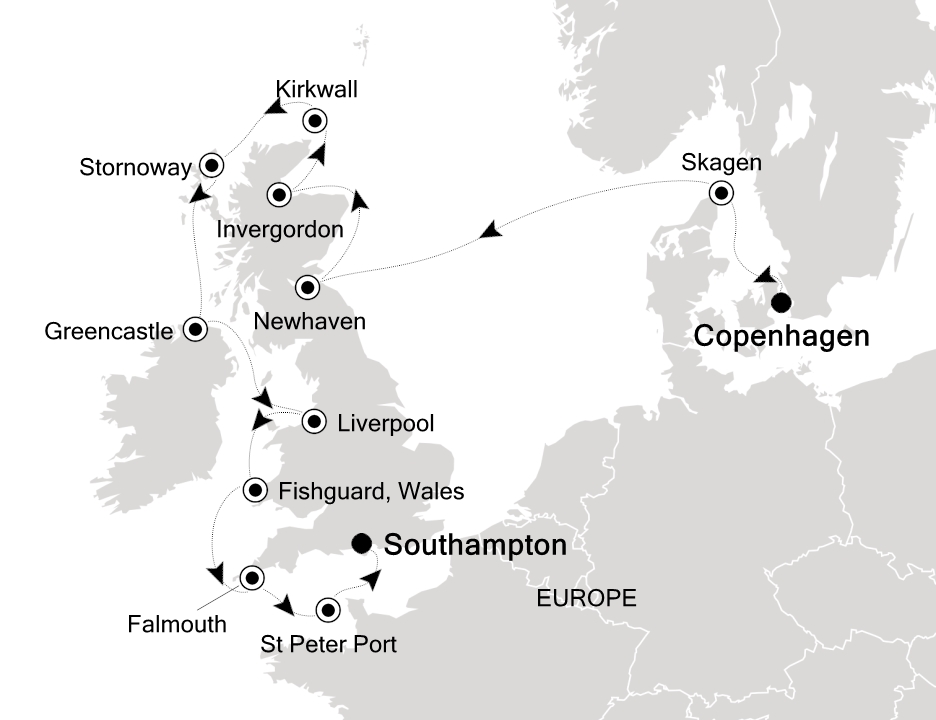
A 12-night ocean voyage aboard Silver Dawn, Copenhagen, Denmark to Southampton, United Kingdom. Destination: Northern Europe & British Isles.
Operated by Silversea Cruises aboard Silver Dawn.
Copenhagen
Skagen
Newhaven (Edinburgh), Scotland
Aberdeen
Invergordon (Highland)
Stornoway (Isle of Lewis)
Greencastle (Londonderry)
Greenock (Glasgow), Scotland
Liverpool
Fishguard, Wales
Falmouth, England
Southampton
Effortlessly cool and down to earth, Copenhagen is a contemporary, clean and classy highlight of Scandinavia. A city built to be liveable, Copenhagen has refused to compromise, resulting in a forward-thinking metropolis that’s green and clean. Swim in the waters of Havnebadet Islands during summer, or shelter from winter’s bite by snuggling in beside a roaring open fire during winter. You can even hop on a train to Sweden, traversing the famous span of a Nordic Noir star - the Öresund Bridge. It takes just a touch over half an hour to step off the train in Malmö. There’s only one way to truly explore Copenhagen and that’s on two wheels. Easy bike hire schemes will get you moving across this flat city, designed with bikes at the forefront of the mind. Choose a model with electronic assistance to take the strain out of any journey, giving you the freedom to whizz around and explore the modern angular architecture of the centre, and the pastoral colours of Nyhavn waterfront. Head out to the Little Mermaid statue, inspired by Hans Christian Andersen’s fairy tale - the strikingly-restrained statue is the perfect landmark for Copenhagen; unshowy, self-assured and utterly irresistible. The Danish concept of hygge is very much alive here, and you’ll feel that warm cosy feeling as you visit cafes illuminated by the warm glow of hanging filament bulbs, and stuffed to the brim with thick, dusty books. Home to mega-brewer Carlsberg, Copenhagen is also a city for hop enthusiasts, and there is a thriving craft brewing scene to sample. Danish Smørrebrød sandwiches are a must try, or for something a little more substantial, settle in for a culinary voyage and try a taster menu – the city’s restaurants are littered with Michelin stars.
For many, Denmark’s charm might begin and end with Copenhagen. Certainly, the country’s capital is a smorgasbord of culture, canals, gastronomy and design, but one would be foolish to end your Danish discovery there. The country is widely reputed to be the happiest place on earth and Skagen (pronounced skane) is testament to that. Located on the very tip of the Jutland peninsula, where the North Sea meets the Baltic Sea, Skagen is a happy jumble of Scandinavian charm, fabulous arts scene and breathtaking nature, and has the Danish royal seal of approval to prove it! A long time favourite of fashionable Danish holidaymakers, Skagen boats one of the most beautiful coastlines in Europe. White sand beaches espouse vast forests and the whole is something really rather lovely. The sunsets are so spectacular it is not uncommon for whole families to make the trip to the beach and actually applaud as the sun finally dips below the horizon. The town is also home to the Rabjerg Mile, the largest migrating dune in Denmark, which covers 2mk2 and stretches up to 35 metres in height. Unsurprisingly for a place that is on the meeting point of two seas, fishing plays an important part in local economy. Marinated herring is of course a speciality but the nutrient rich surroundings mean that fish of all kind is flavoursome and plentiful. This is usually washed down with a craft beer, so why not make like a local and head for the port, stake a claim at a table and enjoy the very best little Skagen has to offer.
Days at sea are the perfect opportunity to relax unwind and catch up with what you’ve been meaning to do. So whether that is going to the gym, visiting the spa, whale watching, catching up on your reading or simply topping up your tan these blue sea days are the perfect balance to busy days spent exploring shore side.
Edinburgh is to London as poetry is to prose, as Charlotte Brontë once wrote. One of the world's stateliest cities and proudest capitals, it's built—like Rome—on seven hills, making it a striking backdrop for the ancient pageant of history. In a skyline of sheer drama, Edinburgh Castle watches over the capital city, frowning down on Princes Street’s glamour and glitz. But despite its rich past, the city’s famous festivals, excellent museums and galleries, as well as the modern Scottish Parliament, are reminders that Edinburgh has its feet firmly in the 21st century.Nearly everywhere in Edinburgh (the burgh is always pronounced burra in Scotland) there are spectacular buildings, whose Doric, Ionic, and Corinthian pillars add touches of neoclassical grandeur to the largely Presbyterian backdrop. Large gardens are a strong feature of central Edinburgh, where the city council is one of the most stridently conservationist in Europe. Arthur's Seat, a mountain of bright green and yellow furze, rears up behind the spires of the Old Town. This child-size mountain jutting 822 feet above its surroundings has steep slopes and little crags, like a miniature Highlands set down in the middle of the busy city. Appropriately, these theatrical elements match Edinburgh's character—after all, the city has been a stage that has seen its fair share of romance, violence, tragedy, and triumph.Modern Edinburgh has become a cultural capital, staging the Edinburgh International Festival and the Fringe Festival in every possible venue each August. The stunning Museum of Scotland complements the city’s wealth of galleries and artsy hangouts. Add Edinburgh’s growing reputation for food and nightlife and you have one of the world’s most beguiling cities.Today the city is the second most important financial center in the United Kingdom, and the fifth most important in Europe. The city regularly is ranked near the top in quality-of-life surveys. Accordingly, New Town apartments on fashionable streets sell for considerable sums. In some senses the city is showy and materialistic, but Edinburgh still supports learned societies, some of which have their roots in the Scottish Enlightenment. The Royal Society of Edinburgh, for example, established in 1783 "for the advancement of learning and useful knowledge," remains an important forum for interdisciplinary activities.Even as Edinburgh moves through the 21st century, its tall guardian castle remains the focal point of the city and its venerable history. Take time to explore the streets—peopled by the spirits of Mary, Queen of Scots; Sir Walter Scott; and Robert Louis Stevenson—and pay your respects to the world's best-loved terrier, Greyfriars Bobby. In the evenings you can enjoy candlelit restaurants or a folk ceilidh (pronounced kay-lee, a traditional Scottish dance with music), though you should remember that you haven't earned your porridge until you've climbed Arthur's Seat. Should you wander around a corner, say, on George Street, you might see not an endless cityscape, but blue sea and a patchwork of fields. This is the county of Fife, beyond the inlet of the North Sea called the Firth of Forth—a reminder, like the mountains to the northwest that can be glimpsed from Edinburgh's highest points, that the rest of Scotland lies within easy reach.
With close to 220,000 inhabitants, Aberdeen is Scotland's third most populous city. Locally quarried grey granite was used during the mid-18th to mid-20th centuries for many of Aberdeen's buildings, and hence the nicknames it has earned as the Granite City, or the Grey City. Aberdeen granite was also used to build the terraces of the Houses of Parliament and Waterloo Bridge in London. Since the discovery of North Sea oil in the 1970s, Aberdeen has also been called the Oil Capital of Europe or the Energy Capital of Europe. It is no wonder that because of the oil fields in the North Sea, Aberdeen's seaport is very important. The Heliport with its flights to the oil fields is one of the busiest commercial heliports in the world.
Promising epic Highlands scenery and monstrous lochs Invergordon welcomes you to the heart of Scotland's land of castles stories and scenery. Taste the prized Scottish gold in a glass as you swirl and sample the produce of history-rich distilleries or lace up your hiking boots to explore the Great Glen's wild mountains and green and gold blotched moorlands. Sleepy Invergordon provides a charming welcome ashore and you'll immediately enjoy stunning views across the widespread of the Firth. Loch Ness is a massive expanse of still water surrounded by emerald fortress-studded hills. What's lurking beneath has been the subject of intense speculation and captured the world's imagination since 1933. Cruise the loch on a boat trip and keep an eye out for any ripples disturbing the surface - perhaps you will be lucky enough to discover the truth about Nessie's mystery. The River Ness flows on to Inverness the Capital of the Highlands which is overlooked by the sandstone rise of Inverness Castle. The fairytale Cawdor Castle is also within reach set among immaculate gardens and entered via an impressive drawbridge. The castle's links to Shakespeare's Macbeth are often mentioned but in truth they are a little tenuous as this castle was built after King Macbeth's death. Fort George meanwhile is a colossal military institution spread across a huge expanse. Visit to be immersed in the life of a soldier as you wander among the vast battlements amid a sea of redbrick military installations.
Scotland's Outer Hebrides can be rainy, remote and cold – yet their inhabitants rank as the happiest people in the UK. What is their secret? One trip to the lovely port of Stornoway and you’ll soon understand why. Like something on the front of a chocolate box, Stornoway is almost a cliché of everything that is lovely about remotest Scotland: buttercups glowing at the side of single track roads, wisps of bog cotton swaying in the breeze, heather was blooming on the swathes of moorland that cover the interior of the islands, dramatic, romantic landscapes as far as the eye can see … But far from being just beautiful – the mountains, hills, lunar-like rocky plateaus, moorlands, meadows, rugged coastlines and white sandy beaches not to be undermined - Stornoway is full of history, culture and unsurprisingly, more wildlife that you can shake a stick at. Set on the eastern coast of the Isle of Lewis and the Isle of Harris, Stornaway is the capital of the Outer Hebrides, and the jumping off point for all those who want to venture even further north. Although it may sound like two separate islands, Lewis and Harris are actually two parts of the one island, and as such, is full of interesting things to do while you are here. Historians will certainly want to start with the truly magical 5,000 year old Callanish Stones. Scotland’s answer to Stonehenge, these impressive stones are actually part of a cluster of several different archaeological sites in this area. Probably positioned in several stages between 3000 BC and 1500 BC, the grouping consists of an avenue of 19 monoliths extending northward from a circle of 13 stones, with other rows leading south, east, and west. Ruins of a cairn sit within the circle on the east side. Researchers believe they may have been used for astronomical observations, but you can create your own explanations.
A titan of culture and character, with a disarmingly warm welcome, Glasgow is a lively, Scottish city with bucket-loads of personality. Built on a bedrock of hard-work, and deep industrial roots, the city is a fascinating balance of old and new. Architectural treasures like the elegant Glasgow City Chambers of 1888 blend with new, angular shocks like the Riverside Museum and armadillo-shaped Clyde Auditorium - both part of a clutch of exciting new developments along the River Clyde’s banks. Also towering over the river - and perhaps Glasgow’s mightiest symbol - is the Titan - a colossal crane and an almighty reminder of Glasgow’s heritage as a constructor of giant battleships and cruise liners. It is far from a grey industrial city these days, however, and leafy parks, manicured gardens and stacked galleries douse the city with its colour and cultural intrigue. George Square is at the heart of it all, overlooked by Glasgow City Chambers and adorned with memorials, columns and statues honouring influential Scots and Prime Ministers of history. The sounds of shoppers and searing bagpipes rattle along the bustling Buchanan Street, where you can stroll and shop to your heart’s content. Stumble across the West End - Glasgow’s quirkier side - which is brimming with brightly painted cafes and pubs of character and characters, and the perfect spot for a sit-down. Glasgow’s Medieval Cathedral is the city’s oldest building and one of Scotland’s oldest cathedrals, while the university is an immaculate, turreted and vaulted temple of learning. With enormous concert halls, overflowing museums and storied castles, Glasgow is one of the United Kingdom’s most characterful, rewarding cities.
Who can say Liverpool with thinking of the Beatles? Home to the fab four, Penny Lane, Strawberry Fields and the Cavern Club, this northern English city is undoubtedly one of the most important places on the 20th century music scene. Even UNESCO agrees - Liverpool became a City of Music (one of only 19 in the world) in 2015. So understandably, it’s bursting with pride. Not only for its most famous former residents but also its football team, its maritime heritage and its thriving cultural scene (it was Capital of Culture in 2008). A huge regeneration project over the past two decades has seen Liverpool blossom from being a below-par northern English city to a somewhere buzzing with charm. The arrival of the Tate Liverpool paved the way – quickly followed by the restoration of some 2,500 plus listed buildings (that’s more than any English city outside London). The waterfront revitalisation came next with bars, clubs, galleries and independent boutiques, giving Liverpool some of the best dining and shopping there is. Don’t leave here without tasting Scouse – a traditional beef stew – and from where Livepudlians draw their nickname “Scousers”. Culturally speaking, Liverpool is “bang on” as Scousers would say. The three Graces (named after the Greek goddesses of charm, beauty and creativity) line the waterfront, and are responsible in part for Liverpool’s second UNESCO gong as a World Heritage Site. Further afield, the lovely parks and Crosby Beach offer welcome respite from the urban hub.
Perched on a clifftop and stunningly picturesque Fishguard is considered the very heart of North Pembrokeshire. A small market town that almost seems untouched by time you’ll find clusters of quayside cottages family businesses selling local produce and plenty of Gaelic charm! Market day falls on a Saturday and although principally food there are some stalls selling local arts and crafts too. If you are not lucky enough to be visiting on market day the pretty high street has some lovely shops where you can easily while away a couple of hours. Known internationally as the place of the last invasion of Britain when the French landed in 1797 the village heaves with history. Historians will of course already know that the two-day invasion soon failed and the peace treaty was signed in the Royal Oak pub in the market square. The calm waters are perfect for kayaking while walkers will love the national parks that are filled with signposted trails for all levels of ability. Cyclist of all levels will also be pleased Fishguard and its surroundings do have a few hills but also lots of straight roads that offer a gentle visit of the stunning landscape. If all the activity gets too much for you then why not enjoy a delicious local welsh cake in one of the pretty cafes or head to the town hall and have a look at the 100 foot long Last Invasion Tapestry a humorous and entertaining story in a Bayeux tapestry style of the 1797 invasion of mainland Britain.
Falmouth, United Kingdom Cornwall stretches west into the sea, with plenty of magnificent coastline to explore. The predominantly cliff-lined Cornish coast, interspersed with broad expanses of sand, has many tempting places to stop, including Padstow (for a seafood feast), Newquay (a surfing and tourist center), or St. Ives, a delightful artists' colony. From Land's End, the westernmost tip of Britain, you'll discover savage land- and seascapes and panoramic views. The Channel coast is less rugged than the northern coast, with more sheltered beaches. Cornwall has managed to retain a touch of its old insularity, despite the annual invasion of thousands of tourists. It's the birthplace of King Arthur and holds the greatest concentration of Arthurian links. Sights The bustle of this resort town's fishing harbor, yachting center, and commercial port only adds to its charm. In the 18th century Falmouth was the main mail-boat port for North America, and in Flushing, a village across the inlet, you can see the slate-covered houses built by prosperous mail-boat captains. A ferry service now links the two towns. On Custom House Quay, off Arwenack Street, is the King's Pipe, an oven in which seized contraband was burned. National Maritime Museum Cornwall. The granite-and-oak-clad structure by the harbor is an excellent place to come to grips with Cornish maritime heritage, weather lore, and navigational science. You can view the collection of 140 or so boats, examine the tools associated with Cornish boatbuilders, and gaze down from the lighthouselike lookout, which is equipped with maps, telescopes, and binoculars. In the glass-fronted Tidal Zone below sea level, you come face-to-face with the sea itself. Discovery Quay, Falmouth. Admission charged. Pendennis Castle. At the end of its own peninsula stands this formidable castle, built by Henry VIII in the 1540s and improved by his daughter Elizabeth I. You can explore the defenses developed over the centuries. In the Royal Artillery Barracks, the Pendennis Unlocked exhibit explores the castle's history and its connection to Cornwall and England. The castle has sweeping views over the English Channel and across to St. Mawes Castle, designed as a companion fortress to guard the roads. There are also concerts, plays, jousting, and shows for kids. Pendennis Head, Falmouth. Admission charged. Trelissick. Trelissick is known for the colorful Trelissick Garden, owned by the National Trust. King Harry Ferry. A chain-drawn car ferry, the King Harry runs to the scenically splendid Roseland Peninsula each day three times an hour. From its decks you can see up and down the Fal, a deep, narrow river with steep, wooded banks. The river's great depth provides mooring for old ships waiting to be sold; these mammoth shapes lend a surreal touch to the riverscape. B3289, Trelissick. Admission charged. Trelissick Garden. ornwall's mild climate has endowed it with some of the country's most spectacular gardens, among which is this garden on the banks of the Rivre Fal. Famous for its camellias, azaras, and photinias, the terraced garden is set within 375 acres of wooded parkland, offering wonderful panoramic views and making this a paradise for walkers. B3289, Feock. Admission charged. St. Mawes. At the tip of the Roseland Peninsula is the quiet, unspoiled village of St. Mawes, where subtropical plants thrive. The peninsula itself is a lovely backwater with old churches, a lighthouse, and good coast walking. St. Just in Roseland. One of the most beautiful spots in the West Country, this tiny hamlet has a 13th-century church set within a subtropical garden, often abloom with magnolias and rhododendrons, as well as a holy well and a graveyard on the banks of a secluded creek. Roseland. St. Mawes Castle. Outside the village, the well-preserved Tudor-era castle has a cloverleaf shape that makes it seemingly impregnable, yet during the Civil War its Royalist commander surrendered without firing a shot. A3078. Admission charged. Truro. The county seat and Cornwall's only real city, Truro is a good option mostly for food and shopping, and for cathedral and museum buffs. For an overview of the Georgian houses, take a stroll down steep, broad Lemon Street. The elegant 18th-century facades are of pale stone-unusual for Cornwall, where granite predominates. Like Lemon Street, Walsingham Place is a typical Georgian street, a curving, flower-lined pedestrian oasis. Cathedral Church of St. Mary. Although built between 1880 and 1910, this cathedral evokes a medieval church, with an exterior in Early English Gothic style. It's filled with relics from the 16th-century parish church that stood on this site, part of which has been incorporated into a side chapel. An open, cobbled area called High Cross lies in front of the west porch, and the city's main shopping streets fan out from here. 14 St. Mary's St.. Admission charged. Royal Cornwall Museum. This museum displays some fine examples of Cornwall-inspired art, a sampling of Cornish archaeology, an absorbing hodgepodge of local history, and an extensive collection of minerals. There's also a shop and a small café. River St.. Admission charged. Lizard Peninsula. The southernmost point on mainland Britain, this peninsula is a government-designated Area of Outstanding Natural Beauty, named so for the rocky, dramatic coast rather than the flat and boring interior. The huge, eerily rotating dish antennae of the Goonhilly Satellite Communications Earth Station are visible from the road as it crosses Goonhilly Downs, the backbone of the peninsula. There's no coast road, unlike Land's End, but the coastal path offers marvelous opportunities to explore on foot-and is often the only way to reach the best beaches. With no large town (Helston is the biggest, but isn't a tourist center), it's far less busy than the Land's End peninsula. Kynance Cove. A path close to the tip of the peninsula plunges down 200-foot cliffs to this tiny cove dotted with a handful of pint-size islands. The sands here are reachable only during the 2½ hours before and after low tide. The cliffs are made of greenish serpentine rock, interspersed with granite; souvenirs are carved out of the stone. St. Ives. James McNeill Whistler came here to paint his landscapes, Barbara Hepworth to fashion her modernist sculptures, and Virginia Woolf to write her novels. Today sand, sun, and superb art continue to attract thousands of vacationers to the fishing village of St. Ives, named after Saint Ia, a 5th-century female Irish missionary said to have arrived on a floating leaf. The town has long played host to a well-established artists' colony, and there are plenty of craftspeople, too.Tip: Many come to St. Ives for the sheltered beaches; the best are Porthmeor, on the northern side of town, and, facing east, Porthminster-the choice for those seeking more space to spread out. Barbara Hepworth Museum and Sculpture Garden. The studio and garden of Dame Barbara Hepworth (1903-75), who pioneered abstract sculpture in England, are now a museum and sculpture garden. London's prominent Tate gallery runs the museum. The artist lived here for 26 years. Trewyn Studio, Barnoon Hill. Admission charged. Geevor Tin Mine. Now a fascinating mining heritage center, the early-20th-century mine employed 400 men, but in 1985 the collapse of the world tin market wiped Cornwall from the mining map. Wear sturdy footwear for the surface and underground tours. A museum, shop, and café are on the site. B3306, Pendeen. Admission charged. St. Ives Society of Artists Gallery. Local artists display selections of their current work for sale at this gallery in the former Mariners' Church. The Crypt Gallery in the basement is used for private exhibitions. Norway Sq. Tate St. Ives. The spectacular sister of the renowned London museum displays the work of artists who lived and worked in St. Ives, mostly from 1925 to 1975. There's also a selection of pieces from the museum's rich collection. It occupies a modernist building-a fantasia of seaside art deco-period architecture with a panoramic view of rippling ocean. The rooftop café is excellent for the food and views. Porthmeor Beach. Admission charged. St. Michael's Mount. Rising out of Mount's Bay just off the coast, this spectacular island is one of Cornwall's greatest natural attractions. The 14th-century castle perched at the highest point-200 feet above the sea-was built on the site of a Benedictine chapel founded by Edward the Confessor. In its time, the island has served as a church, a fortress, and a private residence. Around the base of the rock are buildings from medieval to Victorian, but they appear harmonious. Fascinating gardens surround the Mount, and many kinds of plants flourish in its microclimate. To get to the island, walk the cobbled causeway from the village of Marazion or, when the tide is in during summer, take the ferry. There are pubs and restaurants in the village, but the island also has a café and restaurant. A394, 3 miles east of Penzance, Marazion. Admission charged. Braunton Burrows. Bird-watching and miles of trails through the dunes are the draws at this sanctuary on the north side of the Taw estuary, the core of the UNESCO-designated North Devon Biosphere Reserve. Empty stretches of sand dunes have vistas of marram grass and the sea, and bird-watching is first-class, especially in winter. The flora is most colorful between May and August. Talks about wildlife and the local habitats are held in the Braunton's Countryside Centre in September and October. Off B3231, 2 miles west of Braunton, Braunton.
Home of the ill-fated Titanic departure, Southampton has a long maritime history. Henry V’s fleet bound for the battle of Agincourt left from here, as did the Mayflower (not from Plymouth as many believe) and the great British ocean liners, Queen Elizabeth 2 and Queen Mary both departed on their maiden voyages from the port. So suffice to say, that Southampton is a seafearing place. Today Southampton is the cruise capital of Northern Europe, so expect a city that understands how to have fun. This comes in a variety of ways: a castellated old city that has lots of charm, some excellent museums (the most notable of which is the Sea City Museum) and extensive green spaces. Authentic Tudor remains provide a fascinating insight to 15th century living while other landmarks date back even further. A stroll around the city is generous in its attractions, so there is no better way to see Southampton than on foot. Culture wise, the city’s bustling Guildhall Square is the centre for art, education and food and drink. Southampton’s location of the south coast of England means just a short distance away lie some interesting spots. Pre-historic enigma Stonehenge is less than an hour away while the quintessentially English market town Salisbury is perfect for a bit of shopping. Both are well worth a visit. For those who prefer their entertainment crafted by Mother Nature, a short ride to the New Forest will give you peace; think idyllic glades, ancient woodland, open moors, heathland and cliff top walks.
From $12,300
per guest · 12 nights
Prices are a guide and vary with season, cabin category and party size. Your advisor will confirm the exact cost before anything is booked.
Classic Veranda
suite
Deluxe Veranda
suite
Grand 1 Bedroom
suite
Grand 2 Bedroom
suite
Owner 1 Bedroom
suite
Owner 2 Bedroom
suite
Panorama
suite
Royal 1 Bedroom
suite
Royal 2 Bedroom
suite
Silver
suite
Silver 2 Bedroom
suite
Superior Veranda
suite
Vista
suite








