




Prefer a conversation?
Our team is always available to guide you through the process and ensure your experience is perfectly matched to your preferences.
Our team is always available to guide you through the process and ensure your experience is perfectly matched to your preferences.
Duration
14 Nights
Price
From $28,800
Ship
Silver Endeavour
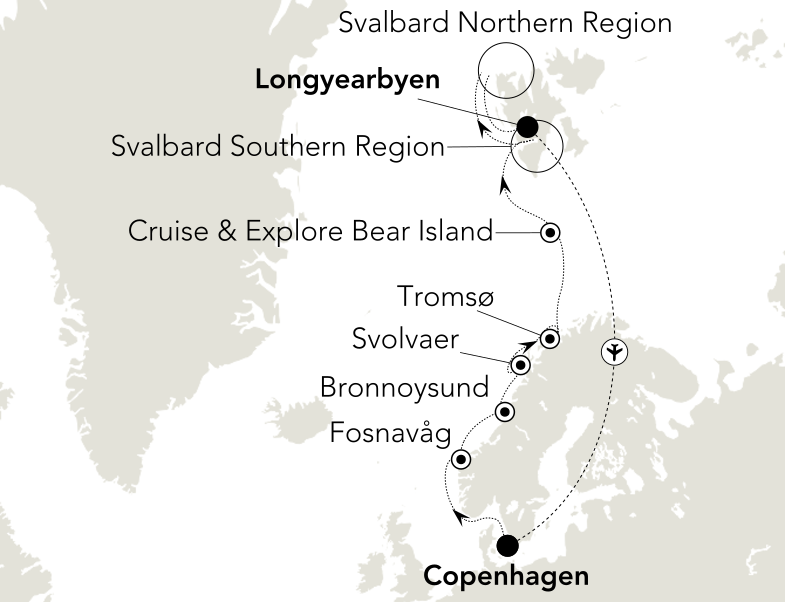
A 14-night expedition voyage aboard Silver Endeavour, Copenhagen, Denmark to Longyearbyen, Norway. Destination: Arctic and Greenland.
Operated by Silversea Cruises aboard Silver Endeavour.
Copenhagen
Fosnavåg
Bronnoysund
Svolvaer
Tromsø
Cruise & Explore Bear Island (Svalbard)
Svalbard Southern Region
Svalbard Northern Region
Longyearbyen
Effortlessly cool and down to earth, Copenhagen is a contemporary, clean and classy highlight of Scandinavia. A city built to be liveable, Copenhagen has refused to compromise, resulting in a forward-thinking metropolis that’s green and clean. Swim in the waters of Havnebadet Islands during summer, or shelter from winter’s bite by snuggling in beside a roaring open fire during winter. You can even hop on a train to Sweden, traversing the famous span of a Nordic Noir star - the Öresund Bridge. It takes just a touch over half an hour to step off the train in Malmö. There’s only one way to truly explore Copenhagen and that’s on two wheels. Easy bike hire schemes will get you moving across this flat city, designed with bikes at the forefront of the mind. Choose a model with electronic assistance to take the strain out of any journey, giving you the freedom to whizz around and explore the modern angular architecture of the centre, and the pastoral colours of Nyhavn waterfront. Head out to the Little Mermaid statue, inspired by Hans Christian Andersen’s fairy tale - the strikingly-restrained statue is the perfect landmark for Copenhagen; unshowy, self-assured and utterly irresistible. The Danish concept of hygge is very much alive here, and you’ll feel that warm cosy feeling as you visit cafes illuminated by the warm glow of hanging filament bulbs, and stuffed to the brim with thick, dusty books. Home to mega-brewer Carlsberg, Copenhagen is also a city for hop enthusiasts, and there is a thriving craft brewing scene to sample. Danish Smørrebrød sandwiches are a must try, or for something a little more substantial, settle in for a culinary voyage and try a taster menu – the city’s restaurants are littered with Michelin stars.
Days at sea are the perfect opportunity to relax unwind and catch up with what you’ve been meaning to do. So whether that is going to the gym, visiting the spa, whale watching, catching up on your reading or simply topping up your tan these blue sea days are the perfect balance to busy days spent exploring shore side.
Norway’s advertising slogan is that it is “powered by nature”. One trip to Bronnoysund and it’s easy to see why. This is quintessential Norway, vast, wild and beautiful, with a few surprises to keep you on your toes! Arrival by sea in Bronnoysund is a bit of an experience. Norway is famously the land of the midnight sun, and with Bronnoysund enjoying the favourable position of being just beneath the Arctic Circle, early morning arrival is both eerie and awe inspiring. The otherworldliness is amplified by the sun shining through the giant hole in Torghatten Mountain. The vast (258 metre) granite mountain is pierced right through centre by a natural hole. Never forgetting that Norway is the country of pixies and trolls, local legend has the answer to this scientifically unexplainable phenomenon: it was created when an arrow ripped through the troll king’s hat, which was thrown into the air to protect a fleeing girl. The hat turned to stone, and the arrow’s hole is preserved there to this day. It is possible to walk through it and enjoy the fabulous views beyond. The rest of Bronnoysund’s surroundings are no less spectacular. The 13,000-plus nearby islands include the Vega Archipelago, a cluster of 6,500 islands that enjoy UNESCO World Heritage Site status. The outstanding universal value of the islands is seen not only in stone age indications but in the unique cultural landscape (particularly that of Eider duck farming) that has provided at least 1,500 islanders with income from the 9th century.
Salt and pepper coloured mountains erupt from the ground behind the pretty port of Svolvaer, which opens up the extraordinary beauty of the Lofoten Islands. You'll never quite get over the majesty of the mountainous backdrop as you explore, although with natural wonders like the rippling Northern Lights, the Midnight Sun, and cruising pods of orcas to admire, there are plenty of distractions. The Gulf Stream shuffles warmer air here, so the climate is surprisingly mild considering how northerly the town is. Wander the compact streets, to see the morning's haul of fish and shrimp on-sale in the harbour, and watch sightseeing boats heading off to some of Norway’s most incredible natural scenery. Exploring Svolvaer Fantastically positioned for exploring the Lofoten peninsular, take a boat journey beside stacked mountains, and negotiate narrow fjords like Trollfjord, as you sail below circling eagles, and cloud-shrouded peaks. In winter, the mountain tips are silhouetted by rippling emerald colours, as dramatic Northern Light displays unfurl, while summer illuminates them with the Midnight Sun’s late burn. If you're feeling adventurous, head out to kayak between scattered islands, haul whopping catches from the glassy waters, or hike mountains like Tjeldbergtind – from which you can look down over the town, and see islands rising from the water like teeth. A little island hopping will take you to Haukland Beach, where gleaming white sand waits, and a blissful emerald ocean laps ashore poetically. Relax on the sand, or wander the dazzling coastline. You'll also be well located for a visit to the Lofotr Viking Museum, where you can see the rippling masts of sailing Viking ships, and the huge wooden longhouse that’s been constructed there. You’ll find what’s perhaps the region’s most immersive museum back in Svolvaer, however. The Lofoten War Museum is a jumbled, but utterly fascinating, treasure-trove of equipment, weaponry and World War II memorabilia. Learn about the role Norway played in the conflict, as you see everything from Nazi Christmas baubles, to a painting and drawings of Disney characters - apparently created by Hitler himself. For art, the KaviarFactory is a striking modern gallery, set in a former fishing warehouse. Its coastal location, and spacious whitewash interior, provides a fittingly spectacular exhibition space for evocative sculptures. The Magic Ice bar, meanwhile, is the place to enjoy a truly refreshing drink – sipped straight from a glass crafted from ice. Enter this sub-zero world of sculpture, where everything from the bar, to the reindeer statues that are dotted around, are hand hewn from huge chunks of thick ice.
Located in the far north of Norway a visit to Tromso beckons you to the extremes of this magical country to explore a fairytale land of jagged mountains glistening glaciers and husky-pulled sledges. Despite its remote location you'll discover a perhaps surprisingly cosmopolitan city with a healthy student population injecting plenty of energy. Sat 250 miles above the Arctic Circle - at 69° north - you can bathe in the midnight sun's glow during summer before winter brings the thick blackness and starry skies of endless polar nights. The darkness doesn't stop the fun - with a polar night half-marathon taking place in January - but the return of the sun is always a reason for a celebration here. To get the best view over the city take the cable car to Storsteinen's amazing viewpoint. Magnificent views down over the city fjord and Tromso's arching bridge will unravel before you. Learn more about northerly traditions polar expeditions and arctic hunting at the Polar Museum. The Science Centre meanwhile explains how humans have harnessed and survived these epic landscapes over the years and explores Tromso's breathtaking natural spectacle - the northern lights. The city is famed for its extraordinary viewing opportunities which are often said to be the best in the world. The Alpine Botanic Garden is the most northern such garden on the planet showcasing some of Norway's hardiest plantlife which survives and thrives at this nose-bleeding altitude.
Bear Island is considered Svalbard’s southernmost island, roughly half way between Spitsbergen and Norway’s North Cape. Although the last polar bears were seen in 2004, the name goes back to Dutch explorer Willem Barentsz and his visit in 1596. The island has been used to hunt walrus, for whaling, and even coal mining has taken place. The strategic location on the border of the Norwegian Sea and the Barents Sea has led to a meteorological station being set up by Norway near Gravodden on Bear Island’s north coast. Some two thirds of the island is a relatively flat plain with shallow freshwater lakes and Ramsar Wetland, while the entire island and the surrounding waters are a Nature Reserve. Bear Island has also been designated an Import Bird Area as it is a staging area for Pink-footed and Barnacle Geese and the steep cliffs south of Sørhamna are home to thousands of breeding seabirds. This is a specially protected area where Zodiacs are allowed to cruise along the cliffs around Kapp Kolthoff. In smaller amounts Atlantic Puffins, Northern Gannets, Glaucous Gulls and Great Skuas are found in between the large Black-legged Kittiwake, Little Auk, Common Guillemot and Brünnich’s Guillemot colonies. The constant battering of the sea has not only created impressive sea caves and tunnels, but unfortunately the Russian vessel Petrozavodsk shipwrecked near Revdalen at the base of the limestone cliffs and the waves are causing a continuous disintegration of the remains of the ship.
Svalbard’s Southern Region and specifically Spitsbergen’s west coast is less ice-clogged than the rest of Svalbard due to the moderating influenced of the Gulf Stream. Several fjords cut into the western coast of Spitsbergen and have been used by trappers and hunters as well as the different mining companies that tried to exploit the riches of the archipelago’s largest island of Spitsbergen. Remains of huts and mines as well as active commercial and scientific settlements can be found and visited. Depending on the time of the season glaciers can be visited on foot or by sea. Northern places like Magdalenefjorden and Hornsund will reveal fascinating views of geological formations craggy mountains spectacular glaciers and a variety of seabirds and seals.
Svalbard’s Southern Region and specifically Spitsbergen’s west coast is less ice-clogged than the rest of Svalbard due to the moderating influenced of the Gulf Stream. Several fjords cut into the western coast of Spitsbergen and have been used by trappers and hunters as well as the different mining companies that tried to exploit the riches of the archipelago’s largest island of Spitsbergen. Remains of huts and mines as well as active commercial and scientific settlements can be found and visited. Depending on the time of the season glaciers can be visited on foot or by sea. Northern places like Magdalenefjorden and Hornsund will reveal fascinating views of geological formations craggy mountains spectacular glaciers and a variety of seabirds and seals.
Svalbard’s Southern Region and specifically Spitsbergen’s west coast is less ice-clogged than the rest of Svalbard due to the moderating influenced of the Gulf Stream. Several fjords cut into the western coast of Spitsbergen and have been used by trappers and hunters as well as the different mining companies that tried to exploit the riches of the archipelago’s largest island of Spitsbergen. Remains of huts and mines as well as active commercial and scientific settlements can be found and visited. Depending on the time of the season glaciers can be visited on foot or by sea. Northern places like Magdalenefjorden and Hornsund will reveal fascinating views of geological formations craggy mountains spectacular glaciers and a variety of seabirds and seals.
Svalbard’s northern region is less influenced by the Norwegian Current coming through the Greenland Sea than the southern region and shows more ice. The northern part of the island of Spitsbergen shows quite a number of impressive fjords, bays and glaciers. The Nordaust Svalbard Nature Reserve includes Spitsbergen’s east coast, the Hinlopen Strait, Nordaustlandet and some islands further east like Kvitoya and Storoya. Several walrus haul-outs, spectacular glaciers, bird cliffs and bird islands, as well as surprising flora in Arctic deserts and the possibility to see polar bears and to visit historically important sites make this an area prone for exploration. Ice conditions will dictate which sites can be seen.
Svalbard’s northern region is less influenced by the Norwegian Current coming through the Greenland Sea than the southern region and shows more ice. The northern part of the island of Spitsbergen shows quite a number of impressive fjords, bays and glaciers. The Nordaust Svalbard Nature Reserve includes Spitsbergen’s east coast, the Hinlopen Strait, Nordaustlandet and some islands further east like Kvitoya and Storoya. Several walrus haul-outs, spectacular glaciers, bird cliffs and bird islands, as well as surprising flora in Arctic deserts and the possibility to see polar bears and to visit historically important sites make this an area prone for exploration. Ice conditions will dictate which sites can be seen.
Svalbard’s northern region is less influenced by the Norwegian Current coming through the Greenland Sea than the southern region and shows more ice. The northern part of the island of Spitsbergen shows quite a number of impressive fjords, bays and glaciers. The Nordaust Svalbard Nature Reserve includes Spitsbergen’s east coast, the Hinlopen Strait, Nordaustlandet and some islands further east like Kvitoya and Storoya. Several walrus haul-outs, spectacular glaciers, bird cliffs and bird islands, as well as surprising flora in Arctic deserts and the possibility to see polar bears and to visit historically important sites make this an area prone for exploration. Ice conditions will dictate which sites can be seen.
Svalbard’s northern region is less influenced by the Norwegian Current coming through the Greenland Sea than the southern region and shows more ice. The northern part of the island of Spitsbergen shows quite a number of impressive fjords, bays and glaciers. The Nordaust Svalbard Nature Reserve includes Spitsbergen’s east coast, the Hinlopen Strait, Nordaustlandet and some islands further east like Kvitoya and Storoya. Several walrus haul-outs, spectacular glaciers, bird cliffs and bird islands, as well as surprising flora in Arctic deserts and the possibility to see polar bears and to visit historically important sites make this an area prone for exploration. Ice conditions will dictate which sites can be seen.
Longyearbyen is the biggest settlement in Svalbard. Seat of the Norwegian administration it also has the best services and infrastructure in the archipelago. Located deep in the Adventfjord a sidearm of the Isfjorden (Icefjord) Longyearbyen’s airport can be used all-year round but its harbor is blocked by ice in winter. Most shops hotels restaurants and a hospital are within easy walking distance of the port. One of the most prominent buildings in town is the UNIS center where several Norwegian universities have joined forces to operate and offer the northernmost higher education to both Norwegian and international students. Adjacent to UNIS and well worth a visit is the Svalbard Museum covering the natural history and exploitation of Svalbard. Remnants of the former mining activity can be seen all around Longyearbyen and even in town.
From $28,800
per guest · 14 nights
Prices are a guide and vary with season, cabin category and party size. Your advisor will confirm the exact cost before anything is booked.
Classic Veranda
suite
Deluxe Veranda
suite
Grand 1 Bedroom
suite
Owner 1 Bedroom
suite
Premium Veranda
suite
Silver
suite
Superior Veranda
suite








