




Prefer a conversation?
Our team is always available to guide you through the process and ensure your experience is perfectly matched to your preferences.
Our team is always available to guide you through the process and ensure your experience is perfectly matched to your preferences.
Duration
7 Nights
Price
From $8,300
Ship
Silver Ray
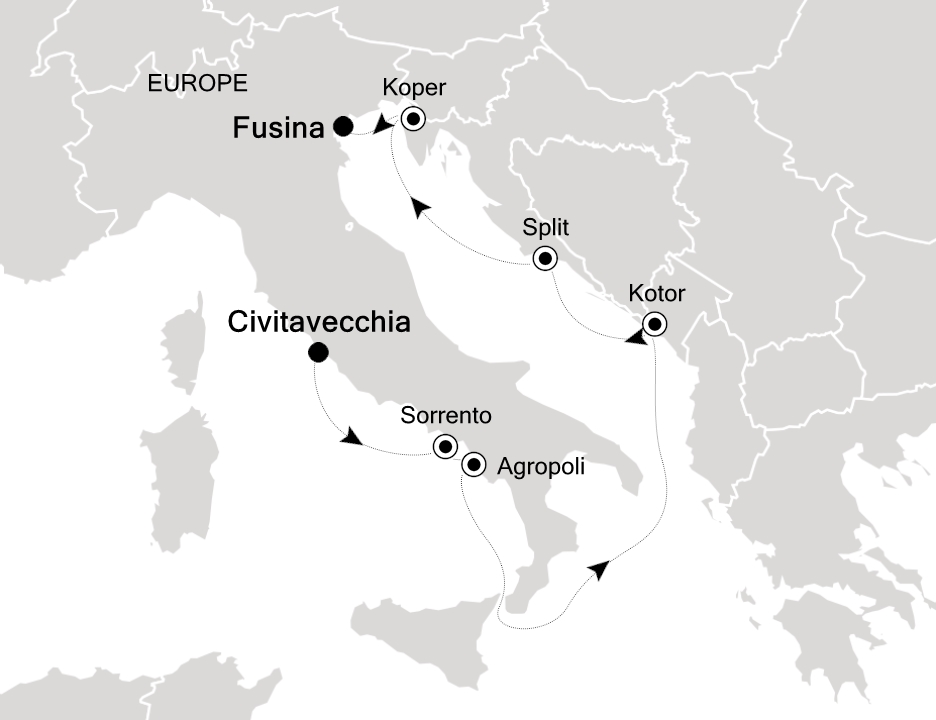
A 7-night ocean voyage aboard Silver Ray, Civitavecchia, Italy to Fusina, Italy. Destination: Mediterranean.
Operated by Silversea Cruises aboard Silver Ray.
Civitavecchia (Rome)
Sorrento
Kotor
Split
Zadar
Koper
Fusina (Venice)
All roads lead to Rome, and with good reason - this city is one of the world’s most thrilling, offering unmatched history along every street. An evocative, inspiring and utterly artistic capital of unrivalled cultural impact, Rome is a city of back-to-back landmarks, which will take you on an exhilarating journey through the ages. This may be one of the world’s oldest cities, but it’s well and truly lived in. The ruins are punctuated with murmuring cafes, and the outdoor seating of restaurants sprawls out across piazzas, enticing you to sample tangles of creamy pasta and crispy pizzas. Rome’s incredible Roman Forum is littered with the ruins of its ancient administrations, which have stood firm for 2,000 years, since the times when the area was the centre of the Western world. Few sites are more simultaneously beautiful and haunting than that of the storied Colosseum, which looms deep into Rome’s rich blue sky. Take a tour to learn details of the grisly goings-on within. The best way to experience Rome is to wander its streets, gelato in hand. There is a lot to see here - whether it’s the domed spectacle of the Pantheon, or the elaborate flowing waters and artistry of the Trevi Fountain. Vatican City is an astonishing, colossal display of Catholic grandeur, while the Spanish Steps – crowned by the Trinità dei Monti church – offer a beautiful spot to gather and soak up the lively atmosphere of this humming city. With so much on the to-do list, you’ll relish the breaks you take, enjoying simple pleasures like a strong espresso, or fresh pasta with tomato sauce and ripped basil.
Sorrento's colourful, sun-faded facades cascade down from green hills and cliffs to the Bay of Naples' gently lapping waters. The perfect base for exploring this Italian corner of outstanding natural beauty, venture to the curvaceous roads of the Amalfi coast - or enjoy leisurely jaunts across the shimmering waves to Capri's gem of an island. While it makes for a fantastic jumping-off point, Sorrento itself has oodles of rustic fishing town charm, so don't rush off too quickly. Piazza Tasso is the locals’ main meeting spot and a starting point for a wander through the picturesque streets. Throw back a quick espresso caffeine kick at a standing cafe, before strolling through Corso Italia - Sorrento's spine - which is lined with boutiques, museums, bars and restaurants. The historic Church of San Francesco blossoms with colourful celebrations of weddings, which spill out into its gorgeous ivy-tangled cloisters. Or head down to relax by the small beach and fishing-boat filled harbours. The looming, cloud-wisped cone of Mount Vesuvius is unlikely to escape your attention, and this now docile volcano was responsible for a famous tale of destruction when it wiped out the ancient city of Pompeii in a heartbeat. Known for the haunting, frozen casts of the city’s unfortunate inhabitants - the massive site is a miraculous snapshot of an Ancient Roman city in its pomp. Wander the stone slabs streets, visit the beautiful theatre, and the columns of the sprawling ancient forum – painstakingly recovered and rendered from below the ash. If you’re feeling a little peckish, enjoy quick and delicious flame-cooked pizzas of oil, basil, tomato, and buffalo mozzarella. The volcanic soil imbues the local wines with rich flavour – soak in the waterfront views while savouring Taurasi and Lacryma Christi flavours. Or sample the luminous lemony-hit of ubiquitous limoncellos.
Days at sea are the perfect opportunity to relax unwind and catch up with what you’ve been meaning to do. So whether that is going to the gym, visiting the spa, whale watching, catching up on your reading or simply topping up your tan these blue sea days are the perfect balance to busy days spent exploring shore side.
Embedded into the slopes of the steep Lovćen mountain and overlooking the deep blue Adriatic the fortified town of Kotor boasts a spectacular imposing staging that few can match. Sq Squeezing in through the tight Bay of Kotor is a daunting and impressive approach in itself as you arrive via one of Europe’s most stunning waterways. A pearl of Montenegro and the Adriatic Kotor's warren-like streets drip with history and authenticity. Under Venetian influence for four centuries the city's UNESCO World Heritage Site old town invites you to wander amid atmospheric stone-clad streets overlooked by a sea of terracotta roofs and the double towers of the cathedral. Many favour Kotor for its compact layout smaller crowds and authenticity however - having been spared from shelling during Yugoslavia's breakup. The tightknit streets here are patrolled by a slinking population of feline residents who were adopted as the town’s mascots after being left behind by transient trader ships. Learn of the city's extensive heritage on the waves in the dedicated maritime museum that is contained within Grgurina Palace. Pick your way through tight alleys of workshops and studios walking below fresh laundry strung from windows before settling into shiny paved piazzas for an afternoon coffee or seafood meal. If you’re up for an aerobic challenge tackle the 1 350 steps up the steep walls to St John's fortress. The views over the gorgeous bay make the arduous slog worth it.
Bathing in the Dalmatian Coast’s generous sunshine and overlooking sparkling island-studded waters Split is a city of romantic beauty built around an extraordinary - still beating - historical heart. The setting may be spectacular but it’s the Diocletian’s Palace - a Roman remain of incredible scale and detail that is truly bewitching. With a natural backdrop of dramatic limestone mountains and Croatia’s trademark scenic wonders all around Split is a true heavyweight of the Adriatic. To enter Split’s Diocletian’s Palace is to step into a beautiful time warp. Head first to the Cathedral of Saint Domnius where a hollow bell tower rockets up puncturing the sky. The perfume of lavender hangs heavy wherever you walk in the old town where tucked shops offer artisan chocolates dried figs and freshly-ground coffees. The expansive seafront promenade is all palm trees buzzing bars and eateries and further out you’ll find the peace of Marion Hill - where you can climb to some of the best views in town. Or take the far less exerting wander to Sustipan cemetery’s breathtaking panorama of sea city and distant islands. Trips to island paradises like Hvar and Brac are tempting as are longer excursions to sites like Krka National Park’s Waterfalls - where wide terraces of frothing water thunder into cooling swimmable splash pools below. Nearby Trogir is another UNESCO World Heritage Site offering a cosier no less charming old town and historic port.
Zadar: a city like a history book In turn Roman, Byzantine, Venetian, Austro-Hungarian, Yugoslav and then Croatian, Zadar is an ancient settlement dating back to prehistoric times. Architectural evidence of its history is scattered throughout the streets and maze of alleyways of its historic centre. A must-see for those wishing to discover all the charms of one of the jewels of the Adriatic. At the heart of the city are the Roman remains of Zadar. This huge forum, built between the 1st century BC and the 3rd century, is the heart of the city. Its ruins - carved stones and columns, including the Column of Shame and its chains - still whisper the memory of a time when Zadar was one of the great naval centres of the Adriatic. It was a time when the Romans gave the city its forum and temples, and equipped it with thermal baths and its first sewers, thanks to a feat of Roman engineering: the construction of an aqueduct over 40 kilometres long linking the city to the waters of Lake Vransko. A stone's throw from the ruins of the forum, the church of St Donatus has stood since the 9th century, with its unique and remarkable architectural design. The church, now a concert hall after having been a warehouse and then an archaeological museum, is a circular structure made up of three concentric rings of columns, with 12 columns for the outermost ones, 16 for those in the middle and 20 for the central circle. The result is a fascinating visual effect, particularly for a building over a thousand years old. St Donatus, which has not heard a mass for 200 years, is open to visitors and has preserved some of its relics as well as its pulpit and baptismal font. From its forecourt, you can hear the strange sounds of one of Zadar's other attractions: the Sea Organ, just a few hundred metres away. The only one of its kind in the world, this organ consists of a system of bellows inserted into steps that sink into the waters of the Adriatic. The result is a symphony of sounds created by the waves and air currents. Also worth seeing - Sainte-Anastasie Cathedral and its bell tower Dating from the 12th and 13th centuries, the cathedral was badly hit by bombing during the Second World War. Now fully restored, it boasts a wealth of architectural treasures, including its façade, 3 naves, sculptures and relics. You can climb to the top of its bell tower for a panoramic view of the town. - Church of Saint-Siméon A Baroque church dating back to the 5th century, its bell tower was added in the 17th century. The ochre-coloured monument contains a priceless piece: the sarcophagus covered with gold-plated silver reliefs housing the relics of Saint Simeon. - The Place des Cinq-Puits Built in 1574, the Place des Cinq-Puits takes its name... from the 5 wells located there. For many years, they were the water supply for the inhabitants of Zadar. Just behind it, Queen Jelena Madijevka's garden is the ideal place for a break, with its shady paths, café and peaceful atmosphere. - Port of Foša and Gateway to Terra Firma From the garden, you can see the authentic little port of Foša. Right next door, the Porte de la Terre Ferme (Farmland Gate) has stood since 1543. Long the town's main gateway, it was once equipped with a drawbridge. [Pictures in : Zadar>Tour>Zadar, Nin Slat Works & Royal Vineyards (ZAD-G) starting picture #5 and Zadar>Tour>Dalmatian Panoramas and Rural Estate (ZAD-H) starting picture #5]
With a sweeping old town of Venetian architecture sing-song Italian emanating from its cafes and even a fountain that honours the Rialto Bridge - you could be forgiven for thinking that you’d stepped off the boat into the Floating City itself while exploring Koper. Formerly an island Koper was linked artificially to the Slovenian mainland in 1825. It now serves as the only major port of Slovenia and basks in the sun of the Istrian coast which offers an alluring blend of the best of Croatian Slovenian and Italian. The nation’s capital Ljubljana also lies within easy reach. A working city with plenty of charm below its sea of terracotta roofs the picturesque Tito square lies at Koper’s heart. The Cathedral of Assumption rises above the square and towers over the narrow streets nearby. Take a deep breath and climb the 200 steps for a stunning panorama of the city. Or simply soak up the atmosphere with a wander through Čevljarska Ulica – a set of cobbled streets adorned with artisan shops small bars and restaurants. Soak up the sights of Koper the country’s oldest town or make for the Slovenian capital Ljubljana - to discover a lively city of green parks leafy open spaces and pedestrianised boulevards. The pretty Ljubljana River stretches through the city’s heart providing casual strolls and charming bike rides. Nearby encounter a scene from a fairy-tale as you see the breathlessly picturesque Bled Castle emerging from a tiny island in the centre of a cloudy-blue alpine lake.
Losing none of its allure over the years, this floating city of canals, bridges and masks is a place of eternal beauty and enduring elegance. The lagoon of more than 100 islands is a heavenly sight, transporting visitors on a journey through time - from its Roman inception, through centuries of trade to the modern face we see today. Navigate Venice’s sparkling waterways by romantic gondola, or on cruises along wide canal boulevards. Span the Grand Canal over its iconic original crossing, the Rialto Bridge, which - with its parade of tiny shops - gives some of the city’s most endearing views. If the crowds unsettle you at any point, take two turns away from the main thoroughfares to find peace alone, amid the city's labyrinth of tiny streets. Hurry to Piazza San Marco to be immersed in Venice’s elegant glory. Basilica San Marco transports you back to the wealthy days of the Doges, who ruled for over 1,000 years. Initially their private chapel, it’s now decorated with beautiful Byzantine mosaics. Nearby the Campanile di San Marco bell tower offers views over the higgledy-piggledy rooftops of times gone by. Just a hop skip and a jump around the corner is the Doge’s Palace, where the levels of opulence ramp up even further. Justice was meted out in this stunning Palace, with the guilty walking to the cells across the covered Bridge of Sighs. Vaporetto trips to local islands offer even more adventures to float your boat, whether it’s Murano with its world-famous glass, Torcello with its amazing Cathedrals, or Burano with its handmade lace and delightfully colourful painted houses.
From $8,300
per guest · 7 nights
Prices are a guide and vary with season, cabin category and party size. Your advisor will confirm the exact cost before anything is booked.
Classic Veranda
suite
Deluxe Veranda
suite
Grand 1 Bedroom
suite
Junior Grand 1 Bedroom
suite
Junior Grand 2 Bedroom
suite
Master
suite
Medallion
suite
Otium
suite
Owner 1 Bedroom
suite
Owner 2 Bedroom
suite
Premium Medallion
suite
Premium Veranda
suite
Signature
suite
Silver
suite
Superior Veranda
suite








