




Prefer a conversation?
Our team is always available to guide you through the process and ensure your experience is perfectly matched to your preferences.
Our team is always available to guide you through the process and ensure your experience is perfectly matched to your preferences.
Duration
8 Nights
Price
From $7,250
Ship
Silver Ray
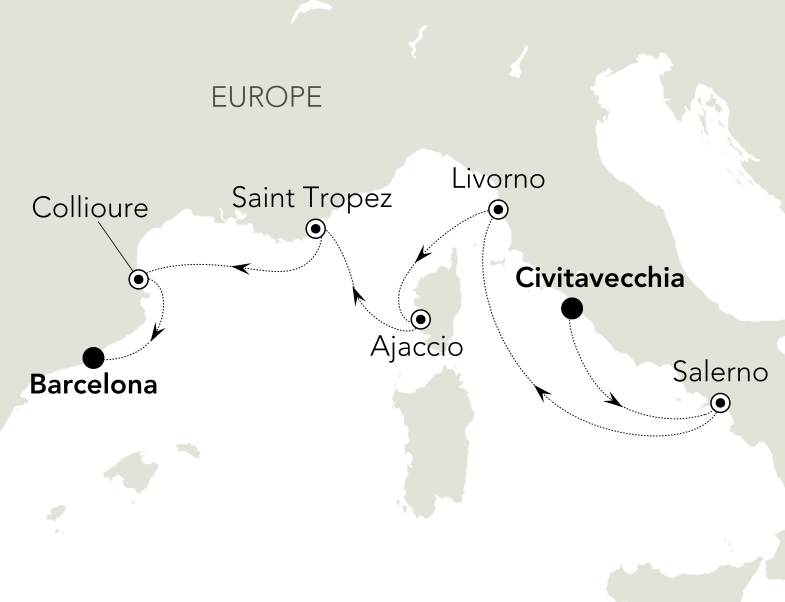
A 8-night ocean voyage aboard Silver Ray, Civitavecchia, Italy to Barcelona, Spain. Destination: Mediterranean.
Operated by Silversea Cruises aboard Silver Ray.
Civitavecchia (Rome)
Salerno
Livorno (Tuscany)
Ajaccio (Corsica)
Saint Tropez
Collioure
Barcelona
All roads lead to Rome, and with good reason - this city is one of the world’s most thrilling, offering unmatched history along every street. An evocative, inspiring and utterly artistic capital of unrivalled cultural impact, Rome is a city of back-to-back landmarks, which will take you on an exhilarating journey through the ages. This may be one of the world’s oldest cities, but it’s well and truly lived in. The ruins are punctuated with murmuring cafes, and the outdoor seating of restaurants sprawls out across piazzas, enticing you to sample tangles of creamy pasta and crispy pizzas. Rome’s incredible Roman Forum is littered with the ruins of its ancient administrations, which have stood firm for 2,000 years, since the times when the area was the centre of the Western world. Few sites are more simultaneously beautiful and haunting than that of the storied Colosseum, which looms deep into Rome’s rich blue sky. Take a tour to learn details of the grisly goings-on within. The best way to experience Rome is to wander its streets, gelato in hand. There is a lot to see here - whether it’s the domed spectacle of the Pantheon, or the elaborate flowing waters and artistry of the Trevi Fountain. Vatican City is an astonishing, colossal display of Catholic grandeur, while the Spanish Steps – crowned by the Trinità dei Monti church – offer a beautiful spot to gather and soak up the lively atmosphere of this humming city. With so much on the to-do list, you’ll relish the breaks you take, enjoying simple pleasures like a strong espresso, or fresh pasta with tomato sauce and ripped basil.
Salerno is situated at the northern end of the Gulf of Salerno. The old town, rising up the slopes of the hill on the site of the ancient Salernum, still bears evidence of its great days during the medieval period. It had the oldest medical school in Europe, which flourished from the 11th century until it was closed down by Napoleon's brother-in-law, Murat, in 1812. Today, Salerno's main attraction is an imposing Romanesque cathedral, built in 1085 and remodeled in the late 18th century. A flight of steps leads up to an atrium with 28 columns from Paestum and fourteen ancient sarcophagi. The magnificent bronze doors were made in Constantinople in 1099. Inside is the ornate tomb of Margaret of Anjou and the tomb of Pope Gregory VII, who died in Salerno in 1085. In the richly decorated crypt under the alter lie the remains of the Evangelist Matthew, brought here from Paestum.A 45-minute walk from the cathedral leads to a hilltop crowned by the old Lombard Castello, from where extensive views are available. Along the seafront, to the east of the harbor, extends a fine promenade lined with impressive modern buildings. The Corso Giuseppe Garibaldi is the town's principal traffic artery.Travelers coming to Salerno mainly use the port as a starting point for visits to the Greek temples of Paestum. Other favorite excursions from here are to Pompeii and to visit the popular resort towns of Amalfi and Ravello. Pier Information The ship is scheduled to dock at Pier 22. A tourist office is located at the port and is open from 8:00 a.m. to 1:30 p.m. From the pier it is approximately two miles to the town center. Taxis are generally available at the pier for trips farther afield. Be sure to establish the fare with the driver before starting out. Shopping Local handicrafts, clothing, shoes and mozzarella cheese are items to look for. Major shopping areas are along Via dei Mercanti, Via Duomo and Corso Vittorio Emanuele. Most shops are closed between 1:30 p.m. and 5:00 p.m. The local currency is the euro. Cuisine The always popular pasta dishes are a good choice. Other favorites include fresh seafood and local specialties. The home-produced ricotta and mozzarella are especially recommended. Good local wines will complement your meal. Other Sites Museo Diocesano At the Piazza Plebiscito, behind the cathedral, this museum houses a fine collection of medieval carved tablets. Museo Provinciale Occupying two floors of the San Benedetto Monastery, the main attraction at the museum is a handsome bronze head of Apollo fished out of the bay in the 1930s.
Days at sea are the perfect opportunity to relax unwind and catch up with what you’ve been meaning to do. So whether that is going to the gym, visiting the spa, whale watching, catching up on your reading or simply topping up your tan these blue sea days are the perfect balance to busy days spent exploring shore side.
The Tower of Matilde is an iconic structure of the city of Livorno. This medieval tower is said to have been built by the famous mathematician and astronomer Galileo Galilei. It is named after Matilde di Canossa, an influential noblewoman who played a key role in the political and religious conflicts of the 11th century. Matilde was a powerful figure in medieval Italy, and her legacy is still felt in Livorno today. The tower was built on her orders as a defensive stronghold to protect the city against invaders, and its strategic location on the coast made it an important part of the city's defenses. Over the centuries, the Tower of Matilde has been restored and renovated several times, but it still retains its original medieval charm. The tower is a classic example of medieval architecture, with its thick walls, narrow windows, and imposing structure. The tower was later used as a watchtower during World War II and is now a popular tourist attraction as visitors can climb to the top and enjoy panoramic views of the surrounding area. The Tower of Matilde is also an important cultural landmark in Livorno. It is often used as a venue for cultural events and exhibitions, and its unique atmosphere and ambiance make it a popular destination for artists and writers.
The Tower of Matilde is an iconic structure of the city of Livorno. This medieval tower is said to have been built by the famous mathematician and astronomer Galileo Galilei. It is named after Matilde di Canossa, an influential noblewoman who played a key role in the political and religious conflicts of the 11th century. Matilde was a powerful figure in medieval Italy, and her legacy is still felt in Livorno today. The tower was built on her orders as a defensive stronghold to protect the city against invaders, and its strategic location on the coast made it an important part of the city's defenses. Over the centuries, the Tower of Matilde has been restored and renovated several times, but it still retains its original medieval charm. The tower is a classic example of medieval architecture, with its thick walls, narrow windows, and imposing structure. The tower was later used as a watchtower during World War II and is now a popular tourist attraction as visitors can climb to the top and enjoy panoramic views of the surrounding area. The Tower of Matilde is also an important cultural landmark in Livorno. It is often used as a venue for cultural events and exhibitions, and its unique atmosphere and ambiance make it a popular destination for artists and writers.
Famed as the island birthplace of French Emperor, Napoléon Bonaparte, Ajaccio has made a towering contribution to European history. Bonaparte may be omnipresent in Ajaccio – with statues watching out over palm-tree lined boulevards bearing his name - but there is a lot more to this charming city, where an unhurried Mediterranean attitude mixes with the trendy buzz of a French Riviera resort. The stunning setting pairs glowing blue water with a dramatic backdrop of towering, snow-capped peaks. Bonaparte may have been famously short in stature, but he stands as a true giant of history. The National Bonaparte Museum is the ideal place to learn more of his life, in the very house where he was born in 1769. Just inside the modest Cathedral Notre-Dame-de-l'Assomption – surrounded by frescoed walls – you’ll also see the stone font where he was baptised. Elsewhere, the perched watchtower of Îles Sanguinaires is a short boat ride away, or Plage de Capo di Feno’s stunning, isolated band of white sand and transparent waters may tempt you outside of the historic city. Settle at a restaurant near the harbour to taste succulent wild boar, stewed in rich red wine casserole, or to crack into soft lobster meat. You also have to enjoy the famous fiadone cheesecake made from local brocciu cheese while you’re here, and to let the magic of unique Corsican Polyphony music carry you away. Three singers expertly blend harmonies to create a spine-tingling combination of melody – you’ll notice the distinctive style, as they each cover an ear to focus more clearly on their individual contribution.
A glitzy, glamorous coastal resort that needs no introduction, Saint Tropez is the French Riviera hotspot of choice for A-listers and flotillas of gleaming yachts. The sparkle of its beaches, and clarity of its light, continues to attract artists - but it was the famous presence of Brigitte Bardot that leant Saint Tropez its enduring glamour and steamy appeal. Nowadays, speedboats skim offshore, while fine vintages from the vineyards nearby are uncorked in top-notch restaurants, in this well-heeled highlight of the Cote d'Azur. Famous bars offer views of the port along Quai Jean Jaurès, with its iconic cherry-red directors' chairs. Here you can admire the monstrous wealth of yachts that sparkle on the waters. On the same corner, big-name brand labels glimmer in the shops of rue François Sibilli - which cuts inland from the charming waterfront. The earthier appeal of boules clinking and thumping into the ground can be enjoyed at Place des Lices, where sun-wrinkled locals compete. Saint Tropez has a few beaches of its own, but famous stretches like Pampelonne Beach draw the biggest crowds to relax on star-studded golden sands. La Ponche, the authentic fishing quarter, retains its cobbled, historic elegance, and a 17th-century, hexagon-shaped citadel watches over the city and coastline from above. Coastal walks in the sea air snake away from the city’s bustle, and a series of headlands shape the stunning riviera landscape surrounding Saint Tropez. The historic monochrome Cap Camarat lighthouse adds a pleasing accent to hikes above the sparkling Mediterranean’s waves.
The south coast of France is nothing if not beautiful. To the east you have the sparkling seas of the Riviera while to the west, the terrain becomes craggier, less built upon but no less lovely. As you travel west ports get smaller and less glossy – but remain undeniably authentic. Such is true of Collioure. This charming seaside resort might not have the mega yachts (or mega bucks) of St. Tropez and Monte-Carlo, but it certainly has a local flavour that is unique to the south-west of France. So much so that the post-impressionist movement Fauvism was immortalised here. Apparently the movement was created when artists including Matisse, Picasso and Derain arrived in 1905 and realised they could not purchase black pain in the area. They were thus forced to find a creative solution to their problem. The answer was, of course, the dotty pictures that defined 20th century art. So magnetic was the region that others flocked to the area, and even today Collioure’s church is one of the most painted locations in France, with a record 242 reproductions. So perhaps the best guide to Collioure is not the usual guide books, but rather a crash course in modern art. Little seems to have changed since the painters left the seaside village, olive and lemon groves are still abundant, grape vines still line the horizon and stone cottages still stand. Cicadas still sing, fishing boats – bringing home the region’s speciality of anchovies – still float, and life carries on very much as it must have done in 1905.
Having attracted over 82 million visitors in 2017, Spain is gaining popularity as a travel destination. The country lures travellers from across the world with its promise of authenticity, charisma, and memorable moments. Spain’s culture is a celebration of the finer things in life, an expression of spirit, heritage and fun: colourful fiestas, delectable cuisine, age-defining art, music, dance, sport and so much more. Each region of the country has evolved a character of its own, meaning the country is unified by a sense of cultural multiplicity. Barcelona, the capital of Catalonia, is a masterpiece that embellishes the Spanish canvas. The fact that the Barcelona’s iconic cathedral, La Sagrada Familia, is still under construction over 141 years after construction commenced pays testament to the city’s artistic perfectionism, which pervades all aspects of life here. Apparent in the city’s architecture, layout, and cultural practices, aestheticism retains its value here. Antoni Gaudí, whose iconic style of modernist architecture is among Barcelona’s leading attractions, could perhaps be credited with designing the face of this magnificent city. Enjoy getting to know the vivacious personality behind Barcelona’s beauty.
From $7,250
per guest · 8 nights
Prices are a guide and vary with season, cabin category and party size. Your advisor will confirm the exact cost before anything is booked.
Classic Veranda
suite
Deluxe Veranda
suite
Grand 1 Bedroom
suite
Junior Grand 1 Bedroom
suite
Junior Grand 2 Bedroom
suite
Master
suite
Medallion
suite
Otium
suite
Owner 1 Bedroom
suite
Owner 2 Bedroom
suite
Premium Medallion
suite
Premium Veranda
suite
Signature
suite
Silver
suite
Superior Veranda
suite








