




Prefer a conversation?
Our team is always available to guide you through the process and ensure your experience is perfectly matched to your preferences.
Our team is always available to guide you through the process and ensure your experience is perfectly matched to your preferences.
Duration
8 Nights
Price
From $7,000
Ship
Silver Dawn
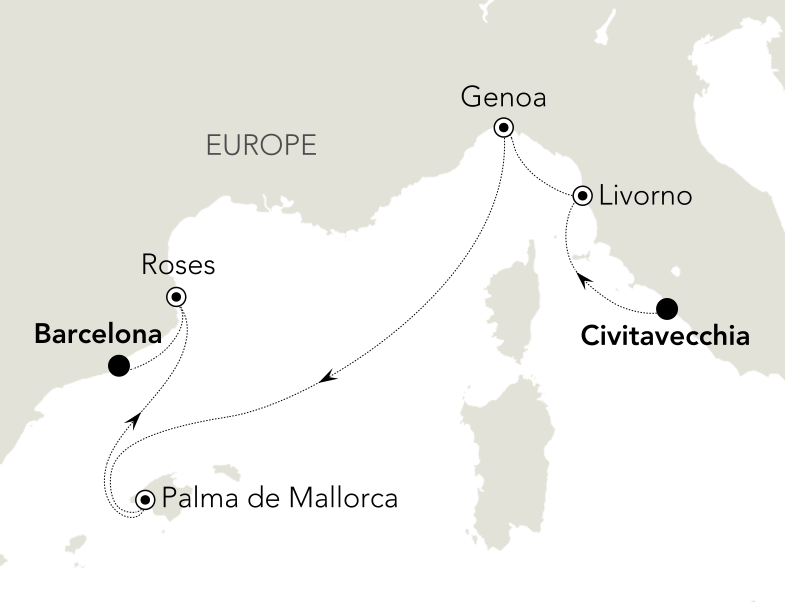
A 8-night ocean voyage aboard Silver Dawn, Civitavecchia, Italy to Barcelona, Spain. Destination: Mediterranean.
Operated by Silversea Cruises aboard Silver Dawn.
Civitavecchia (Rome)
Livorno (Tuscany)
Genoa
Palma de Mallorca
Roses
Barcelona
All roads lead to Rome, and with good reason - this city is one of the world’s most thrilling, offering unmatched history along every street. An evocative, inspiring and utterly artistic capital of unrivalled cultural impact, Rome is a city of back-to-back landmarks, which will take you on an exhilarating journey through the ages. This may be one of the world’s oldest cities, but it’s well and truly lived in. The ruins are punctuated with murmuring cafes, and the outdoor seating of restaurants sprawls out across piazzas, enticing you to sample tangles of creamy pasta and crispy pizzas. Rome’s incredible Roman Forum is littered with the ruins of its ancient administrations, which have stood firm for 2,000 years, since the times when the area was the centre of the Western world. Few sites are more simultaneously beautiful and haunting than that of the storied Colosseum, which looms deep into Rome’s rich blue sky. Take a tour to learn details of the grisly goings-on within. The best way to experience Rome is to wander its streets, gelato in hand. There is a lot to see here - whether it’s the domed spectacle of the Pantheon, or the elaborate flowing waters and artistry of the Trevi Fountain. Vatican City is an astonishing, colossal display of Catholic grandeur, while the Spanish Steps – crowned by the Trinità dei Monti church – offer a beautiful spot to gather and soak up the lively atmosphere of this humming city. With so much on the to-do list, you’ll relish the breaks you take, enjoying simple pleasures like a strong espresso, or fresh pasta with tomato sauce and ripped basil.
The Tower of Matilde is an iconic structure of the city of Livorno. This medieval tower is said to have been built by the famous mathematician and astronomer Galileo Galilei. It is named after Matilde di Canossa, an influential noblewoman who played a key role in the political and religious conflicts of the 11th century. Matilde was a powerful figure in medieval Italy, and her legacy is still felt in Livorno today. The tower was built on her orders as a defensive stronghold to protect the city against invaders, and its strategic location on the coast made it an important part of the city's defenses. Over the centuries, the Tower of Matilde has been restored and renovated several times, but it still retains its original medieval charm. The tower is a classic example of medieval architecture, with its thick walls, narrow windows, and imposing structure. The tower was later used as a watchtower during World War II and is now a popular tourist attraction as visitors can climb to the top and enjoy panoramic views of the surrounding area. The Tower of Matilde is also an important cultural landmark in Livorno. It is often used as a venue for cultural events and exhibitions, and its unique atmosphere and ambiance make it a popular destination for artists and writers.
The Tower of Matilde is an iconic structure of the city of Livorno. This medieval tower is said to have been built by the famous mathematician and astronomer Galileo Galilei. It is named after Matilde di Canossa, an influential noblewoman who played a key role in the political and religious conflicts of the 11th century. Matilde was a powerful figure in medieval Italy, and her legacy is still felt in Livorno today. The tower was built on her orders as a defensive stronghold to protect the city against invaders, and its strategic location on the coast made it an important part of the city's defenses. Over the centuries, the Tower of Matilde has been restored and renovated several times, but it still retains its original medieval charm. The tower is a classic example of medieval architecture, with its thick walls, narrow windows, and imposing structure. The tower was later used as a watchtower during World War II and is now a popular tourist attraction as visitors can climb to the top and enjoy panoramic views of the surrounding area. The Tower of Matilde is also an important cultural landmark in Livorno. It is often used as a venue for cultural events and exhibitions, and its unique atmosphere and ambiance make it a popular destination for artists and writers.
Most famous for being the birthplace of Christopher Columbus, Genoa is one of Italy’s true unsung heroes. Stretched out along the Mediterranean coast just over 100 miles from France, the city is the capital of Liguria, or the Italian Riviera, and has the history to prove it. Once the main trading centre for Italy, Genoa has a fine legacy of wealth behind it. The area once had complete control over the Tyrrhenian Sea, and its vast reach stretched as far as Nice to the west, Sardinia in the south and into the Piedmont mountains in the north. Exports were many, but perhaps the most lucrative of these was the rough denim cloth that sailors would wear, today more popularly known under the moniker blue jean. This affluence has left its mark on the city, think ornate gates, large, leafy palazzos, lavishly decorate churches and a Centro Storico – or Old Town – that speaks volumes. Grab your best hiking boots and wander the narrow alleys and steep hills and imbibe in the inherent Italianism of the city. No could talk about Genoa’s history without mentioning its food. Home of both Pesto and Focaccia, Genoa is considered by many to be one of the cornerstones of Italian gastronomy. The city’s cuisine is very much a product of its terrain: The Mediterranean yields freshly caught fish and seafood found on almost every menu, while the mountains supply the meat, cheese and above all herbs that flavour the dishes. It may not be fancy, but if you like good, simple Italian food, you have come to the right place.
Most famous for being the birthplace of Christopher Columbus, Genoa is one of Italy’s true unsung heroes. Stretched out along the Mediterranean coast just over 100 miles from France, the city is the capital of Liguria, or the Italian Riviera, and has the history to prove it. Once the main trading centre for Italy, Genoa has a fine legacy of wealth behind it. The area once had complete control over the Tyrrhenian Sea, and its vast reach stretched as far as Nice to the west, Sardinia in the south and into the Piedmont mountains in the north. Exports were many, but perhaps the most lucrative of these was the rough denim cloth that sailors would wear, today more popularly known under the moniker blue jean. This affluence has left its mark on the city, think ornate gates, large, leafy palazzos, lavishly decorate churches and a Centro Storico – or Old Town – that speaks volumes. Grab your best hiking boots and wander the narrow alleys and steep hills and imbibe in the inherent Italianism of the city. No could talk about Genoa’s history without mentioning its food. Home of both Pesto and Focaccia, Genoa is considered by many to be one of the cornerstones of Italian gastronomy. The city’s cuisine is very much a product of its terrain: The Mediterranean yields freshly caught fish and seafood found on almost every menu, while the mountains supply the meat, cheese and above all herbs that flavour the dishes. It may not be fancy, but if you like good, simple Italian food, you have come to the right place.
Days at sea are the perfect opportunity to relax unwind and catch up with what you’ve been meaning to do. So whether that is going to the gym, visiting the spa, whale watching, catching up on your reading or simply topping up your tan these blue sea days are the perfect balance to busy days spent exploring shore side.
A rugged Mediterranean gem, arising out of the rich blue haze, Mallorca is a Spanish island of cuisine, culture, and sun-gorged beaches. Palma de Mallorca is the island's dominating capital, and a sand-coloured mirage of glorious buildings and living history. Conquered and liberated countless times over the years, since its Bronze Age founding, the city is your gateway to ceaseless Mediterranean beauty, buzzy markets, and intense flavours. Cafes and bars wait close to the sweeping coastline, where you can enjoy strong espressos to kick start the day, or splashes of red Majorcan wines to round it off. Bicycles trundle up and down the promenade, which invites you to wander in the morning sunshine beside the waves. Dominated by the indefatigable form of Santa María cathedral, which looms over the city and coastline, Palma de Mallorca is drenched in history and culture. The labyrinth of the old town is a cobbled haven, which bustles with dripping ice creams and sun-lashed squares. Settle to try the island’s superb cuisine, and savour local ingredients with an exceptional depth of flavour. Something about the sunshine here makes tomatoes extra sharp and delicious, while the seafood is consistently juicy and plump. The creation of the mighty cathedral, Le Seu, began in 1229 and was eventually concluded in 1601. A perfect encapsulation of Palma de Mallorca’s blend of the historic and the contemporary, even Gaudi lent his hand to it, and the interior features a spectacular modernist take on the New Testament from artist Miquel Barcelo, which is painted across the chapel’s walls. The splendid Royal Palace of La Almudaina fortress stands nearby, a left-behind Moorish footprint of square towers and Arabic archways that now serves as an official summer residence for the King of Spain.
Located at the tip of Northern Spain - close to the French border - Roses is a city known for its magnificent beaches, and extraordinary history. Blessed with beaches painted with a broad brush, the long, wide stretches of golden sand here make it one of the Costa Brava's most desirable locations. Roses sits on the outward curve of the Bay of Roses - facing west - so it’s one of the few places on the coast where you can sit back to watch the sunset lighting up the waves with roaring oranges and pinks, as the night draws in. Exploring Roses Giant waves of inviting sandy beach offer plenty of space for everyone to stretch out and make the most of Roses’ glorious sunshine. The Bay of Roses is an undisturbed banana of golden sand, while Playa de Roses invites you to lie back, and watch ships slipping across the horizon. For a touch of colour, head out to Butterfly Park Empuriabrava, where gorgeous toucans, vivid flowers, and patterned butterflies flash brightly. Afterwards, wander into town for sangria, or to taste barbecued octopus. Should you somehow tire of endless golden beaches and the Med's lapping waves, then dig into the history that the bay has to offer. Founded by the Ancient Greeks in the 5th Century BC, the glorious ruins of Empúries lie exposed at the southern end of the Gulf of Roses – watching over Sant Marti de Empuries beach. The low walls, and eroded pathways of Greek and Roman ruins are beautifully preserved - with delicate octagon-patterning and mosaic floors to discover. Take the free audio guide to learn how the Roman and Greek settlements coexisted harmoniously. In Roses itself, explore rich medieval history at the Citadel. Facing repeated attacks from the pirates and privateers of North Africa, Roses constructed steep Medieval fortifications to seal off the city. Enter the walls to walk among the sprinkled wildflowers and littered ruins. If you're lucky, you might hear live music reflecting off the stone-work, during the soaring performances that are often held within the grounds. Roses can certainly do good food, and it was home to the legendary - almost mythological - restaurant elBulli. Repeatedly crowned the World's Best Restaurant, the three Michelin-starred restaurant closed its doors for the last time in 2011, serving a 49-course meal to go out with a bang. While there are talks of a comeback, in the meantime, satisfy your appetite with options like Els Brancs and La Llar - which both boast Michelin stars.
Having attracted over 82 million visitors in 2017, Spain is gaining popularity as a travel destination. The country lures travellers from across the world with its promise of authenticity, charisma, and memorable moments. Spain’s culture is a celebration of the finer things in life, an expression of spirit, heritage and fun: colourful fiestas, delectable cuisine, age-defining art, music, dance, sport and so much more. Each region of the country has evolved a character of its own, meaning the country is unified by a sense of cultural multiplicity. Barcelona, the capital of Catalonia, is a masterpiece that embellishes the Spanish canvas. The fact that the Barcelona’s iconic cathedral, La Sagrada Familia, is still under construction over 141 years after construction commenced pays testament to the city’s artistic perfectionism, which pervades all aspects of life here. Apparent in the city’s architecture, layout, and cultural practices, aestheticism retains its value here. Antoni Gaudí, whose iconic style of modernist architecture is among Barcelona’s leading attractions, could perhaps be credited with designing the face of this magnificent city. Enjoy getting to know the vivacious personality behind Barcelona’s beauty.
From $7,000
per guest · 8 nights
Prices are a guide and vary with season, cabin category and party size. Your advisor will confirm the exact cost before anything is booked.
Classic Veranda
suite
Deluxe Veranda
suite
Grand 1 Bedroom
suite
Grand 2 Bedroom
suite
Owner 1 Bedroom
suite
Owner 2 Bedroom
suite
Panorama
suite
Royal 1 Bedroom
suite
Royal 2 Bedroom
suite
Silver
suite
Silver 2 Bedroom
suite
Superior Veranda
suite
Vista
suite








