




Prefer a conversation?
Our team is always available to guide you through the process and ensure your experience is perfectly matched to your preferences.
Our team is always available to guide you through the process and ensure your experience is perfectly matched to your preferences.
Duration
10 Nights
Price
From $11,700
Ship
Silver Ray
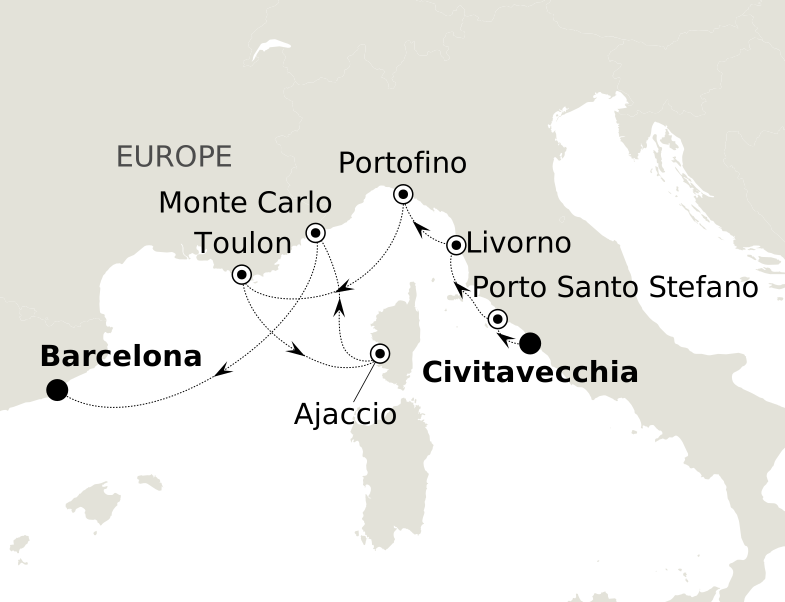
A 10-night ocean voyage aboard Silver Ray, Civitavecchia, Italy to Barcelona, Spain. Destination: Mediterranean.
Operated by Silversea Cruises aboard Silver Ray.
Civitavecchia (Rome)
Porto Santo Stefano
Livorno (Tuscany)
Portofino
Toulon
Ajaccio (Corsica)
Monte Carlo (Grand Prix)
Barcelona
All roads lead to Rome, and with good reason - this city is one of the world’s most thrilling, offering unmatched history along every street. An evocative, inspiring and utterly artistic capital of unrivalled cultural impact, Rome is a city of back-to-back landmarks, which will take you on an exhilarating journey through the ages. This may be one of the world’s oldest cities, but it’s well and truly lived in. The ruins are punctuated with murmuring cafes, and the outdoor seating of restaurants sprawls out across piazzas, enticing you to sample tangles of creamy pasta and crispy pizzas. Rome’s incredible Roman Forum is littered with the ruins of its ancient administrations, which have stood firm for 2,000 years, since the times when the area was the centre of the Western world. Few sites are more simultaneously beautiful and haunting than that of the storied Colosseum, which looms deep into Rome’s rich blue sky. Take a tour to learn details of the grisly goings-on within. The best way to experience Rome is to wander its streets, gelato in hand. There is a lot to see here - whether it’s the domed spectacle of the Pantheon, or the elaborate flowing waters and artistry of the Trevi Fountain. Vatican City is an astonishing, colossal display of Catholic grandeur, while the Spanish Steps – crowned by the Trinità dei Monti church – offer a beautiful spot to gather and soak up the lively atmosphere of this humming city. With so much on the to-do list, you’ll relish the breaks you take, enjoying simple pleasures like a strong espresso, or fresh pasta with tomato sauce and ripped basil.
A summer escape for Rome’s historic elite the stacked waterfront of Porto Santo Stefano is a secluded taste of idyllic southern Tuscany. Physically closer to Rome than Florence the city is strung to Italy’s western coast by two sandy harnesses and sits on the unqiue peninsula of Monte Argentario - which was once an island. Flamboyant pink flamingos and herons stroll through the encased lagoon while Porto Santo Stefano’s waterfront hums with clinking cafes and strolling visitors. The luxury yachts in the harbour show that Porto Santo Stefano has lost none of its luxury appeals and with beaches wild hikes and waterfront beauty it continues to lure visitors to this secluded escape. Known for its fishing and cuisine - which is based around heavy use of the Tyrrhenian Sea’s juicy bounty. Stroll to Piazza dei Rioni for a dripping lemon gelato or wander the streets noticing the lingering World War II damage – the city was heavily bombed during the conflict. Fortunately the historic star-shaped Spanish fort was spared and it still watches out resolutely over the waters. Rugged coastline falls to secluded beaches with a wilder unkempt charm. Sail the coves - seeing cascading olive groves - or island-hop to Giglio and Giannuti which lie 12 miles from shore and can be seen from the monastery topped Argentario mountain. On the other side of the promontory you’ll find Porto Ercole - where the lifeless body of the Old Master Caravaggio was discovered.
The Tower of Matilde is an iconic structure of the city of Livorno. This medieval tower is said to have been built by the famous mathematician and astronomer Galileo Galilei. It is named after Matilde di Canossa, an influential noblewoman who played a key role in the political and religious conflicts of the 11th century. Matilde was a powerful figure in medieval Italy, and her legacy is still felt in Livorno today. The tower was built on her orders as a defensive stronghold to protect the city against invaders, and its strategic location on the coast made it an important part of the city's defenses. Over the centuries, the Tower of Matilde has been restored and renovated several times, but it still retains its original medieval charm. The tower is a classic example of medieval architecture, with its thick walls, narrow windows, and imposing structure. The tower was later used as a watchtower during World War II and is now a popular tourist attraction as visitors can climb to the top and enjoy panoramic views of the surrounding area. The Tower of Matilde is also an important cultural landmark in Livorno. It is often used as a venue for cultural events and exhibitions, and its unique atmosphere and ambiance make it a popular destination for artists and writers.
The Tower of Matilde is an iconic structure of the city of Livorno. This medieval tower is said to have been built by the famous mathematician and astronomer Galileo Galilei. It is named after Matilde di Canossa, an influential noblewoman who played a key role in the political and religious conflicts of the 11th century. Matilde was a powerful figure in medieval Italy, and her legacy is still felt in Livorno today. The tower was built on her orders as a defensive stronghold to protect the city against invaders, and its strategic location on the coast made it an important part of the city's defenses. Over the centuries, the Tower of Matilde has been restored and renovated several times, but it still retains its original medieval charm. The tower is a classic example of medieval architecture, with its thick walls, narrow windows, and imposing structure. The tower was later used as a watchtower during World War II and is now a popular tourist attraction as visitors can climb to the top and enjoy panoramic views of the surrounding area. The Tower of Matilde is also an important cultural landmark in Livorno. It is often used as a venue for cultural events and exhibitions, and its unique atmosphere and ambiance make it a popular destination for artists and writers.
Effervescent and exclusive, Portofino rests on a privileged peninsular. Lavish yachts mingle together, seeking out sought-after berths in the harbour, while gelato drips onto the stone-paved streets in this, the most alluring and glamorous town of the Italian Riviera. This section of the Ligurian Coast is a protected area, and home to some of the country’s most picturesque, and jaw-dropping scenery - which is best viewed from the deck of a sailing boat. Crisp white villas roll out across the verdant green hillsides, surrounded by laden vineyards and olive groves. Down in Portofino itself, the buzz of chatter and the clatter of cutlery, provide the soundtrack to busy terrace bars and restaurants, which serve up fine food and delicious sea views. Portofino’s achingly beautiful harbour arcs around the lapping waves, with a warmly-hued waterfront of peach and apricot colours - which also adorns postcards and promotional travel guides of Italy. For the authentic Portofino experience, sail out onto the tranquil waters of the Gulf of Tigullio, to mingle amongst the privileged at play, or settle back in the shade as you take aperitivo on the picturesque waterfront Piazzetta. Here you can sip the famous Ligurian wines, and stave off hunger with focaccia con il formaggio - or platters of fine cheese and hams. Deeper into Portofino, you’ll find artisans crafting their wares and weaving together lace, or you can ascend to viewpoints like the lemon shaded Church of San Giorgio, to look over the pretty jumble from up above. A wander out along the headland to the tapering tip of the peninsular, rewards with the views of Portofino’s iconic white lighthouse beaming out light and welcoming ships to this slice of Riviera heaven.
Built around a sheltered bay, with 1,700-foot Mount Faron as an impressive backdrop, Toulon is an important naval port and a city of industry and manufacturing. Its large harbor serves as the base for the French navy's Mediterranean fleet and as the home to a sizeable marina, with yachts and pleasure boats adding bright splashes of color. Toulon was the site where Napoleon Bonaparte first made a name for himself in 1793 during a siege in which the English, who had taken over Toulon, were expelled. During World War II, the bulk of the French fleet anchored off Toulon was scuttled by French crews to prevent its acquisition by occupying German forces. The city was liberated in 1944 by French troops. A maze of pedestrian streets constitutes the heart of old Toulon. Shops and colorful stalls make it an attractive area to explore. Avenue de la République runs parallel to the waterfront. At the western edge of the quay is the Naval Museum featuring an excellent collection of old and new ship models, figureheads, paintings and other items related to Toulon’s maritime history. The town’s attractions can be seen in a fairly short time. Most visitors come here to explore the hinterland and other parts of the Riviera.
Famed as the island birthplace of French Emperor, Napoléon Bonaparte, Ajaccio has made a towering contribution to European history. Bonaparte may be omnipresent in Ajaccio – with statues watching out over palm-tree lined boulevards bearing his name - but there is a lot more to this charming city, where an unhurried Mediterranean attitude mixes with the trendy buzz of a French Riviera resort. The stunning setting pairs glowing blue water with a dramatic backdrop of towering, snow-capped peaks. Bonaparte may have been famously short in stature, but he stands as a true giant of history. The National Bonaparte Museum is the ideal place to learn more of his life, in the very house where he was born in 1769. Just inside the modest Cathedral Notre-Dame-de-l'Assomption – surrounded by frescoed walls – you’ll also see the stone font where he was baptised. Elsewhere, the perched watchtower of Îles Sanguinaires is a short boat ride away, or Plage de Capo di Feno’s stunning, isolated band of white sand and transparent waters may tempt you outside of the historic city. Settle at a restaurant near the harbour to taste succulent wild boar, stewed in rich red wine casserole, or to crack into soft lobster meat. You also have to enjoy the famous fiadone cheesecake made from local brocciu cheese while you’re here, and to let the magic of unique Corsican Polyphony music carry you away. Three singers expertly blend harmonies to create a spine-tingling combination of melody – you’ll notice the distinctive style, as they each cover an ear to focus more clearly on their individual contribution.
The smell of octane in the air, the power of Formula One engines hurtling round hairpin bends, the palpable excitement you could cut with a knife… it can only mean one thing… Yes, it’s the Monaco Grand Prix! For four days the tiny principality bursts into life in Technicolor, for an event that is truly not to be missed. This is the jewel in the crown of Formula One experiences, not just because it is attended by the jet set, celebrities and royalty alike. For drivers it is the race they all want to win. But, with the prestige comes added competition, overtaking on the narrow streets is near impossible and speed is strictly controlled. If F1 wasn’t cutthroat at the best of times, the Monaco Grand Prix certainly ramps it up to a whole new level. The race takes place on the actual streets of the one square mile country – bringing normal business to a complete standstill. Yet, this is taken by local residents on the chin (all schools and many businesses actually close during the four days), and the party feeling that permeates the Principality for the duration extends to locals and visitors alike. However, if you do need to get away from the madding crowd, the nearby Eze village is a medieval world away from the hustle and bustle. Nice, a short drive away, offers a chance to enjoy a more authentic side to the Riviera. Stroll the gorgeous Promenade des Anglais, shop up a storm in the Old Town and enjoy the national pastime of watching the world go by. A chilled glass of rosé in hand, bien sur!
The smell of octane in the air, the power of Formula One engines hurtling round hairpin bends, the palpable excitement you could cut with a knife… it can only mean one thing… Yes, it’s the Monaco Grand Prix! For four days the tiny principality bursts into life in Technicolor, for an event that is truly not to be missed. This is the jewel in the crown of Formula One experiences, not just because it is attended by the jet set, celebrities and royalty alike. For drivers it is the race they all want to win. But, with the prestige comes added competition, overtaking on the narrow streets is near impossible and speed is strictly controlled. If F1 wasn’t cutthroat at the best of times, the Monaco Grand Prix certainly ramps it up to a whole new level. The race takes place on the actual streets of the one square mile country – bringing normal business to a complete standstill. Yet, this is taken by local residents on the chin (all schools and many businesses actually close during the four days), and the party feeling that permeates the Principality for the duration extends to locals and visitors alike. However, if you do need to get away from the madding crowd, the nearby Eze village is a medieval world away from the hustle and bustle. Nice, a short drive away, offers a chance to enjoy a more authentic side to the Riviera. Stroll the gorgeous Promenade des Anglais, shop up a storm in the Old Town and enjoy the national pastime of watching the world go by. A chilled glass of rosé in hand, bien sur!
Days at sea are the perfect opportunity to relax unwind and catch up with what you’ve been meaning to do. So whether that is going to the gym, visiting the spa, whale watching, catching up on your reading or simply topping up your tan these blue sea days are the perfect balance to busy days spent exploring shore side.
Having attracted over 82 million visitors in 2017, Spain is gaining popularity as a travel destination. The country lures travellers from across the world with its promise of authenticity, charisma, and memorable moments. Spain’s culture is a celebration of the finer things in life, an expression of spirit, heritage and fun: colourful fiestas, delectable cuisine, age-defining art, music, dance, sport and so much more. Each region of the country has evolved a character of its own, meaning the country is unified by a sense of cultural multiplicity. Barcelona, the capital of Catalonia, is a masterpiece that embellishes the Spanish canvas. The fact that the Barcelona’s iconic cathedral, La Sagrada Familia, is still under construction over 141 years after construction commenced pays testament to the city’s artistic perfectionism, which pervades all aspects of life here. Apparent in the city’s architecture, layout, and cultural practices, aestheticism retains its value here. Antoni Gaudí, whose iconic style of modernist architecture is among Barcelona’s leading attractions, could perhaps be credited with designing the face of this magnificent city. Enjoy getting to know the vivacious personality behind Barcelona’s beauty.
From $11,700
per guest · 10 nights
Prices are a guide and vary with season, cabin category and party size. Your advisor will confirm the exact cost before anything is booked.
Classic Veranda
suite
Deluxe Veranda
suite
Grand 1 Bedroom
suite
Junior Grand 1 Bedroom
suite
Junior Grand 2 Bedroom
suite
Master
suite
Medallion
suite
Otium
suite
Owner 1 Bedroom
suite
Owner 2 Bedroom
suite
Premium Medallion
suite
Premium Veranda
suite
Signature
suite
Silver
suite
Superior Veranda
suite








