




Prefer a conversation?
Our team is always available to guide you through the process and ensure your experience is perfectly matched to your preferences.
Our team is always available to guide you through the process and ensure your experience is perfectly matched to your preferences.
Duration
8 Nights
Price
From $6,750
Ship
Silver Dawn
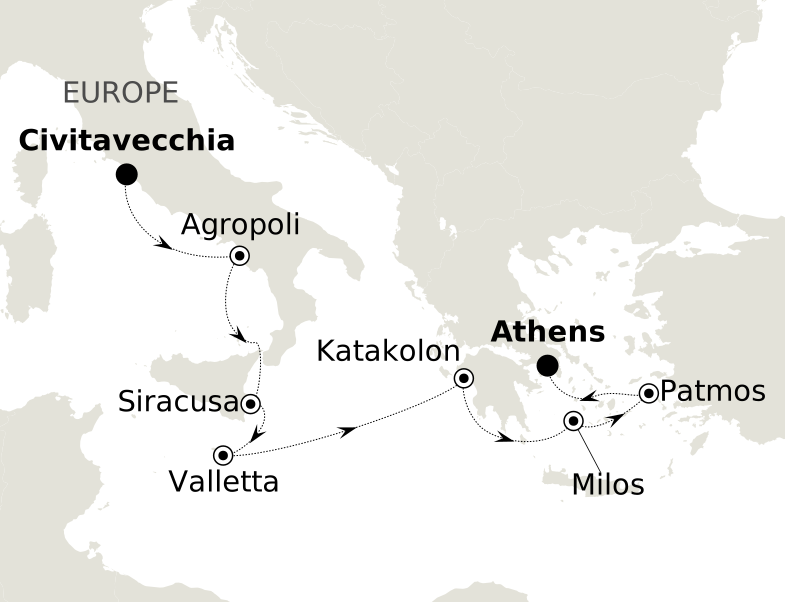
A 8-night ocean voyage aboard Silver Dawn, Civitavecchia, Italy to Athens, Greece. Destination: Mediterranean.
Operated by Silversea Cruises aboard Silver Dawn.
Civitavecchia (Rome)
Agropoli
Siracusa (Sicily)
Valletta
Katakolon (Olympia)
Milos, Nisos Melos
Patmos
Athens (Piraeus)
All roads lead to Rome, and with good reason - this city is one of the world’s most thrilling, offering unmatched history along every street. An evocative, inspiring and utterly artistic capital of unrivalled cultural impact, Rome is a city of back-to-back landmarks, which will take you on an exhilarating journey through the ages. This may be one of the world’s oldest cities, but it’s well and truly lived in. The ruins are punctuated with murmuring cafes, and the outdoor seating of restaurants sprawls out across piazzas, enticing you to sample tangles of creamy pasta and crispy pizzas. Rome’s incredible Roman Forum is littered with the ruins of its ancient administrations, which have stood firm for 2,000 years, since the times when the area was the centre of the Western world. Few sites are more simultaneously beautiful and haunting than that of the storied Colosseum, which looms deep into Rome’s rich blue sky. Take a tour to learn details of the grisly goings-on within. The best way to experience Rome is to wander its streets, gelato in hand. There is a lot to see here - whether it’s the domed spectacle of the Pantheon, or the elaborate flowing waters and artistry of the Trevi Fountain. Vatican City is an astonishing, colossal display of Catholic grandeur, while the Spanish Steps – crowned by the Trinità dei Monti church – offer a beautiful spot to gather and soak up the lively atmosphere of this humming city. With so much on the to-do list, you’ll relish the breaks you take, enjoying simple pleasures like a strong espresso, or fresh pasta with tomato sauce and ripped basil.
Honey-coloured Siracusa is a staggering UNESCO World Heritage Site, and an extraordinary Sicilian city of immense ancient history. The modern population is a fraction of what it was at the city’s heyday around 400 BC, when Athens’ might was successfully challenged and faced down, reinforcing the city’s incredible power and status. Siracusa’s historical nucleus waits to be discovered on the compact islet of Ortygia. The city was founded here, but grew over time, spreading across to the mainland. A small channel separates the two, which is now spanned by twin bridges. Wander the atmospheric streets of this time warp, to reach the shining elegance of Piazza Duomo. The Baroque cathedral rises like a giant sandcastle, and you can settle opposite to cradle a glass of wine and enjoy the view over the immaculate square - people watching before the glorious baroque façade. Dig deep into its history at the mainland's archaeological park. Here you can wander between the remains of a Greek theatre, constructed in the 5th century BC, and now used as a grandiose, atmospheric venue for events and performances. You’ll also encounter a Roman Amphitheatre - where gladiators battled brutally, and the spectacular ear-shaped cave, which is famed for its extraordinary, secret-revealing acoustics. It was given its name - the Ear of Dionysius - by Caravaggio. Visit the legendary Fonte Arethusa, or lose yourself in the Ortygia Market – you’ll find everything here, from fresh fish, to spices and local bottles of wines. Look out for a flavour-filled jar of real Sicilian u strattu - an intense tomato paste that is the secret ingredient to many Sicilian recipes. The local ingredients are imbued with flavour by this volcanic land’s fertile soils and the firepower of Europe’s most active volcano Mount Etna, waits just to the north.
Perched high on the imposing Sciberras Peninsula, Valletta immediately presents its massive, protective walls and vertical bastions to visitors arriving by sea. Rising to 47 metres in places, the fortifications protect lavish palaces, grand domes and illustrious gardens. Built by the Knights of St John on the narrow peninsular, Valletta is a compact, richly historical treasure trove of Baroque wonders. Ascend to reach the restful, flower-filled Upper Barrakka Gardens, where cannons fire and boom in salute at noon each day, sending echoing cracks of noise out across the waves below. Recognised as 2018’s European Capital of Culture, Valletta is a fascinating and dense haven of history and intrigue. A busy, bustling capital, the breathtaking St John’s Cathedral - commissioned in 1572 - is almost concealed among its narrow streets. The relatively modest exterior is counterpointed by a staggeringly opulent, gold-leaf bathed interior, containing a Caravaggio masterpiece - the shadowy vision of the Beheading of St John. Cinematic and magnificent, Valletta has served as a filming location for Game of Thrones - but real epic history abounds on this rocky isle too. From the prehistoric and megalithic sites of the Hypogeum of Paola and Tarxien, to the fascinating War Museum at Fort St Elmo. Mdina also waits nearby, and the former medieval capital is a striking contrast to the island’s main city. Cars are barred from its streets, and it offers endlessly atmospheric old-time wanders. With a strategic positioning in the Mediterranean, Malta is a jewel that many have wrestled for over the centuries. Independence from Britain was finally achieved in 1964, but the close allegiance remains evident, with English recognised as an official language, cars driving on the left, and red post boxes and telephone gleaming in Malta’s sunshine.
Days at sea are the perfect opportunity to relax unwind and catch up with what you’ve been meaning to do. So whether that is going to the gym, visiting the spa, whale watching, catching up on your reading or simply topping up your tan these blue sea days are the perfect balance to busy days spent exploring shore side.
Holding the torch as the spiritual home of the Olympic Games Olympia has an enduring legacy and its values echo around the world during humanity’s greatest sporting contest. Come ashore at Katakolon - a small port village on the Peloponnese peninsula facing the Ionian Sea and relax on beautiful Kourouta Beach. Or head inland through this legendary destination to the historic home of the Olympic Games. Located in the valley of the River Alfeios Olympia is a staggering archaeological site of immense ruins and enduring legacy. Visit the museum and Olympia Stadium - where the ancient games were held in honour of the Greek god Zeus. As many as 45 000 spectators fit into the mud seats to witness the ultimate contest of athleticism. See the stand where judges would sit and the white blocks where runners would line up to compete. The tradition continues stronger than ever and the Olympic flame of the modern games is ignited by the sun here in the ruins of the Temple of Hera. It is then taken to spread the Olympic values across the globe. The Temple of Zeus and the Statue of Zeus - one of the Seven Wonders of the Ancient World - also rose here in all of their glory. Hewn from limestone the temple contained the 13-metre tall statue of Zeus which was sculpted by Phidias - one of Ancient Greece's finest artists. Although the statue has been destroyed you can walk the temple's ruins and see the guesthouse where the majestic wonder was painstakingly crafted.
Milos, one of the thousands of Greek islands, is to be found in the SW Cyclades, a large island group in the Aegean Sea. It is 86 nautical miles from Piraeus and approximately half way between Piraeus and Crete. Its surface area is 151 square kilometres and its varied coastline is 125 kilometres long. Adamas is the main port of Milos and also a seaside village of white houses shimmering on the blue waters of the Aegean. This village was founded in 1835 by refugees from Sfakia who came from Crete after the failure of their rebellion against the Turks From these times and on, Adamas became increasingly important historically because of its large, safe, naturally made harbour, and its strategic position in the eastern Mediterranean Adamas is surrounded by many beaches and offers various touristy facilities such as banks, post-office, doctors, tourist agencies, port police. Many old churches as well as mining and ecclesiastical museums are worth visiting. The geographical bearing of its capital, Plaka, is 36o 44' 35'' longitude, 24o 25' 28'' latitude. In general terms, it is a low island, whose highest peak is Prophet Elias in the north-west, rising to 751 metres. The Small Mountain in the same area is 636 metres high, while no other peak reaches over 400 metres. Its’ most characteristic feature is its magnificent gulf, providing a natural harbour, which is possibly the largest in the Mediterranean. This, in combination, with the island’s vast mineral wealth, has played and is still playing, a major role in the history, economy, culture and development of the island society throughout the last 7,000 years. Most of the inhabitants live in the 8 villages, which are in the flat, northern part of the island. These are the capital Plaka, Plakes, Triovassalos, Pera Triovassalos, Tripiti, Pollonia, Zefiria, and Adamas. Officially, Milos is part of the county of the Cyclades, whose capital is the town of Ermupolis, on the island of Syros. However, de-centralisation of the administration has been achieved by sub-dividing the county into four provinces. One of these is Milos province, incorporating the Western Cycladic islands, Kimolos, Siphnos and Seriphos and with its administrative capital on Milos. Its geological make-up, which will be dealt with later, is volcanic. However, this formation, which is different from that of the rest of the Cyclades group (with the exception of Kimolos), is the reason for the island's lack of forests, rich vegetation, natural water supplies and rivers. Never the less, it has given it colour. This unique Milos colour, is dazzlingly evident in its multitude of beautiful beaches - more than 75- with their glistening silver sand and clear blue waters. Also in the chalky white, terracotta, ochre and jet black rocks, the like of which can be seen nowhere else in the whole of Greece. CRUISE SIGHTS Church Of Agia Triada The church of Agia Triada (Holy Trinity) is located in the centre of Adamas, the port of Milos. This church dates from the 17th century and it houses a small ecclesiastical museum. Mineralogical Museum This museum was established to help promote the effects of mining in the history of Milos and to display the mineral wealth of the island. It is located at the waterfront in Adamas. Ancient Theatre This theatre was probably constructed in the Hellenistic times. However, today only the Roman phase of this monument survives. It is located close to Catacombs. CRUISE SHOPPING There are quite a few souvenir shops in Adamas and Plaka, where you can get your own copy of Aphrodite and some Greek souvenirs and local products. CRUISE ACTIVITIES Beaches: Sarakiniko - Location: 4 km east of Plaka - Location: 4 km east of Plaka Description: This beach is one of the most beautiful beaches of Milos and surely the most particular one. It is located along the coastal road east of Adamas, north-east of Milos. It is the most photographed spot of the island. Its particular landscape is very impressive and surely unforgettable: long horizontal rocks bent over the sea; those rocks are eroded by time and salt water, and have small and huge hollows all over them. The entire landscape formed by the volcanic rocks doesn't show any signs of vegetation and is coloured entirely in a bright white, which makes an interesting contrast with the deep blue and turquoise of the surrounding waters. This amazing scenery gives one the impression of standing on the surface of the moon. Agia Kiriaki- Location: 14 km south east of Plaka - Location: 14 km south east of Plaka Description: From Zefiria a road leads to the beautiful coast of Agia Kyriaki, an organized beach with pure white sand and emerald crystal-clear waters. Firiplaka – Location: 15 km south east of Plaka – Location: 15 km south east of Plaka Description: Firiplaka Beach Milos: Right next to the lovely beach of Tsigrado lies the superb beach of Firiplaka. It is a long beach with silver sand and huge coloured rocks forming its coastline. The waters in Firiplaka are really exotic: crystalline and shallow green-blue, they never fail to enchant anyone who had the chance to swim in them. Papafragas - Location: 10 km east of Plaka - Location: 10 km east of Plaka Description: After Kapros one can find the idyllic landscape of Papafragas, one of the most impressive sites of Milos. From the top of the rock, it resembles a huge natural swimming pool, an enormous cave carved out of the cliff’s side. A tiny path leads to the tiny strip of sand that forms the beach. Crystalline waters of changing colours, depending on the weather and the light, welcome the visitor and invite him to enjoy their coolness. Deep dark sea caves surround the place. The most ancient site of Milos is just a few metres away: the amazing Papafragos, the ancient town of Phylakope,. The few remaining ruins of walls, buildings and tombs are now almost entirely covered by the water, but still bear witness of the life and civilisation existing there during the Neolithic period. Provatas - Location: 13 km south east of Plaka - Location: 13 km south east of Plaka Description: The beautiful beach of Provatas is located in the south-western side of Milos. Small hotels, good restaurants and the beauty of the place are more than enough to attract many visitors every summer. Huge multi-coloured rocks, golden sand and limpid waters complete the superb image of Provatas. Tsigrado - Location: 14 km south east of Plaka - Location: 14 km south east of Plaka Description: Tsigrado is one of the most beautiful southern beaches of Milos. Located right next to Firiplaka, Tsigrado is a small sandy cove with crystal water. Going down this beach is a bit difficult as visitors have to pass through a rocky passage to get there. The surrounding environment with the rocky cliffs is quite impressive.
The seahorse-shaped Patmos is a Greek island of stunning seascapes and immense cultural significance.Whether you’re religious or not there is something of the divine in this gorgeous island - a place of sanctuary fringed by crystal-clear waters and blissful beaches. Sleepy whitewash towns gleam in the strong sunshine while cats slink between the crumbling walls of this ruggedly beautiful island. High on the hillside above the cobalt-blue bay you’ll find the sacred chapel where an exiled John of Patmos is said to have entered the Cave of the Apocalypse and prophesied of the end of the world’s fire and brimstone – a striking juxtaposition with the peaceful serenity of the calm location. Higher up you’ll find the 11th-century Monastery of St. John which offers spectacular views of the island’s mounds curving around like a scorpion’s tail. It stands watching over the island like a fortified crown. Sun-wrinkled black-robed monks climb the streets up to this World Heritage site where bells peel out melodically. Inside vaulted chambers and stunning frescoes tell stories amid the striking religious iconography. Chora’s incredible narrow streets - moulded white - are an enchanting place to lose your bearings spreading below the monastery. Elsewhere blissful beaches stretch out across the coastline or this remote Greek island’s curves can be admired while bobbing offshore in a sailboat.
A city of legend, civilisation and enduring culture, Athens is a majestic and magical urban sprawl. Extraordinary elegance and grace combine with grit and graft in Greece's capital, where highways encase ruins from antiquity, and gleaming museums and galleries stand beside concrete sprayed with edgy street art. These contrasts enhance and elevate the wonders of this 2,500-year-old city, however, which can count notable contributions to philosophy, drama and democracy, among its global legacy. Piraeus' giant port and naval base welcome you to the edge of the Athens' urban area. From there it's a simple jaunt to the centre. The majestic ancient citadel of the Acropolis dominates an elevated platform and is a constant presence as you explore the city. The wonderful remains of the columned temple of the Parthenon - which date back to the 5th century BC - stand here, representing the pinnacle of classical architecture. The nearby Acropolis Museum adds context to your visit and frames the broad views from its giant glass windows. Or rise up Mount Lycabettus, to be rewarded with perhaps Athens' best panorama of the Acropolis sitting high over the city on its grand stage. See the marble horseshoe of the Old Olympic Stadium, where the first modern Olympics were held in 1896, for more of the city's enduring legacy. Elsewhere, golden beaches and temples stretch out along the coastline, should you wish to explore a little further afield. Coffee is an art form to the Greeks, and it's an unwritten rule that coffee time must never be rushed. So prepare to settle down for a couple of hours and lose yourself in a good chat. Feeling hungry - try traditional souvlaki made with sauces handed from generation to generation.
From $6,750
per guest · 8 nights
Prices are a guide and vary with season, cabin category and party size. Your advisor will confirm the exact cost before anything is booked.
Classic Veranda
suite
Deluxe Veranda
suite
Grand 1 Bedroom
suite
Grand 2 Bedroom
suite
Owner 1 Bedroom
suite
Owner 2 Bedroom
suite
Panorama
suite
Royal 1 Bedroom
suite
Royal 2 Bedroom
suite
Silver
suite
Silver 2 Bedroom
suite
Superior Veranda
suite
Vista
suite








