




Prefer a conversation?
Our team is always available to guide you through the process and ensure your experience is perfectly matched to your preferences.
Our team is always available to guide you through the process and ensure your experience is perfectly matched to your preferences.
Duration
11 Nights
Price
From $9,800
Ship
Silver Dawn
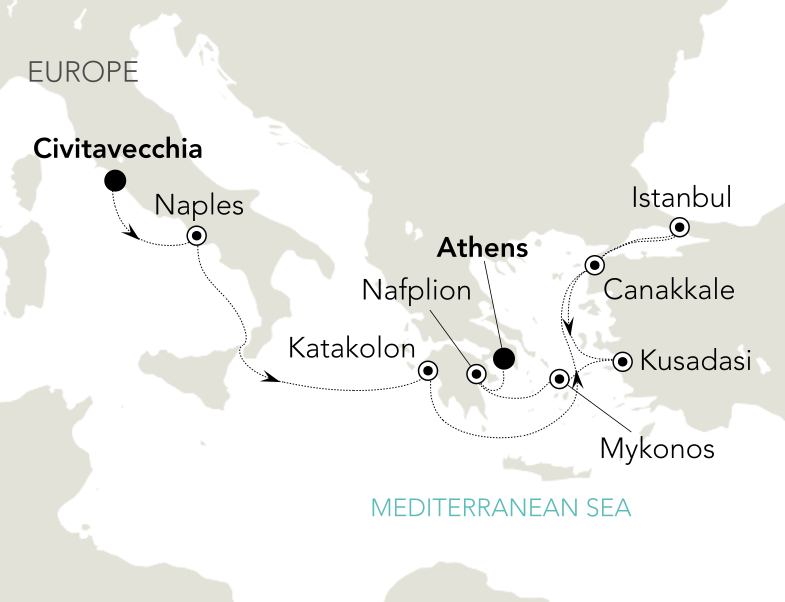
A 11-night ocean voyage aboard Silver Dawn, Civitavecchia, Italy to Athens, Greece. Destination: Mediterranean.
Operated by Silversea Cruises aboard Silver Dawn.
Civitavecchia (Rome)
Naples
Katakolon (Olympia)
Istanbul
Canakkale
Kusadasi
Mykonos
Nafplion
Athens (Piraeus)
All roads lead to Rome, and with good reason - this city is one of the world’s most thrilling, offering unmatched history along every street. An evocative, inspiring and utterly artistic capital of unrivalled cultural impact, Rome is a city of back-to-back landmarks, which will take you on an exhilarating journey through the ages. This may be one of the world’s oldest cities, but it’s well and truly lived in. The ruins are punctuated with murmuring cafes, and the outdoor seating of restaurants sprawls out across piazzas, enticing you to sample tangles of creamy pasta and crispy pizzas. Rome’s incredible Roman Forum is littered with the ruins of its ancient administrations, which have stood firm for 2,000 years, since the times when the area was the centre of the Western world. Few sites are more simultaneously beautiful and haunting than that of the storied Colosseum, which looms deep into Rome’s rich blue sky. Take a tour to learn details of the grisly goings-on within. The best way to experience Rome is to wander its streets, gelato in hand. There is a lot to see here - whether it’s the domed spectacle of the Pantheon, or the elaborate flowing waters and artistry of the Trevi Fountain. Vatican City is an astonishing, colossal display of Catholic grandeur, while the Spanish Steps – crowned by the Trinità dei Monti church – offer a beautiful spot to gather and soak up the lively atmosphere of this humming city. With so much on the to-do list, you’ll relish the breaks you take, enjoying simple pleasures like a strong espresso, or fresh pasta with tomato sauce and ripped basil.
The legend of the Siren Parthenope Naples' foundation is not only shrouded in one but two legends, all having one 'person' in common: the siren Parthenope. She and her sisters, Leucosia and Ligaea, are the three resident sirens of the Galli Islands, with their "shores all bleached with human bones and debris", who lured sailors with their enchanting voices and music, only for them to run aground and perish. Parthenope was precisely this magical, murderous voice, while Leucosia and Ligaeus played the flute and citara. The first legend is linked to Ulysses, the first man not to succumb to the siren's call, thanks to Circe's advice. Curious but not mad, he ordered his sailors to plug their ears with wax and tie him firmly to the mast. In this way, he was able to enjoy the pleasure of hearing the music and songs without paying a high price. There are different stories here, some claiming that Parthenope fell in love with Ulysses, others not. In any case, the three sisters, in despair and humiliation, threw themselves into the sea and died. If you are surprised to read that, keep in mind that we're talking about sirens from Antiquity, young women transformed into half-woman half-bird monsters, punished by the goddess Demeter for not having stopped Hades, the god of the Underworld, from kidnapping their mistress Persephone (and daughter of Demeter). Mermaids with fish tails only appeared in the Middle Ages. So, Parthenope and her sisters perished. Their bodies were carried by the sea to Terina for Ligaea and Licosa for Leucosia. Parthenope's body was carried by the waves to the island of Megaride, Naples, where the Castel dell'Ovo stands today. She gave her name to the town and the inhabitants worshipped her, making her the town's patron saint. Another legend exists, from the 19th century. A centaur - Vesuvius - fell madly in love with our siren Parthenope, provoking the jealousy of Zeus. In revenge, he turned the centaur into a volcano. In despair, Parthenope committed suicide and her body washed up in Naples, allowing her to be close to her lover in death. Today there are three fountains dedicated to her: the Fontana delle Zizze (Neapolitan for 'nipples') beside Corso Umberto I with its winged mermaid, a second on the Piazza Jacopo Sannazzaro in Piedigrotta and a third, modern, near the shops at the Central Station. Naples is still referred to as the "Parthenopean city".
Days at sea are the perfect opportunity to relax unwind and catch up with what you’ve been meaning to do. So whether that is going to the gym, visiting the spa, whale watching, catching up on your reading or simply topping up your tan these blue sea days are the perfect balance to busy days spent exploring shore side.
Holding the torch as the spiritual home of the Olympic Games Olympia has an enduring legacy and its values echo around the world during humanity’s greatest sporting contest. Come ashore at Katakolon - a small port village on the Peloponnese peninsula facing the Ionian Sea and relax on beautiful Kourouta Beach. Or head inland through this legendary destination to the historic home of the Olympic Games. Located in the valley of the River Alfeios Olympia is a staggering archaeological site of immense ruins and enduring legacy. Visit the museum and Olympia Stadium - where the ancient games were held in honour of the Greek god Zeus. As many as 45 000 spectators fit into the mud seats to witness the ultimate contest of athleticism. See the stand where judges would sit and the white blocks where runners would line up to compete. The tradition continues stronger than ever and the Olympic flame of the modern games is ignited by the sun here in the ruins of the Temple of Hera. It is then taken to spread the Olympic values across the globe. The Temple of Zeus and the Statue of Zeus - one of the Seven Wonders of the Ancient World - also rose here in all of their glory. Hewn from limestone the temple contained the 13-metre tall statue of Zeus which was sculpted by Phidias - one of Ancient Greece's finest artists. Although the statue has been destroyed you can walk the temple's ruins and see the guesthouse where the majestic wonder was painstakingly crafted.
Days at sea are the perfect opportunity to relax unwind and catch up with what you’ve been meaning to do. So whether that is going to the gym, visiting the spa, whale watching, catching up on your reading or simply topping up your tan these blue sea days are the perfect balance to busy days spent exploring shore side.
A chaotic, colossal collision of east and west – start your day in Europe and end it in Asia, all without breaking a sweat. Sprawling across two continents, the city has been toed, froed and yanked between countless civilisations over its history, leaving a multi-layered, majestic tapestry of culture to untangle. An army of narrow minarets puncture the skyline, while the soaring towers of palaces and labyrinths of bazaars - where bargains are the reward for brave hagglers - fill up this dynamic city of 15 million people. With a rich portfolio of Byzantine and Ottoman architecture, Istanbul enjoys one of the world's most dynamic skylines and has an intense, infectious energy. The vast Aya Sofya is the starting point for exploring this huge city's deep wealth of cultural treasures. Built in the 6th century as a Greek Orthodox church, it was later transformed into an Ottoman imperial mosque – and latterly a museum. Cast your eyes up to take in the full scale of the colossal dome, one of the world's largest, which floats on a magnificent bed of light. See the Blue Mosque, with its glorious blue İznik tiles, or head to the Galata Tower which was once the tallest structure in Istanbul, and is ideal for a panoramic view of the city. Grab handfuls of dates and spices, shop for jewellery and patterned fabrics as you're swallowed whole by the Grand Bazaar - one of the world's biggest and busiest covered indoor markets. To understand Istanbul is to visit its kahvehans. Few rituals are taken as seriously as Turkish coffee - prepared to be incredibly strong. Sweeten the aftertaste with Turkish delight, or baklava – try the smooth pistachio version called kuru baklava.
A chaotic, colossal collision of east and west – start your day in Europe and end it in Asia, all without breaking a sweat. Sprawling across two continents, the city has been toed, froed and yanked between countless civilisations over its history, leaving a multi-layered, majestic tapestry of culture to untangle. An army of narrow minarets puncture the skyline, while the soaring towers of palaces and labyrinths of bazaars - where bargains are the reward for brave hagglers - fill up this dynamic city of 15 million people. With a rich portfolio of Byzantine and Ottoman architecture, Istanbul enjoys one of the world's most dynamic skylines and has an intense, infectious energy. The vast Aya Sofya is the starting point for exploring this huge city's deep wealth of cultural treasures. Built in the 6th century as a Greek Orthodox church, it was later transformed into an Ottoman imperial mosque – and latterly a museum. Cast your eyes up to take in the full scale of the colossal dome, one of the world's largest, which floats on a magnificent bed of light. See the Blue Mosque, with its glorious blue İznik tiles, or head to the Galata Tower which was once the tallest structure in Istanbul, and is ideal for a panoramic view of the city. Grab handfuls of dates and spices, shop for jewellery and patterned fabrics as you're swallowed whole by the Grand Bazaar - one of the world's biggest and busiest covered indoor markets. To understand Istanbul is to visit its kahvehans. Few rituals are taken as seriously as Turkish coffee - prepared to be incredibly strong. Sweeten the aftertaste with Turkish delight, or baklava – try the smooth pistachio version called kuru baklava.
Canakkale, Turkey Canakkale is the main city of the province of the same name situated on both sides of the Dardanelles and with its shores touching both Europe and Asia Minor. The city has been strategically significant for millennia as a crossover point of migrants, traders and armies. Today, colourful yachts pass through the strait and stop at Canakkale to visit this historically rich area, home to many widely known legends. During its turbulent history it saw the Persian king Xerxes make the crossing in 481 BC, Alexander the Great followed about 150 years later and the Ottoman armies invaded Europe from here. But the two most important battles were the mythological war of Troy, immortalized by Homer in his Iliad, and during World War I when Turkish troops under Mustafa Kemal Ataturk defended the region against enemy forces. To honour the 500,000 soldiers who gave their lives at Gallipoli, the peninsula has been made a national park of remembrance. Visitors to Canakkale come to see the modern Trojan horse that has been erected at the site of Troy as the symbol of the fabled war and to view the nearby battlefields and war memorials of Gallipoli. Going Ashore in Canakkale Pier Information The ship is scheduled to dock at Canakkale Kepez Pier. The centre of town is approximately 3 miles (5 km) from the ships berth. Taxis are generally available at the pier entrance. Shopping Traditional crafts, such as ceramic pots and as well as wines produced in the Bozcaada and Gokceada regions are a suggested purchase. The market is located in the adjoining streets behind the clock tower. Cuisine Not particularly known for haute cuisine, Canakkale's best eateries are located in area hotels. A most enjoyable and inexpensive meal may be taken along the waterfront close to the ferry docks. A regional favourite is "pideci" a flat bread topped with whole eggs, cheese and ground lamb, dabbed with butter and baked. Other Sights The town tourist office is located across from the clock tower near the ferry docks. Cannon Monument In the broad main street at the centre of town is a monument constructed of WWI cannons and commemorates a battle fought on March 18, 1915. Military Zone The Military & Naval Museum is located at the southern end of the waterfront. Within is a mock-up of the old minelayer Nusrat and memorabilia of the battle of Gallipoli. Archaeology Museum Located on the road to Troy, the museum houses chronologically arranged exhibits of fossils and implements of Troy and Dardanos. Private arrangements for independent sightseeing may be requested through the Shore Concierge Office on board.
Explore the towering columns, and storied remains of Ephesus - one of the most spectacular cities left by the Ancient Greeks. Kusadasi welcomes you to the Turkish coastline and is your base for exploring these majestic remains, which sit just 10 miles inland from the port. The Ephesus UNESCO World Heritage Site is a true archaeological gold mine, and an amazingly well-preserved site - once home to 150,000 people. The grand Temple of Artemis rose up majestically here and was recognised as one of the Seven Wonders of the Ancient World before its untimely destruction. The grand city was a fitting location for such a wonder, and with a mere 20% estimated to have been uncovered, the scale and majesty of Ephesus is hard to fully comprehend, as you walk its ancient streets. Visit the precious Library of Celsus - a gorgeous, double-layered façade of columns and artistry - and enjoy the city's gently illuminated, atmospheric venues - which still host stirring evening concerts. Ephesus's museum adds context to the 25,000 treasures that are exhibited within. After a long hot day exploring, recharge with a perfectly-charred and seasoned kebab or vegetable and rice stuffed grape leaves like dolma. In Kusadasi itself, you can discover a lively seaside city with a buzzing Aegean beach scene, and a glut of restaurants and cafes to kick back in.
Indulge in idyllic island life, as you take your fill of superb foods and wines, and soak in endless views of sweeping turquoise seascapes and pretty whitewash buildings. Known for its lively nightlife and rejuvenating, care-free outlook, Mykonos is a dazzlingly beautiful island escape. The secret is well and truly out, but nonetheless, Mykonos has managed to retain the enduring, exclusive allure that first drew celebrities like Brigitte Bardot to its star-studded shores. True to its roots, Mykonos is a rich land of culture, tradition and swirling legend, and the island is said to be built on the frozen bodies of giants slain by Hercules and to have been the legendary battleground between Zeus and the Titans. Head out onto the crystalline waters to seek out serene islands, hit perfect beaches, or venture into the labyrinth of Mykonos Town. White facades, red roofs and cobalt blue shutters add to this lively town’s appeal. Explore narrow streets housing studios – where artisans piece together mosaics - and plenty of restaurants and bars offer sanctuary. Head to Little Venice for a waterfront view of one of the island’s famed sunsets, and to enjoy an aperitif of the favourite aniseed liqueur, ouzo. Boasting numerous attractive sandy coves, a wealth of top-notch restaurants, and rich cultural appeal, it’s little wonder that Mykonos is one of the most popular Greek Islands. Discover this jaw-droppingly scenic island paradise, watched over by its iconic huddles of picturesque windmills.
Greece’s first capital remains the escape of choice for Athenians, who weekend here to indulge in the town's gorgeous seaside setting. One of the country's most romantic towns, the warm colour palette and tempting, island-sprinkled waters, pull on plenty of heartstrings. With perfect beaches, crystal clear waters for swimming, and evocative fortress-capped mountains, Nafplion is a sun-soaked Greek beauty. A gorgeous blend of Greek, Byzantine, Venetian and Ottoman influences, stroll the seafront promenade and soak up the ambience in tavernas and bars. Head into the warren of an old town, which is full of narrow streets, neoclassical architecture and pink-flowered trees drooping over walls. Located on the hill that towers over Nafplion, Palamidi Fortress is a Venetian castle built in 1714, and its steep walls flow dramatically down the slope. If you're feeling brave, a slog of 857 steps will take you to the top to see beautiful views across Nafplion and the Argolic Gulf. Acronafplia fortress is Nafplion's oldest castle, and its walls enclosed the entire town until the 13th century. Just offshore, the Venetian Bourtzi fortress rises on a tiny islet, a short boat ride away across the glistening waters. Venetians built this harbour fortress to protect the town before it later housed the official executioner. Today its hardy walls shake to music, during its summer festival, and the castle enjoys a gorgeous view back over the waves to the town's humming waterfront. Ancient cities like Corinth lie close by, recovered and unearthed after being wiped from history by immense earthquakes.
A city of legend, civilisation and enduring culture, Athens is a majestic and magical urban sprawl. Extraordinary elegance and grace combine with grit and graft in Greece's capital, where highways encase ruins from antiquity, and gleaming museums and galleries stand beside concrete sprayed with edgy street art. These contrasts enhance and elevate the wonders of this 2,500-year-old city, however, which can count notable contributions to philosophy, drama and democracy, among its global legacy. Piraeus' giant port and naval base welcome you to the edge of the Athens' urban area. From there it's a simple jaunt to the centre. The majestic ancient citadel of the Acropolis dominates an elevated platform and is a constant presence as you explore the city. The wonderful remains of the columned temple of the Parthenon - which date back to the 5th century BC - stand here, representing the pinnacle of classical architecture. The nearby Acropolis Museum adds context to your visit and frames the broad views from its giant glass windows. Or rise up Mount Lycabettus, to be rewarded with perhaps Athens' best panorama of the Acropolis sitting high over the city on its grand stage. See the marble horseshoe of the Old Olympic Stadium, where the first modern Olympics were held in 1896, for more of the city's enduring legacy. Elsewhere, golden beaches and temples stretch out along the coastline, should you wish to explore a little further afield. Coffee is an art form to the Greeks, and it's an unwritten rule that coffee time must never be rushed. So prepare to settle down for a couple of hours and lose yourself in a good chat. Feeling hungry - try traditional souvlaki made with sauces handed from generation to generation.
From $9,800
per guest · 11 nights
Prices are a guide and vary with season, cabin category and party size. Your advisor will confirm the exact cost before anything is booked.
Classic Veranda
suite
Deluxe Veranda
suite
Grand 1 Bedroom
suite
Grand 2 Bedroom
suite
Owner 1 Bedroom
suite
Owner 2 Bedroom
suite
Panorama
suite
Royal 1 Bedroom
suite
Royal 2 Bedroom
suite
Silver
suite
Silver 2 Bedroom
suite
Superior Veranda
suite
Vista
suite








