




Prefer a conversation?
Our team is always available to guide you through the process and ensure your experience is perfectly matched to your preferences.
Our team is always available to guide you through the process and ensure your experience is perfectly matched to your preferences.
Duration
12 Nights
Price
From $12,900
Ship
Silver Shadow
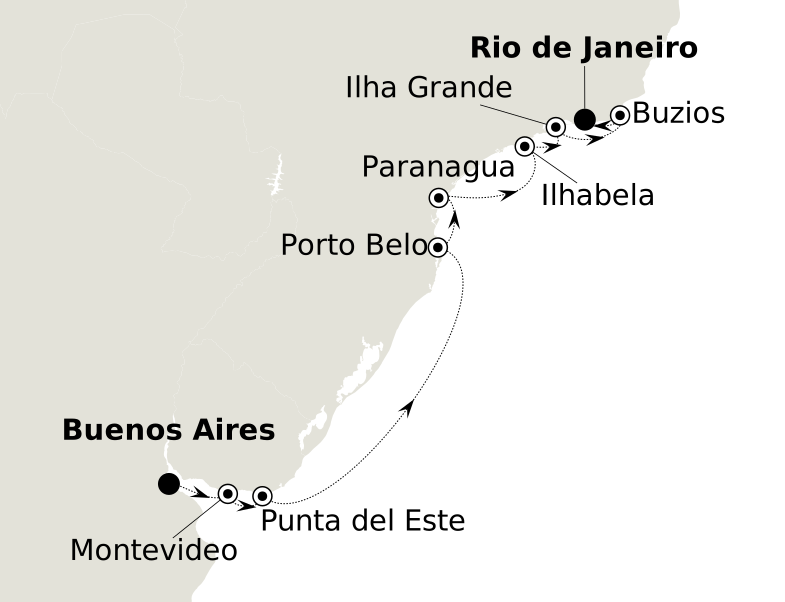
A 12-night ocean voyage aboard Silver Shadow, Buenos Aires, Argentina to Rio de Janeiro, Brazil. Destination: South America.
Operated by Silversea Cruises aboard Silver Shadow.
Buenos Aires
Montevideo
Punta del Este
Porto Belo
Paranaguá
Ilhabela
Ilha Grande
Buzios
Rio de Janeiro
Passionate, and alive with an infectious crackling energy, the Argentine capital is a breathlessly romantic city, which blends old-world colonial architecture with a down-to-earth Latin American clamour. Famed for steamy tango interplays, and expertly seared steak slabs, a visit to Buenos Aires is a fiery fiesta for the senses. Parque Tres de Febrero is a 400-hectare oasis where 18,000 rose bushes bloom, and skyscrapers give way to still lakes and pretty paths of rollerblading locals. Mighty palm trees - that look like exploding fireworks - stand tall in Plaza de Mayo, the heart of this sprawling cosmopolitan capital of 48 barrios. The square has served as the stage for many fundamental events in this country’s history, and the location where the seeds of independence were sewn continues to serve as the city’s gathering point - and is a place for solidarity, rebellion and revolution. The presidential Casa Rosada’s salmon-hued Palatial Palace borders the plaza, while nearby Museum Nacional de Bellas Artes houses the largest collection of public art in Latin America. Teatro Colón, the opulent 1908 opera house, is one of the world’s finest venues - musical performance here take on an ethereal quality, with the exceptional acoustics transferring every quiver of bow, and tremor of vocal cord, to the audience in spine-tingling clarity. The gargantuan, precipitous terraces of Bombonera Stadium form another of Buenos Aires’s incredible venues, and a wall of noise emanates from it when Boca Juniors take to the field. Juicy steak and punchy Malbec flow in the city’s parrillas – steakhouses - while glitzy bars and thumping nightclubs welcome revellers late into the night. It’s not just the meat that sizzles here either - tango dancers fill milongas - dance halls - to strut passionately until the early hours. Sip steaming mate, the country’s national drink, shop in covered markets, and explore Cementerio de la Recoleta - a city of grand graves and intricate memorials honouring presidents, politicians and notable Argentine heroes from history.
Passionate, and alive with an infectious crackling energy, the Argentine capital is a breathlessly romantic city, which blends old-world colonial architecture with a down-to-earth Latin American clamour. Famed for steamy tango interplays, and expertly seared steak slabs, a visit to Buenos Aires is a fiery fiesta for the senses. Parque Tres de Febrero is a 400-hectare oasis where 18,000 rose bushes bloom, and skyscrapers give way to still lakes and pretty paths of rollerblading locals. Mighty palm trees - that look like exploding fireworks - stand tall in Plaza de Mayo, the heart of this sprawling cosmopolitan capital of 48 barrios. The square has served as the stage for many fundamental events in this country’s history, and the location where the seeds of independence were sewn continues to serve as the city’s gathering point - and is a place for solidarity, rebellion and revolution. The presidential Casa Rosada’s salmon-hued Palatial Palace borders the plaza, while nearby Museum Nacional de Bellas Artes houses the largest collection of public art in Latin America. Teatro Colón, the opulent 1908 opera house, is one of the world’s finest venues - musical performance here take on an ethereal quality, with the exceptional acoustics transferring every quiver of bow, and tremor of vocal cord, to the audience in spine-tingling clarity. The gargantuan, precipitous terraces of Bombonera Stadium form another of Buenos Aires’s incredible venues, and a wall of noise emanates from it when Boca Juniors take to the field. Juicy steak and punchy Malbec flow in the city’s parrillas – steakhouses - while glitzy bars and thumping nightclubs welcome revellers late into the night. It’s not just the meat that sizzles here either - tango dancers fill milongas - dance halls - to strut passionately until the early hours. Sip steaming mate, the country’s national drink, shop in covered markets, and explore Cementerio de la Recoleta - a city of grand graves and intricate memorials honouring presidents, politicians and notable Argentine heroes from history.
Uruguay's only real metropolis has its share of glitzy shopping avenues and modern office buildings. But few visitors come here specifically in search of urban pleasures. This city of 1½ million doesn't have the whirlwind vibe of Rio de Janeiro or Buenos Aires, but it's a fine old city with sumptuous, if worn, colonial architecture, and a massive coastal promenade that—as it passes fine beaches, restaurants, and numerous parks—recalls the sunny sophistications of the Mediterranean. In fact, if you've been to Buenos Aires, Montevideo may strike you as a smaller, more manageable, less expensive incarnation of Argentina's capital. Built along the eastern bank of the Río de la Plata (River of Silver), Montevideo takes full advantage of its location. When the weather's good, La Rambla, a 22-km (14-mi) waterfront avenue that links the Old City with the eastern suburbs and changes names about a dozen times, gets packed with fishermen, ice-cream vendors, and joggers. Around sunset, volleyball and soccer games wind down as couples begin to appear for evening strolls. Polls consistently rate Montevideo as having the highest quality of life of any city in Latin America. After one visit here, especially on a lovely summer evening, you just might agree. Modern Montevideo expanded outward from the peninsular Ciudad Vieja, the Old City, still noted for its narrow streets and mix of elegant colonial and art deco architecture. El Prado, an exclusive enclave a few miles north of the city center, is peppered with lavish mansions and grand parks. When you remember that these mansions were once summer homes for aristocratic Uruguayans who spent most of the year elsewhere, you'll get some idea of the wealth this small country once enjoyed. Dining Menus don't vary much in Montevideo—meat is always the main dish—so the food may not provide a distraction from the blinding light (even the most fashionable restaurant in Montevideo seems to be brightly illuminated). Hotels Many downtown hotels are grouped around the big three squares, Plaza Independencia, Plaza Fabini, and Plaza Cagancha. In the weeks before and after Carnaval in February, rooms become hard to come by. Otherwise, rooms are plentiful in summer, when beach-bound residents desert the city. Nightlife In Montevideo you'll find quiet, late-night bars, hip-hop clubs, and folk-music shows. The entertainment and cultural pages of local papers are the best sources of information; particularly useful is the Guía del Ocio, a magazine inserted into the Friday edition of the daily newspaper El País. With few exceptions, bars and clubs come to life around 1 am and don't close until it's time for breakfast. Shopping Let's face it: Montevideans head to Buenos Aires when they want to go on an extra-special shopping excursion. But quality and selection are decent here, and prices are lower than in Argentina. Stores in Centro, along Avenida 18 de Julio, offer the standard selection of urban merchandise. The truly fun shopping experience is to be found in the city's markets. Feria Tristán Narvaja Started in the early 1900s by Italian immigrants, Feria Tristán Narvaja is Montevideo's top attraction on Sunday and one of the city's largest and most popular fairs. (It operates only on Sunday, a day when all other markets, and much of the city, are closed. Hours run about 9–4.) The fair, a 5- to 10-minute walk from the Old City and in the Centro district, is plentifully stocked with secondhand goods and antiques. Parque Villa Biarritz The Saturday morning market at Parque Villa Biarritz in the neighborhood of Pocitos, sells crafts, clothes, and some antiques. You can find some vendors set up other days of the week, as well. The small park also has a recreational center, Club Biguá, with tennis courts and other sports facilities Plaza Cagancha Between Avenida 18 de Julio and Calle Rondeau in Centro, Plaza Cagancha regularly has vendors set up in the area selling trinkets and crafts. El Mercado de la Abundancia Dating back to 1836, El Mercado de la Abundancia is a fun indoor market in Centro, a few blocks from the Palacio Municipal. Inside are a tango dance center, a handful of good choices for a lunchtime parrillada, and a crafts fair. Sights Iglesia Matriz It's officially the Cathedral of the Immaculate Conception and St. Phillip and St. James, but it is known to Montevideans as the Matriz ("head") Church, as well as the Catedral Metropolitana de Montevideo. The cathedral is the oldest public building in Montevideo, with a distinctive pair of dome-cap bell towers that stand guard over the plaza below. Besides its rich marble interior, colorful floor tiling, stained glass, and dome, the Matriz Church is notable as the final resting place of many of Uruguay's most important political and military figures. El Cabildo The original City Hall is where the Uruguayan constitution was signed in 1830. This two-story colonial edifice houses an impressive collection of paintings, antiques, costumes, and rotating history exhibits. Fountains and statuary line the interior patios. English-speaking guides are available. Plaza Independencia Connecting Cuidad Vieja and the Centro, Independence Square is the heart of Montevideo. All that remains of the original walls of the Spanish fort is the Puerta de la Ciudadela, the triumphal gate to the Old City. In the center stands a 30-ton statue of General José Gervasio Artigas, the father of Uruguay and the founder of its 19th-century independence movement. At the base of the monument, polished granite stairs lead to an underground mausoleum that holds Artigas's remains. The mausoleum is a moving memorial: bold graphics chiseled in the walls of this giant space detail the feats of Artigas's life. Two uniformed guards dressed in period uniforms stand at solemn attention beside the urn in this uncanny vault. There's a changing of the guard every Friday at noon.[]Towering over the north side of the plaza, the 26-story Palacio Salvo was the tallest building in South America when it inaugurated in 1928 (it's still one of the tallest buildings in Uruguay). Today this emblematic art deco edifice is simply an office building. It was here where the palace now stands that Gerardo Matos Rodríguez composed La Cumparsita, a famous tango that transformed into a Uruguayan cultural hymn. You can still hear strains playing around the building twice a day. Plaza Constitución This plaza, also known as Plaza Matriz, is the heart of Montevideo's Ciudad Vieja. An ornate cantilever fountain in the center of this tree-filled square was installed in 1871 to commemorate the construction of the city's first water system. Museo del Gaucho y la Moneda This museum is in a rococo 19th-century mansion near Calle Julio Herrera y Obes, four blocks east of Plaza Independencia. Here you'll find articles from the everyday life of the gauchos, from traditional garb to the detailed silver work on the cups used for mate (an indigenous herb from which tea is brewed). Ancient South American and European coins are on the first floor. Tours in English are available with a couple days' notice. Club Uruguay Uruguay's most prestigious private social club, founded in 1888, is headquartered in this eclectic, three-story neoclassical national monument on the south side of Plaza Matriz. The club was formed for high society of European descent, but today is open to the public. Friendly, English-speaking guides happily bring visitors up the marble staircases so that they can marvel at the elegant salons. The club also hosts cultural events, including music performances and art shows, throughout the year. Non-members are welcome at the on-site bar and restaurant, but full access to the club's luxe facilities, including a library and billiards room, is reserved for its exclusive members. Mercado del Puerto For Montevideo's quintessential lunch experience, head to the old port market, a restored 1868 building of vaulted iron beams and colored glass, and a terrific example of urban renewal at its best. The market shields 14 stalls and eateries where, over large fires, the best asado (barbecue) in the city is cooked. It's a mix of casual lunch-counter places and sit-down restaurants. The traditional drink here is a bottle of medio y medio (champagne mixed with white wine). Many other eateries congregate outside around the perimeter of the building and are open for dinner as well as lunch. Parque del Prado The oldest of the city's parks is also one of the most popular. Locals come to see El Rosedal, the rose garden with more than 800 different varieties, and the fine botanical garden. Also in the 262-acre park you'll find the statue called La Diligencia, by sculptor José Belloni. Museo del Carnaval Move over, Rio. Montevideo's annual Carnaval celebration may be more low-key than that of its northern neighbor, but it lasts for a full 40 days. This museum next to the Mercado del Puerto celebrates and honors the pre-Lenten festivities year-round with displays featuring the elaborate costumes and photos of processions.
The fingertips of a showstopping sculpture, emerging from Punta Del Este’s golden sands, is the perfect example of this chic beach city's creative outlook. Stunning stretches of shining sands line the peninsula’s coast, attracting the great and glamourous from across Uruguay and Argentina. Drawn to the beautiful beaches of this seaside city, the well-heeled visitors are joined by a flotilla of yachts, which park up for summer in the ‘Monaco of the South’ - the continent’s city to see and be seen. One of Punda del Este's main beaches, Playa Mansa, enjoys calms seas and a sun-soaked location - overlooked by a soaring lighthouse, which is orbited by gliding sea birds. The sand is soft and inviting, so lie back to soak up the intense sun, before views of Gorriti Island just offshore. On the other side is Playa Brava, where the city’s signature artwork, ‘The Hand’ - one of many quirky sculptures that litter the streets - grasps at the sky. Relax your way – whether that’s cracking golf balls along coastal courses, cycling beside washing waves, or swimming in tempting waters. Bustling nightlife, art galleries, and museums give Punta del Este an artsy, eclectic atmosphere. Close to the port, you can discover fancy restaurants, serving up stacks of fresh seafood – and enjoy opulent meals while relishing golden views down over the port, where lavish yachts and modest fishing boats mingle. Head down to the harbour to see fishermen selling freshly caught produce and sea lions gathering to feast on the scraps.
Days at sea are the perfect opportunity to relax unwind and catch up with what you’ve been meaning to do. So whether that is going to the gym, visiting the spa, whale watching, catching up on your reading or simply topping up your tan these blue sea days are the perfect balance to busy days spent exploring shore side.
Days at sea are the perfect opportunity to relax unwind and catch up with what you’ve been meaning to do. So whether that is going to the gym, visiting the spa, whale watching, catching up on your reading or simply topping up your tan these blue sea days are the perfect balance to busy days spent exploring shore side.
Beautiful beaches attract many to Porto Belo, but there are other natural attractions. The Atlantic forest of the Brazil coast has a great variety of plants and birds, including many found nowhere else. It is second only to the Amazon in diversity. But most of the forest has been cleared for agriculture. Trekking in the surviving forest near Port Belo puts you amid the super-rich and rare ecosystem. Azorean culture has become a source of pride to locals in recent years. Between 1747 and 1756, Portugal sent nearly 7500 immigrants from the Azores and Madeira to the state of Santa Catarina. They were enticed with money, land, agricultural tools, seeds, livestock and weapons to populate and secure the Portuguese colonial territory from local indigenous people and rival Europeans. They settled and flourished in settlements such as Porto Belo for ten generations. You can still find Azorean cultural influences in cuisine, holy ghost festivals, colourful boats and architecture seen at Praça dos Pescadores (Fishermen’s Square) in Porto Belo. German influence is strong in the southern Brazilian state of Santa Catarina. From the early 19th century, Germans emigrated and made up over 50% of immigrants to the state. Adapting to tropical conditions was hard, but many coped with farming and excelled in producing children. Today towns like Blumenau maintain a strong German influence in architecture and festivities, and especially in the essential tradition of locally brewed beer and classic German sausages.
Portuguese for beautiful island, Ilhabela carries its name well. Considered a natural paradise by both locals and visitors alike, the island is a kaleidoscope of beautiful beaches, lush tropical rainforests and an incredible 360 waterfalls. Located a four hour drive (and a 15-minute ferry ride) from São Paolo, 85% of the island is a UNESCO-Biosphere Reserve. While people may come initially to Ihalbela for its famous beaches, (one of which was named as a top ten worldwide beach by The Guardian), expect much greater things that just sunning and relaxing in the shade from this little island. With almost 25 miles/40 kilometres of pristine beaches, fun in the sun is certainly always an option, but Ilhabela is also a vibrant little city, full of vivacity and history, just waiting to be discovered. Located on the west coast of the island, Ilhabela town still shows signs of its colonial past, examples of which can be see through the local architecture. Perhaps one of the most photogenic chapels you will see on the island is the Nossa Senhora D’Ajuda. Built in 1806, the Catholic church is a pretty little white-washed building set on a hill, positioned as if protecting over the town. Decked with colourful bunting much of the time, the church is filled to the rafters on holy days with locals expressing their faith.
Ilha Grande, or Large Island, is located on the Costa Verde, "Green Coast," perhaps the most enchanting region of the Rio de Janeiro state. Ilha Grande rests near Angra dos Reis Bay with some 360 exotic tropical islands and white sandy beaches, hundreds of tiny ports and countless options for boating. The beaches, nestled between mountains and islands, are mostly small and isolated, with calm, clean waters. The climate on the Costa Verde is an attraction in itself; warm, lazy weather with a cooling seabreeze takes the edge off otherwise hot summer days.A call at Ilha Grande provides the opportunity to explore the beauty of this enchanting island. Guests not participating in the organized excursion will have the opportunity to take a tender to the beach and laze in the sun or enjoy watersports activities. Pier Information The ship is scheduled to anchor. Guests will be taken ashore to the beach via ship's tenders. Shopping Several stalls along the beach offer local art and craft items. The local currency is the real. Cuisine Two rustic restaurants offer assorted beverages and fried fish, a local favorite. Other Sites Other Options A beautiful beach invites swimming and snorkeling. Rental of watersports equipment is available along the beach. Important: Guests renting watersports equipment do so at their own risk.
Upscale and desirable Buzios is a beachy escape to a land of sun and thick palm-clad hills. With 17 luxurious horseshoe-shaped beaches spreading out nearby and a lively nightlife and culinary scene Buzios is a place to kick back and soak up some of the best of Brazil's envied beach life. Formed from three separate towns Manguinhos Armação de Búzios and Ossos Buzios is an attractive Portuguese-flavoured corner of this stunning country. Stroll the cobbles of Rua das Pedras for a taste of old-time colonial charm. Elevated viewpoints let you rise high and admire the weaving coastline and turquoise waters below - dotted with paddleboarders pushing through waves and green islands emerging. Just like St Tropez Buzios came to the wider world's attention when Brigitte Bardot visited the shining white sands imparting a head-turning sprinkle of stardust and an air of allure that hasn't faded since. Look out for the waterfront statue of the influential French actress. Growing from fishing village origins Buzios is now one of Brazil's favoured places to soak up the magic of this coastline. Snorkel with sea turtles gliding around you or lie back and enjoy the rejuvenating sunshine - which bathes the heavenly coves here. Sail on the deck of a catamaran to take in the beauty off-shore dropping in at beaches of varying character - from fiery red sands to hidden banana bends and overlooked islands.
Lie back on the golden sands to soak up the extraordinary setting - or watch on as muscled cariocas - locals - perform effortless athletic feats, during casual volleyball matches. A trip up to Rio de Janeiro’s iconic art-deco statue of Christ the Redeemer is, of course, a must do - offering an extraordinary view of the city rolling out before your eyes. You’ll also want to take a cable car to swing by the top of Sugarloaf Mountain, which juts sharply into the sky from nowhere. Brazil’s second largest city moves to an infectious samba beat, and the famous thumping Carnival floods colour and floats down its streets each year. Of course, Rio is also a city of sharp cultural contrasts – offering fun in the sun for some, while life goes on very much as it always has for others. Take a guided tour, led by a resident, to see the conditions inside these complex tapestries of colour and chaos first-hand. Tijuca National Park, offers easy-to-access tranquillity, immersing you in dense forestry and whopping birdsong. Later, watch the fiery shades of sunset spread across the sky in the city’s oh so famous evening light show. With so much to offer, you’ll quickly learn how Rio earned its other name ‘Cidade Maravilhosa’ – The Marvellous City.
Lie back on the golden sands to soak up the extraordinary setting - or watch on as muscled cariocas - locals - perform effortless athletic feats, during casual volleyball matches. A trip up to Rio de Janeiro’s iconic art-deco statue of Christ the Redeemer is, of course, a must do - offering an extraordinary view of the city rolling out before your eyes. You’ll also want to take a cable car to swing by the top of Sugarloaf Mountain, which juts sharply into the sky from nowhere. Brazil’s second largest city moves to an infectious samba beat, and the famous thumping Carnival floods colour and floats down its streets each year. Of course, Rio is also a city of sharp cultural contrasts – offering fun in the sun for some, while life goes on very much as it always has for others. Take a guided tour, led by a resident, to see the conditions inside these complex tapestries of colour and chaos first-hand. Tijuca National Park, offers easy-to-access tranquillity, immersing you in dense forestry and whopping birdsong. Later, watch the fiery shades of sunset spread across the sky in the city’s oh so famous evening light show. With so much to offer, you’ll quickly learn how Rio earned its other name ‘Cidade Maravilhosa’ – The Marvellous City.
From $12,900
per guest · 12 nights
Prices are a guide and vary with season, cabin category and party size. Your advisor will confirm the exact cost before anything is booked.
Grand 1 Bedroom
suite
Grand 2 Bedroom
suite
Medallion
suite
Owner 1 Bedroom
suite
Owner 2 Bedroom
suite
Royal 1 Bedroom
suite
Royal 2 Bedroom
suite
Silver
suite
Terrace
suite
Veranda 1
suite
Veranda 2
suite
Veranda 3
suite
Veranda 4
suite
Vista
suite








