




Prefer a conversation?
Our team is always available to guide you through the process and ensure your experience is perfectly matched to your preferences.
Our team is always available to guide you through the process and ensure your experience is perfectly matched to your preferences.
Duration
8 Nights
Price
From $4,600
Ship
Silver Nova
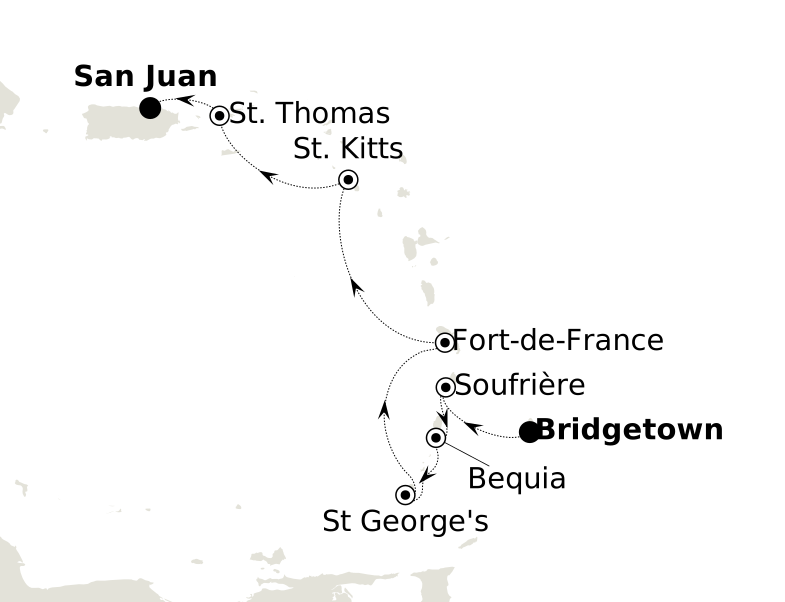
A 8-night ocean voyage aboard Silver Nova, Bridgetown, Barbados to San Juan, United States of America. Destination: Caribbean & Central America.
Operated by Silversea Cruises aboard Silver Nova.
Bridgetown
Soufrière, St. Lucia
Bequia
St George's
Fort-de-France
St. Kitts (Basseterre)
St. Thomas
San Juan
Bridgetown, the captivating capital of Barbados, combines faded colonial history, captivating tradition, and vivid white beaches plucked directly from your richest imagination of Caribbean perfection. Recently listed as a UNESCO World Heritage site, thanks to its beautifully preserved colonial architecture, Bridgetown’s mask of modernity covers a core of complex history and fascinating culture. Sherbet coloured buildings line up to overlook the waterfront of the Constitution River at the ‘The Careenage’ - where gleaming ships bob on the blue water, and peaceful strolls along a wooden boardwalk await. Stop for a sobering moment at the commemorative plaque honouring the people traded at this spot, when Bridgetown was the British Empire’s most important harbour, and first stop on the Transatlantic Slave Trade crossing. Just five minutes’ stroll from here is Carlisle Bay - a postcard-perfect place where you'll find crystal-clear, turquoise seawater glowing in the Caribbean sun, and a mile of soft white powder sand. A treasure trove for divers, the shipwrecks scattered below the shallow water’s waves are now inhabited by turtles and swirling, rainbow-coloured tropical fish. Head to the backstreets, where street food vendors serve up spicy chicken soup, barbecued pigtails and thirst-quenching coconut water. There are bargains aplenty to be had on Broad Street, where duty-free malls and souvenir stalls cram together, vying for your attention. Roebuck Street is the spot where one of the Caribbean’s favourite drinks, rum, was discovered - having been created here from the by-products of the island’s booming sugarcane trade. Nowadays, it’s lined with bars splashing every variety of the deliciously spicy dark libation imaginable into glasses. For a touch more culture, visit one of the oldest synagogues in The Americas - Nidhe Israel Synagogue, which was built in 1654. The adjoining museum tells the story of Barbados’ Jewish immigrants, who were instrumental in the island’s development.
Overlooked by the sharp-peaked twins of the Pitons Soufriere enjoys one of St. Lucia’s most scenic locations. Rolling down to meet the turquoise sea water lush green vegetation surrounds the island’s first capital - which took its name from the simmering Sulphur Springs that burble nearby. A member of the French Windward Islands the Gallic flavour is strong here with candy-coloured colonial architecture adding to the island’s postcard-perfect appeal. The iconic pair of the Pitons have stood guard over this colourful town of seafront charm since its founding in 1746 - and they form the island's proudest and most recognisable natural landmark. Rocketing up into the sky like giant pyramids they loom picturesquely above the jungle’s tangle and rich blue Caribbean waters. Below the Botanical Gardens bloom with elaborate displays of tropical plant life and gushing falls - like the Toraille Waterfall - glow as the water catches the sun's light. As you’d expect St. Lucia also offers stunning golden beaches and turquoise waters where you can meet jewel-coloured fish like clownfish and angelfish hiding amongst the protective arms of healthy coral reefs. Enjoy fresh catches of the day in Soufriere’s restaurants or satisfy a sweeter tooth with a visit to the island’s chocolate producing cocoa groves.
An almost mythical utopia of virgin beaches, rustic rum shacks and bays so scenic you feel like you’re intruding - Bequia Island is an island mirage of Caribbean perfection. This is the real, unspoiled experience - and with just 6,000 locals living here, you quickly start to recognise the same smiling faces, welcoming you with outstretched arms. Offering glorious - often deserted - beaches of pure golden sand, and hillside sweeps of forest and almond trees, Bequia Island is an extraordinary feast for the senses. Unlike some of the flashier Caribbean islands, Bequia - a part of the Grenadines - is a rustic, unassuming and off-the-beaten-path choice. The staggeringly picturesque natural harbour, Admiralty Bay, greets you on arrival, and is peppered with day-tripping yachts bobbing on the gentle waves. The island’s tiny capital, Port Elizabeth, sits behind, with its bustling fruit and vegetable market, turtle sanctuary, and stalls selling hand-crafted model ships. This tiny, pretty island is ridged along the centre, and you can earn your beachside bliss with a gentle hike to the top of Mount Peggy, looking out over views of Grenada and St Vincent. At just seven miles long, you can discover the whole island in a few hours – but that would be to miss the point somewhat. Bequia Island coaxes you in to slow the pace and soothe your soul on blissful beaches, where you can revel in the uncomplicated joys of sitting, reading and swimming in heavenly shallow waters. The royally approved Princess Margaret Beach is one of the finest - an arching band of soft sand and cobalt-blue waters. As evening sets in, you may find you’re beckoned to share with communal barbecues of the day’s fresh catch with the locals, or to indulge in rum-heavy cocktails at beachside bars, lashed together from sea-blanched wooden limbs.
With beautiful seascapes, lush vegetation and intense natural ingredients, the Isle of Spice has the perfect recipe for a flavourful visit. A true sensory experience, St George's is famous as the world’s second-largest exporter of the spice, nutmeg. Just as much of a treat for the eyes as it is for the palate, its jungled mounds, idyllic white-sand beaches, and turquoise Caribbean seas are a glorious sight to behold. Thrilling waterfalls pour through the rainforest, while banana and cocoa groves spread wildly across the island. Grenada’s capital rolls down to an attractive waterfront decorated with pretty floral buildings, Georgian architecture and picturesque terracotta roofs. Breathe in deep at the spice market, where the freshest ingredients fill stalls. Heaps of fresh nutmeg, vanilla pods, cinnamon and cocoa beans all add to the colourful mosaic. Dip into the waters of Bamboo Waterfall, or venture to Grand Etang, to explore the rich and fertile interior of this scenic island, where mischievous mona monkeys explore treetops and a collapsed volcano holds the waters of a glorious caldera lake. If all of that exploring sounds like hard work - don’t worry, the island is skirted by some of the Caribbean’s dreamiest visions of seaside luxury - from famous natural beauties like Grand Anse Beach to secret stretches hidden amongst the palm trees. Soak in the vivid colours, best enjoyed with an iced cocktail and a taste of the locally distilled, spiced rum punch.
Days at sea are the perfect opportunity to relax unwind and catch up with what you’ve been meaning to do. So whether that is going to the gym, visiting the spa, whale watching, catching up on your reading or simply topping up your tan these blue sea days are the perfect balance to busy days spent exploring shore side.
The largest of the Windward Islands, Martinique is 4,261 mi (6,817 km) from Paris, but its spirit and language are decidedly French, with more than a soupçon of West Indian spice. Tangible, edible evidence of the fact is the island's cuisine, a superb blend of French and creole. Martinique is lushly landscaped with tropical flowers. Trees bend under the weight of fruits such as mangoes, papayas, lemons, limes, and bright-red West Indian cherries. Acres of banana plantations, pineapple fields, and waving sugarcane stretch to the horizon. The towering mountains and verdant rain forest in the north lure hikers, while underwater sights and sunken treasures attract snorkelers and scuba divers. Martinique is also wonderful if your idea of exercise is turning over every 10 minutes to get an even tan and your taste in adventure runs to duty-free shopping. A popular cruise-ship excursion goes to St-Pierre, which was buried by ash when Mont Pelée erupted in 1902.
St. Kitts verdant volcanic slopes rise from crystal clear Caribbean waters, promising a land of escape, relaxation and rejuvenation. A place for ‘limin’ - the local word for kicking back, Caribbean style, you’ll be welcomed to an island paradise blessed with swarming reefs, hidden white-sand beaches, and irresistible shallow seas. Bigger sibling to nearby Nevis, St. Kitts is a place of unrestrained natural beauty. Soak up the dreamy Caribbean bliss, or explore sprawling island rainforests, teeming with hummingbirds and the distant sounds of waterfalls, as you walk the island’s vine-tangled paths. A ride on Basseterre’s scenic sugar train is a rumbling, immersive journey through the heart of this Caribbean island of culture and vivid unspoiled scenery. Carriages that once transported crops of sugar cane to the city sweep around long curving bends, revealing a spectacular introduction to St. Kitts. The landscapes here are beautiful, and things are no less spectacular offshore, where glorious crystalline waters invite you to dive with turtles, and explore doomed wrecks like the River Taw ship – which has now exploded with marine life. In Basseterre itself, stop off to see the pea-green Berkeley Memorial clock, which stands in the Circus, surrounded by busy St. Kitts life. Independence Square is also waiting among the city’s charming Georgian buildings. Renamed from Pall Mall on the 19th of September 1983 - to celebrate the island’s independence - the pretty square gravitates around a colourful burbling fountain, and has a dark history, as a former slave market. Wary canons watch out over the waves far below at Brimstone Hill Fortress, a site of significant history, which dates back to 1690. Known as the ‘Gibraltar of the West Indies’ due to its importance at the heart of the British empire, St. Kitts was one of the first island in the West Indies to be colonised. Nowadays, its World Heritage Site fortress offers panoramic views along the coastline it was built to defend.
The steep, spectacular hills that surround St Thomas's exquisite harbour provide a fitting entry point for this island of overwhelming natural splendour. The jungled-mountains reach up above tempting beaches and scuba diving sites, while Charlotte Amalie - the island's capital - sprawls down towards the water, bedecked with shops and tasty restaurants. Part of the beautiful U.S. Virgin Islands - together with St John and St Croix - these lands were purchased by the US in 1917. Nowadays, St Thomas is a patchwork of cultures, and a lively welcome to the islands, serving as a gracious host to the many visitors who linger - as well as those who jump on ferries, yachts and catamarans to explore the blessed beaches of the Caribbean's other retreats. A stunning island of dramatic jungled-scenery, keep your camera close to hand as you swing up the Skyride to Paradise Point, to look down over the natural amphitheatre of the dock and city below. Snap some more postcard-perfect shots at Drake’s Seat - said to be Sir Francis Drake's lookout point, where he could survey for approaching enemy ships. Nowadays, the views over Magens Bay and the infinite sea are always peaceful, and this is a great spot to catch a fiery Caribbean sunset spilling across the sky. Take catamaran cruises to explore the shining coastline, or seek out the glorious coves and caves that are hidden along the island's perimeter. Land on the secluded shores of tiny islands, before scuba diving and snorkelling above the twisted boughs of lost ships, reclaimed by the waters and inhabited by curious tropical fish life. Kayak over still lagoon waters, or take the chance to lay back on soft beaches strewn with tiny shells, as St Thomas's beauty washes over you.
Tour description San Juan, Puerto Rico Although Puerto Rico is a commonwealth of the United States, few cities in the Caribbean are as steeped in Spanish tradition as San Juan. Within a seven-square-block area in Old San Juan are restored 16th-century buildings, museums, art galleries, bookstores, and 200-year-old houses with balustraded balconies overlooking narrow, cobblestone streets. In contrast, San Juan's sophisticated Condado and Isla Verde areas have glittering hotels, fancy boutiques, casinos, and discos. Out in the countryside is 28,000-acre El Yunque National Forest, a rain forest with more than 240 species of trees growing at least 100 feet high. You can stretch your sea legs on dramatic mountain ranges, numerous trails, in vast caves, at coffee plantations, old sugar mills, and hundreds of beaches. No wonder San Juan is one of the busiest ports of call in the Caribbean. Like any other big city, San Juan has its share of petty crime, so guard your wallet or purse, especially in crowded markets and squares. Sights Old San Juan, the original city founded in 1521, contains carefully preserved examples of 16th- and 17th-century Spanish-colonial architecture. More than 400 buildings have been beautifully restored. Graceful wrought-iron balconies with lush hanging plants extend over narrow streets paved with adoquines (blue-gray stones originally used as ballast on Spanish ships). The Old City is partially enclosed by walls that date from 1633 and once completely surrounded it. Designated a U.S. National Historic Zone in 1950, Old San Juan is chockablock with shops, open-air cafés, homes, tree-shaded squares, monuments, and people. You can get an overview on a morning's stroll (bear in mind that this "stroll" includes some steep climbs). However, if you plan to immerse yourself in history or to shop, you'll need a couple of days. Alcaldía. San Juan's city hall was built between 1602 and 1789. In 1841, extensive alterations were made so that it would resemble the city hall in Madrid, with arcades, towers, balconies, and an inner courtyard. Renovations have refreshed the facade of the building and some interior rooms, but the architecture remains true to its colonial style. Only the patios are open to public viewings. A municipal tourist information center and an art gallery with rotating exhibits are in the lobby. 153 Calle San Francisco, Plaza de Armas, Old San Juan. Castillo San Cristóbal. This huge stone fortress, built between 1634 and 1790, guarded the city from land attacks from the east. The largest Spanish fortification in the New World, San Cristóbal was known in the 17th and 18th centuries as the Gibraltar of the West Indies. Five freestanding structures divided by dry moats are connected by tunnels. You're free to explore the gun turrets (with cannon in situ), officers' quarters, re-created 18th-century barracks, and gloomy passageways. Along with El Morro, San Cristóbal is a National Historic Site administered by the U.S. Park Service; it's a World Heritage Site as well. Rangers conduct tours in Spanish and English. Calle Norzagaray at Av. Muñoz Rivera, Old San Juan. Admission charged. Castillo San Felipe del Morro (El Morro). At the northwestern tip of the Old City is El Morro ("the promontory"), a fortress built by the Spaniards between 1539 and 1786. Rising 140 feet above the sea, the massive six-level fortress was built to protect the harbor entrance. It is a labyrinth of cannon batteries, ramps, barracks, turrets, towers, and tunnels. Built to protect the port, El Morro has a commanding view of the harbor. You're free to wander throughout. The cannon emplacement walls and the dank secret passageways are a wonder of engineering. The fort's small but enlightening museum displays ancient Spanish guns and other armaments, military uniforms, and blueprints for Spanish forts in the Americas, although Castillo San Cristóbal has more extensive and impressive exhibits. There's also a gift shop. The fort is a National Historic Site administered by the U.S. Park Service; it's a World Heritage Site as well. Various tours and a video are available in English. Calle del Morro, Old San Juan. Admission charged. Catedral de San Juan Bautista. The Catholic shrine of Puerto Rico had humble beginnings in the early 1520s as a thatch-roofed, wooden structure. After a hurricane destroyed the church, it was rebuilt in 1540, when it was given a graceful circular staircase and vaulted Gothic ceilings. Most of the work on the present cathedral, however, was done in the 19th century. The remains of Ponce de León are behind a marble tomb in the wall near the transept, on the north side. The trompe l'oeil work on the inside of the dome is breathtaking. Unfortunately, many of the other frescoes suffer from water damage. 151 Calle Cristo, Old San Juan. Admission charged. Galería Nacional. Built by Dominican friars in 1523, this convent-the oldest in Puerto Rico-once served as a shelter during Carib Indian attacks and, more recently, as headquarters for the Antilles command of the U.S. Army. The beautifully restored building contains the Galería Nacional, which showcases the collection of the Institute of Puerto Rican Culture. Arranged chronologically, the museum traces the development of Puerto Rican art over the centuries, from José Campeche and Francisco Oller to Rafael Tufiño and Myrna Báez. You'll also find a good collection of santos, traditional wood carvings of saints. 98 Calle Norzagaray, Old San Juan. Admission charged. La Fortaleza. Sitting atop the fortified city walls overlooking the harbor, the Fortaleza was built between 1533 and 1540 as a fortress, but it wasn't a very good one. It was attacked numerous times and was occupied twice, by the British in 1598 and the Dutch in 1625. When El Morro and the city's other fortifications were finished, the Fortaleza became the governor's palace. Numerous changes have been made to the original primitive structure over the past four centuries, resulting in the current eclectic yet eye-pleasing collection of marble and mahogany, medieval towers, and stained-glass galleries. It is still the official residence of the island's governor, and is the Western Hemisphere's oldest executive mansion in continual use. Guided tours of the gardens and the building's exterior are conducted several times a day in English and Spanish. Call ahead, as the schedule changes daily. Proper attire is required: no sleeveless shirts or very short shorts. The tours begin near the main gate in a yellow building called the Real Audiencia, housing the Oficina Estatal de Preservación Histórica. Western end of Calle Fortaleza, Old San Juan. Museo de las Américas. On the second floor of the imposing former military barracks, Cuartel de Ballajá, this museum houses four permanent exhibits: Popular Arts, African Heritage, the Indian in America, and Conquest and Colonization. You'll also find a number of temporary exhibitions of works by regional artists. A wide range of handicrafts is available in the gift shop. Calle Norzagaray and Calle del Morro, Old San Juan. Admission charged. Elsewhere in San Juan Casa Bacardí Visitor Center. Exiled from Cuba, the Bacardí family built a small rum distillery here in the 1950s. Today it's the world's largest, with the capacity to produce 100,000 gallons of spirits a day and 21 million cases a year. You can hop on a little tram to take an approximately 45-minute tour of the visitor center, though you don't visit the distillery itself. Yes, you'll be offered a sample. Bay View Industrial Park, Rte. 165, Km 2.6, at Rte. 888, Cataño. Museo de Arte de Puerto Rico. One of the biggest museums in the Caribbean, this beautiful neoclassical building was once the San Juan Municipal Hospital. The collection of Puerto Rican art starts with works from the colonial era, most of them commissioned for churches. Here you'll find works by José Campeche, the island's first great painter. His Immaculate Conception, finished in 1794, is a masterpiece. Also well represented is Francisco Oller y Cestero, who was the first to move beyond religious subjects to paint local scenes. Another gallery room is filled with works by artists inspired by Oller. The original building, built in the 1920s, proved to be too small to house the museum's collection: the newer east wing is dominated by a five-story-tall stained-glass window, the work of local artist Eric Tabales. There's also a beautiful garden filled with a variety of native flora and a 400-seat theater that's worth seeing for its remarkable hand-crocheted lace curtain. 299 Av. José de Diego, Santurce. Admission charged. Shopping San Juan is not a duty-free port, so you won't find bargains on electronics and perfumes. However, shopping for native crafts can be fun. Popular souvenirs and gifts include santos (small, hand-carved figures of saints or religious scenes), hand-rolled cigars, local coffee, handmade lace, and carnival masks. In Old San Juan, especially on Calles Fortaleza and Cristo, you can find everything from T-shirt emporiums to selective crafts stores, bookshops, art galleries, jewelry boutiques, and even shops that specialize in made-to-order Panama hats. Calle Cristo is lined with factory-outlet stores, including Coach and Ralph Lauren. Beaches San Juan doesn't have the island's best beaches, but anyone can rent a chair for the day at one of the public entry points.
From $4,600
per guest · 8 nights
Prices are a guide and vary with season, cabin category and party size. Your advisor will confirm the exact cost before anything is booked.
Classic Veranda
suite
Deluxe Veranda
suite
Grand 1 Bedroom
suite
Junior Grand 1 Bedroom
suite
Junior Grand 2 Bedroom
suite
Master
suite
Medallion
suite
Otium
suite
Owner 1 Bedroom
suite
Owner 2 Bedroom
suite
Premium Medallion
suite
Premium Veranda
suite
Signature
suite
Silver
suite
Superior Veranda
suite








