




Prefer a conversation?
Our team is always available to guide you through the process and ensure your experience is perfectly matched to your preferences.
Our team is always available to guide you through the process and ensure your experience is perfectly matched to your preferences.
Duration
11 Nights
Price
From $6,450
Ship
Silver Spirit
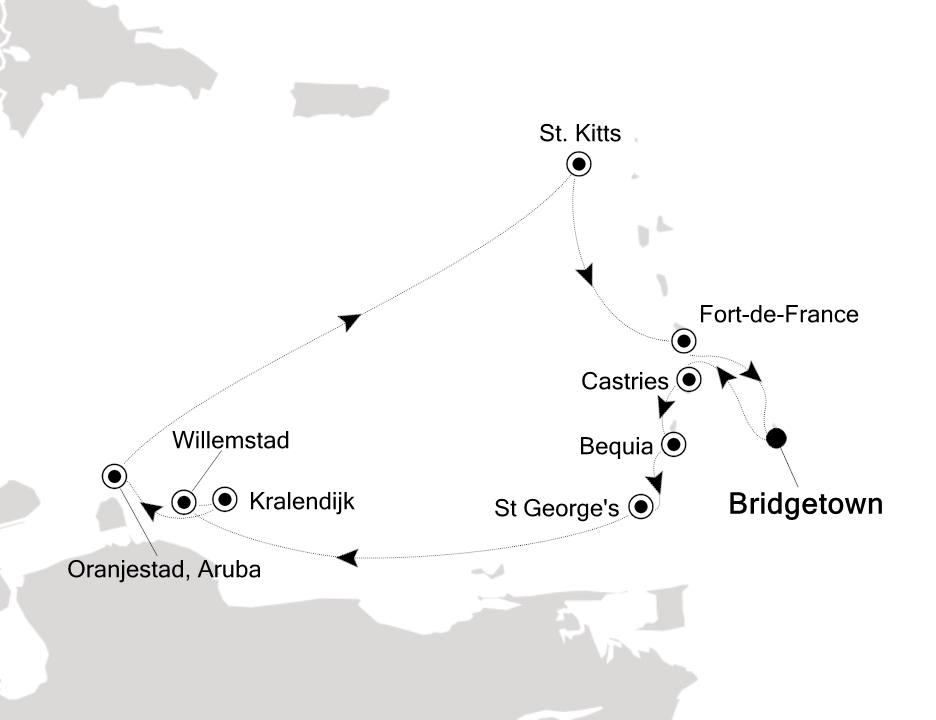
A 11-night ocean voyage aboard Silver Spirit, Bridgetown, Barbados to Bridgetown, Barbados. Destination: Caribbean & Central America.
Operated by Silversea Cruises aboard Silver Spirit.
Bridgetown
Castries (St. Lucia)
Bequia
St George's
Willemstad, Curaçao
Kralendijk, Bonaire
Oranjestad, Aruba
St. Kitts (Basseterre)
Fort-de-France
Bridgetown, the captivating capital of Barbados, combines faded colonial history, captivating tradition, and vivid white beaches plucked directly from your richest imagination of Caribbean perfection. Recently listed as a UNESCO World Heritage site, thanks to its beautifully preserved colonial architecture, Bridgetown’s mask of modernity covers a core of complex history and fascinating culture. Sherbet coloured buildings line up to overlook the waterfront of the Constitution River at the ‘The Careenage’ - where gleaming ships bob on the blue water, and peaceful strolls along a wooden boardwalk await. Stop for a sobering moment at the commemorative plaque honouring the people traded at this spot, when Bridgetown was the British Empire’s most important harbour, and first stop on the Transatlantic Slave Trade crossing. Just five minutes’ stroll from here is Carlisle Bay - a postcard-perfect place where you'll find crystal-clear, turquoise seawater glowing in the Caribbean sun, and a mile of soft white powder sand. A treasure trove for divers, the shipwrecks scattered below the shallow water’s waves are now inhabited by turtles and swirling, rainbow-coloured tropical fish. Head to the backstreets, where street food vendors serve up spicy chicken soup, barbecued pigtails and thirst-quenching coconut water. There are bargains aplenty to be had on Broad Street, where duty-free malls and souvenir stalls cram together, vying for your attention. Roebuck Street is the spot where one of the Caribbean’s favourite drinks, rum, was discovered - having been created here from the by-products of the island’s booming sugarcane trade. Nowadays, it’s lined with bars splashing every variety of the deliciously spicy dark libation imaginable into glasses. For a touch more culture, visit one of the oldest synagogues in The Americas - Nidhe Israel Synagogue, which was built in 1654. The adjoining museum tells the story of Barbados’ Jewish immigrants, who were instrumental in the island’s development.
Explore a land of vibrant colour, from the tranquil turquoise water that surrounds it, to the verdant green peaks of its famous soaring volcanic plugs - The Pitons; which give this mesmerising island its form. Waterfalls thunder in the jungled interior, should you successfully drag yourself from St Lucia's gleaming beaches and dive spots - where patchworks of colourful fish dance below the waves. Offering the picturesque island luxury of your wildest dreams, St. Lucia is a cinematic, thrilling Caribbean idyl. Marigot Bay served as the tropical backdrop for 1967’s Doctor Dolittle film, and the island's amiable animal life is never too far away - spot flashes of bright red, as parrots zip between palm trees, before catching sight of dolphins splashing playfully offshore. Vigie beach is a charmed spot to lie back and recline in the sun’s glow, watching as overlapping layers of mesmerising blue hues intertwine. St. Lucia’s iconic Pitons mountains deliver as the perfect backdrop to any envy generating photograph - rising up exponentially from the calm waters like sharp shark fins. Castries is this heavenly island’s capital, and while the Cathedral Basilica of the Immaculate Conception may seem a little humble from the outside, the soft sounds of soulful hymns emanating from within are sure to draw you in. The astonishing interior glows with bright frescoes, lit up by the sunlight that spills inside, and atmospheric rows of flickering candles. There's more rich Caribbean colour to behold at the ramshackle Castries Market, where you can take handfuls of fragrant spices, like nutmeg and cinnamon, and enjoy the singsong ritual of bartering, as you move between tables heaving under bounties of green bananas and rosy mangos.
An almost mythical utopia of virgin beaches, rustic rum shacks and bays so scenic you feel like you’re intruding - Bequia Island is an island mirage of Caribbean perfection. This is the real, unspoiled experience - and with just 6,000 locals living here, you quickly start to recognise the same smiling faces, welcoming you with outstretched arms. Offering glorious - often deserted - beaches of pure golden sand, and hillside sweeps of forest and almond trees, Bequia Island is an extraordinary feast for the senses. Unlike some of the flashier Caribbean islands, Bequia - a part of the Grenadines - is a rustic, unassuming and off-the-beaten-path choice. The staggeringly picturesque natural harbour, Admiralty Bay, greets you on arrival, and is peppered with day-tripping yachts bobbing on the gentle waves. The island’s tiny capital, Port Elizabeth, sits behind, with its bustling fruit and vegetable market, turtle sanctuary, and stalls selling hand-crafted model ships. This tiny, pretty island is ridged along the centre, and you can earn your beachside bliss with a gentle hike to the top of Mount Peggy, looking out over views of Grenada and St Vincent. At just seven miles long, you can discover the whole island in a few hours – but that would be to miss the point somewhat. Bequia Island coaxes you in to slow the pace and soothe your soul on blissful beaches, where you can revel in the uncomplicated joys of sitting, reading and swimming in heavenly shallow waters. The royally approved Princess Margaret Beach is one of the finest - an arching band of soft sand and cobalt-blue waters. As evening sets in, you may find you’re beckoned to share with communal barbecues of the day’s fresh catch with the locals, or to indulge in rum-heavy cocktails at beachside bars, lashed together from sea-blanched wooden limbs.
With beautiful seascapes, lush vegetation and intense natural ingredients, the Isle of Spice has the perfect recipe for a flavourful visit. A true sensory experience, St George's is famous as the world’s second-largest exporter of the spice, nutmeg. Just as much of a treat for the eyes as it is for the palate, its jungled mounds, idyllic white-sand beaches, and turquoise Caribbean seas are a glorious sight to behold. Thrilling waterfalls pour through the rainforest, while banana and cocoa groves spread wildly across the island. Grenada’s capital rolls down to an attractive waterfront decorated with pretty floral buildings, Georgian architecture and picturesque terracotta roofs. Breathe in deep at the spice market, where the freshest ingredients fill stalls. Heaps of fresh nutmeg, vanilla pods, cinnamon and cocoa beans all add to the colourful mosaic. Dip into the waters of Bamboo Waterfall, or venture to Grand Etang, to explore the rich and fertile interior of this scenic island, where mischievous mona monkeys explore treetops and a collapsed volcano holds the waters of a glorious caldera lake. If all of that exploring sounds like hard work - don’t worry, the island is skirted by some of the Caribbean’s dreamiest visions of seaside luxury - from famous natural beauties like Grand Anse Beach to secret stretches hidden amongst the palm trees. Soak in the vivid colours, best enjoyed with an iced cocktail and a taste of the locally distilled, spiced rum punch.
Days at sea are the perfect opportunity to relax unwind and catch up with what you’ve been meaning to do. So whether that is going to the gym, visiting the spa, whale watching, catching up on your reading or simply topping up your tan these blue sea days are the perfect balance to busy days spent exploring shore side.
Bright and brilliant colours coat the waterfront buildings of Willemstad, gleaming attractively below the generous Caribbean sun. The capital of the Carribean island Curacao, Willemstad is famous for its technicolour UNESCO World Heritage Site city centre, and a narrow channel connects the sea with the Schottegat harbour, which expands inland like a blooming flower. Settled by the Dutch in the 1630s, they brought colourful architecture, lavish red-roofed mansions, and gorgeous European-style waterfront buildings to this beautiful Caribbean island. Watching over the entrance to this luxurious port is Rif Fort - a 19th-century fortress, which looms above the Sint Anna Bay channel. From here, wind your way to the Queen Emma Bridge - a pontoon bridge known as the Swinging Old Lady, which was built in 1888 to connect Otrobanda and Punda. Enjoy the wonderful views of Willemstad's lavish, pastel-coloured Punda waterfront set before you. Visit the small boats that pull up side by side to sell juicy fruits and vegetables, in a floating market on the waters below. At sunset, the gingerbread stretch bathes in lights, glowing evocatively as the last of the evening's light ebbs away. Wander Willemstad to discover the lemon-shaded Mikve Israel-Emanuel Synagogue, said to be the oldest synagogue in the Americas, see the historic liqueur distillery or head for Queen Wilhelmina Park - where the letters 'DUSHI' are spelt out in a standing sign. You'll hear this word a lot - the island's favourite way of describing the little things that make life worth living. The beaches of Curacao are certainly 'dushi', with tempting sandy curves on practically every corner. Snorkel in the turquoise waves, among dashing fish life and sleek sea turtles.
Kralendijk, Bonaire The first inhabitants on Bonaire were the Arawak Indians. Then in 1499, Amerigo Vespucci discovered Bonaire and claimed it for Spain. Because the island had no gold nor sufficient rainfall to develop agriculture, the Spaniards forced the native Indians into slavery on the large plantations of Hispaniola, resulting in the almost depopulation of the island. In 1526, the governor of Bonaire decided to bring in laborers from Venezuela and, with the help of the local Indians, he began to raise cattle. Within a few years, cows, sheep, goats, pigs, donkeys and horses were being raised on the island and became valuable for their hides. Along with stock farming, sea salt was being recovered in artificial salt pans on the southern end of the island and salt soon became a precious commodity. Over the next few centuries, convicts from Spanish colonies in South America were brought to the island and small settlements were begun. In the 17th century the Dutch arrived on Bonaire. Self-rule was granted by the Netherlands in 1954 but it remained a Dutch protectorate. Thanks to its abundant bird life and beautiful coral reefs, Bonaire began to emerge as a holiday resort. Hotels began to open and the airport, originally constructed in 1955, was expanded in 1972 to support the increase in visitors. Today, Bonaire is well known to scuba divers and bird-watchers. There is little agriculture and most of the island is covered in scrub and cacti. Going Ashore at Bonaire Pier Information The ship is scheduled to dock at Kralendijk North Pier. The town centre is within walking distance from the pier. Shopping Most of the shops are located on Kaya Grandi, Bonaire's main street, and its adjacent streets. Bonaire is not a major shopping center but you will find many small stores selling good quality watches, gold jewelry, Dutch cheeses and fine china. Look for local arts and crafts with an ocean theme. The local currency is the Netherlands Antillean Florins (NAFl). U.S. dollars are also widely accepted. Cuisine The ethnic diversity of the island's culture has led to a wide variety of tastes and cuisines that include French, Chinese, Continental, Thai and Italian. Many restaurants offer theme buffets such as Tex-Mex or island barbecues. Barhaps, or snack bars, are popular as are restaurants that offer tabletop grilling. Local restaurants feature freshly caught seafood and seafood gumbos or goat stew. Other Sights Washington Slagbaii National Park Once a plantation producing divi-divi trees and aloe, the park is now a model of conservation designed to maintain fauna, flora and geological treasures. Scuba Diving If you are interested in setting up a dive, please see the Tour Manager on board the ship who will be pleased to make the necessary arrangements for you. Private Arrangements For those guests interested in touring at your leisure, we are pleased to offer Silver Shore Privato - both half-day and full-day private arrangements by private car or van. You may book this in advance at Silversea.com or it may be purchased on board, subject to availability. Other private arrangements for independent sightseeing may be arranged by emailing Concierge@silversea.com.
Stroll multi-coloured Oranjestad - the capital of enchanting Aruba - and feel the sun’s bronzing kiss, on the shores of one of the sunniest islands in the Caribbean. Settle in for a day on the beach, to relish the stunning weather on some of the region's finest shores - where white sands glow, gentle waves sparkle, and knotted divi divi trees lean. Offering sensational diving and snorkelling, you can swim in the shallow, warm waters, or head out on a catamaran or submarine to investigate further and deeper. If you can drag yourself away from the sparkling beaches and glowing turquoise waters, venture inland towards Bushiribana Gold Mill Ruins, which lie on the route to Aruba Natural Bridge. The vast natural arch collapsed in 2005, but picturesque Baby Bridge remains to take the plaudits at this scenic spot. The island takes its form from the looming, 165-metre-high volcanic hill called Hooiberg - named after the Dutch for ‘haystack’. The volcano's cone is omnipresent as you traverse the island, and if you’re up for a challenge, you can take the wheezy rise up the 650 steps to the lookout. You’ll climb among sunbathing iguanas, and reaching cacti, to views that unravel as far as Venezuela’s coastline on clear days. Visit the island's farms of butterflies and ostriches, or explore amongst Oranjestad's Spanish and Dutch flavours. Pick out bargains from the fancy shops of the colourful boutique-lined streets, or choose from local makers selling hand-crafted wares. The multicultural blend extends to the cuisine that’s cooked up, with a tantalising fusion of the best of Dutch, Asian and Caribbean flavours.
Days at sea are the perfect opportunity to relax unwind and catch up with what you’ve been meaning to do. So whether that is going to the gym, visiting the spa, whale watching, catching up on your reading or simply topping up your tan these blue sea days are the perfect balance to busy days spent exploring shore side.
St. Kitts verdant volcanic slopes rise from crystal clear Caribbean waters, promising a land of escape, relaxation and rejuvenation. A place for ‘limin’ - the local word for kicking back, Caribbean style, you’ll be welcomed to an island paradise blessed with swarming reefs, hidden white-sand beaches, and irresistible shallow seas. Bigger sibling to nearby Nevis, St. Kitts is a place of unrestrained natural beauty. Soak up the dreamy Caribbean bliss, or explore sprawling island rainforests, teeming with hummingbirds and the distant sounds of waterfalls, as you walk the island’s vine-tangled paths. A ride on Basseterre’s scenic sugar train is a rumbling, immersive journey through the heart of this Caribbean island of culture and vivid unspoiled scenery. Carriages that once transported crops of sugar cane to the city sweep around long curving bends, revealing a spectacular introduction to St. Kitts. The landscapes here are beautiful, and things are no less spectacular offshore, where glorious crystalline waters invite you to dive with turtles, and explore doomed wrecks like the River Taw ship – which has now exploded with marine life. In Basseterre itself, stop off to see the pea-green Berkeley Memorial clock, which stands in the Circus, surrounded by busy St. Kitts life. Independence Square is also waiting among the city’s charming Georgian buildings. Renamed from Pall Mall on the 19th of September 1983 - to celebrate the island’s independence - the pretty square gravitates around a colourful burbling fountain, and has a dark history, as a former slave market. Wary canons watch out over the waves far below at Brimstone Hill Fortress, a site of significant history, which dates back to 1690. Known as the ‘Gibraltar of the West Indies’ due to its importance at the heart of the British empire, St. Kitts was one of the first island in the West Indies to be colonised. Nowadays, its World Heritage Site fortress offers panoramic views along the coastline it was built to defend.
The largest of the Windward Islands, Martinique is 4,261 mi (6,817 km) from Paris, but its spirit and language are decidedly French, with more than a soupçon of West Indian spice. Tangible, edible evidence of the fact is the island's cuisine, a superb blend of French and creole. Martinique is lushly landscaped with tropical flowers. Trees bend under the weight of fruits such as mangoes, papayas, lemons, limes, and bright-red West Indian cherries. Acres of banana plantations, pineapple fields, and waving sugarcane stretch to the horizon. The towering mountains and verdant rain forest in the north lure hikers, while underwater sights and sunken treasures attract snorkelers and scuba divers. Martinique is also wonderful if your idea of exercise is turning over every 10 minutes to get an even tan and your taste in adventure runs to duty-free shopping. A popular cruise-ship excursion goes to St-Pierre, which was buried by ash when Mont Pelée erupted in 1902.
Bridgetown, the captivating capital of Barbados, combines faded colonial history, captivating tradition, and vivid white beaches plucked directly from your richest imagination of Caribbean perfection. Recently listed as a UNESCO World Heritage site, thanks to its beautifully preserved colonial architecture, Bridgetown’s mask of modernity covers a core of complex history and fascinating culture. Sherbet coloured buildings line up to overlook the waterfront of the Constitution River at the ‘The Careenage’ - where gleaming ships bob on the blue water, and peaceful strolls along a wooden boardwalk await. Stop for a sobering moment at the commemorative plaque honouring the people traded at this spot, when Bridgetown was the British Empire’s most important harbour, and first stop on the Transatlantic Slave Trade crossing. Just five minutes’ stroll from here is Carlisle Bay - a postcard-perfect place where you'll find crystal-clear, turquoise seawater glowing in the Caribbean sun, and a mile of soft white powder sand. A treasure trove for divers, the shipwrecks scattered below the shallow water’s waves are now inhabited by turtles and swirling, rainbow-coloured tropical fish. Head to the backstreets, where street food vendors serve up spicy chicken soup, barbecued pigtails and thirst-quenching coconut water. There are bargains aplenty to be had on Broad Street, where duty-free malls and souvenir stalls cram together, vying for your attention. Roebuck Street is the spot where one of the Caribbean’s favourite drinks, rum, was discovered - having been created here from the by-products of the island’s booming sugarcane trade. Nowadays, it’s lined with bars splashing every variety of the deliciously spicy dark libation imaginable into glasses. For a touch more culture, visit one of the oldest synagogues in The Americas - Nidhe Israel Synagogue, which was built in 1654. The adjoining museum tells the story of Barbados’ Jewish immigrants, who were instrumental in the island’s development.
From $6,450
per guest · 11 nights
Prices are a guide and vary with season, cabin category and party size. Your advisor will confirm the exact cost before anything is booked.
Classic Veranda
suite
Deluxe Veranda
suite
Grand 1 Bedroom
suite
Grand 2 Bedroom
suite
Medallion
suite
Owner 1 Bedroom
suite
Owner 2 Bedroom
suite
Panorama
suite
Royal 1 Bedroom
suite
Royal 2 Bedroom
suite
Silver
suite
Silver 2 Bedroom
suite
Superior Veranda
suite
Vista
suite








