




Prefer a conversation?
Our team is always available to guide you through the process and ensure your experience is perfectly matched to your preferences.
Our team is always available to guide you through the process and ensure your experience is perfectly matched to your preferences.
Duration
10 Nights
Price
From $12,000
Ship
Silver Wind Expedition
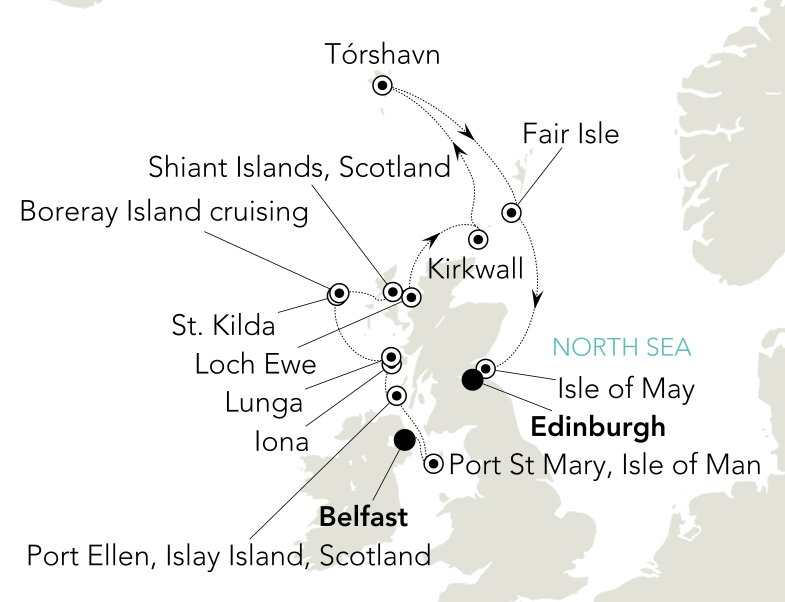
A 10-night expedition voyage aboard Silver Wind, Belfast, United Kingdom to Edinburgh, United Kingdom. Destination: Northern Europe & British Isles.
Operated by Silversea Cruises aboard Silver Wind Expedition.
Belfast
Port St Mary, Isle of Man
Port Ellen, Islay Island, Scotland
Iona
Lunga
St. Kilda
Shiant Islands, Scotland
Loch Ewe
Kirkwall, Orkney Islands, Scotland
Tórshavn (Faroe Islands)
Fair Isle, Scotland
Isle of May
Edinburgh (Leith)
Reborn as a cool modern city Belfast has successfully left its troubles behind emerging as a hotbed of culture and architecture where the comfort of a cosy pub is never far away. A walk across the Lagan Weir Footbridge brings you to Belfast’s fascinating Titanic District – an area of the city devoted to its rich ship-building heritage. The state-of-the-art Titanic Museum brings the story of the doomed vessel to life and is the largest museum dedicated to the infamously ‘unsinkable’ ship. There’s just enough time to give the 10-metre long Salmon of Knowledge sculpture a quick peck for luck before continuing to explore. A stark barbed wire and graffitied sheet metal barrier marks an abrupt scar through the city’s residential areas. The Peace Line was constructed during the height of the Troubles when Belfast was plagued by sectarian divisions between Protestants and Catholics. Nowadays you can jump in a black taxi tour to see the colourful murals and living history of the walls which stand as a stark reminder of the fragility of peace. After exploring the city’s historic divisions a reminder of Belfast’s uniting creativity can be found at the Metropolitan Arts Centre – a seven-storey tall building which invites light to gloriously cascade inside. The Cathedral Quarter is a cobbled blend of flower-adorned pubs restaurants and theatres and venues where music spills out onto the streets at night and many a pint is cheerily shared.
The Isle of Man sits in the middle, but a world apart, from the UK. It is in the Irish sea almost equidistant from Scotland, England and Northern Ireland. But it is not part of any of them. It is a self-governing British crown dependency. The island’s cultural heritage is Gaelic with influences from the Norse and surrounding lands. This background has produced an island with its own traditions. Everything associated with the Isle of Man is Manx. The people are Manx and the language is Manx. Port St Mary is a quiet former trading and fishing port at the southern end of the Isle which provides access to the rural countryside and nearby towns. One route leads past historic thatched cottages in the crofters hamlet of Gregneash, and on to The Sound. Walking routes cross the narrow Mull Peninsula through scenery and history to Port Erin, a quaint old coastal settlement and shoreline set amongst a rugged coastline. In tune with the yesteryear feel of the island, a steam train still operates on the island, taking visitors to destinations like the Castle Rushen, built in 1200 and once the home of a Norse king. Manx people are proud of their Manx cats, famous for having no or little tail, the result of a genetic mutation passed down the generations. Manx Loaghtan sheep are another animal that evolved on the Isle. These sheep have two (sometimes three) pairs of remarkable horns.And the island is not just an isle of men – the name ‘Isle of Man’ evolved from ‘Manannán’, the Celtic god of the sea.
If tiny islands that resonate with peace and tranquillity are your idea of travel heaven, then welcome to Iona. Almost 200 miles east of Edinburgh, set in Scotland’s Inner Hebrides, this magical island has a spiritual reputation that precedes it. And luckily, more than lives up to. The island is miniscule. Just three miles long and only one and a half miles wide, this is not a place that hums with urban attractions. 120 people call Iona home (this number rises significantly if the gull, tern and Kittiwake population is added), although residential numbers do go up (to a whopping 175) in summer. The beautiful coastline is lapped by the gulf stream and gives the island a warm climate with sandy beaches that look more Mediterranean than Scottish! Add to that a green field landscape that is just beautiful, and you’ll find that Iona is a place that stays with you long after you leave. Iona’s main attraction is of course its abbey. Built in 563 by Saint Columbia and his monks, the abbey is the reason why Iona is called the cradle of Christianity. Not only is the abbey (today an ecumenical church) one of the best – if not the best – example of ecclesiastical architecture dating from the Middle Ages, but it also serves as an important site of spiritual pilgrimage. St. Martin’s Cross, a 9th century Celtic cross that stands outside the abbey, is considered as the finest example of Celtic crosses in the British Isles. Rèilig Odhrain, or the cemetery, allegedly contains the remains of many Scottish kings.
The stunning Isle of Lunga is the largest island in the Treshnish archipelago. With volcanic origin the isle was populated until the 19th Century, and remains of black houses can be seen around this magnificent coastal jewel. Abundant plant life and exotic birdlife are now the main inhabitants of the area. Fortunate visitors may view the magnificent array of birds, especially the great puffins that breed on the island's plateau from mid-April till early August. By late summer, Lunga transforms into a quiet and peaceful haven after the busy seabird breeding season. While the iconic puffins and most nesting birds have returned to the open ocean, the island still offers dramatic coastal scenery, wildflower-covered slopes, and a strong sense of remote Hebridean beauty. Guests may encounter seals hauled out on rocky shores, and birds of prey are sometimes seen overhead, adding to the wild charm of the landscape.
Gloriously remote, St. Kilda is an archipelago 50 miles off the Isle of Harris. Although the four islands are uninhabited by humans, thousands of seas birds call these craggy cliffs home, clinging to the sheer faces as if by magic. Not only is St. Kilda home to the UK’s largest colony of Atlantic Puffin (almost 1 million), but also the world largest colony Gannets nests on Boreray island and its sea stacks. The islands also home decedents of the world’s original Soay sheep as well as having a breed of eponymously named mice. The extremely rare St. Kilda wren unsurprisingly hails from St. Kilda, so birders should visit with notebook, binoculars and camera to hand. While endemic animal species is rife on the island, St. Kilda has not been peopled since 1930 after the last inhabitants voted that human life was unsustainable. However, permanent habitation had been possible in the Medieval Ages, and a vast National Trust for Scotland project to restore the dwellings is currently being undertaken. The islands even enjoyed a status as being an ideal holiday destination in the 19th century. Today, the only humans living on the islands are passionate history, science and conservation scholars. One of the caretakers even acts as shopkeeper and postmaster for any visitors who might like to send a postcard home from St. Kilda. It should be noted that St. Kilda is the UKs only (and just one of 39 in the world) dual World Heritage status from UNESCO in recognition of its Natural Heritage and cultural significance.
As an isolated island of the remote St Kilda Group, Boreray island is one of the most far flung and weather impacted islands of the North East Atlantic. Imagine trying to live here during stormy weather. Landing requires jumping or swimming ashore; and yet the island has been lived on or visited from Neolithic times. Collecting seabirds and their eggs, and storing them for winter, may have been even more important than raising sheep. Boreray Sheep are the rarest breed of sheep in Britain. They evolved from short-tailed sheep brought from the Scottish mainland but have been isolated long enough to have evolved into a distinctive small and horned breed. Only found on Boreray Island, they remained as a wild flock when the last people left the St Kilda Islands in 1930. The Souy are a separate and different breed of sheep found on the other St Kilda Islands. Look out for the Boreray Sheep grazing on the slopes of hilly Boreray Island. Seabirds thrive on Boreray and its two attendant rocks stacks, raising new chicks each summer. Northern Gannets glide overhead as they attempt difficult landings at nest sites. Seeing gannets plunge from a great height into the sea is an exciting way to understand the effort required to feed themselves and chicks. Northern Fulmers nest on the volcanic rock cliffs and Atlantic Puffins fly in and out of burrow-strewn slopes. Boreray is part of the St Kilda World Heritage Site, a rare example of a site recognised for both its outstanding natural and cultural values.
Cliffs of tall hexagonal columns create a sensational landscape at the Shiant Islands, especially when viewed from the sea. The cliffs of six-sided rock columns look like the cross-section of an enormous honeycomb. The rock formations were formed when molten volcanic magma cooled very slowly underground. Millions of years of erosion has exposed the six-sided columns to the sea, and to us. The tallest of these formations is 120 metres (390 feet) high. During spring and summer, flights of seabirds near the Shiant Islands catch the eye. Many long-winged seabirds wheel and soar gracefully. Others are more shaped for underwater swimming and fly in direct lines, beating stubby wings to resemble flying potatoes. Some birds nest in burrows while others, like Black-legged Kittiwakes, nest on cliffs. Rather than build nests, guillemots lay eggs on bare rock ledges. The pointed shape of the eggs ensures they roll in a tight circle, not off the ledge to the sea below. The Shiant Islands are part of the Outer Hebrides and located between the Isles of Lewis and Skye. Historically, they have supported families of sheep grazers who could tolerate a lonely island outpost. The Shiants were known as the last place in Britain where the Black Rat occurred in substantial numbers. Originally introduced to Britain from Asia in Roman times these rodents caused problems, eating eggs and chicks of seabirds. A successful eradication program eliminated the rats in 2016, giving the seabird colonies well-earned peace.
Loch Ewe is the only north facing Loch in Scotland, with an interesting history and a fine scenic landscape this area has a true natural beauty. During WW2 the loch was a convoy collecting point with a strong naval presence; it was therefore protected by light and heavy aircraft guns, a boom net and mine defence system helped to shield this precious settlement. Loch Ewe is a natural deep water sea loch that links to the Atlantic Ocean with a relatively small mouth giving the loch a vast amount of protection from the weather. Nearby Inver ewe gardens thrive on the warm currents of the North Atlantic Drift to create an oasis of colour and fertility where exotic plants from many countries flourish on latitude more northerly than Moscow, giving an almost continual display of colour throughout the year.
Scattered just off the northern tip of Scotland Kirkwall is the capital of the Orkney Islands - a scenic archipelago of fascinating dual heritage. The Viking influence is deep while a prehistoric past and World War history adds to the endless stories that these dramatic islands have to tell. Sparse and beautiful let the sweeping seascapes of frothing waves and dance of the northern lights enchant you as you explore. Windswept beaches are inhabited by whooping swans while grassy cliffs hide puffins amid their wavy embrace. Sea caves and crumbling castles - and the dramatic meeting of the North Sea and the Atlantic Ocean add to the romantic beauty of these lands which may be physically close to the UK but feel an entire world away. The sandstone St. Magnus Cathedral is the centrepiece of Orkney's main town - a place of winding lanes and atmospheric walks - and Britain's northernmost cathedral is a masterpiece that took 300 years to complete. Started in 1137 the beautiful cathedral is adorned with mesmerising stain-glass windows and has been evocatively named as the Light of the North. Look down over the ruined Bishop’s and Earl’s Palaces nearby from the tip of the cathedral's tower. Or test out the islands' history-rich distilleries which produce smokey single malts - said to be the best in the world. You can also venture out to Europe's best-preserved Stone Age Village at the extraordinary World Heritage Site of Skara Brae which offers an unparalleled vision into prehistoric life.
Titanic scenery, mist-whipped mountains and staggering oceanic vistas await you here in the Faroe Islands - a far-flung archipelago of immense natural beauty. This remote and isolated gathering of 18 islands – adrift in the far North Atlantic Ocean – is a self-governing part of the Kingdom of Denmark, and colourful Tórshavn bustles up against the seafront, forming one of the tiniest capital cities in the world. Wander between pretty, half-timbered houses and visit one of the world’s oldest parliament buildings, during your time here. With Viking history swirling too, Torshavn is a quaint, charming and heritage-rich city. Surrounded by thrilling landscapes, and cosy Scandi culture, the Faroe Islands are an envy-inducing, off-the-beaten-track destination. From Torshavn, scatter to your choice of island destinations, or spend time soaking in the storybook appeal and clarity of air in the scenic old town. Pop into local shops or head for restaurants - where you can taste local foods like salt-cured fish and hunks of lamb. See waterfalls plummeting directly into the ocean from vertical cliffs, along with emerald-green carpeted fjords, as you explore these extraordinary, lost islands. Puffins and sea birds relish the island’s craggy sea cliffs and coastline – visit the island of Mykines to see the birds burrowing deep into the steep cliffs to nest. Strap on your hiking boots to rise to the challenge of the mesmerising scenery. Fjords etch into the coastline, and you can encounter peaceful lakes and massive valleys dug out by glaciers. Off-shore, sea stacks totter up out of the swelling, frothy waves.
Lying mid-way between Shetland and the Orkney islands, Fair Isle is a tiny jewel in the sea. Famous for birds, knitwear and historic shipwrecks, the island offers a warm and friendly welcome to visitors. With a population of only around 70 people this island is truly a beautiful setting and is one of Britain’s most successful communities. View the cloudy light turquoise water as it drifts out to sea beneath the breath-taking Sheep Rock, rising over 100 metres, which is almost an isle of its own. Fair Isles oceanic climate brings stormy but fairly mild winters, in summer, you can expect rapid changes in the weather, sparkling sunshine can be followed by a thick blanket of mist and fog, and this makes the isle a truly inspiring area. Over the centuries the island has changed hands many times and was named the island of peace by Norse settlers. The isle has been a useful landmark for shipping but in storms and fog it is highly dangerous creating over 100 known shipwrecks such as the Spanish armada flag ship “El Gran Grifon”.
The Isle of May in Scotland is owned and managed by Scottish Natural Heritage as a National Nature Reserve and is an important breeding ground for approximately one-quarter of a million seabirds. In fact, over 40,000 puffin burrows have been counted as occupied. Not only kittiwakes, shags, eiders, and guillemots but also Razorbills, Arctic Terns, Sandwich Terns and Common Terns, Lesser Gulls, Herring Gulls and Great Black-backed Gulls nest here. The island is located roughly four nautical miles off the coast of mainland Scotland and is used by biologists for surveying migrating passerines and for ringing breeding seabirds to better study their movements and breeding success. While hosting an impressive array and quantity of seabirds, the island itself is small at only 1.8 kilometers (1.1 miles) long, and less than half a kilometer (one-third of a mile) wide.
Rise to the heights of the craggy outcrop of Arthur's Seat, the greatest of the seven mountains surrounding Edinburgh, to survey one of the world's most magical cities from a truly privileged outlook. Few cities can genuinely claim to have it all, but Edinburgh may be one, with its immense artistry, gorgeous architecture and deep contribution to high culture. A cultural, creative and curious place it may be, but the locals are anything but superior, and many a friendly chat and ribbing takes place in the nooks of its flower-draped pubs. Open parks, and the majestic Royal Botanic Gardens - open since 1670 - offer more colour among the wash of pretty Georgian and brick buildings. With such architectural and artistic wealth, it's no surprise that Edinburgh continues to be a city of literature, where the written word is revered above all else. The looming memorial dedicated to Sir Walter Scott symbolises this and is one of the world's largest monuments dedicated to a writer. The Writers' Museum is dedicated to the craft of other Scottish wordsmiths, such as Sir Robert Burns and Robert Louis Stevenson. The old town is a quaint and enchanting place, and Edinburgh's storied literary heritage continues to grow, with J.K. Rowling formulating Harry Potter's magical world in the cute cafes here. Wander the bustling, gas-lamp-lit cobbled streets, and sink into a fairy-tale world of your own, before ascending to Edinburgh Castle – which rises majestically above the city on its volcanic plug perch.
From $12,000
per guest · 10 nights
Prices are a guide and vary with season, cabin category and party size. Your advisor will confirm the exact cost before anything is booked.
Classic Veranda
suite
Deluxe Veranda
suite
Grand 1 Bedroom
suite
Grand 2 Bedroom
suite
Medallion
suite
Owner 1 Bedroom
suite
Owner 2 Bedroom
suite
Royal 1 Bedroom
suite
Royal 2 Bedroom
suite
Silver
suite
Vista
suite








