




Prefer a conversation?
Our team is always available to guide you through the process and ensure your experience is perfectly matched to your preferences.
Our team is always available to guide you through the process and ensure your experience is perfectly matched to your preferences.
Duration
9 Nights
Price
From $8,400
Ship
Silver Nova
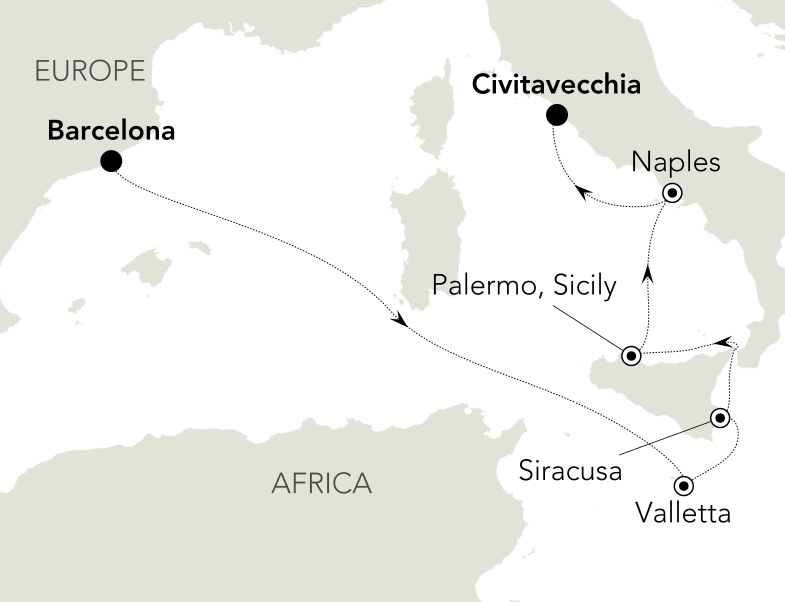
A 9-night ocean voyage aboard Silver Nova, Barcelona, Spain to Civitavecchia, Italy. Destination: Mediterranean.
Operated by Silversea Cruises aboard Silver Nova.
Barcelona
Valletta
Siracusa (Sicily)
Palermo, Sicily
Naples
Civitavecchia (Rome)
Having attracted over 82 million visitors in 2017, Spain is gaining popularity as a travel destination. The country lures travellers from across the world with its promise of authenticity, charisma, and memorable moments. Spain’s culture is a celebration of the finer things in life, an expression of spirit, heritage and fun: colourful fiestas, delectable cuisine, age-defining art, music, dance, sport and so much more. Each region of the country has evolved a character of its own, meaning the country is unified by a sense of cultural multiplicity. Barcelona, the capital of Catalonia, is a masterpiece that embellishes the Spanish canvas. The fact that the Barcelona’s iconic cathedral, La Sagrada Familia, is still under construction over 141 years after construction commenced pays testament to the city’s artistic perfectionism, which pervades all aspects of life here. Apparent in the city’s architecture, layout, and cultural practices, aestheticism retains its value here. Antoni Gaudí, whose iconic style of modernist architecture is among Barcelona’s leading attractions, could perhaps be credited with designing the face of this magnificent city. Enjoy getting to know the vivacious personality behind Barcelona’s beauty.
Days at sea are the perfect opportunity to relax unwind and catch up with what you’ve been meaning to do. So whether that is going to the gym, visiting the spa, whale watching, catching up on your reading or simply topping up your tan these blue sea days are the perfect balance to busy days spent exploring shore side.
Perched high on the imposing Sciberras Peninsula, Valletta immediately presents its massive, protective walls and vertical bastions to visitors arriving by sea. Rising to 47 metres in places, the fortifications protect lavish palaces, grand domes and illustrious gardens. Built by the Knights of St John on the narrow peninsular, Valletta is a compact, richly historical treasure trove of Baroque wonders. Ascend to reach the restful, flower-filled Upper Barrakka Gardens, where cannons fire and boom in salute at noon each day, sending echoing cracks of noise out across the waves below. Recognised as 2018’s European Capital of Culture, Valletta is a fascinating and dense haven of history and intrigue. A busy, bustling capital, the breathtaking St John’s Cathedral - commissioned in 1572 - is almost concealed among its narrow streets. The relatively modest exterior is counterpointed by a staggeringly opulent, gold-leaf bathed interior, containing a Caravaggio masterpiece - the shadowy vision of the Beheading of St John. Cinematic and magnificent, Valletta has served as a filming location for Game of Thrones - but real epic history abounds on this rocky isle too. From the prehistoric and megalithic sites of the Hypogeum of Paola and Tarxien, to the fascinating War Museum at Fort St Elmo. Mdina also waits nearby, and the former medieval capital is a striking contrast to the island’s main city. Cars are barred from its streets, and it offers endlessly atmospheric old-time wanders. With a strategic positioning in the Mediterranean, Malta is a jewel that many have wrestled for over the centuries. Independence from Britain was finally achieved in 1964, but the close allegiance remains evident, with English recognised as an official language, cars driving on the left, and red post boxes and telephone gleaming in Malta’s sunshine.
Perched high on the imposing Sciberras Peninsula, Valletta immediately presents its massive, protective walls and vertical bastions to visitors arriving by sea. Rising to 47 metres in places, the fortifications protect lavish palaces, grand domes and illustrious gardens. Built by the Knights of St John on the narrow peninsular, Valletta is a compact, richly historical treasure trove of Baroque wonders. Ascend to reach the restful, flower-filled Upper Barrakka Gardens, where cannons fire and boom in salute at noon each day, sending echoing cracks of noise out across the waves below. Recognised as 2018’s European Capital of Culture, Valletta is a fascinating and dense haven of history and intrigue. A busy, bustling capital, the breathtaking St John’s Cathedral - commissioned in 1572 - is almost concealed among its narrow streets. The relatively modest exterior is counterpointed by a staggeringly opulent, gold-leaf bathed interior, containing a Caravaggio masterpiece - the shadowy vision of the Beheading of St John. Cinematic and magnificent, Valletta has served as a filming location for Game of Thrones - but real epic history abounds on this rocky isle too. From the prehistoric and megalithic sites of the Hypogeum of Paola and Tarxien, to the fascinating War Museum at Fort St Elmo. Mdina also waits nearby, and the former medieval capital is a striking contrast to the island’s main city. Cars are barred from its streets, and it offers endlessly atmospheric old-time wanders. With a strategic positioning in the Mediterranean, Malta is a jewel that many have wrestled for over the centuries. Independence from Britain was finally achieved in 1964, but the close allegiance remains evident, with English recognised as an official language, cars driving on the left, and red post boxes and telephone gleaming in Malta’s sunshine.
Honey-coloured Siracusa is a staggering UNESCO World Heritage Site, and an extraordinary Sicilian city of immense ancient history. The modern population is a fraction of what it was at the city’s heyday around 400 BC, when Athens’ might was successfully challenged and faced down, reinforcing the city’s incredible power and status. Siracusa’s historical nucleus waits to be discovered on the compact islet of Ortygia. The city was founded here, but grew over time, spreading across to the mainland. A small channel separates the two, which is now spanned by twin bridges. Wander the atmospheric streets of this time warp, to reach the shining elegance of Piazza Duomo. The Baroque cathedral rises like a giant sandcastle, and you can settle opposite to cradle a glass of wine and enjoy the view over the immaculate square - people watching before the glorious baroque façade. Dig deep into its history at the mainland's archaeological park. Here you can wander between the remains of a Greek theatre, constructed in the 5th century BC, and now used as a grandiose, atmospheric venue for events and performances. You’ll also encounter a Roman Amphitheatre - where gladiators battled brutally, and the spectacular ear-shaped cave, which is famed for its extraordinary, secret-revealing acoustics. It was given its name - the Ear of Dionysius - by Caravaggio. Visit the legendary Fonte Arethusa, or lose yourself in the Ortygia Market – you’ll find everything here, from fresh fish, to spices and local bottles of wines. Look out for a flavour-filled jar of real Sicilian u strattu - an intense tomato paste that is the secret ingredient to many Sicilian recipes. The local ingredients are imbued with flavour by this volcanic land’s fertile soils and the firepower of Europe’s most active volcano Mount Etna, waits just to the north.
The capital of Sicily, Palermo is a fiery, authentic city and a cultural powerhouse on the periphery of Europe. Juicy lemons weigh down the branches of its tree-lined streets, while treats like cannoli tubes, filled with ricotta-blended cream, provide a sweet taste of the local cuisine. Oozing layered character, explore this incredible city at leisure, or head out to nearby villages, which offer preserved medieval charm. Stacked markets spill out onto Palermo’s souk-like streets, while grand piazzas host elaborate fountains and sculptures, below the watch of baroque church domes. Many cultures have clashed and combined on this island’s shores, - since the days of antiquity - giving the city the dubious honour of being the world’s most conquered city. A genuine patchwork of influences, Palermo’s triumph lies in somehow combining it all into one fascinating whole. Palermo is a delightfully dishevelled city. Wander bomb-damaged streets of neglect, which suddenly open out to the grandest of cathedrals and most majestic of stunning palaces. The 12th-century Palermo Cathedral is a glorious domed structure – rise to the top, to look across the city’s restaurant-filled alleyways from above. Next, encounter the Norman, Arabic, and Byzantine fusion of the Norman Palace and the incredible golden mosaics and sweeping archways of the adjacent Royal Chapel. Visit Europe’s third-largest opera house, or Mondello’s beach, which offers relaxation on a beautiful arc of white sand. Stop in at the selection of restaurants, which serve up fresh fish, and refreshing granita al limone.
Days at sea are the perfect opportunity to relax unwind and catch up with what you’ve been meaning to do. So whether that is going to the gym, visiting the spa, whale watching, catching up on your reading or simply topping up your tan these blue sea days are the perfect balance to busy days spent exploring shore side.
The legend of the Siren Parthenope Naples' foundation is not only shrouded in one but two legends, all having one 'person' in common: the siren Parthenope. She and her sisters, Leucosia and Ligaea, are the three resident sirens of the Galli Islands, with their "shores all bleached with human bones and debris", who lured sailors with their enchanting voices and music, only for them to run aground and perish. Parthenope was precisely this magical, murderous voice, while Leucosia and Ligaeus played the flute and citara. The first legend is linked to Ulysses, the first man not to succumb to the siren's call, thanks to Circe's advice. Curious but not mad, he ordered his sailors to plug their ears with wax and tie him firmly to the mast. In this way, he was able to enjoy the pleasure of hearing the music and songs without paying a high price. There are different stories here, some claiming that Parthenope fell in love with Ulysses, others not. In any case, the three sisters, in despair and humiliation, threw themselves into the sea and died. If you are surprised to read that, keep in mind that we're talking about sirens from Antiquity, young women transformed into half-woman half-bird monsters, punished by the goddess Demeter for not having stopped Hades, the god of the Underworld, from kidnapping their mistress Persephone (and daughter of Demeter). Mermaids with fish tails only appeared in the Middle Ages. So, Parthenope and her sisters perished. Their bodies were carried by the sea to Terina for Ligaea and Licosa for Leucosia. Parthenope's body was carried by the waves to the island of Megaride, Naples, where the Castel dell'Ovo stands today. She gave her name to the town and the inhabitants worshipped her, making her the town's patron saint. Another legend exists, from the 19th century. A centaur - Vesuvius - fell madly in love with our siren Parthenope, provoking the jealousy of Zeus. In revenge, he turned the centaur into a volcano. In despair, Parthenope committed suicide and her body washed up in Naples, allowing her to be close to her lover in death. Today there are three fountains dedicated to her: the Fontana delle Zizze (Neapolitan for 'nipples') beside Corso Umberto I with its winged mermaid, a second on the Piazza Jacopo Sannazzaro in Piedigrotta and a third, modern, near the shops at the Central Station. Naples is still referred to as the "Parthenopean city".
The legend of the Siren Parthenope Naples' foundation is not only shrouded in one but two legends, all having one 'person' in common: the siren Parthenope. She and her sisters, Leucosia and Ligaea, are the three resident sirens of the Galli Islands, with their "shores all bleached with human bones and debris", who lured sailors with their enchanting voices and music, only for them to run aground and perish. Parthenope was precisely this magical, murderous voice, while Leucosia and Ligaeus played the flute and citara. The first legend is linked to Ulysses, the first man not to succumb to the siren's call, thanks to Circe's advice. Curious but not mad, he ordered his sailors to plug their ears with wax and tie him firmly to the mast. In this way, he was able to enjoy the pleasure of hearing the music and songs without paying a high price. There are different stories here, some claiming that Parthenope fell in love with Ulysses, others not. In any case, the three sisters, in despair and humiliation, threw themselves into the sea and died. If you are surprised to read that, keep in mind that we're talking about sirens from Antiquity, young women transformed into half-woman half-bird monsters, punished by the goddess Demeter for not having stopped Hades, the god of the Underworld, from kidnapping their mistress Persephone (and daughter of Demeter). Mermaids with fish tails only appeared in the Middle Ages. So, Parthenope and her sisters perished. Their bodies were carried by the sea to Terina for Ligaea and Licosa for Leucosia. Parthenope's body was carried by the waves to the island of Megaride, Naples, where the Castel dell'Ovo stands today. She gave her name to the town and the inhabitants worshipped her, making her the town's patron saint. Another legend exists, from the 19th century. A centaur - Vesuvius - fell madly in love with our siren Parthenope, provoking the jealousy of Zeus. In revenge, he turned the centaur into a volcano. In despair, Parthenope committed suicide and her body washed up in Naples, allowing her to be close to her lover in death. Today there are three fountains dedicated to her: the Fontana delle Zizze (Neapolitan for 'nipples') beside Corso Umberto I with its winged mermaid, a second on the Piazza Jacopo Sannazzaro in Piedigrotta and a third, modern, near the shops at the Central Station. Naples is still referred to as the "Parthenopean city".
All roads lead to Rome, and with good reason - this city is one of the world’s most thrilling, offering unmatched history along every street. An evocative, inspiring and utterly artistic capital of unrivalled cultural impact, Rome is a city of back-to-back landmarks, which will take you on an exhilarating journey through the ages. This may be one of the world’s oldest cities, but it’s well and truly lived in. The ruins are punctuated with murmuring cafes, and the outdoor seating of restaurants sprawls out across piazzas, enticing you to sample tangles of creamy pasta and crispy pizzas. Rome’s incredible Roman Forum is littered with the ruins of its ancient administrations, which have stood firm for 2,000 years, since the times when the area was the centre of the Western world. Few sites are more simultaneously beautiful and haunting than that of the storied Colosseum, which looms deep into Rome’s rich blue sky. Take a tour to learn details of the grisly goings-on within. The best way to experience Rome is to wander its streets, gelato in hand. There is a lot to see here - whether it’s the domed spectacle of the Pantheon, or the elaborate flowing waters and artistry of the Trevi Fountain. Vatican City is an astonishing, colossal display of Catholic grandeur, while the Spanish Steps – crowned by the Trinità dei Monti church – offer a beautiful spot to gather and soak up the lively atmosphere of this humming city. With so much on the to-do list, you’ll relish the breaks you take, enjoying simple pleasures like a strong espresso, or fresh pasta with tomato sauce and ripped basil.
From $8,400
per guest · 9 nights
Prices are a guide and vary with season, cabin category and party size. Your advisor will confirm the exact cost before anything is booked.
Classic Veranda
suite
Deluxe Veranda
suite
Grand 1 Bedroom
suite
Junior Grand 1 Bedroom
suite
Junior Grand 2 Bedroom
suite
Master
suite
Medallion
suite
Otium
suite
Owner 1 Bedroom
suite
Owner 2 Bedroom
suite
Premium Medallion
suite
Premium Veranda
suite
Signature
suite
Silver
suite
Superior Veranda
suite








