




Prefer a conversation?
Our team is always available to guide you through the process and ensure your experience is perfectly matched to your preferences.
Our team is always available to guide you through the process and ensure your experience is perfectly matched to your preferences.
Duration
7 Nights
Price
From $6,300
Ship
Silver Nova
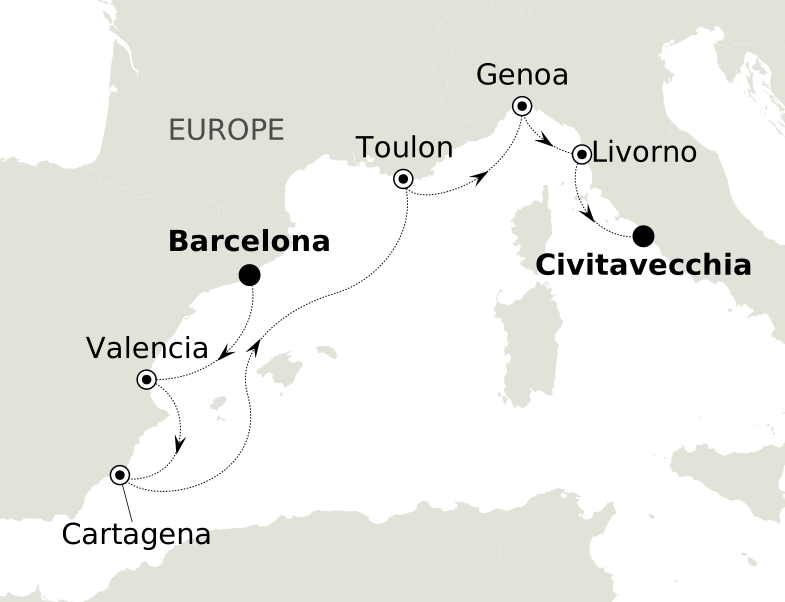
A 7-night ocean voyage aboard Silver Nova, Barcelona, Spain to Civitavecchia, Italy. Destination: Mediterranean.
Operated by Silversea Cruises aboard Silver Nova.
Barcelona
Valencia
Cartagena (Spain)
Toulon
Genoa
Livorno (Tuscany)
Civitavecchia (Rome)
Having attracted over 82 million visitors in 2017, Spain is gaining popularity as a travel destination. The country lures travellers from across the world with its promise of authenticity, charisma, and memorable moments. Spain’s culture is a celebration of the finer things in life, an expression of spirit, heritage and fun: colourful fiestas, delectable cuisine, age-defining art, music, dance, sport and so much more. Each region of the country has evolved a character of its own, meaning the country is unified by a sense of cultural multiplicity. Barcelona, the capital of Catalonia, is a masterpiece that embellishes the Spanish canvas. The fact that the Barcelona’s iconic cathedral, La Sagrada Familia, is still under construction over 141 years after construction commenced pays testament to the city’s artistic perfectionism, which pervades all aspects of life here. Apparent in the city’s architecture, layout, and cultural practices, aestheticism retains its value here. Antoni Gaudí, whose iconic style of modernist architecture is among Barcelona’s leading attractions, could perhaps be credited with designing the face of this magnificent city. Enjoy getting to know the vivacious personality behind Barcelona’s beauty.
Spain's third largest city basks in a self-assured glow of its very own - not least because of the glorious sunshine that illuminates striking architecture and sweeping beaches. In this city of contrasts, you can discover the Holy Grail in the confines of the cathedral, before heading out to the City of Arts and Sciences' sci-fi vision of architectural ambition. The city crackles with energy all year round, but reaches a cacophonous fever pitch during Las Fallas festival - which welcomes spring with an almighty bang, and a riotous celebration of flame, firework and fiesta. A glorious belt of green parkway also snakes through the city, having flourished in the former river bed left behind when the Turia was redirected to spare the city from history's devastating floods. Perfect for cycling, it winds towards Valencia's contemporary showpiece, an unapologetically futuristic complex of structures - which rise like gleaming white rib cages from the shimmering pools surrounding them.The food is no less thrilling, with experimentation complementing rich tradition. Jewelled with succulent ingredients from the surrounding fields - you may be surprised that Valencia's famous paella contains rabbit and chicken meat rather than seafood. Do your self a favour, while also impressing the locals, by scraping off the 'socarrat' - the prized crunchy crust that sweetens as it forms at the bottom of the pan.
On the crossroads of mighty cultures, this Murcian port has endless ancient stories to share. A valuable natural harbour attracted many civilisations to this sun-bathed, southeasterly setting - following its foundation by the Carthaginians in 227 BC. Blending the imprints left by countless cultures on this global junction, the presence of everyone from the Vandals to the Phoenicians and Moors can be felt as you explore, walking between ruins and celebrated modernist architecture along Calle Mayor. Cartagena is crowned by the soaring Castillo de la Concepcion - rise to the stout castle aboard a panoramic lift. Inside, look through reams of archaeological treasures, or admire the rolling views down over the port and across the waters. Watch out for the electric blue peacocks who strut flamboyantly. Cartagena's emergence as a visitor destination coincided with a stunning discovery in 1988 - the bowl of a gloriously preserved Roman Theatre. Enter to sit among the grandiose ancient venue, so evocative, you can't help but imagine the historic performances that have graced its stage. Wander the breezy waterfront, looking across the narrow strait towards Africa's distant haze, and spotting gleaming warships. Cartagena's perfect harbour means it has been one of Spain's oldest strategic navy positions since the 16th century. Settle to enjoy the joys of tapas in lively bars - sampling crisped paella, squid and honeyed-aubergine. Easter's Semana Santa festivities are typically lively here, as hooded processions, lavish floats and sombre fiery displays roll through the streets.
Days at sea are the perfect opportunity to relax unwind and catch up with what you’ve been meaning to do. So whether that is going to the gym, visiting the spa, whale watching, catching up on your reading or simply topping up your tan these blue sea days are the perfect balance to busy days spent exploring shore side.
Built around a sheltered bay, with 1,700-foot Mount Faron as an impressive backdrop, Toulon is an important naval port and a city of industry and manufacturing. Its large harbor serves as the base for the French navy's Mediterranean fleet and as the home to a sizeable marina, with yachts and pleasure boats adding bright splashes of color. Toulon was the site where Napoleon Bonaparte first made a name for himself in 1793 during a siege in which the English, who had taken over Toulon, were expelled. During World War II, the bulk of the French fleet anchored off Toulon was scuttled by French crews to prevent its acquisition by occupying German forces. The city was liberated in 1944 by French troops. A maze of pedestrian streets constitutes the heart of old Toulon. Shops and colorful stalls make it an attractive area to explore. Avenue de la République runs parallel to the waterfront. At the western edge of the quay is the Naval Museum featuring an excellent collection of old and new ship models, figureheads, paintings and other items related to Toulon’s maritime history. The town’s attractions can be seen in a fairly short time. Most visitors come here to explore the hinterland and other parts of the Riviera.
Most famous for being the birthplace of Christopher Columbus, Genoa is one of Italy’s true unsung heroes. Stretched out along the Mediterranean coast just over 100 miles from France, the city is the capital of Liguria, or the Italian Riviera, and has the history to prove it. Once the main trading centre for Italy, Genoa has a fine legacy of wealth behind it. The area once had complete control over the Tyrrhenian Sea, and its vast reach stretched as far as Nice to the west, Sardinia in the south and into the Piedmont mountains in the north. Exports were many, but perhaps the most lucrative of these was the rough denim cloth that sailors would wear, today more popularly known under the moniker blue jean. This affluence has left its mark on the city, think ornate gates, large, leafy palazzos, lavishly decorate churches and a Centro Storico – or Old Town – that speaks volumes. Grab your best hiking boots and wander the narrow alleys and steep hills and imbibe in the inherent Italianism of the city. No could talk about Genoa’s history without mentioning its food. Home of both Pesto and Focaccia, Genoa is considered by many to be one of the cornerstones of Italian gastronomy. The city’s cuisine is very much a product of its terrain: The Mediterranean yields freshly caught fish and seafood found on almost every menu, while the mountains supply the meat, cheese and above all herbs that flavour the dishes. It may not be fancy, but if you like good, simple Italian food, you have come to the right place.
The Tower of Matilde is an iconic structure of the city of Livorno. This medieval tower is said to have been built by the famous mathematician and astronomer Galileo Galilei. It is named after Matilde di Canossa, an influential noblewoman who played a key role in the political and religious conflicts of the 11th century. Matilde was a powerful figure in medieval Italy, and her legacy is still felt in Livorno today. The tower was built on her orders as a defensive stronghold to protect the city against invaders, and its strategic location on the coast made it an important part of the city's defenses. Over the centuries, the Tower of Matilde has been restored and renovated several times, but it still retains its original medieval charm. The tower is a classic example of medieval architecture, with its thick walls, narrow windows, and imposing structure. The tower was later used as a watchtower during World War II and is now a popular tourist attraction as visitors can climb to the top and enjoy panoramic views of the surrounding area. The Tower of Matilde is also an important cultural landmark in Livorno. It is often used as a venue for cultural events and exhibitions, and its unique atmosphere and ambiance make it a popular destination for artists and writers.
All roads lead to Rome, and with good reason - this city is one of the world’s most thrilling, offering unmatched history along every street. An evocative, inspiring and utterly artistic capital of unrivalled cultural impact, Rome is a city of back-to-back landmarks, which will take you on an exhilarating journey through the ages. This may be one of the world’s oldest cities, but it’s well and truly lived in. The ruins are punctuated with murmuring cafes, and the outdoor seating of restaurants sprawls out across piazzas, enticing you to sample tangles of creamy pasta and crispy pizzas. Rome’s incredible Roman Forum is littered with the ruins of its ancient administrations, which have stood firm for 2,000 years, since the times when the area was the centre of the Western world. Few sites are more simultaneously beautiful and haunting than that of the storied Colosseum, which looms deep into Rome’s rich blue sky. Take a tour to learn details of the grisly goings-on within. The best way to experience Rome is to wander its streets, gelato in hand. There is a lot to see here - whether it’s the domed spectacle of the Pantheon, or the elaborate flowing waters and artistry of the Trevi Fountain. Vatican City is an astonishing, colossal display of Catholic grandeur, while the Spanish Steps – crowned by the Trinità dei Monti church – offer a beautiful spot to gather and soak up the lively atmosphere of this humming city. With so much on the to-do list, you’ll relish the breaks you take, enjoying simple pleasures like a strong espresso, or fresh pasta with tomato sauce and ripped basil.
From $6,300
per guest · 7 nights
Prices are a guide and vary with season, cabin category and party size. Your advisor will confirm the exact cost before anything is booked.
Classic Veranda
suite
Deluxe Veranda
suite
Grand 1 Bedroom
suite
Junior Grand 1 Bedroom
suite
Junior Grand 2 Bedroom
suite
Master
suite
Medallion
suite
Otium
suite
Owner 1 Bedroom
suite
Owner 2 Bedroom
suite
Premium Medallion
suite
Premium Veranda
suite
Signature
suite
Silver
suite
Superior Veranda
suite








