




Prefer a conversation?
Our team is always available to guide you through the process and ensure your experience is perfectly matched to your preferences.
Our team is always available to guide you through the process and ensure your experience is perfectly matched to your preferences.
Duration
14 Nights
Price
From $9,600
Ship
Silver Dawn
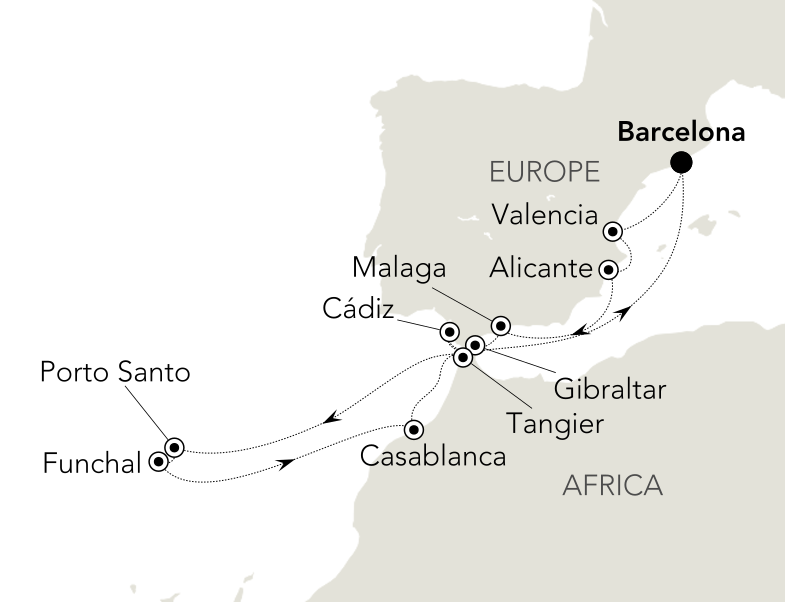
A 14-night ocean voyage aboard Silver Dawn, Barcelona, Spain to Barcelona, Spain. Destination: Mediterranean.
Operated by Silversea Cruises aboard Silver Dawn.
Barcelona
Valencia
Alicante
Malaga (Costa del Sol)
Cádiz
Gibraltar
Porto Santo, Madeira
Funchal, Madeira
Casablanca
Tangier
Having attracted over 82 million visitors in 2017, Spain is gaining popularity as a travel destination. The country lures travellers from across the world with its promise of authenticity, charisma, and memorable moments. Spain’s culture is a celebration of the finer things in life, an expression of spirit, heritage and fun: colourful fiestas, delectable cuisine, age-defining art, music, dance, sport and so much more. Each region of the country has evolved a character of its own, meaning the country is unified by a sense of cultural multiplicity. Barcelona, the capital of Catalonia, is a masterpiece that embellishes the Spanish canvas. The fact that the Barcelona’s iconic cathedral, La Sagrada Familia, is still under construction over 141 years after construction commenced pays testament to the city’s artistic perfectionism, which pervades all aspects of life here. Apparent in the city’s architecture, layout, and cultural practices, aestheticism retains its value here. Antoni Gaudí, whose iconic style of modernist architecture is among Barcelona’s leading attractions, could perhaps be credited with designing the face of this magnificent city. Enjoy getting to know the vivacious personality behind Barcelona’s beauty.
Spain's third largest city basks in a self-assured glow of its very own - not least because of the glorious sunshine that illuminates striking architecture and sweeping beaches. In this city of contrasts, you can discover the Holy Grail in the confines of the cathedral, before heading out to the City of Arts and Sciences' sci-fi vision of architectural ambition. The city crackles with energy all year round, but reaches a cacophonous fever pitch during Las Fallas festival - which welcomes spring with an almighty bang, and a riotous celebration of flame, firework and fiesta. A glorious belt of green parkway also snakes through the city, having flourished in the former river bed left behind when the Turia was redirected to spare the city from history's devastating floods. Perfect for cycling, it winds towards Valencia's contemporary showpiece, an unapologetically futuristic complex of structures - which rise like gleaming white rib cages from the shimmering pools surrounding them.The food is no less thrilling, with experimentation complementing rich tradition. Jewelled with succulent ingredients from the surrounding fields - you may be surprised that Valencia's famous paella contains rabbit and chicken meat rather than seafood. Do your self a favour, while also impressing the locals, by scraping off the 'socarrat' - the prized crunchy crust that sweetens as it forms at the bottom of the pan.
The bustling resort of Alicante serves not only as the port for Madrid, but is also one of the loveliest vacation spots along Spain’s sunny Costa Blanca. The latter is primarily due to the pleasant climate. Various civilizations have flourished along these shores. Early records indicate that the city dates back to a Carthaginian settlement established in 325 BC. These settlers were followed by the Romans, who equally found the area inviting. Then the Moors ruled this region for five centuries and named the city Al-Akant. Today’s name probably stems from this origin. The city’s occupation by Roman and Moorish forces accounts for a notable and varied heritage. In fact, much of this cultural impact is still apparent today in numerous buildings, names and the cuisine. Much of the city’s economy is based on tourism and agriculture. Wine, raisins, and other products from the surrounding areas find their way into the cargo holds of ships bound for worldwide destinations. Sun-worshippers arrive in droves to enjoy the guaranteed sunshine. Long stretches of beach add to the attraction and lend it to sports and leisure activities. Old and new Alicante meet near the city center, with the newest sections featuring modern hotels, top restaurants, and exclusive shops. The older sections offer such interesting sites as the Castillo Santa Barbara, the Church of Santa Maria, San Nicolas Cathedral, and several fine museums. The Museum of 20th Century Art displays works by Picasso, Dali, and Tàpies. Alicante is a fine city to wander, making a stop now and then for a refreshing beverage at an open-air café. Pier Information Your ship will dock at either Estacion Maritima or Pier 14, approximately one half mile from town. Taxis are generally not available on the pier, unless requested in advance. Shopping Leather shoes, perfumed soap, nougat, and regional fragrances are all nice mementos. Shop at Corte Ingles Department Store and in shops located around the Town Hall. The local currency is the euro. Cuisine Casual dining can be found in rustic eateries in the Old Town. Spanish cuisine is delicious, but can be spicy. Try the tapas served traditionally in local bars. These snacks consist of olives, nuts, and small pieces of sausage, and taste especially good with a glass of local wine. Other Sites Old Quarter The town’s Old Quarter features a labyrinth of winding streets. The character of old Spain is very much in evidence here. Church of Santa Maria The façade of the 14th-century church is a swirl of Baroque decoration. The Castle of Santa Barbara This castle dominates Alicante from atop the 620-foot-high Benacantil Hill. From here, one can enjoy views of the city and the Mediterranean. The top can be reached by car or via an elevator.
Days at sea are the perfect opportunity to relax unwind and catch up with what you’ve been meaning to do. So whether that is going to the gym, visiting the spa, whale watching, catching up on your reading or simply topping up your tan these blue sea days are the perfect balance to busy days spent exploring shore side.
Bathing in the sunshine coast’s stunning subtropical climate, and laying out endless spectacular beaches, it’s no surprise that Malaga is one of Spain’s most popular cities. The already impressive cultural appeal of this holiday city has skyrocketed over recent years, and with a storied old town and Moorish fortifications, Malaga has a lot to offer. Nearby, you can recline on the renowned beaches of the Costa del Sol, or venture inland to discover the Moorish treasures of Granada and Cordoba. La Malagueta beach is Malaga’s spacious urban beach, perfect for a sunbathe and a dip in the warm water, before enjoying seaside cocktails or seafood tapas in the restaurants nearby. Malaga and the Costa del Sol may be best known for glorious weather and beaches, but Malaga can now stake a genuine claim as an artistic powerhouse too. Visit the renowned Picasso museum – housed in the artist’s birthplace – before exploring the freshly opened outpost of the Pompidou Centre. The art also spills out onto the streets in the colourful Soho district – splashed with vibrant street paintings. Known as La Manquita – or the one-armed woman – the city’s cathedral rises over the historic old town. Its huge bell tower stands tall, but an accompanying second tower was never completed - hence the nickname. The Alcazaba fortress palace looms over the waterfront and forms a spectacularly preserved remnant from the era when the Moors controlled the Andalucía region. Discover more of the Arabic influence by visiting Granada’s Alhambra palace, or Cordoba’s La Mezquita mosque. Together with Seville’s converted cathedral, the cities form Andalucía’s Golden Triangle of Moorish wonders.
More than a hundred watchtowers gaze out across the waves surrounding this ancient Andalusian city. Sprinkled with evocative cobbled side streets, you’ll explore 3,000 years’ worth of history, while stumbling across palm-tree lined plazas of shaded coffee sippers. Cadiz claims the mantle of Western Europe’s oldest city, and every piece of architecture - and every wrong turn - offers a chance to discover fascinating new tales. Founded by the Phoenicians in 1100BC, Christopher Columbus used the city as a base for his exploratory, map-defining voyages of 1493 and 1502. The port grew in importance and wealth as Cadiz’s strategic location close to Africa’s northern tip helped it blossom into a centre for New World trade. Catedral de Cádiz, is a display of the city’s wealth and importance, looming spectacularly over the Atlantic’s waves, with cawing seagulls sweeping between its twin bell towers. Inside, treasures from the city’s trading exploits in the West Indies and beyond - which helped fuel the growth of this historically prosperous city – are on display. Enveloped by ocean on almost every side, Cadiz has something of an island feel, and you can cool off from southern Spain’s unrelenting sunshine on the sweeping golden sand beach of Playa Victoria. The two towers of the new El Puente de la Constitución de 1812 mark a contemporary landmark in this most ancient of cities, in the form of a spectacular new road bridge. Torre Tavira, meanwhile, is the most famous of Cadiz’s army of watchtowers, and the highest point in the city. Reach the top for a view of the ocean fringing the city’s expanse, and to learn about the towers - constructed so trading merchants could survey the harbour from their lavish homes. The Central Market is a chaotic place of bartering, where flashing knives dissect fresh fish. Stop in at the orbiting bars to enjoy tapas, freshly prepared with the market’s produce.
More than a hundred watchtowers gaze out across the waves surrounding this ancient Andalusian city. Sprinkled with evocative cobbled side streets, you’ll explore 3,000 years’ worth of history, while stumbling across palm-tree lined plazas of shaded coffee sippers. Cadiz claims the mantle of Western Europe’s oldest city, and every piece of architecture - and every wrong turn - offers a chance to discover fascinating new tales. Founded by the Phoenicians in 1100BC, Christopher Columbus used the city as a base for his exploratory, map-defining voyages of 1493 and 1502. The port grew in importance and wealth as Cadiz’s strategic location close to Africa’s northern tip helped it blossom into a centre for New World trade. Catedral de Cádiz, is a display of the city’s wealth and importance, looming spectacularly over the Atlantic’s waves, with cawing seagulls sweeping between its twin bell towers. Inside, treasures from the city’s trading exploits in the West Indies and beyond - which helped fuel the growth of this historically prosperous city – are on display. Enveloped by ocean on almost every side, Cadiz has something of an island feel, and you can cool off from southern Spain’s unrelenting sunshine on the sweeping golden sand beach of Playa Victoria. The two towers of the new El Puente de la Constitución de 1812 mark a contemporary landmark in this most ancient of cities, in the form of a spectacular new road bridge. Torre Tavira, meanwhile, is the most famous of Cadiz’s army of watchtowers, and the highest point in the city. Reach the top for a view of the ocean fringing the city’s expanse, and to learn about the towers - constructed so trading merchants could survey the harbour from their lavish homes. The Central Market is a chaotic place of bartering, where flashing knives dissect fresh fish. Stop in at the orbiting bars to enjoy tapas, freshly prepared with the market’s produce.
A curious slice of Britain - picked up and plonked into the sun sea and sand of southern Spain - Gibraltar is a unique and historic peninsula crowned by the iconic Rock of Gibraltar mountain. Bright red phone boxes gleam Union Jacks flutter in the breeze and cones of fish and chips are scoffed in the sun in this most British of outposts. At times a surreal and strange juxtaposition you can be gazing at the African shoreline from the beach one moment and carefully treading across the runway of a crammed-in international airport the next. Gibraltar's cathedral-like Rock towers 400 metres above the waves and the stark limestone mountain watches out across a narrow strategic strait between the European and African continents. The pointed Rock is a symbol of this unique place and you can hike it - or take the convenient cable car - to enjoy the views and meet the mischievous colony of Barbary macaques who live on its slopes. Europe's only wild monkeys roam free and loose on the mountain. The Siege Tunnels bring to life the struggles for this land with the plucky British boring tunnels through the rock by hand effectively converting it into a giant watchtower capable of defending the distant territory. Natural caves inside droop with stalactites while a squat Moorish castle stands proudly at its summit. Grand Casemates Square is a sunbathed plaza and drizzly old Britain feels a world away as you sit back and sip ice-cold beers and cocktails in Gibraltar's historic centre.
Days at sea are the perfect opportunity to relax unwind and catch up with what you’ve been meaning to do. So whether that is going to the gym, visiting the spa, whale watching, catching up on your reading or simply topping up your tan these blue sea days are the perfect balance to busy days spent exploring shore side.
The small island of Porto Santo lies 21 miles northeast from Madeira, a two and a half hour trip by local ferry.As a result of this close proximity, Porto Santo’s history has been associated with that of its larger sister island since the 14th century, when both appear on a Genoese map. It was in the early 15th century that the Portuguese explorer, Joao Goncalves Zarco, landed on uninhabited Porto Santo after being blown off course while exploring the coast of Africa. He returned the following year on a voyage sponsored by Henry the Navigator; this time he spotted Madeira on the horizon. Compared to Madeira, Porto Santo still remains largely unspoiled, with beautiful sand beaches. Its climate is fairly predictable - dry and warm with few differences in temperature between the seasons, which allows swimming almost year-round. In addition to fine beaches, the island’s major claim to fame is based on the fact that Christopher Columbus lived here for some time and was married to the daughter of the local governor. In the small capital,Vila Baleira, the house of Columbus has been converted into a museum.Another attraction on Porto Santo is the Pico do Castelo. The fort, standing on the highest point of the island, was erected in the 16th century to ward off attacks by French and Algerian pirates. In recent years, thousands of trees have been planted in various parts of the island in an effort to stem the erosion of precious soil. Results so far offer pleasingly green patches in an otherwise dry and arid landscape. Remote Porto Santo still offers visitors an air of tranquility and a look at an unhurried way of life, where stress has not yet had its effect on the 5,000 or so islanders. On the other hand, one must also keep in mind that tourist facilities on Porto Santo are not of the same high standard as on the sister island, Madeira. Pier Information The ship is scheduled to dock at the port of Santo. The pier is about two miles from Vila Baleira, the island’s small capital.Taxis may be found in limited supply for the short ride to town or for a trip around the island. Rates should be agreed on before leaving the pier. Facilities at the port include telephone and fax services, a pharmacy and a rental car office. Shopping Local souvenirs include objects made from straw such as miniature windmills and dolls. They can be found in shops around Vila Baleira. Opening hours are generally from 9:00 a.m. to 1:00 p.m., opening again at 3:00 p.m. Most shops accept U.S. dollars. The local currency is the euro. Cuisine If you feel like having lunch ashore, seafood is your best choice, which you can find at either Mar e Sol or Por do Sol in Vila Baleira. Other Sites Of interest in town are several churches, the town hall square, a monument dedicated to Portuguese discoveries and the Museum “Casa Colombo.” Around the island you find ruins of 16th-century fortifications and a geological monument at Pico Ana Ferreira. Most of these sights are covered on the tour.
The discovery of Madeira or the legend of the two lovers Although there are serious doubts as to whether the island was known as far back as antiquity, the official discovery of Madeira dates back to the 15th century and is attributed to Joao Goncalves Zarco. He set foot on Porto Santo in 1419 and on Madeira a year later. He named the island "Madeira"-wood in Portuguese- because of the immense forests that cover the island. However, legend has it that Zarco did not come here by chance. It is said that in the 14th century, a couple of lovers who were not bound by the sacred bonds of marriage fled by sea to live out their love. Their names were Anne d'Hertford, a Frenchwoman, and Robert MacKean, an Englishman. Their boat, pushed by a storm, ran aground on the island of Madeira. The two unfortunate lovers died shortly afterwards, one from illness, the other from sadness, but the sailors who were with them on the boat survived. Unfortunately for them, they were captured and sold into slavery in Morocco, where they recounted their adventures and the discovery of an island covered in forests with gigantic trees. The story reached the ears of the Portuguese, and it was thanks to them that João Gonçalves Zarco discovered Madeira and its precious wood.
Days at sea are the perfect opportunity to relax unwind and catch up with what you’ve been meaning to do. So whether that is going to the gym, visiting the spa, whale watching, catching up on your reading or simply topping up your tan these blue sea days are the perfect balance to busy days spent exploring shore side.
Immortal lines from the silver screen may have imprinted a warm, fuzzy visage of old Casablanca into our minds, but this thriving city is a curious example of what Morocco’s modernity looks like. Glistening white art deco buildings line the wide pathways that sweep through Casablanca, as the sea sparkles like a thin mirage on the horizon. There’s an aura of creativity amid Casablanca’s culture and chaos, helping to make the city one of Morocco’s most curious and compelling. The Hassan II Mosque took a staggering seven years and 10,000 artists to craft its legacy as the country's largest mosque, and to bring the world's tallest minaret to sky-high reality. A vision of cool to the touch marble, cavernous prayer rooms and intricate inlays, the mosque is extraordinary in scale and ambition. Retractable roofs let the sun flood in, while dizzying glass floors dazzle, and the blue Atlantic waves surge below your feet. After that humbling visit, stroll along La Corniche - where surfers glide across rough and tumble waves, and chic cafes offer front-row seats for sweet peppermint teas with a side of people-watching. Casablanca is a diner's city - boulevards laced with French-fusion restaurants, buzzy beachfront joints, and raw seafood bars provide gem-like offerings fresh from the boat. Those seeking a slice of that golden-age Hollywood romance can wander through the medina, with its unabashed ramshackle feel, and maze of alleyways punctuated with busy barber shops and butchers.
Set on the Maghreb coast, Tangier is Africa’s outstretched hand to Europe. With its bustling markets and lively waterfront, this city on Morroco's north is an energetic and invigorating place and an exciting immersion into an incredible continent. The location, on the highly strategic narrowing of the Strait of Gibraltar, made Tangier a vital Phoenician trading town - and the resulting city is an invigorating mesh of cultures and curiosities. Part of the fun of Tangier is the well-rehearsed dance, as you dodge good-natured hawkers, and this is certainly a place to stroll with confidence and purpose. Delve into the mayhem of the walled Medina of Tangier for a rush of stimulation, as bartering and bantering echoes along the tight alleys. Crowded, noisy and busy, you’ll be sold to with a smile as you wander between stands of colourful spices, dried fruits and fabrics in this authentic Moroccan marketplace. Refresh and escape the sun with a fresh orange juice - or a sip of mint tea. Close to the city, you can find the Caves of Hercules, a coastal hollow that opens at both ends. The Phoenicians cut a window in the shape of the African continent, which reveals views of the Atlantic's waves, and legend says Hercules rested within its confines. From Tangier, you can also venture inland to the Rif Mountains, where gorgeous Chefchaouen - a village of bright blue alleyways - waits. Punctuated by blooming flowers, the entire town is a beautiful, moulded artwork of colour, spilling down the mountain like a waterfall.
Days at sea are the perfect opportunity to relax unwind and catch up with what you’ve been meaning to do. So whether that is going to the gym, visiting the spa, whale watching, catching up on your reading or simply topping up your tan these blue sea days are the perfect balance to busy days spent exploring shore side.
Having attracted over 82 million visitors in 2017, Spain is gaining popularity as a travel destination. The country lures travellers from across the world with its promise of authenticity, charisma, and memorable moments. Spain’s culture is a celebration of the finer things in life, an expression of spirit, heritage and fun: colourful fiestas, delectable cuisine, age-defining art, music, dance, sport and so much more. Each region of the country has evolved a character of its own, meaning the country is unified by a sense of cultural multiplicity. Barcelona, the capital of Catalonia, is a masterpiece that embellishes the Spanish canvas. The fact that the Barcelona’s iconic cathedral, La Sagrada Familia, is still under construction over 141 years after construction commenced pays testament to the city’s artistic perfectionism, which pervades all aspects of life here. Apparent in the city’s architecture, layout, and cultural practices, aestheticism retains its value here. Antoni Gaudí, whose iconic style of modernist architecture is among Barcelona’s leading attractions, could perhaps be credited with designing the face of this magnificent city. Enjoy getting to know the vivacious personality behind Barcelona’s beauty.
From $9,600
per guest · 14 nights
Prices are a guide and vary with season, cabin category and party size. Your advisor will confirm the exact cost before anything is booked.
Classic Veranda
suite
Deluxe Veranda
suite
Grand 1 Bedroom
suite
Grand 2 Bedroom
suite
Owner 1 Bedroom
suite
Owner 2 Bedroom
suite
Panorama
suite
Royal 1 Bedroom
suite
Royal 2 Bedroom
suite
Silver
suite
Silver 2 Bedroom
suite
Superior Veranda
suite
Vista
suite








