




Prefer a conversation?
Our team is always available to guide you through the process and ensure your experience is perfectly matched to your preferences.
Our team is always available to guide you through the process and ensure your experience is perfectly matched to your preferences.
Duration
9 Nights
Price
From $8,400
Ship
Silver Ray
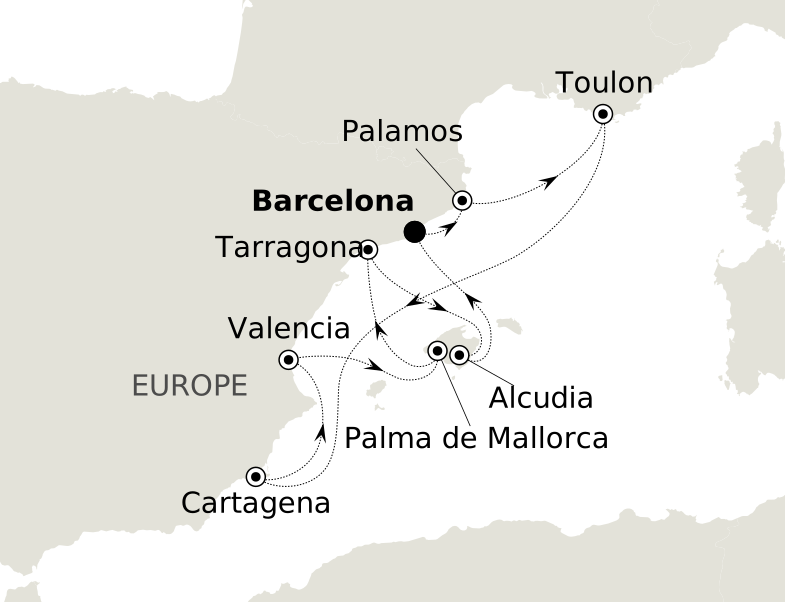
A 9-night ocean voyage aboard Silver Ray, Barcelona, Spain to Barcelona, Spain. Destination: Mediterranean.
Operated by Silversea Cruises aboard Silver Ray.
Barcelona
Palamos
Toulon
Cartagena (Spain)
Valencia
Palma de Mallorca
Tarragona
Alcudia, Mallorca
Having attracted over 82 million visitors in 2017, Spain is gaining popularity as a travel destination. The country lures travellers from across the world with its promise of authenticity, charisma, and memorable moments. Spain’s culture is a celebration of the finer things in life, an expression of spirit, heritage and fun: colourful fiestas, delectable cuisine, age-defining art, music, dance, sport and so much more. Each region of the country has evolved a character of its own, meaning the country is unified by a sense of cultural multiplicity. Barcelona, the capital of Catalonia, is a masterpiece that embellishes the Spanish canvas. The fact that the Barcelona’s iconic cathedral, La Sagrada Familia, is still under construction over 141 years after construction commenced pays testament to the city’s artistic perfectionism, which pervades all aspects of life here. Apparent in the city’s architecture, layout, and cultural practices, aestheticism retains its value here. Antoni Gaudí, whose iconic style of modernist architecture is among Barcelona’s leading attractions, could perhaps be credited with designing the face of this magnificent city. Enjoy getting to know the vivacious personality behind Barcelona’s beauty.
A place of monasteries tucked into mountains, surreal art, and gorgeous beaches, Palamos is your gateway to the Costa Brava’s scenic beauty, and the cultural wonders of Catalonia. Inspect Palamos’ rugged coastline, and you can almost see the Catalan flag’s blood and gold colours reflected in the craggy red cliffs and golden sands. Soak in the unfiltered glory of Spain’s Wild Coast, which is fringed with attractive beaches and rock-dappled outcrops lunging into the blue Mediterranean waves. Known for its rich, meaty prawns, Palamos is a flavourful stop of culture, coastline and historic charm. Just 20 miles inland from Palamos’ tempting beaches, you’ll find Girona’s Medieval city looming. Four rivers converge here, in this delightfully walkable city. Soak up the atmosphere of the cobbled old town, which is protected by historic ramparts. A steep ramp of 90 steps leads up to the Baroque façade of the Cathedral of Girona, which towers over the city and impresses with the world’s widest Gothic nave – a full 22 metres across. Figueres is also close by, where you can enter the ‘theatrical dream’ conceived by the master of surrealism, Salvador Dalí. Born in Figueres, his hometown honours his memory and global influence at the irresistible Dalí Theatre-Museum - a gloriously bizarre and immersive experience, and a fitting summation of his creative outlook. Opened in 1974, Dalí himself had an input into the design of the giant egg topped building, having worked on its creation during the final decade of his life.
Built around a sheltered bay, with 1,700-foot Mount Faron as an impressive backdrop, Toulon is an important naval port and a city of industry and manufacturing. Its large harbor serves as the base for the French navy's Mediterranean fleet and as the home to a sizeable marina, with yachts and pleasure boats adding bright splashes of color. Toulon was the site where Napoleon Bonaparte first made a name for himself in 1793 during a siege in which the English, who had taken over Toulon, were expelled. During World War II, the bulk of the French fleet anchored off Toulon was scuttled by French crews to prevent its acquisition by occupying German forces. The city was liberated in 1944 by French troops. A maze of pedestrian streets constitutes the heart of old Toulon. Shops and colorful stalls make it an attractive area to explore. Avenue de la République runs parallel to the waterfront. At the western edge of the quay is the Naval Museum featuring an excellent collection of old and new ship models, figureheads, paintings and other items related to Toulon’s maritime history. The town’s attractions can be seen in a fairly short time. Most visitors come here to explore the hinterland and other parts of the Riviera.
Days at sea are the perfect opportunity to relax unwind and catch up with what you’ve been meaning to do. So whether that is going to the gym, visiting the spa, whale watching, catching up on your reading or simply topping up your tan these blue sea days are the perfect balance to busy days spent exploring shore side.
On the crossroads of mighty cultures, this Murcian port has endless ancient stories to share. A valuable natural harbour attracted many civilisations to this sun-bathed, southeasterly setting - following its foundation by the Carthaginians in 227 BC. Blending the imprints left by countless cultures on this global junction, the presence of everyone from the Vandals to the Phoenicians and Moors can be felt as you explore, walking between ruins and celebrated modernist architecture along Calle Mayor. Cartagena is crowned by the soaring Castillo de la Concepcion - rise to the stout castle aboard a panoramic lift. Inside, look through reams of archaeological treasures, or admire the rolling views down over the port and across the waters. Watch out for the electric blue peacocks who strut flamboyantly. Cartagena's emergence as a visitor destination coincided with a stunning discovery in 1988 - the bowl of a gloriously preserved Roman Theatre. Enter to sit among the grandiose ancient venue, so evocative, you can't help but imagine the historic performances that have graced its stage. Wander the breezy waterfront, looking across the narrow strait towards Africa's distant haze, and spotting gleaming warships. Cartagena's perfect harbour means it has been one of Spain's oldest strategic navy positions since the 16th century. Settle to enjoy the joys of tapas in lively bars - sampling crisped paella, squid and honeyed-aubergine. Easter's Semana Santa festivities are typically lively here, as hooded processions, lavish floats and sombre fiery displays roll through the streets.
Spain's third largest city basks in a self-assured glow of its very own - not least because of the glorious sunshine that illuminates striking architecture and sweeping beaches. In this city of contrasts, you can discover the Holy Grail in the confines of the cathedral, before heading out to the City of Arts and Sciences' sci-fi vision of architectural ambition. The city crackles with energy all year round, but reaches a cacophonous fever pitch during Las Fallas festival - which welcomes spring with an almighty bang, and a riotous celebration of flame, firework and fiesta. A glorious belt of green parkway also snakes through the city, having flourished in the former river bed left behind when the Turia was redirected to spare the city from history's devastating floods. Perfect for cycling, it winds towards Valencia's contemporary showpiece, an unapologetically futuristic complex of structures - which rise like gleaming white rib cages from the shimmering pools surrounding them.The food is no less thrilling, with experimentation complementing rich tradition. Jewelled with succulent ingredients from the surrounding fields - you may be surprised that Valencia's famous paella contains rabbit and chicken meat rather than seafood. Do your self a favour, while also impressing the locals, by scraping off the 'socarrat' - the prized crunchy crust that sweetens as it forms at the bottom of the pan.
A rugged Mediterranean gem, arising out of the rich blue haze, Mallorca is a Spanish island of cuisine, culture, and sun-gorged beaches. Palma de Mallorca is the island's dominating capital, and a sand-coloured mirage of glorious buildings and living history. Conquered and liberated countless times over the years, since its Bronze Age founding, the city is your gateway to ceaseless Mediterranean beauty, buzzy markets, and intense flavours. Cafes and bars wait close to the sweeping coastline, where you can enjoy strong espressos to kick start the day, or splashes of red Majorcan wines to round it off. Bicycles trundle up and down the promenade, which invites you to wander in the morning sunshine beside the waves. Dominated by the indefatigable form of Santa María cathedral, which looms over the city and coastline, Palma de Mallorca is drenched in history and culture. The labyrinth of the old town is a cobbled haven, which bustles with dripping ice creams and sun-lashed squares. Settle to try the island’s superb cuisine, and savour local ingredients with an exceptional depth of flavour. Something about the sunshine here makes tomatoes extra sharp and delicious, while the seafood is consistently juicy and plump. The creation of the mighty cathedral, Le Seu, began in 1229 and was eventually concluded in 1601. A perfect encapsulation of Palma de Mallorca’s blend of the historic and the contemporary, even Gaudi lent his hand to it, and the interior features a spectacular modernist take on the New Testament from artist Miquel Barcelo, which is painted across the chapel’s walls. The splendid Royal Palace of La Almudaina fortress stands nearby, a left-behind Moorish footprint of square towers and Arabic archways that now serves as an official summer residence for the King of Spain.
Perched high above the Mediterranean just sixty miles southwest of Barcelona, Tarragona is an important cultural center in its own right. Visitors are drawn by its history, architecture and art, as well as opportunities to enjoy the beaches, marinas and golf courses. During its heyday during the Roman Empire, Tarraco was second in importance only to Rome. Many reminders of this era remain, including the old city walls, the amphitheater, the Forum, aqueducts and the Circus, with its underground vaults. A stroll in the old section of the city is sure to bring you past vestiges of this time over two thousand years ago. The countryside around Tarragona is also noted as one of Spain’s finest wine regions. The city is filled with bodegas in which vast quantities of these wines are stored, waiting to be bottled and enjoyed by aficionados around the world. Pier Information Your ship is scheduled to dock at Muelle Costa. The distance from the pier to the center of town is approximately half a mile. Taxis are generally available on the pier. Shopping Shop at the market, along the Rambla Nova and the pedestrian streets in the city center (the Carre Major and Carre Mendez Nunez). The old town boasts numerous antique shops and art galleries. The local currency is the euro. Cuisine Tarragona’s cuisine is known to have a distinctive flavor. Tasty local dishes consist basically of seafood blended with local produce such as olive oil, hazelnuts, almonds, sweet peppers, onions, garlic and tomatoes. Romesco is a sauce served with salads, broiled meats and fish. Other Sites Passeig Arqueologic This half-mile walk, shaded by cypresses, passes ancient city walls dating back 22 centuries, grottos and gardens. It also features a bronze statue of Augustus gifted by Italy in 1934. Roman Pretorium This 2,000-year old fortress is said to be the birthplace of Pontius Pilate. Archaeological Museum It houses one of Spain’s finest collection of Roman art. Of particular interest are a number of mosaics, including the famous Medusa’s head. Museum of Modern Art Adjoining the Roman Pretorium is this modern museum building. To its south extends the former Jewish quarter of Tarragona. Golf Costa Dorada Golf Club The Club Golf Costa Dorada offers a challenging 18 holes set in a 55 hectare hillside location. Its elevated position offers beautiful views of the Mediterranean as the course winds through the pine and olive trees.
The first city to be located here was a Roman settlement, in 123 BC. The Moors reestablished a town, and after the Reconquest it became a feudal possession of the Knights Templar; the first ring of city walls dates to the early 14th century. Begin your visit at the Church of Sant Jaume and walk through the maze of narrow streets inside to the Porta de Xara, with its twin crenellated towers.
Having attracted over 82 million visitors in 2017, Spain is gaining popularity as a travel destination. The country lures travellers from across the world with its promise of authenticity, charisma, and memorable moments. Spain’s culture is a celebration of the finer things in life, an expression of spirit, heritage and fun: colourful fiestas, delectable cuisine, age-defining art, music, dance, sport and so much more. Each region of the country has evolved a character of its own, meaning the country is unified by a sense of cultural multiplicity. Barcelona, the capital of Catalonia, is a masterpiece that embellishes the Spanish canvas. The fact that the Barcelona’s iconic cathedral, La Sagrada Familia, is still under construction over 141 years after construction commenced pays testament to the city’s artistic perfectionism, which pervades all aspects of life here. Apparent in the city’s architecture, layout, and cultural practices, aestheticism retains its value here. Antoni Gaudí, whose iconic style of modernist architecture is among Barcelona’s leading attractions, could perhaps be credited with designing the face of this magnificent city. Enjoy getting to know the vivacious personality behind Barcelona’s beauty.
From $8,400
per guest · 9 nights
Prices are a guide and vary with season, cabin category and party size. Your advisor will confirm the exact cost before anything is booked.
Classic Veranda
suite
Deluxe Veranda
suite
Grand 1 Bedroom
suite
Junior Grand 1 Bedroom
suite
Junior Grand 2 Bedroom
suite
Master
suite
Medallion
suite
Otium
suite
Owner 1 Bedroom
suite
Owner 2 Bedroom
suite
Premium Medallion
suite
Premium Veranda
suite
Signature
suite
Silver
suite
Superior Veranda
suite








