




Prefer a conversation?
Our team is always available to guide you through the process and ensure your experience is perfectly matched to your preferences.
Our team is always available to guide you through the process and ensure your experience is perfectly matched to your preferences.
Duration
10 Nights
Price
From $8,750
Ship
Silver Ray
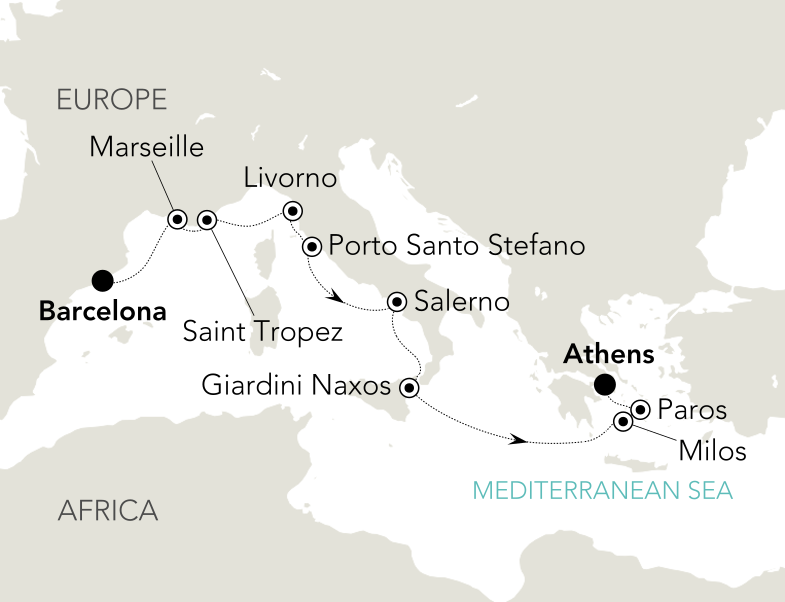
A 10-night ocean voyage aboard Silver Ray, Barcelona, Spain to Athens, Greece. Destination: Mediterranean.
Operated by Silversea Cruises aboard Silver Ray.
Barcelona
Marseille
Saint Tropez
Livorno (Tuscany)
Porto Santo Stefano
Salerno
Giardini Naxos (Sicily)
Milos, Nisos Melos
Paros
Athens (Piraeus)
Having attracted over 82 million visitors in 2017, Spain is gaining popularity as a travel destination. The country lures travellers from across the world with its promise of authenticity, charisma, and memorable moments. Spain’s culture is a celebration of the finer things in life, an expression of spirit, heritage and fun: colourful fiestas, delectable cuisine, age-defining art, music, dance, sport and so much more. Each region of the country has evolved a character of its own, meaning the country is unified by a sense of cultural multiplicity. Barcelona, the capital of Catalonia, is a masterpiece that embellishes the Spanish canvas. The fact that the Barcelona’s iconic cathedral, La Sagrada Familia, is still under construction over 141 years after construction commenced pays testament to the city’s artistic perfectionism, which pervades all aspects of life here. Apparent in the city’s architecture, layout, and cultural practices, aestheticism retains its value here. Antoni Gaudí, whose iconic style of modernist architecture is among Barcelona’s leading attractions, could perhaps be credited with designing the face of this magnificent city. Enjoy getting to know the vivacious personality behind Barcelona’s beauty.
France’s sunniest and oldest city may not have the glamour of some of its Cote D’Azur neighbours, but what it lacks in glitz, it certainly makes up for in authenticity and cultural depth. France's second-biggest city, Marseille served as European Capital of Culture in 2013 and is a fantastic hub of museums, creativity and colour. The Le Panier district is a vivid illustration of this - with its faded streets revitalised by overflowing flowerpots and pretty naturally-distressed doorways. Look down to the yacht-crammed port - where fishermen still unload fresh catches - from the viewpoint at the spectacular Notre-Dame de la Garde - a true crowning glory. Standing over walled fortifications - and capped by an elegant dome - the soaring golden statue of Madonna and Child rises high into the air and is visible all over the city. The huge Marseille Cathedral is equally impressive, with its stunning zebra-striped exterior. Palais Longchamp, built-in 1862, twinkles with flowing water, and its saturated gardens and splashing fountains were built to celebrate the engineering feat of successfully redirecting water to the city. You can’t leave Marseille without tucking into its famous fish stew – bouillabaisse. Flavoured with thyme, garlic and hunks of Mediterranean fish and plump prawns, it’s a bold and delicious taste of Provence. Wash your hands clean after, with some of Marseille’s traditional soap, created using a fragrant recipe of rich olive oil. Escape the hubbub of the city, to soak in the natural glory of Calanques National Park. Hike, kayak and sail your way through a treasure trove of limestone cliffs, dropping off to hidden beaches.
A glitzy, glamorous coastal resort that needs no introduction, Saint Tropez is the French Riviera hotspot of choice for A-listers and flotillas of gleaming yachts. The sparkle of its beaches, and clarity of its light, continues to attract artists - but it was the famous presence of Brigitte Bardot that leant Saint Tropez its enduring glamour and steamy appeal. Nowadays, speedboats skim offshore, while fine vintages from the vineyards nearby are uncorked in top-notch restaurants, in this well-heeled highlight of the Cote d'Azur. Famous bars offer views of the port along Quai Jean Jaurès, with its iconic cherry-red directors' chairs. Here you can admire the monstrous wealth of yachts that sparkle on the waters. On the same corner, big-name brand labels glimmer in the shops of rue François Sibilli - which cuts inland from the charming waterfront. The earthier appeal of boules clinking and thumping into the ground can be enjoyed at Place des Lices, where sun-wrinkled locals compete. Saint Tropez has a few beaches of its own, but famous stretches like Pampelonne Beach draw the biggest crowds to relax on star-studded golden sands. La Ponche, the authentic fishing quarter, retains its cobbled, historic elegance, and a 17th-century, hexagon-shaped citadel watches over the city and coastline from above. Coastal walks in the sea air snake away from the city’s bustle, and a series of headlands shape the stunning riviera landscape surrounding Saint Tropez. The historic monochrome Cap Camarat lighthouse adds a pleasing accent to hikes above the sparkling Mediterranean’s waves.
The Tower of Matilde is an iconic structure of the city of Livorno. This medieval tower is said to have been built by the famous mathematician and astronomer Galileo Galilei. It is named after Matilde di Canossa, an influential noblewoman who played a key role in the political and religious conflicts of the 11th century. Matilde was a powerful figure in medieval Italy, and her legacy is still felt in Livorno today. The tower was built on her orders as a defensive stronghold to protect the city against invaders, and its strategic location on the coast made it an important part of the city's defenses. Over the centuries, the Tower of Matilde has been restored and renovated several times, but it still retains its original medieval charm. The tower is a classic example of medieval architecture, with its thick walls, narrow windows, and imposing structure. The tower was later used as a watchtower during World War II and is now a popular tourist attraction as visitors can climb to the top and enjoy panoramic views of the surrounding area. The Tower of Matilde is also an important cultural landmark in Livorno. It is often used as a venue for cultural events and exhibitions, and its unique atmosphere and ambiance make it a popular destination for artists and writers.
A summer escape for Rome’s historic elite the stacked waterfront of Porto Santo Stefano is a secluded taste of idyllic southern Tuscany. Physically closer to Rome than Florence the city is strung to Italy’s western coast by two sandy harnesses and sits on the unqiue peninsula of Monte Argentario - which was once an island. Flamboyant pink flamingos and herons stroll through the encased lagoon while Porto Santo Stefano’s waterfront hums with clinking cafes and strolling visitors. The luxury yachts in the harbour show that Porto Santo Stefano has lost none of its luxury appeals and with beaches wild hikes and waterfront beauty it continues to lure visitors to this secluded escape. Known for its fishing and cuisine - which is based around heavy use of the Tyrrhenian Sea’s juicy bounty. Stroll to Piazza dei Rioni for a dripping lemon gelato or wander the streets noticing the lingering World War II damage – the city was heavily bombed during the conflict. Fortunately the historic star-shaped Spanish fort was spared and it still watches out resolutely over the waters. Rugged coastline falls to secluded beaches with a wilder unkempt charm. Sail the coves - seeing cascading olive groves - or island-hop to Giglio and Giannuti which lie 12 miles from shore and can be seen from the monastery topped Argentario mountain. On the other side of the promontory you’ll find Porto Ercole - where the lifeless body of the Old Master Caravaggio was discovered.
Salerno is situated at the northern end of the Gulf of Salerno. The old town, rising up the slopes of the hill on the site of the ancient Salernum, still bears evidence of its great days during the medieval period. It had the oldest medical school in Europe, which flourished from the 11th century until it was closed down by Napoleon's brother-in-law, Murat, in 1812. Today, Salerno's main attraction is an imposing Romanesque cathedral, built in 1085 and remodeled in the late 18th century. A flight of steps leads up to an atrium with 28 columns from Paestum and fourteen ancient sarcophagi. The magnificent bronze doors were made in Constantinople in 1099. Inside is the ornate tomb of Margaret of Anjou and the tomb of Pope Gregory VII, who died in Salerno in 1085. In the richly decorated crypt under the alter lie the remains of the Evangelist Matthew, brought here from Paestum.A 45-minute walk from the cathedral leads to a hilltop crowned by the old Lombard Castello, from where extensive views are available. Along the seafront, to the east of the harbor, extends a fine promenade lined with impressive modern buildings. The Corso Giuseppe Garibaldi is the town's principal traffic artery.Travelers coming to Salerno mainly use the port as a starting point for visits to the Greek temples of Paestum. Other favorite excursions from here are to Pompeii and to visit the popular resort towns of Amalfi and Ravello. Pier Information The ship is scheduled to dock at Pier 22. A tourist office is located at the port and is open from 8:00 a.m. to 1:30 p.m. From the pier it is approximately two miles to the town center. Taxis are generally available at the pier for trips farther afield. Be sure to establish the fare with the driver before starting out. Shopping Local handicrafts, clothing, shoes and mozzarella cheese are items to look for. Major shopping areas are along Via dei Mercanti, Via Duomo and Corso Vittorio Emanuele. Most shops are closed between 1:30 p.m. and 5:00 p.m. The local currency is the euro. Cuisine The always popular pasta dishes are a good choice. Other favorites include fresh seafood and local specialties. The home-produced ricotta and mozzarella are especially recommended. Good local wines will complement your meal. Other Sites Museo Diocesano At the Piazza Plebiscito, behind the cathedral, this museum houses a fine collection of medieval carved tablets. Museo Provinciale Occupying two floors of the San Benedetto Monastery, the main attraction at the museum is a handsome bronze head of Apollo fished out of the bay in the 1930s.
Hugging a long, sweeping bay, Giardini Naxos welcomes you ashore to some of Sicily’s most scenic and historic sites. Naxos was the first Greek settlement on Sicily, and it is surrounded by remarkable remains and swirling mythology. With a long arc of sun-soaked golden sand, you can kick back by the waves - and cool off with a dip into the sea's refreshing embrace. Up above the seaside revelry, the spectacular Taormina hillside town perches - containing rich Roman and Greek history. Visit to encounter one of Sicily’s best views, as you look down over the rejuvenating blue of the sea, and the looming backdrop of Mount Etna rising in the distance. The majestic, honey-coloured Greek theatre is a highlight, standing before the distant loom of the volcano. Head towards the puffs of cloud, and wisps of smoke, that gather around the peak of Sicily’s mighty volcano, which is among the most active in Europe. Arrive through vineyards, thriving in this fertile soil, before taking the 1,737-metre incline to the summit of the legendary mountain of fire, across fields of solidified lava flows. Known to the Greeks as the home of the God of Fire, and the one-eyed Cyclops, the mountain continues to amaze and awe with its restless power. Vineyards carpet the scenery - interrupted by occasional cactai and citrus groves – and produce some of Sicily’s most refined flavours. Enjoy a glass of wine on Giardini Naxos’ seafront, and toast your time on these rich Sicilian shores
Days at sea are the perfect opportunity to relax unwind and catch up with what you’ve been meaning to do. So whether that is going to the gym, visiting the spa, whale watching, catching up on your reading or simply topping up your tan these blue sea days are the perfect balance to busy days spent exploring shore side.
Milos, one of the thousands of Greek islands, is to be found in the SW Cyclades, a large island group in the Aegean Sea. It is 86 nautical miles from Piraeus and approximately half way between Piraeus and Crete. Its surface area is 151 square kilometres and its varied coastline is 125 kilometres long. Adamas is the main port of Milos and also a seaside village of white houses shimmering on the blue waters of the Aegean. This village was founded in 1835 by refugees from Sfakia who came from Crete after the failure of their rebellion against the Turks From these times and on, Adamas became increasingly important historically because of its large, safe, naturally made harbour, and its strategic position in the eastern Mediterranean Adamas is surrounded by many beaches and offers various touristy facilities such as banks, post-office, doctors, tourist agencies, port police. Many old churches as well as mining and ecclesiastical museums are worth visiting. The geographical bearing of its capital, Plaka, is 36o 44' 35'' longitude, 24o 25' 28'' latitude. In general terms, it is a low island, whose highest peak is Prophet Elias in the north-west, rising to 751 metres. The Small Mountain in the same area is 636 metres high, while no other peak reaches over 400 metres. Its’ most characteristic feature is its magnificent gulf, providing a natural harbour, which is possibly the largest in the Mediterranean. This, in combination, with the island’s vast mineral wealth, has played and is still playing, a major role in the history, economy, culture and development of the island society throughout the last 7,000 years. Most of the inhabitants live in the 8 villages, which are in the flat, northern part of the island. These are the capital Plaka, Plakes, Triovassalos, Pera Triovassalos, Tripiti, Pollonia, Zefiria, and Adamas. Officially, Milos is part of the county of the Cyclades, whose capital is the town of Ermupolis, on the island of Syros. However, de-centralisation of the administration has been achieved by sub-dividing the county into four provinces. One of these is Milos province, incorporating the Western Cycladic islands, Kimolos, Siphnos and Seriphos and with its administrative capital on Milos. Its geological make-up, which will be dealt with later, is volcanic. However, this formation, which is different from that of the rest of the Cyclades group (with the exception of Kimolos), is the reason for the island's lack of forests, rich vegetation, natural water supplies and rivers. Never the less, it has given it colour. This unique Milos colour, is dazzlingly evident in its multitude of beautiful beaches - more than 75- with their glistening silver sand and clear blue waters. Also in the chalky white, terracotta, ochre and jet black rocks, the like of which can be seen nowhere else in the whole of Greece. CRUISE SIGHTS Church Of Agia Triada The church of Agia Triada (Holy Trinity) is located in the centre of Adamas, the port of Milos. This church dates from the 17th century and it houses a small ecclesiastical museum. Mineralogical Museum This museum was established to help promote the effects of mining in the history of Milos and to display the mineral wealth of the island. It is located at the waterfront in Adamas. Ancient Theatre This theatre was probably constructed in the Hellenistic times. However, today only the Roman phase of this monument survives. It is located close to Catacombs. CRUISE SHOPPING There are quite a few souvenir shops in Adamas and Plaka, where you can get your own copy of Aphrodite and some Greek souvenirs and local products. CRUISE ACTIVITIES Beaches: Sarakiniko - Location: 4 km east of Plaka - Location: 4 km east of Plaka Description: This beach is one of the most beautiful beaches of Milos and surely the most particular one. It is located along the coastal road east of Adamas, north-east of Milos. It is the most photographed spot of the island. Its particular landscape is very impressive and surely unforgettable: long horizontal rocks bent over the sea; those rocks are eroded by time and salt water, and have small and huge hollows all over them. The entire landscape formed by the volcanic rocks doesn't show any signs of vegetation and is coloured entirely in a bright white, which makes an interesting contrast with the deep blue and turquoise of the surrounding waters. This amazing scenery gives one the impression of standing on the surface of the moon. Agia Kiriaki- Location: 14 km south east of Plaka - Location: 14 km south east of Plaka Description: From Zefiria a road leads to the beautiful coast of Agia Kyriaki, an organized beach with pure white sand and emerald crystal-clear waters. Firiplaka – Location: 15 km south east of Plaka – Location: 15 km south east of Plaka Description: Firiplaka Beach Milos: Right next to the lovely beach of Tsigrado lies the superb beach of Firiplaka. It is a long beach with silver sand and huge coloured rocks forming its coastline. The waters in Firiplaka are really exotic: crystalline and shallow green-blue, they never fail to enchant anyone who had the chance to swim in them. Papafragas - Location: 10 km east of Plaka - Location: 10 km east of Plaka Description: After Kapros one can find the idyllic landscape of Papafragas, one of the most impressive sites of Milos. From the top of the rock, it resembles a huge natural swimming pool, an enormous cave carved out of the cliff’s side. A tiny path leads to the tiny strip of sand that forms the beach. Crystalline waters of changing colours, depending on the weather and the light, welcome the visitor and invite him to enjoy their coolness. Deep dark sea caves surround the place. The most ancient site of Milos is just a few metres away: the amazing Papafragos, the ancient town of Phylakope,. The few remaining ruins of walls, buildings and tombs are now almost entirely covered by the water, but still bear witness of the life and civilisation existing there during the Neolithic period. Provatas - Location: 13 km south east of Plaka - Location: 13 km south east of Plaka Description: The beautiful beach of Provatas is located in the south-western side of Milos. Small hotels, good restaurants and the beauty of the place are more than enough to attract many visitors every summer. Huge multi-coloured rocks, golden sand and limpid waters complete the superb image of Provatas. Tsigrado - Location: 14 km south east of Plaka - Location: 14 km south east of Plaka Description: Tsigrado is one of the most beautiful southern beaches of Milos. Located right next to Firiplaka, Tsigrado is a small sandy cove with crystal water. Going down this beach is a bit difficult as visitors have to pass through a rocky passage to get there. The surrounding environment with the rocky cliffs is quite impressive.
As one of the lesser known islands in the Aegean Sea, Paros enjoys its reputation as being the underdog of the Cyclades. Often overshadowed by Mykonos to the north, or Santorini to the south, the savvy traveller knows this island paints one of the finest pictures of Greece that you’re ever likely to find. Arrival in Paros is postcard perfect and exactly as you imagine it. Cafes and tavernas line the pretty port, bougainvillea covers narrow streets, brightly painted fishing boats bob gently in the harbour. If you arrive early enough, you’ll find the catches of the day being sold for pennies. All the touch points are there: evocative blue shuttered, white-washed houses, windmills and domed churches on the horizon, arid hillside above an azure bay that homes promise of fresh figs, olives and the seductive lullaby of cicadas. This image might seem clichéd but in Paros, it’s reality. If strolling the cobbled streets that snake into the village does not sustain your love of Greek history, then head for the Archaeological Museum in the centre of town. Paros has been inhabited since 3200 BC and has a past of maritime battles, followed by economic development and cultural flourishing. The island was well known for its fabulous marble, a fine example of which is the lovely Town Hall in Lefkes village (notably Venus de Milo was also crafted from Parian marble). Literary lovers will also know that Paros was the birthplace of Greek lyrical poet Archilochus, statues of whom can be found all over the island.
A city of legend, civilisation and enduring culture, Athens is a majestic and magical urban sprawl. Extraordinary elegance and grace combine with grit and graft in Greece's capital, where highways encase ruins from antiquity, and gleaming museums and galleries stand beside concrete sprayed with edgy street art. These contrasts enhance and elevate the wonders of this 2,500-year-old city, however, which can count notable contributions to philosophy, drama and democracy, among its global legacy. Piraeus' giant port and naval base welcome you to the edge of the Athens' urban area. From there it's a simple jaunt to the centre. The majestic ancient citadel of the Acropolis dominates an elevated platform and is a constant presence as you explore the city. The wonderful remains of the columned temple of the Parthenon - which date back to the 5th century BC - stand here, representing the pinnacle of classical architecture. The nearby Acropolis Museum adds context to your visit and frames the broad views from its giant glass windows. Or rise up Mount Lycabettus, to be rewarded with perhaps Athens' best panorama of the Acropolis sitting high over the city on its grand stage. See the marble horseshoe of the Old Olympic Stadium, where the first modern Olympics were held in 1896, for more of the city's enduring legacy. Elsewhere, golden beaches and temples stretch out along the coastline, should you wish to explore a little further afield. Coffee is an art form to the Greeks, and it's an unwritten rule that coffee time must never be rushed. So prepare to settle down for a couple of hours and lose yourself in a good chat. Feeling hungry - try traditional souvlaki made with sauces handed from generation to generation.
From $8,750
per guest · 10 nights
Prices are a guide and vary with season, cabin category and party size. Your advisor will confirm the exact cost before anything is booked.
Classic Veranda
suite
Deluxe Veranda
suite
Grand 1 Bedroom
suite
Junior Grand 1 Bedroom
suite
Junior Grand 2 Bedroom
suite
Master
suite
Medallion
suite
Otium
suite
Owner 1 Bedroom
suite
Owner 2 Bedroom
suite
Premium Medallion
suite
Premium Veranda
suite
Signature
suite
Silver
suite
Superior Veranda
suite








